Analysis
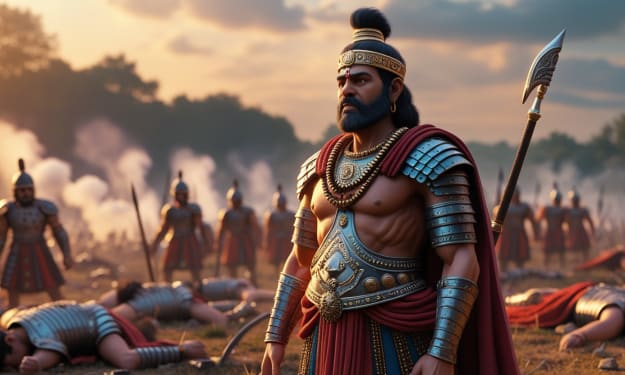
"Draped in Empire: The Legendary Dress of Alexander the Great and Its Priceless Legacy". AI-Generated.
Draped in Power: The History and Worth of Alexander the Great's Regal Dress : This article explores the historical background and significance of Alexander the Great's iconic royal attire. More than just clothing, his dress symbolized divine power, imperial ambition, and the merging of Eastern and Western traditions. Estimated today to be worth hundreds of millions of dollars if it still existed, Alexander’s royal dress remains a powerful symbol of leadership and legacy. : Throughout history, few figures have captured the world’s imagination like Alexander the Great. From his conquests that stretched from Macedonia to the Indus Valley, to his legendary charisma, Alexander’s image has endured for over two millennia. One of the most powerful visual emblems of his rule was his royal dress—not merely a piece of clothing, but a carefully crafted statement of power, unity, and divine right. The Historical Setting Born in 356 BCE to King Philip II of Macedon and Queen Olympias, Alexander was groomed for greatness from a young age. He was taught by none other than Aristotle, and by the age of 20, he inherited a powerful kingdom. His military campaigns would eventually create one of the largest empires in ancient history. But Alexander’s genius extended beyond the battlefield. He understood the value of symbolism and image, especially in foreign lands. As he began adopting Persian customs following the conquest of the Achaemenid Empire, Alexander's dress evolved into a blend of Macedonian, Greek, and Persian elements, reflecting his ambition to unite East and West. It became both a political tool and a spiritual garment, linking him with gods and emperors. Description of the Dress There are no surviving examples of Alexander’s original garments, but ancient texts and artistic depictions give us clues. His iconic dress included several elements: The White Tunic: Made from fine linen or silk, it was a symbol of purity and divinity, often dyed subtly with purples and blues to signify royalty. The Persian Robe (Kandys): A long flowing cloak, richly embroidered with gold threads and precious stones. This marked his adoption of Eastern traditions. The Diadem: A white band worn around the head, symbolizing kingship. After defeating Darius III, Alexander adopted the Persian version of the diadem. Jewelled Accessories: Gold armlets, belts, and brooches embedded with emeralds and rubies. Lion Motif Sandals or Boots: These sometimes bore motifs of strength and power, such as lions or eagles, linking him to Hercules and Zeus. Alexander used clothing as a way to communicate legitimacy to his newly conquered subjects, who were accustomed to grand displays of wealth and divine kingship. Cultural and Political Impact In Macedonia and among his Greek peers, Alexander’s adoption of Persian royal attire was controversial. Many of his generals viewed it as a betrayal of Greek traditions. However, Alexander saw himself as a universal ruler. He wore his elaborate dress to court, ceremonies, and religious rituals, and even encouraged his commanders to do the same. By dressing like a Persian king, he sent a powerful message to his subjects: Alexander was more than just a Greek conqueror—he was a world ruler. He effectively used fashion as a diplomatic tool to bridge cultures, easing tensions and gaining loyalty from the Persian nobility. The Worth of Alexander's Dress If Alexander’s original royal ensemble were somehow preserved and discovered today, its estimated worth would likely exceed $300 million. This valuation comes not only from the potential historical and archaeological value but also the craftsmanship and materials involved: Gold and gemstone embroidery: If his robe was indeed lined with real gold thread and precious gems, even the fabric itself would be worth millions. Historical provenance: Artifacts directly linked to Alexander would command astronomical prices at auctions. Symbolic value: As a symbol of one of the most famous empires in history, the dress would attract institutions, museums, and collectors from around the globe. Such an item would likely never be sold outright—it would be placed in the world’s top museums under tight security and studied extensively. The Legacy Alexander’s dress did more than symbolize power—it influenced generations of leaders. The Roman Emperors adopted similar regalia. Napoleon styled himself in Alexandrian fashion. Even modern ceremonial military attire draws from ancient traditions like those initiated by Alexander. In myth and legend, Alexander is sometimes portrayed as a semi-divine figure, and his attire contributes to this larger-than-life image. His clothing became the visual proof of his ambition: to not just rule the known world, but to shape its culture forever. Conclusion Alexander the Great’s royal dress was not just clothing—it was a masterpiece of political propaganda, cultural fusion, and divine symbolism. Blending the traditions of Greece and Persia, it reflected his unprecedented ambition and his attempt to unite the known world under one rule. Today, it stands as a historical mystery and a powerful symbol of leadership, empire, and vision. If found, its value—both material and symbolic—would be immeasurable. Would you like a Ghibli-style or traditional-style illustration of Alexander wearing this dress?
By Say the truth 2 years ago in History
Residential vs. Commercial:
Whether you're planning to build your dream home or a high-functioning commercial space, selecting the right architect is the first and most critical step. Madurai, a city rich in culture and modern growth, offers a variety of architectural services — but how do you find the right one? More importantly, should you choose differently for residential and commercial projects?
By Suresh ads2 years ago in History
Sunset in the mountains of Durmitor
Sunset in the mountains of Durmitor The afternoon was different. The sun was slowly setting on the mountainside, spreading golden colors in the sky. The sunset could be seen from the campus dormitory, like a perfectly arranged scene—as if painted by Allah with his own hands.
By Arshad Ali2 years ago in History
The Emperor’s Mirror: How Ashoka’s Regret Changed a Civilization
The Emperor’s Mirror: How Ashoka’s Regret Changed a Civilization Introduction: Blood on the Throne The battlefield of Kalinga was soaked in blood. Corpses of soldiers and civilians lay scattered. Emperor Ashoka stood among them, not as a triumphant conqueror—but as a broken man. The war he had won came at a cost no empire could justify: over 100,000 lives lost, cities burned, and families shattered.
By MystiTech Hub2 years ago in History
Understanding Aggregate Trends for Apple Intelligence Using Differential Privacy
Apple's ecosystem has always placed a strong emphasis on user privacy. With the introduction of Apple Intelligence, a suite of AI features integrated across its devices, this commitment to privacy remains paramount. To enhance these intelligent features by understanding user behavior and trends without compromising individual privacy, Apple is leveraging a sophisticated technique called differential privacy.
By Mahdi Rahman2 years ago in History
Governing the Moon A History
This original historical study on the Moon Treaty's beginnings was funded by the Office of Technology, Policy, and Strategy in order to better investigate and comprehend a new space policy concern future lunar governance. Humanity's ability to plan our lunar journey could be just as crucial as
By MD NAFIUL ISLAM2 years ago in History
I Had Not Failed My Country
Few tales in athletics have as much resonance as that of the renowned swimmer Brojen Das, who became the first Asian to successfully cross the English Channel. More than merely recounting a personal triumph, his line "I Had Not Failed My Country" is a potent illustration of commitment, tenacity, and an unwavering love for one's nation. In addition to sharing his victory, Brojen Das's words illuminate the heart of a man who, with each stroke he made at sea, carried the aspirations of a whole country.
By Md. Saidul Islam Sanjid2 years ago in History
"Glimpse into the Abyss: First-Ever Footage of the Colossal Squid in Its Natural Habitat. . AI-Generated.
A Scientific Milestone Reveals the Deep-Sea Phantom in Motion. In the dark and icy waters of the Southern Ocean, a scientific breakthrough has electrified the marine biology community. For the first time in recorded history, the colossal squid (Mesonychoteuthis hamiltoni), long considered one of the ocean’s most mysterious and elusive giants, has been captured on film in its natural rdinary. event marks a monumental step in deep-sea exploration and sheds light on a species that has stirred legends, fear, and scientific curiosity for centuries.
By Ashfaque Mahmud 🇧🇩2 years ago in History
How much should I spend on a bridal bouquet
Planning a wedding is an exciting yet overwhelming journey, filled with countless decisions to make. One of the most cherished elements of this special day is the bridal bouquet. It's not just a beautiful arrangement of flowers; it's a symbol of love, joy, and new beginnings. But how much should you really spend on this floral masterpiece?
By edenflowersandevents2 years ago in History
MAUMAU GENERAL'S GRAND RETURN?
47 years after his disappearance, the country rejoiced at the alleged return of the former Maumau General, Stanley Mathenge. He had been invited by the then President Mwai Kibaki who had been sworn into power a few months prior after a journalist had claimed to have found the former guerrilla still in exile in Ethiopia. The new Kibaki regime had signaled a new era of hope and although Mathenge’s return was perceived as yet another good omen, it deteriorated into an embarrassing scandal after the man claiming to be Mathenge turned out to be an Ethiopian farmer.
By HINGES OF TIME2 years ago in History