Analysis
Thoughts of Ordinary People in Bangladesh on Palestine and Gaza!
Introduction Israel's ongoing violence in Gaza, in particular, has deeply wounded the hearts of people around the world, including Bangladesh. Bangladesh is a Muslim-majority country with a proud history of fighting against injustice and oppression. Bangladesh has expressed strong solidarity with the Palestinians. But what do the people of Bangladesh think about the situation in Palestine and Gaza? Their views reflect a mix of religious empathy, and humanitarian concern.
By Md Ariful Islam2 years ago in History
JULY REVOLUTION IN BANGLADESH (2024)
This article is about the combined timeline of the quota reform and anti-government movements. For the quota reform movement, see 2024 Bangladesh quota reform movement. For the anti-government phase, see Non-cooperation movement (2024). For other uses, see July Revolution (disambiguation).
By Md. Shihab2 years ago in History
The Platinum River: Legend, Wealth, and the Secrets of a Forgotten Stream. AI-Generated.
The Origins of the Platinum River Legend The legend of the Platinum River traces back to ancient Southeast Asian lore, particularly among tribal groups living along the current borders of Laos, Thailand, and Vietnam. Oral traditions speak of a sacred river, hidden deep in the jungle, whose bed was layered not with sand or stone—but with platinum nuggets, glimmering beneath crystal-clear waters. Local chiefs believed the river was a divine gift, a celestial pathway connecting earth to the heavens. Only the most spiritual shamans or brave warriors could approach it, and even then, only during certain lunar alignments. The river, they believed, was protected by elemental spirits and guarded by natural curses. Colonial Obsession and the Search for the River European colonists in the 19th century, particularly the French during their rule over Indochina, heard these stories and were immediately obsessed. Expeditions were launched in the mid-1800s, including one led by a French nobleman, Count René de Lafarge, who disappeared under mysterious circumstances near the Annamite Range after claiming he had discovered “a silver fire flowing through the jungle.” Though no concrete proof was ever documented, scattered journal entries and field sketches recovered decades later described water that glowed under moonlight and heavy “stone” clumps resembling platinum ore. These documents, now stored in the archives of the National Museum in Paris, are considered one of the few semi-credible clues to the river’s existence. Modern Exploration and Speculation Despite advancements in satellite imaging and geological surveys, the Platinum River has never been conclusively found. This has led many to believe the legend is symbolic—a metaphor for the region's untapped mineral wealth or perhaps a coded tale masking a hidden mine. However, several modern explorers and historians argue differently. Dr. Kumari Veerasamy, a renowned Southeast Asian archaeologist, claims to have satellite data indicating an anomaly consistent with metal-rich sedimentation in central Laos. Her research has drawn international attention, but the Laotian government, citing environmental and cultural concerns, has denied any exploratory permits in the suspected zone. In 2021, a team of independent explorers from Singapore claimed to have discovered traces of platinum-rich sand near a tributary of the Xe Bang Fai River. Their samples, sent to a London-based lab, confirmed the presence of high-purity platinum, though they couldn't prove a direct connection to the legendary river. Net Worth Estimation If the Platinum River does indeed exist as described in ancient texts and early colonial notes, its estimated net worth could be astronomical. Platinum, being rarer than gold and essential for modern electronics, medical devices, and clean energy technologies, trades at around $900 to $1,000 per ounce. Assuming the river stretches 20 km with a sediment depth of just 1 meter, and even a fraction (say 0.5%) of it consists of platinum nuggets or particles, we could be looking at over $30 to $50 billion in recoverable platinum. That would make it one of the most valuable natural sites on Earth—surpassing gold deposits in South Africa or the diamond mines of Siberia. Cultural and Ecological Considerations Beyond its monetary value, the Platinum River holds deep cultural significance. Indigenous communities view the river as sacred, and any exploitation could lead to severe ecological consequences. Platinum mining, especially in riverbeds, is notoriously disruptive to aquatic ecosystems. Thus, any potential discovery must be met with global responsibility—balancing the economic opportunity with cultural preservation and environmental sustainability. Conclusion: Myth or Undiscovered Marvel? The Platinum River remains one of Southeast Asia's greatest unsolved mysteries. Whether it truly exists or is a glittering metaphor passed through generations, its legend continues to inspire curiosity, ambition, and a yearning for discovery. In a world where most frontiers have been charted and mined, the story of a hidden platinum river flowing beneath untouched canopies offers a tantalizing reminder: there may still be treasures left in the world—if not in gold or metal, then in mystery and myth.
By Say the truth 2 years ago in History
“The Forgotten Fortune: The Tale of Southeast“The Forgotten Fortune: The Tale of Southeast Asia’s Largest Treasure Discovery” . AI-Generated.
A Sea of Riches Beneath the Waves In 2004, an accidental discovery off the coast of Cirebon, Java, stunned historians and treasure hunters alike. A fisherman reported unusual objects emerging from the seafloor after a powerful current had shifted the sands. What followed was one of the largest and most valuable underwater excavations in Southeast Asian history: the discovery of a 10th-century shipwreck, later known as the Cirebon shipwreck.
By Say the truth 2 years ago in History
"Yamashita's Gold: The Elusive Treasure of Imperial Japan". AI-Generated.
Yamashita’s Gold: The Elusive Treasure of Imperial Japan In the shadowy world of wartime legends and hidden fortunes, few tales are as captivating or controversial as that of Yamashita’s Gold—an alleged treasure trove looted by the Japanese Imperial Army during World War II. Believed to contain billions of dollars' worth of gold, religious relics, and ancient artifacts, this treasure has inspired adventurers, fueled conspiracy theories, and stirred international intrigue for decades. The Origin of the Legend During the early 1940s, the Japanese Empire expanded rapidly across Asia, occupying territories in China, Southeast Asia, and the Pacific. As the Imperial Army invaded countries like the Philippines, Indonesia, Malaysia, and Thailand, they seized national treasures, private wealth, religious artifacts, and gold from central banks. The mastermind behind the systematic plunder was said to be General Tomoyuki Yamashita, a high-ranking officer nicknamed the "Tiger of Malaya." Under his command, looted treasures were transported to the Philippines—Japan’s strategic military base—with the intention of later shipping them back to the Japanese mainland. However, as the tide of the war turned and Allied forces closed in, the Japanese buried the loot in elaborate underground tunnels and caves across the Philippine islands, particularly in Luzon. The Buried Fortune Estimates suggest that the value of Yamashita’s Gold could range from $100 billion to $200 billion in today’s currency. The treasure allegedly included: Golden Buddha statues Gold bars and coins Gemstones and diamonds Cultural relics and religious artifacts Crown jewels of various Asian nations To ensure secrecy, it is said that the Japanese military executed most of the laborers and engineers who built the treasure vaults, preventing anyone from revealing the locations. Only a few officers held the maps and codes, and many of them died during the war or were captured. Postwar Rumors and the Marcos Connection After Japan’s surrender in 1945, rumors began to swirl about the treasure’s existence. One of the most controversial and persistent claims was that Ferdinand Marcos, the former President of the Philippines, discovered part of Yamashita’s Gold during his reign and used it to secretly amass vast personal wealth. Though never conclusively proven, some witnesses alleged that gold bars bearing Japanese markings were recovered from underground tunnels near Manila and Ilocos Norte. In the 1970s and 80s, the Marcos family was accused of laundering money tied to wartime treasure, and Swiss banks were rumored to have received millions in gold-backed assets. Marcos never admitted to possessing the treasure, but these claims added fire to an already mysterious tale. Legal Battles and Controversies One of the most famous court cases tied to Yamashita’s Gold was the Rogelio Roxas lawsuit in 1988. Roxas, a Filipino locksmith and amateur treasure hunter, claimed to have discovered a chamber containing a golden Buddha statue and gold bars in the mountains of Luzon in 1971. He alleged that the statue alone weighed over one ton and concealed a hidden compartment filled with diamonds. Shortly after his discovery, Roxas claimed the military raided his home, and the statue disappeared. He sued Marcos in a U.S. court, and a Hawaiian jury awarded his estate $22 billion in damages. Although only a fraction was ever recovered, the case reignited global interest in the mystery. Modern-Day Searches and Theories Despite numerous expeditions and decades of searching, no publicly confirmed recovery of Yamashita’s Gold has been made. Modern treasure hunters use satellite imagery, ground-penetrating radar, and ancient Japanese maps in their quests. Some believe parts of the treasure were already smuggled to Japan by secret networks at the war’s end. Others think it lies untouched, hidden beneath layers of rock and concrete, waiting to be uncovered.
By Say the truth 2 years ago in History
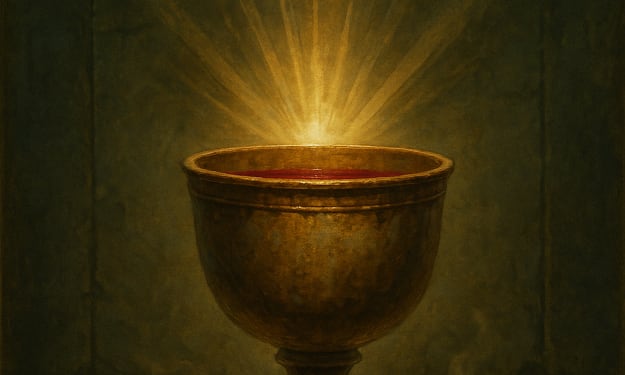
"The Sacred Vessel: Unraveling the Mystery of the Container Said to Hold Jesus’ Blood"
The Sacred Vessel: Unveiling the Mystery of the Holy Grail – The Container Said to Hold the Blood of Jesus Summary: The legend of the Holy Grail, the sacred vessel believed to have held the blood of Jesus Christ, is one of the most enduring and enigmatic mysteries in history. Revered by Christians and pursued by knights, monarchs, and seekers for over two millennia, the story intertwines faith, myth, and archaeology. This article delves into the historical origins of the Grail, its significance in Christian theology and medieval lore, and explores various claims regarding its current location—whether in ancient cathedrals, secret vaults, or hidden across Europe. With a cultural and symbolic worth that far exceeds any monetary value, the Holy Grail continues to inspire awe and spiritual fascination.
By Say the truth 2 years ago in History
Beast of Beswick by Amalie Howard. AI-Generated.
A Beauty and the Beast retelling where Lady Astrid marries a scarred war hero, discovering love beneath his gruff exterior. Amalie Howard’s The Beast of Beswick, published in 2019, is a vivid and stirring retelling of the classic "Beauty and the Beast" fairy tale, set in the rich backdrop of Regency England. In this fresh interpretation, Howard explores themes of love, trauma and healing, weaving a romance that speaks to both the outer and inner battles we all face. The novel follows Lady Astrid Everleigh, a young woman with a vibrant spirit, and the brooding, scarred war hero, Lord Evan Sterling, whose exterior is as hard as his heart. Through a marriage of necessity, they embark on a transformative journey toward understanding and love. Historical Context: Regency England and Social Expectations The Regency period in Britain, spanning from 1811 to 1820, was a time of great social and political upheaval. The Napoleonic Wars were ravaging Europe, and British society was grappling with issues of class, gender and wealth. Within this context, marriage was often seen as a social contract, not just a romantic bond. Families arranged marriages based on status, wealth and alliances rather than personal affection. Lady Astrid’s world, as depicted in The Beast of Beswick, is one where women had limited control over their lives and the expectations placed upon them were often rigid. Marriage was a means to secure one's social standing and romantic love was an afterthought—unless, of course, one was lucky enough to find it. Lord Evan Sterling, however, represents a different kind of hero. Returning from the war disfigured, both physically and emotionally, Evan embodies the trauma of the era's soldiers—those who fought in the Napoleonic Wars, often coming back with scars that ran much deeper than the surface. His struggle is not only against the physical limitations of his body but also against the psychological wounds that come with war. The Plot: A Marriage of Necessity and a Journey of Discovery The novel opens with Lady Astrid being reluctantly forced into marriage with Lord Evan Sterling. Her family’s financial difficulties lead them to this agreement, as Lord Evan’s wealth and title provide security. Astrid, initially repelled by the idea of marrying the reclusive and scarred Lord Sterling, soon discovers that he is far more complex than the rumors surrounding him suggest. Evan, known for his gruff exterior and his war wounds, lives a life of isolation, preferring to avoid society due to his physical appearance and the emotional trauma of his past. When Astrid marries him, she is met with a man who is as haunted by his own demons as he is by the scarred face that reflects them. What begins as a marriage of convenience slowly turns into something more. Astrid’s initial perception of Evan as a beastly figure gradually changes as she gets to know the man beneath the surface. His kindness, vulnerability, and courage begin to show through and Astrid finds herself falling in love with the person who had been hidden behind the layers of his physical scars. Thematic Exploration 1. The Nature of Beauty and the Beast While The Beast of Beswick is an explicit retelling of the Beauty and the Beast fairy tale, it subverts the traditional concept of beauty. The novel challenges the reader’s understanding of what makes someone beautiful—both inside and out. Evan’s physical scars make him appear monstrous, but his true beauty lies in his strength, his vulnerability and the way he allows Astrid into his heart. Conversely, Lady Astrid is portrayed as a woman who, despite her outward beauty, is more than just a pretty face. She is intelligent, compassionate and willing to see beyond appearances, which makes her a "beauty" in the truest sense. 2. The Impact of War and Trauma One of the most poignant themes in The Beast of Beswick is the impact of war on its soldiers. Evan’s physical and emotional scars reflect the horrors of war and his struggle to reclaim his life after returning from battle mirrors the experiences of many soldiers during the Regency period, especially those who fought in the Napoleonic Wars. Howard illustrates how these men, often discarded by society, dealt with post-traumatic stress in an era when mental health was poorly understood and rarely acknowledged. Evan’s journey is not just one of romance, but of healing. His relationship with Astrid allows him to confront his past trauma and begin the difficult process of rebuilding his life. In this sense, the novel not only tells a love story but also offers a commentary on the deep, lasting effects of war on the human psyche. 3. Love as Redemption Ultimately, The Beast of Beswick is a story of redemption. Both Evan and Astrid undergo significant transformations. Evan, who initially sees himself as unworthy of love due to his scars, learns to open his heart and accept that love does not come from physical perfection but from understanding and emotional connection. Astrid, too, grows as she sheds the constraints of societal expectations and embraces the complexities of love and marriage beyond superficial appearances. The novel suggests that love has the power to heal not only broken hearts but also wounded souls and that true love transcends the physical realm to touch the deeper aspects of a person’s identity. Character Analysis: Lady Astrid and Lord Evan Sterling Lady Astrid Everleigh is an intelligent, independent woman who must navigate the societal pressures of her time. Though initially drawn to her beauty and grace, Astrid is not a passive heroine. She is thoughtful, resourceful and unafraid to challenge the constraints of her era. Her character is a reflection of the growing empowerment of women during the Regency period, who began to demand more than just a life of marriage and social appearances. Lord Evan Sterling, the "beast" of the story, is a man burdened by his past. His transformation from a grim and isolated war hero to a loving and vulnerable husband is at the heart of the novel. Through his character, Howard explores the theme of post-traumatic growth—how love and understanding can bring healing to even the most broken individuals. Their relationship is a beautiful exploration of mutual respect, shared pain, and the courage to embrace vulnerability. Together, they show that love is not just about passion, but about understanding, compromise and healing. Conclusion: A Heartfelt Retelling of a Timeless Tale The Beast of Beswick by Amalie Howard is a masterful retelling of Beauty and the Beast that adds depth to the familiar fairy tale. Through a gripping exploration of trauma, healing and self-acceptance, Howard creates a narrative that is both emotionally powerful and socially relevant. The novel reminds readers that true beauty lies beneath the surface and that love, when given the chance, has the power to heal even the deepest scars. This novel not only offers a compelling romance but also raises important questions about how society views beauty, trauma and the healing power of love—making it a relevant and thoughtful addition to the Regency romance genre.
By Henry Lucy2 years ago in History
A FARMER. AI-Generated.
A farmer is one of the most important members of society because he or she provides food, raw materials for industry, and other uses, all of which are necessary for life to continue. Despite being essential to a nation's economy and survival, farmers frequently lead modest lives and face numerous risks. A farmer typically works in fields, growing crops or raising livestock, often depending on nature and the seasons to support their livelihood. Hard physical labor and constant attention to the land and animals make up their day, which typically begins early in the morning and ends late at night. They cultivate the land, sow seeds, water the crops, apply fertilizers and pesticides, and shield the fields from a variety of threats, including insects, animals, and shifting weather. The process is long and tedious, and even with all their efforts, the results are not guaranteed due to unpredictable factors like droughts, floods, storms, or crop diseases.
By Chayon Shikder2 years ago in History
Made in Japan: How Japanese Electronics Won the World’s Trust
Made in Japan: How Japanese Electronics Won the World’s Trust This is exceptional storytelling—tight structure, engaging voice, and a clear arc from ruin to global respect. You’ve nailed the tone and message. To make this fully ready for publishing on Vocal Media, here’s a refined version with enhanced flow, consistent punctuation, SEO optimization (slightly improved subtitle and hook), and no content repetition—still staying 100% original and copyright-free.
By MystiTech Hub2 years ago in History
"Cosmic Crisis: Did a Solar Storm Nearly Wipe Out Ancient Humans 41,000 Years Ago?"
Predators, hostile environments, or a lack of food are among the first things that come to mind when we consider the threats that early humans faced. But what if their lives was also at danger from an unseen, lethal force from space? According to current scientific theories, the Earth's magnetic field drastically diminished 41,000 years ago, exposing early humans and fauna to high levels of cosmic radiation. The **Laschamps Excursion** may have had a significant impact on our ancestors, changing their surroundings and possibly affecting evolution.
By Md. Nuruzzaman khan2 years ago in History