Analysis
Trends and Issues in Nursing
The advancements in healthcare, societal shifts, and challenges facing the world all have an impact on the profession of nursing, which is dynamic and constantly changing. The following are some important current nursing issues and trends: 1. Problems with the Workforce and Nursing Shortage There is a worldwide shortage of nurses as a result of retirements, burnout, and a lack of new graduates. Patient-to-nurse ratios that are too high cause stress and lower the quality of care. Better working conditions, incentives for retention, and increased funding for nursing education are the solutions. 2. Problems with mental health and burnout After the pandemic, many nurses experience compassion fatigue, post-traumatic stress disorder, and emotional exhaustion. Stress in the workplace as a result of long shifts, a lack of staff, and high patient acuity. Support for mental health, training in resilience, and improved policies regarding work-life balance are the solutions. 3. Nursing Technological Developments Predictive analytics for patient care and chatbots for triage are examples of AI and machine learning. Telehealth expansion includes virtual nursing and remote patient monitoring. Electronic health records, or EHRs, can simplify documentation, but they can also lead to "click fatigue." 4. Nursing's DEI (diversity, equity, and inclusion) Diversity in leadership roles is lacking. Training in cultural competency to enhance diverse population patient care. addressing minority nurses' discrimination. 5. Range of Practice and Nurse Independence Advocacy for NPs to practice independently in some states (in the United States) known as Full Practice Authority (FPA). Restrictions imposed by regulations and opposition from physician groups are barriers. 6. Management of Chronic Diseases and an Aging Population There are more elderly patients who require specialized care. An increase in chronic diseases requiring long-term nursing interventions (such as diabetes and heart disease). 7. Nursing Education & Faculty Shortage There aren't enough nurses teaching the program, so there aren't many seats. Move toward simulation training and education that is based on competencies. 8. Safety and Violence in the Workplace Patients and visitors are increasingly attacking nurses. Training in security and de-escalation needs to be improved. 9. International Nursing and Globalization Migration of nurses from developing to developed nations, causing brain drain need for uniform licensing (such as the NCLEX for international nurses). 10. Nursing and Public Health and Climate Change The role of nurses in responding to disasters (natural disasters, pandemics). promoting methods of healthcare that are long-lasting.
By Nurul Huda about a year ago in History
The Boy Who Carried a Dream
In a quiet village nestled between the green hills of Bangladesh, lived a boy named Imran. He was only twelve years old, but his eyes sparkled with a maturity far beyond his age. He lived with his mother in a small, tin-roofed house. His father had died when Imran was just three, and since then, his mother had worked at a local rice mill to support them.Imran loved books. But not just any books—he loved science books, books about stars, planets, machines, and inventions. While other boys played football in the fields after school, Imran would sit under the old banyan tree with his nose buried in pages filled with wonder.His dream was simple: he wanted to be an engineer. Not just any engineer—but one who would create machines that could help farmers, like his neighbors, work more easily.But dreams, as Imran would learn, are expensive.His school was several kilometers away, and he walked barefoot every day to attend. The books he read were all borrowed—sometimes from school, sometimes from an old teacher who had taken a liking to the curious boy. His mother barely made enough to feed them, let alone buy extra books or materials.One night, as rain poured down from the heavens and thunder shook their little house, Imran studied by the light of a kerosene lamp. The wind blew in through the cracks in the wall, but he didn’t stop. His mother watched him quietly, a mix of pride and worry in her eyes.“You should sleep,” she said softly.“I will, Ma. Just one more chapter,” he replied, eyes still fixed on the page.Days turned into months. Imran won the district science fair with a handmade model of a solar-powered irrigation system. The local newspaper featured his photo. For the first time, people in the village began to believe—this boy might go far.But life had its tests.One day, his mother collapsed at work. The doctor said she needed surgery and months of rest. Imran was devastated. The hospital bills were beyond anything they could He stood outside the hospital, staring at the sky, tears streaming down his face. He could feel his dream slipping away.The next morning, he went to the market. He took up a job cleaning dishes at a roadside tea stall. Before school, after school, sometimes instead of school. He did whatever he could to pay for his mother’s medicine.But he never stopped reading. He carried a small notebook in his pocket where he wrote ideas, drew machines, and jotted questions he hoped to find answers to one day.One evening, as he cleaned the stall, a well-dressed man watched him curiously. The man noticed Imran scribbling in his notebook during breaks.“What are you writing, boy?” he asked.Imran hesitated but then showed him. The man flipped through the pages—diagrams, notes, even simple engineering designs. He was surprised.“Where did you learn all this?”“Books… school… I just try to learn on my own,” Imran said shyly.The man smiled. “I’m Professor Rahman. I teach at Dhaka University. Would you show me more tomorrow?”That meeting changed everything.Professor Rahman visited Imran’s house the next week. He spoke to the principal of his school and arranged a scholarship. He ensured his mother received proper medical treatment. He even brought books—so many that Imran’s little shelf overflowed.Years passed. Imran went on to study engineering at Dhaka University. He topped his class. His ideas began to attract attention. His final year project—an affordable, solar-powered water pump for rural farmers—won an international award.News spread back to the village. People gathered around the old banyan tree, reading about the boy who once walked barefoot to school and now stood on world stages speaking about innovation.Imran didn’t forget his roots.He returned to his village, not as a visitor, but as a builder. He opened a small research center to train young students. He worked with local farmers to introduce simple technologies that saved them time and effort.One day, while walking through the fields, a young boy came running to him.“Sir, I want to be like you,” the boy said.Imran smiled, handing him a small notebook.“Then start by writing your dreams here,” he said.That night, under the same banyan tree, the village children gathered around as Imran spoke—not just about machines or technology, but about belief, sacrifice, and the strength of never giving up.Because dreams, he now knew, could grow even in the hardest soil—if only someone cared to water them. afford.
By Sumaiya’s Wordboxabout a year ago in History
Lalbagh Fort
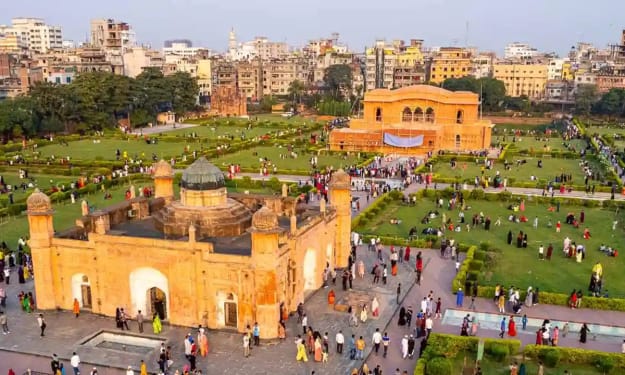
Lalbagh Fort or Fort Aurangabad, an incomplete Mughal palace fortress at Dhaka on the river Buriganga in the southwestern part of the old city. The river now flows quite a ways from the fort because it has moved further south. D'Oily's painting (1809-11) shows that more than half of this east-west oblong fortress touched the water of the river on its south and southwestern sides.
By Md. Mohorom Aliabout a year ago in History
Geographical Location of Bangladesh and Its Importance in Industrial Development: An Analysis
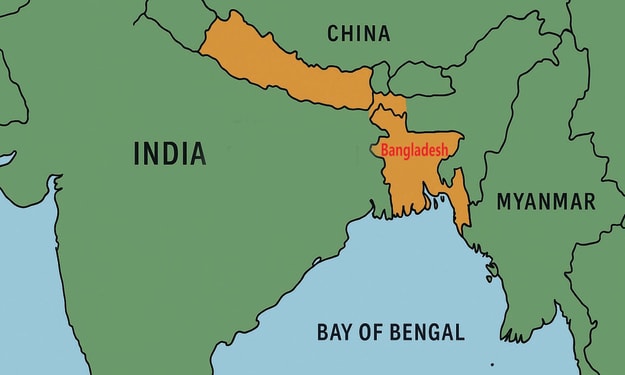
Bangladeshs geographical position in the world: A strategic power in terms of industry and economy. Bangladesh is a small but important country in South Asia whose geographical position carries a unique importance in the eyes of the world economy. Surrounded by India Myanmar Nepal China and the Bay of Bengal this country is considered a junction of South and Southeast Asia not only geographically but also economically and strategically.
By Md.Moniruzzamanabout a year ago in History
Bangladesh
The History and Culture of Bangladesh: A Tapestry of Resilience and Rich Tradition Bangladesh, a country located in South Asia, boasts a rich and diverse history along with a vibrant cultural heritage. Nestled on the northern coast of the Bay of Bengal and bordered by India and Myanmar, Bangladesh has long been a crossroads of civilizations, religions, and trade. The history and culture of this land reflect centuries of change, struggle, creativity, and resilience. Ancient and Medieval History The region now known as Bangladesh has been inhabited for thousands of years. It was part of ancient kingdoms such as Vanga, Pundra, and Gauda. During the 3rd century BCE, it became part of the Maurya Empire under Emperor Ashoka, who spread Buddhism throughout the region. Later, the Gupta Empire (4th–6th century CE) brought a golden age of culture, science, and learning. By the 8th century, Bengal was ruled by the Pala dynasty, a Buddhist empire that contributed significantly to art, architecture, and education. The Pala period was followed by the Hindu Sena dynasty. In the 13th century, Muslim rulers from the Delhi Sultanate began to expand into Bengal, introducing Islam, which eventually became the dominant religion. The Mughal Era and Colonial Rule The Mughal Empire (16th–18th century) brought prosperity, architectural beauty, and urban development to Bengal. Dhaka, the capital of modern Bangladesh, flourished as a center of trade and administration under the Mughals. In the 18th century, as the Mughal Empire weakened, the British East India Company gained control of Bengal after the Battle of Plassey in 1757. This marked the beginning of nearly two centuries of British colonial rule. Under British control, Bengal became a major center for jute production and trade, but the colonial economic policies also led to poverty and famines. Language Movement and the Birth of Bangladesh In 1947, British India was divided into two nations: India and Pakistan. Bangladesh became East Pakistan, part of the new state of Pakistan, despite being geographically separated from West Pakistan by over a thousand miles. Cultural and linguistic differences soon led to tensions. The people of East Pakistan spoke Bengali, while the government of Pakistan attempted to impose Urdu as the sole national language. This led to the historic Language Movement of 1952, during which several students were killed while protesting for the recognition of Bengali as an official language. This movement played a crucial role in shaping national identity and is commemorated every year on February 21 as International Mother Language Day. In 1971, following years of political and economic discrimination, East Pakistan declared independence, leading to the Bangladesh Liberation War. After a nine-month struggle and immense human cost, Bangladesh emerged as an independent nation on December 16, 1971. Cultural Heritage The culture of Bangladesh is deeply rooted in its language, literature, music, and traditional arts. Bengali literature has a long and rich history, with figures like Rabindranath Tagore (who composed the national anthem) and Kazi Nazrul Islam shaping the cultural landscape with their poetry and songs of freedom. Music and dance play an integral role in Bangladeshi life. Folk traditions such as Baul songs, Bhawaiya, and Jari are popular, especially in rural areas. Classical and modern music, including Rabindra Sangeet and Nazrul Geeti, continues to thrive. Bangladeshi festivals are colorful and diverse, reflecting the country’s multi-religious society. Pohela Boishakh, the Bengali New Year, is celebrated with processions, music, and food. Religious festivals like Eid, Durga Puja, and Buddha Purnima are also widely observed. Traditional clothing, such as the saree for women and panjabi for men, reflects both elegance and regional identity. Bangladeshi cuisine is known for its use of rice, lentils, and spices, with dishes like biryani, hilsa fish curry, and pithas being especially popular. Conclusion The history and culture of Bangladesh are marked by a unique blend of tradition, struggle, and resilience. From ancient empires to modern nationhood, Bangladesh’s journey is one of identity, creativity, and the enduring spirit of its people. Today, it continues to honor its past while embracing the promise of a dynamic and diverse future.
By Nabir Mondolabout a year ago in History
Synology tightens restrictions devices
Synology that the company is preparing to implement new restrictions on third-party hard drives in its upcoming network-attached storage (NAS) devices later this year. As a result of the changes, it might be much more difficult to use third-party drives in Synology devices for common applications like backing up computers at home or serving as local media servers. The good news is that the change won't affect you if you already own a Synology NAS, according to the company. "Starting with Plus Series models released in 2025, Synology brand and that the company has certified to meet its specifications.
By Md. Mohorom Aliabout a year ago in History
The Mysteries of the Bermuda Triangle: Fact, Fiction, and Fascination. AI-Generated.
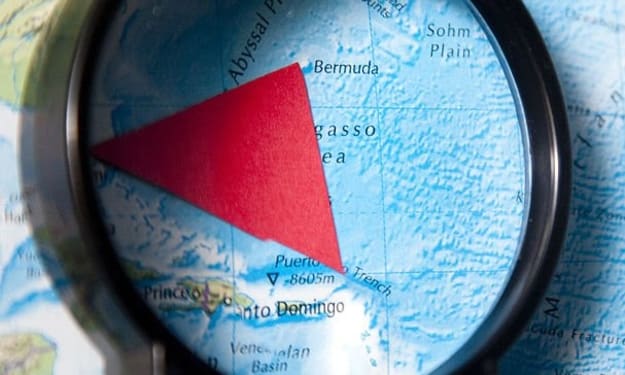
The Bermuda Triangle, also referred to as the Devil's Triangle, is one of the most fascinating and enigmatic places on Earth. Spanning a loosely defined area in the Atlantic Ocean between Bermuda, Florida, and Puerto Rico, it has captivated the imagination of adventurers, scientists, and conspiracy theorists alike. Stories of mysterious disappearances, strange phenomena, and legends have built an aura of intrigue around this triangular stretch of ocean. While the Bermuda Triangle's reputation is partially based on myths, it continues to inspire curiosity and debate.
By Noob Hackerabout a year ago in History
Cancer-causing Arsenic is building up in the world`s news.
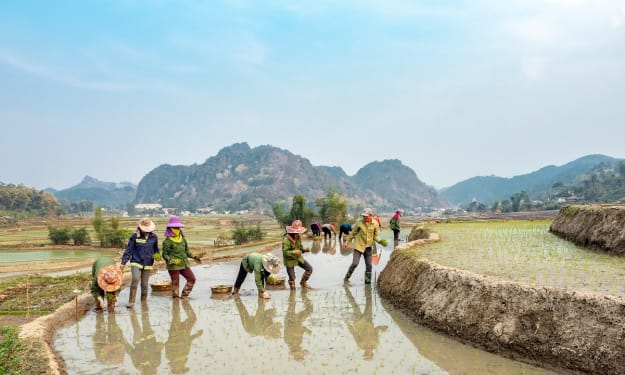
Cancer-causing Arsenic is building up in the world`s news. Rice, a staple food for over half of the world's population, is increasingly accumulating arsenic, a toxic element linked to cancer. In countries like Bangladesh, where rice is a staple food, this trend is especially concerning.
By Tanvir naoajabout a year ago in History
The Silent Scream of Smyrna: The Overlooked Massacre of 1922
The Silent Scream of Smyrna: The Overlooked Massacre of 1922 During the final moments of the Greco-Turkish War, an ancient metropolis that once prospered as a center of culture and commerce in the Mediterranean became the backdrop for a calamitous event that altered the trajectory of history: the Great Inferno of Smyrna. Currently known as İzmir in present-day Turkey, Smyrna was not only among the most affluent cities of the Ottoman Empire but also one of the most heterogeneous. Greeks, Armenians, Jews, and Turks coexisted for centuriesuntil 1922. This massacre, frequently termed “The Smyrna Catastrophe,” stands as one of the most somber and least reported incidents in contemporary history. It persists as an emblem of treachery, ethnic cleansing, and the inadequacy of the global community to take action. The aftermath resulted in a vast humanitarian crisis and the annihilation of a culture that had thrived for millennia. A City on the Verge By 1922, the Greco-Turkish War had culminated in a violent crescendo. Greek forces, who had occupied Smyrna in 1919 with Allied assistance, were decisively repelled by the Turkish National Movement led by Mustafa Kemal Atatürk. As Turkish troops regained control of Smyrna on September 9, 1922, what ensued was not merely a military triumphit was a thorough alteration of the region’s demographic and cultural identity. In the days following the Turkish arrival, violence erupted. Eyewitnesses from Western consulates, missionaries, journalists, and survivors recounted mass executions, assaults, and looting predominantly targeting the Greek and Armenian populations. The climax was the Great Inferno, which ignited on September 13, consuming the Greek and Armenian districts of the city while the Turkish and Jewish neighborhoods remained intact. An Inferno and a Massacre The precise number of fatalities remains uncertain due to the chaotic circumstances of the event, but estimates indicate that over 100,000 individuals were either slain or succumbed to the ensuing fire, starvation, and illness. More than 400,000 Greeks and Armenians fled the city, with many seeking refuge in overcrowded vessels docked in the harbor. Some were denied entry or assistance by foreign warships positioned nearbyan international betrayal that continues to mar diplomatic histories. Eyewitness narratives described the sea turning crimson with blood, the atmosphere thick with smoke and cries, and flames consuming centuries of heritage and legacy. American relief worker Asa Jennings and British author George Horton were among the few who chronicled the atrocities, although their accounts were suppressed beneath diplomatic apathy. Cultural and Economic Devastation The annihilation of Smyrna was not merely a slaughter of individualsit was an extermination of culture. Ancient libraries, churches, manuscripts, and artifacts were reduced to ashes. The city's economic prosperity, once celebrated as the "Pearl of the Aegean," was consumed by flames. The projected financial damage to properties, artifacts, and infrastructure surpassed $3 billion USD in current value. However, no valuation can adequately reflect the loss of human life and cultural heritage. Smyrna was among the few cities that possessed not only economic affluence but also an exceptional cosmopolitan essence. Its obliteration concluded an era of pluralism in Asia Minor. Greek and Armenian civilization in the region, which had thrived for over 2,500 years, was eradicated within days. Global Inaction Despite the presence of numerous foreign powers in Smyrna at the timeincluding British, American, French, and Italian naval vesselsnone intervened to halt the atrocities or provide assistance to the fleeing population. This inaction exacerbated the death toll and further deepened the trauma for survivors. Records indicate that political interests, war fatigue, and post-WWI diplomacy muffled global response. Many historians contend that the massacre of Smyrna constituted a form of ethnic cleansing, aimed at transforming Anatolia into a solely Turkish homeland. Although seldom recognized as such, it persists as a haunting precedent in contemporary history. Legacy and Acknowledgment For decades, the massacre of Smyrna was obscured beneath political narratives and nationalist agendas. Survivors and their descendants frequently transmitted their trauma through oral histories and familial records. It is only in recent years that academic interest has begun to reexamine and reveal the truth. Memorials, literary works, and historical accounts such as Lou Ureneck’s The Great Fire have rekindled interest in the tragedy. Nonetheless, formal acknowledgment, apologies, or reparations remain elusive. Conclusion The downfall of Smyrna and the massacre of 1922 was not only the obliteration of a cityit was the silencing of an entire civilization. Forgotten by many and unrecognized in historical texts, the blood of Smyrna’s innocents continues to mark the annals of a century that witnessed innumerable atrocities. In commemorating Smyrna, we honor not only the victims but also the enduring truth that no massacre should remain concealed beneath the remnants of diplomacy.
By Say the truth about a year ago in History
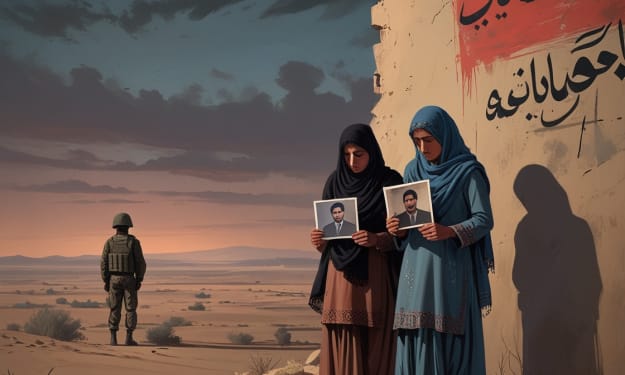
Silent Genocide: The Hidden Massacre of Balochistan. AI-Generated.
The Concealed Afflictions: The Balochistan Massacre – An Overlooked Episode of Contemporary History In spite of being one of the least addressed atrocities of the contemporary period, the persistent turmoil and purported massacres in Balochistan stand as a distressing reminder of the muted agony of a populace ensnared in the realm of politics and power. This article reveals the concealed particulars of decades of discord in the Baloch region, examining its historical origins, political conflicts, and the human toll that persistspredominantly disregarded by international media and historical narratives. The Concealed Afflictions: The Balochistan Massacre – An Overlooked Episode of Contemporary History When history is recorded by the triumphant, entire segments of anguish are frequently excluded. One such segment transpires in the rugged mountains and arid terrains of Balochistanan extensive, resource-abundant region divided among Pakistan, Iran, and Afghanistan. Although lesser-known to the global community, Balochistan has suffered a harrowing legacy of political oppression, insurrections, and brutal crackdowns, prompting numerous historians and human rights advocates to label the conflict as a contemporary silent massacre. A Land of Abundance, A People Marginalized Balochistan is the largest province of Pakistan in terms of area, yet the least inhabited. It possesses ample natural resources, including natural gas, gold, coal, and copper. In spite of this affluence, the area endures as one of the most destitute and underdeveloped in South Asia. Baloch nationalists contend that the federal government has long exploited Balochistan’s resources while providing minimal returns to its inhabitants. This sentiment is not novel. The impetus for unrest was initiated soon after the establishment of Pakistan in 1947. The princely state of Kalat (part of Balochistan) initially pursued independence but was subsequently annexed by Pakistan in 1948, igniting the first of several Baloch revolts. Each insurrectionwhether in 1958, 1962, 1973, or the more recent movementshas been met with forceful military response. Oppression and Alleged Massacres Since the early 2000s, the conflict has intensified considerably. The Pakistani military and intelligence agencies have been accused by numerous human rights organizations of executing enforced disappearances, extrajudicial killings, and acts of torture. Thousands of Baloch activists, students, intellectuals, and ordinary villagers have reportedly gone missing. Their remains are sometimes later discovered disfigured, discarded in remote siteswhat locals grimly label as “kill and dump” operations. While precise statistics are challenging to corroborate owing to restricted access to the area and fear of reprisals, estimates from various NGOs indicate that over 20,000 individuals may have vanished over the past two decades. Human Rights Watch and Amnesty International have both documented severe violations in the region; however, global political focus has been scantpartly owing to Balochistan's geopolitical sensitivity.
By Say the truth about a year ago in History