Analysis
The U.S. Is the World’s No.1 Freelance Market – Here’s How You Can Cash In. AI-Generated.
In a world increasingly driven by digital transformation and remote work, freelancing has emerged as a booming global industry. At the forefront of this revolution is the United States – now officially the largest and most dynamic freelance market on the planet.
By Habib Mahmudabout a year ago in History
The top 5 great russian writers
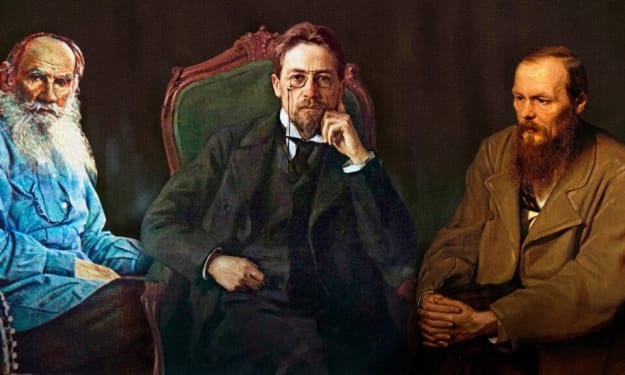
Russian writers hold a special place in the world of literature. The influence of Russian literature extends beyond the realm of literary circles—it has impacted politics, economics, and society across the globe. Almost every writer and reader, big or small, holds Russian literature in high regard. There is hardly another example where the writers of a single country have had such a far-reaching influence. Russian literature reached its peak of richness in the 19th century. With a new language, fresh artistry, and modern ornamentation, it brought about a literary revolution that rippled beyond Russia and captivated the entire world. Even today, the world remains enchanted by the fragrance of the Golden Age of Russian literature. This Golden Age was glorified and enriched by several great writers. Today’s discussion is about five of them. Alexander Pushkin Alexander Sergeyevich Pushkin is often called the Shakespeare of Russian literature. The Golden Age of Russian literature began with Pushkin. Though he is regarded as the father of modern Russian poetry, he revived the entire landscape of Russian literature through his dramas, short stories, and novels. Born in 1799 and passing away in 1837, Pushkin was born into an aristocratic family in Tsarist Moscow. Despite his noble birth, he led a revolutionary and combative life. Although he is considered the father of Russian literature, he spent the first ten years of his life primarily speaking French. At just 15, he shocked everyone with his radically different poetry. His poems are largely romantic. Some of his famous works include Message of Europe, Ruslan and Ludmila, The Bronze Horseman, and Boris Godunov. His most beloved literary work is the verse novel Eugene Onegin, which took a lifetime to write. It is so complex that its English translation required two volumes for just 100 pages of the original. Pushkin was influenced by the liberal philosophies of Kant and Voltaire. He was a reformist and consistently wrote against monarchy. His revolutionary poetry frequently brought him into conflict with the authorities, resulting in years of exile. Pushkin was the first Russian writer whose works spread globally. Pushkin led a chaotic life—he was stubborn and short-tempered. He fought many duels. In one such duel by the Black River, he was shot. Two days later, the eccentric, debt-ridden Pushkin died at just 38. By then, he had already reshaped the map of Russian literature. Nikolai Gogol Pushkin’s friend Gogol was born ten years after Pushkin (in 1809) and died fifteen years later (in 1852), living a brief life of just 43 years. Gogol was born into a literary-minded family in Ukraine, then part of the Roman Empire. As a literary heir, he developed an early passion for poetry and drama. Gogol, like Pushkin, led a wild life. He self-published his first poetry book, and when no one bought a single copy, he burned all the remaining copies in a fit of rage. But he didn’t stop writing. He traveled extensively across the Soviet Union, Switzerland, Germany, Italy—even Palestine. He formed friendships with philosophers, writers, and spiritual figures throughout the Soviet region. He held multiple jobs, none of which satisfied him. Initially, Gogol wrote poetry and stories about Ukrainian village life. Over time, his writing style evolved. His friendship with Pushkin greatly enriched both their literary careers. Gogol’s works combined satire and realism, which distinguished him from others. It is believed he mocked Tsarism in his writings. His most famous works include the short story The Overcoat and the novel Dead Souls. It is largely due to Dead Souls that he is considered the pioneer of modern Russian novels. After Pushkin’s death in 1837, Gogol fell into despair and turned toward spirituality. He began to believe that the Devil was using him to write sinful material. As a result, he burned the second volume of Dead Souls. This act of destroying both his first and last books completed a symbolic cycle. After burning the final manuscript, Gogol became bedridden, stopped eating, and eventually died ten days later. Thus ended the life of one of modern Russian literature’s finest minds. Fyodor Dostoevsky The year was 1849. Under the Tsarist regime, a group of revolutionaries was taken before a firing squad for operating a secret progressive society. Just before execution, a last-minute order spared them. They were sent into exile. One of them, Fyodor Dostoevsky, was a novelist, short story writer, and philosopher—now one of the brightest names in world literature. Born in Moscow in 1821, Dostoevsky published his first novel Poor Folk at age 24, considered the first social novel in Russia. His four major novels are Crime and Punishment, The Idiot, The Demons, and The Brothers Karamazov. He became renowned for using the “stream of consciousness” technique, which was later popularized by James Joyce. His characters are complex and tormented, often exhausted and confused by moral dilemmas. Joyce described his novels as full of “violence.” Dostoevsky’s ideas and writing influenced countless writers and philosophers, including James Joyce, Albert Camus, Franz Kafka, Friedrich Nietzsche, Samuel Beckett, and even Albert Einstein. He suffered from epilepsy throughout his life and had a severe gambling addiction. A statue of him still stands at a casino in Germany. He lost his savings and even borrowed money meant for his ill wife's treatment, signing contracts under pressure to pay his debts. Despite this, he continued gambling. His first wife, with whom he had a rocky relationship, died of tuberculosis. Later, he fell in love with his 25-years-younger stenographer Anna and married her. Anna helped stabilize his life. Two months before his death in 1881 at age 59, Dostoevsky completed The Brothers Karamazov, which he dedicated to his beloved wife Anna. Leo Tolstoy Since 1901, the Nobel Prize has been awarded in literature, but the biggest controversy remains the committee’s failure to honor Leo Tolstoy. He died in 1910, and even by then, he was considered the greatest name in world literature. His novels War and Peace and Anna Karenina consistently rank at the top of the greatest literary works of all time. War and Peace took five years to write and spans over a thousand pages with more than 600 characters. It tells the story of Napoleon Bonaparte’s invasion of Russia and the rise and fall of aristocratic families. Anna Karenina, written over three years, explores Russian society and a complex romantic relationship. These two novels alone define Tolstoy’s literary legacy, although he also wrote Resurrection, an autobiography, and many timeless short stories. Born into an aristocratic family in 1828, Tolstoy lost both parents at a young age. He was exceptionally intelligent and hardworking. According to Maxim Gorky, Tolstoy was “a world unto himself.” He taught himself Latin, English, Arabic, Italian, and Hebrew—learning new languages just to read books in their original form. Early in life, Tolstoy was unsure whether to pursue literature, but under the influence of his friend and fellow writer Ivan Turgenev, he began writing. His first book Childhood was followed by two more autobiographical volumes. Most people write autobiographies later in life, but Tolstoy began his literary journey with one, as his life was already filled with remarkable events. After a failed stint managing his estate, he traveled across Europe and even fought in the Crimean War. These experiences enriched Tolstoy’s writing. His work extended beyond novels—his short stories are also invaluable. He was a philosopher, too. His teachings on nonviolence influenced Mahatma Gandhi. In his final years, Tolstoy turned toward spirituality, giving away nearly all his wealth. At age 82, he left home in poverty and died of pneumonia at a small train station in Russia—one of the brightest stars of world literature. Anton Chekhov Continuing the tradition of iconic Russian writers, Anton Chekhov also lived a short life—only 44 years. Born in 1860 and passing in 1904, Chekhov was the son of a serf-turned-merchant father and a Ukrainian mother. He grew up in a harsh family environment. In his words, “I have my mother’s heart and my father’s talent.” Chekhov was a doctor by profession, although he earned very little from it. He traveled across Russia, Ukraine, and even to prisoner camps in Japan, offering free medical help, building hospitals, and treating those suffering during a cholera outbreak. During this time, he wrote several letters considered among his finest works. He began writing to support his family financially after suddenly becoming the primary breadwinner. He submitted pieces to newspapers and gradually realized writing was his true calling. Even in his short life, his works gained immense recognition, both during and after his lifetime. He is regarded as one of the world’s greatest short story writers. His plays rank among the most frequently performed in history. His best-known plays include Three Sisters, The Seagull, and The Cherry Orchard. Though initially slow to gain popularity, his fame grew steadily. His most famous short stories include The Lady with the Dog, The Chameleon, The Black Monk, The Steppe, and A Dreary Story. His stories were often more blunt than traditional tales. Like Dostoevsky, Chekhov also gained fame for his use of stream of consciousness. Afraid of marriage, Chekhov married just three years before his death. He and his wife lived in separate cities. His death was also peculiar. After long suffering from tuberculosis, he one day sat up in bed and said in German—despite barely knowing the language—“I am dying.” He smiled, took a glass of champagne, drank it in one sip, and passed away in 1904. Thus ended the life of one of the greatest short story writers and playwrights in world literature.
By Riham Rahman about a year ago in History
Marvel Doesn't Have to Try So Hard: Why Thunderbolts Signals a Promising Shift
For years, the Marvel Cinematic Universe (MCU) has operated on a seemingly unwavering principle: bigger is better. Each phase escalated in scale, culminating in universe-altering events with casts of dozens and stakes that threatened all of reality. While these grand narratives have undeniably delivered moments of thrilling spectacle, a sense of fatigue has begun to settle in for some viewers. The sheer weight of interconnected storylines and the constant pressure to raise the stakes have occasionally overshadowed character development and nuanced storytelling.
By Arif Islamabout a year ago in History
Rolls-Royce Phantom Turns 100: A Look at the Luxury Icon’s History
when a car brand turns 100, it’s a big deal. Crossing the century mark is huge for any company, in any market. But Rolls-Royce has been around for so long that it now has a product turning 100 years old: The Phantom. That makes the luxury icon older than most other brands.
By Emon Mollaabout a year ago in History
Trump mocks trans athletes in women's sports to roaring applause at Alabama commencement speech. AI-Generated.
The reported incident of Donald Trump mocking transgender athletes during a commencement speech in Alabama aligns with his longstanding public stance on the issue, though specific details of such a speech would require verification against recent events (post-October 2023, beyond my knowledge cutoff). Here's a contextual summary based on his known positions and the broader debate:
By Sazidul Islam about a year ago in History
The Sundarbans: A Proud Heritage of Bengal
The sundarban is a her that fills the people of Bengal with pride. Nature has gifted us with forest paradise so magnificent that its stories can be told to the entire world. Recognized as a UNESCO World Heritage Site, the Sundarbans is the largest mangrove forest in the world, situated at the confluence of the Ganges and Brahmaputra rivers. What doesn’t this forest have? It is the home of the world-famous Royal Bengal Tiger. In addition, there are spotted deer, crocodiles, venomous snakes, turtles, and countless other species. The forest is also rich with diverse trees like Sundari, Garan, and Keora. People live in this heritage-rich jungle with their families. They earn their livelihood by collecting honey, cutting wood, and fishing. While doing so, they face numerous dangers—fears of being taken by tigers while collecting honey or wood, fear of snake bites, or attacks by crocodiles while fishing in the rivers. Yet, people continue to live there—they must. And with them, reside their deities \[1]. There are various theories about the human settlement in the Sundarbans. Many scholars believe that people started living there between the 8th and 10th centuries. In the medieval period, human habitation diminished due to various reasons. Some believe it was due to attacks by the Portuguese and the Arakanese. Other accounts exist as well—for example, a Sufi saint is said to have arrived in the 12th century and initiated agricultural activities. Some scholars suggest that woodcutters, fishermen, and farmers used to frequent the rivers of the Sundarbans for their livelihood. Moreover, during the 17th and 18th centuries, bandits also raided this region. While there is disagreement about exactly when permanent settlements began, most agree that they began toward the end of the 19th century. At that time, British Collector General Claude Russell divided the forest into two parts—one for forestry and the other allocated for agriculture and land leasing. From then on, people from nearby regions like Odisha, Bihar, Jharkhand, and Chhattisgarh began settling here for livelihood and land. After their arrival, deforestation increased, especially during the time of Tillman Henckell, who was then the Magistrate of Jessore district \[2]. The Sundarbans is a perilous place for humans. The residents constantly face danger, but over time, they have also discovered ways to survive. Some of these methods are spiritual, others practical. For instance, families fear crocodiles, so the women observe rituals to appease the crocodile deity. When honey collectors, or *mouals*, go deep into the forest, they take along *bauls* (tiger charmers), believed to be experts at handling tigers through chants and rituals. Bauls must also follow strict rules—since Friday is a sacred day for Muslims, they are not allowed to enter the forest on that day; they must not eat pork or crab; they cannot be involved in usury, etc. These rules mainly apply to Muslims. The life of a baul is extremely difficult and dangerous \[2, 3]. One way to understand the rituals, customs, lifestyle, beliefs, and socio-economic conditions of Sundarbans residents is to visit them and conduct interviews. Another way is to study their folk manuscripts (*puthis*), which often narrate tales of their local deities. The Sundarbans is home to both Hindus and Muslims. Among the Muslims, there are communities like Sheikh, Syed, and Pathan. Among Hindus, one finds barbers, fishermen, Chandals, washermen, yogis, etc.—most of whom belong to the Shudra caste. These people depend on the forest for their livelihood and must struggle against nature to survive. As a result, they rely heavily on religious beliefs and their deities to overcome adversity. Among the most revered deities are *Dakshin Rai* and *Bonbibi*. A well-written essay on the origin of Bonbibi can be found here. Dakshin Rai is believed to be the tiger deity. Residents of the Sundarbans worship him, and various mythological tales surround his origin. These stories have been passed down orally. Some believe he is the son of Lord Shiva. Others believe that after Lord Ganesha’s head was severed, it flew south and became the origin of this deity. In the manuscript *Bonbibir Johurnama* by the late Munshi Mohammad Khater, Dakshin Rai is also described as a forest demon or evil spirit. On the other hand, *Bonbibi* is another deity believed to protect everyone in the jungle. The most remarkable aspect is that both Hindu and Muslim communities believe in her divine power. However, the religious ceremonies honoring Bonbibi vary between the two religions. Muslims refer to the deity as Bonbibi, while Hindus call her Bondébi and worship her as a mother goddess. In Sharad Mitra’s essay *On an accumulation droll from eastern Bengal and on a muslimani legend about the Sylvan Saint Banabibi and Tiger deity Dakshina Roy*, it is mentioned that any Muslim girl can be chosen as Bonbibi and entrusted with a red flag. It’s important to note that such belief in a common, imaginary deity across two religious groups is not trivial. Deep philosophical thinking lies behind it. In a place where survival itself is a struggle and merely staying alive is paramount, depending on a mythical figure like Bonbibi is seen as essential—with the hope that she will protect them from any danger \[4]. Even though we know much about the Sundarbans as a region, how much do we truly know about its people? Their thoughts and beliefs differ from those in other parts of Bangladesh and are quite fascinating. Their likes and dislikes may also be different. There is significant scope for research on these people who live so close to nature. These individuals, who spend their lives battling constant threats, present a stark contrast to the lives of modern, urbanized humans. Research can be conducted on this contrast and on how important that difference is. **References:** \[1] Karmakar, S. (2018). *Ethnic identity and forest preservation: A sociological enquiry on Sundarbans, West Bengal*, *Journal of Research in Humanities and Social Science*, Volume 6(1), page: 20-25 \[2] Jalais, A. (2010). *Forest of Tigers: People, Politics & Environment in the Sundarbans* (New Delhi, India: Routledge) \[3] Hunter, W. W. (1973). *A Statistical Account of Bengal. Vol. I. District of the 24 Parganas and Sundarbans* \[4] Sarkar, S. C. (2010). *The Sundarbans: Folk Deities, Monsters and Mortals* (New Delhi, India: Social Science Press and Orient Blackswan) ---
By Riham Rahman about a year ago in History
India vs Pakistan Military Power in 2025: Strength, Strategy & Hope for Peace
India vs Pakistan Military Power in 2025: Strength, Strategy & Hope for Peace India and Pakistan — two border nations with a shared heritage but turbulent relationship. Over the decades, the world has watched these two nations battle, negotiate, and build themselves as powerful forces in South Asia. As we approach 2025, one question remains: How strong are these nations militarily now and in what direction are they headed?
By MD MORSADUL ISLAMabout a year ago in History