Analysis
AI vs. Humans: How Smart Weapons Changed the Face of World War 2025
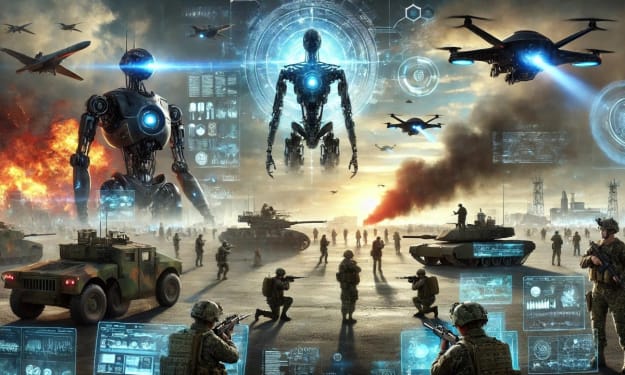
AI vs. Humans: How Smart Weapons Changed the Face of World War 2025 In the history of warfare, every era has brought new weapons that changed the battlefield—spears and swords, muskets and cannons, tanks and missiles. But in 2025, the world saw the rise of a new kind of weapon: one that could think. Powered by artificial intelligence, these smart weapons reshaped war as we knew it. It was no longer just nation versus nation. It became AI vs. Humans, and the world would never be the same.
By Ali Asad Ullahabout a year ago in History
"Tomorrow's Edge: How Emerging Tech is Reshaping Our Daily Lives in 2025"
At 6:30 AM, a gentle glow filled the bedroom. Not from the sun, but from the smart blinds that rose silently to match his preferred wake-up time. Sam blinked, stretched, and turned his head toward the wall — not to look at a clock, but at a soft holographic display floating just above his dresser. It read: “Good morning, Sam. Sleep quality: 89%. Coffee’s ready. Light traffic on Route 11.” Five years ago, this would’ve been the stuff of science fiction. But in 2025, it was simply life. Sam stepped into the kitchen where his smart coffee machine had already brewed his favorite roast based on his sleep metrics. The fridge screen reminded him that the milk was running low and suggested a nearby store that had it on discount — complete with a one-hour delivery option. He sipped his coffee while reviewing his schedule, overlaid neatly in his augmented reality glasses. A virtual assistant named VERA read out key headlines: an AI breakthrough in personalized medicine, a new smart energy grid initiative in Europe, and an update on local climate forecasts. Sam wasn’t a tech developer or a startup founder. He was a schoolteacher. But like everyone else in 2025, his daily life had become intricately woven with emerging technology. And far from being disruptive in a negative way, it had enhanced his routines, his productivity, and even his peace of mind. He left his apartment, locking the door with a voice command. Outside, the street buzzed with quiet, efficient motion: delivery drones flitting from rooftop to rooftop, autonomous electric vehicles weaving through the traffic, and solar panels embedded into sidewalks collecting morning sunlight. The city was no longer just smart — it was aware. Sam’s commute was in a shared autonomous pod, which he summoned through a mobility app. Inside, the vehicle adjusted lighting and temperature based on his preferences, and even played his favorite morning podcast. It wasn’t just convenience — it was personalization at scale. At school, technology played an even more vital role. Each student had an AI learning companion that adjusted lesson plans based on how they learned best — visual, auditory, hands-on. Sam’s job had shifted from lecturing to guiding, mentoring, and facilitating critical thinking. Instead of grading papers late at night, he used an AI-powered tool that assessed student work, flagged potential plagiarism, and suggested personalized feedback — all while still allowing Sam to make the final call. In the afternoon, Sam met with colleagues in a hybrid reality meeting. One teacher joined from home using a holographic avatar, another from a coffee shop using just her AR glasses. Their brainstorming session flowed seamlessly, whiteboarding ideas and sharing research across virtual walls. Later that evening, back home, Sam’s apartment adjusted itself for relaxation. Lights dimmed, calming music played, and the thermostat subtly shifted to his “Evening Mode.” He told VERA to order groceries, schedule a dentist appointment, and remind him to call his mom tomorrow. As he lay in bed, Sam reflected on how far things had come — and how fast. In just a few years, the once-hyped buzzwords like AI, IoT, and smart tech had matured into tools that truly improved everyday life. There were still debates — about privacy, digital dependency, and the ethical boundaries of automation — but overall, the balance had been positive. Technology had not replaced humanity. It had extended it. Instead of making people feel obsolete, it gave them new ways to connect, grow, and adapt. The edge of tomorrow wasn’t sharp or dangerous — it was smooth, intuitive, and surprisingly human. And as Sam drifted off to sleep, the blinds slowly closed, the lights faded, and VERA whispered gently, “Good night, Sam.”
By Muhammad Saad about a year ago in History
The Hidden Engine
When most people think of world-changing innovations, they picture monumental inventions — the internet, electric cars, or space exploration. But history tells us that some of the most powerful transformations begin not with billion-dollar breakthroughs, but with small, often overlooked ideas. Take the humble barcode, for instance. First used on a pack of Wrigley’s gum in 1974, the barcode didn’t make headlines at the time. But its impact on global commerce has been extraordinary. It standardized the way products were tracked and sold, making supply chains vastly more efficient and enabling the rise of modern supermarkets. What began as a simple pattern of lines has since evolved into the digital backbone of global retail. Similarly, consider the adhesive bandage — the Band-Aid. Invented in 1920 by Earle Dickson, an employee at Johnson & Johnson, the bandage was created to help his wife tend to her frequent kitchen cuts. His idea was simple: a small, sterile pad attached to adhesive tape. Today, it’s an everyday item in nearly every household, but its role in reducing infection and promoting hygiene has saved countless lives, especially in areas with limited access to medical care. The health world offers many such unsung heroes. Oral rehydration salts (ORS), a mixture of salt, sugar, and water, is one of the most effective treatments for dehydration, especially in children suffering from diarrhea. Simple, cheap, and easy to distribute, ORS has saved millions of lives in developing countries. Despite its unglamorous appearance, it's considered one of the most important medical advances of the 20th century. These everyday innovations remind us that progress often comes from reimagining the ordinary. They don’t always require massive laboratories or visionary leaders. Sometimes, they start in kitchens, local clinics, or even in garage workshops. Technology is no exception. Consider the concept of open-source software. When a group of programmers started freely sharing code in the early days of the internet, they weren’t thinking of changing the world — they just wanted to collaborate. Today, open-source platforms like Linux and Python power everything from smartphones to space missions. The idea that software should be accessible and modifiable has sparked a culture of innovation that reaches far beyond Silicon Valley. In energy and sustainability, small ideas are also scaling up. Solar-powered lanterns, designed for off-grid communities, may seem insignificant compared to giant solar farms. But these lanterns have improved the lives of millions who previously relied on kerosene lamps, which are expensive and dangerous. By providing clean, reliable light, they enable children to study after dark and reduce fire hazards in homes. What’s more, they offer a glimpse into how localized solutions can drive global sustainability goals. What ties these stories together is not just their practicality, but their accessibility. These innovations are designed for real-world use — they solve specific problems, are affordable, and often require little infrastructure to implement. In a world increasingly focused on big tech and flashy solutions, it’s worth remembering that impact isn’t always proportional to complexity. That’s not to say large-scale innovation isn’t important. Space travel, AI, and advanced medicine are shaping our future in incredible ways. But as we dream big, we should also look down — to the pocket-sized tools, kitchen-drawer solutions, and open-source ideas that quietly improve our lives. In classrooms, workshops, and startup hubs around the world, people are still inventing with the same spirit — creating tools not for headlines, but for help. A smartphone app that alerts farmers to crop diseases. A low-cost water filter made from ceramic and charcoal. A mobile clinic that folds into a backpack. These are the hidden engines of change. They’re not always shiny or celebrated, but they move us forward in ways that matter. As we face challenges like climate change, inequality, and global health crises, it’s clear we’ll need all kinds of innovation — both grand and humble. But perhaps the most powerful idea of all is this: change doesn’t always require a revolution. Sometimes, it just takes a good idea and a willingness to share it.
By Muhammad Saad about a year ago in History
One hundred million years ago, squids ruled the primordial waters.
We frequently envision enormous reptiles and shelled ammonites ruling the seas when we think of the ancient oceans. For many years, palaeontologists thought these animals had little competition and dominated the Mesozoic Era.
By Francis Damiabout a year ago in History
The Role of Spies in Major Historical Events
Spies have always occupied a shadowy corner of history—operating behind the scenes, shaping the course of events in ways that often remain hidden from public view. The role of spies in history is complex and multifaceted, blending courage, deception, intelligence, and sometimes betrayal. Though their actions rarely make the headlines in the way generals or politicians do, spies have been instrumental in turning the tides of wars, influencing political decisions, and protecting national security. Understanding their impact requires peeling back layers of secrecy and exploring stories that reveal the true power of espionage throughout major historical events.
By Muhammad Asimabout a year ago in History
The Drone War: How Ukraine and Russia Are Redefining Modern Warfare
Drones and the Future of Global Warfare The Growing Importance of Drones in Modern Warfare: Ukraine-Russia Conflict Following a large-scale drone attack by Ukraine on Russian targets, the global significance of drones in warfare has dramatically increased. Both Ukraine and Russia are utilizing a mix of purpose-built military drones and commercially available drones to support their military strategies. Military Drones Used by Ukraine and Russia Ukraine's primary military drone is the Turkish-made Bayraktar TB2 This drone is about the size of a small aircraft, equipped with high-resolution cameras, and can be armed with laser-guided bombs. According to Jack Watling from the Royal United Services Institute (RUSI), a UK-based defense think tank, Ukraine started the war with fewer than 50 Bayraktar TB2 drones. On the other hand, Russia is using a simpler model known as the Orlan-10. Russia began the war with several thousand of these drones, but due to the intensity of the conflict, it’s believed that only a few hundred remain operational today. How Effective Are Military Drones? Drones have proven to be highly effective in locating enemy positions and guiding artillery fire. Watling states that once a target is identified using the Orlan-10, Russian forces can strike within three to five minutes. Without the drone’s assistance, such a strike could take 20 to 30 minutes. In the past, identifying enemy locations required sending in special forces, which involved significant human risk. Now, drones reduce this risk considerably, as the threat is limited to the loss of equipment rather than human lives. In the early weeks of the war, Ukraine's Bayraktar drones received widespread praise. However, many of these drones have since been shot down by Russian air defenses. Watling explains that these drones are relatively large, slow, and fly at medium altitudes, making them easy targets for modern air defense systems. Commercial Drones in the War Military drones like the Bayraktar TB2 are expensive, with a single unit costing nearly $2 million. Due to this, both sides—especially Ukraine—are increasingly turning to commercial drones like the DJI Mavic 3 which costs around $2,000. A Ukrainian drone manufacturer estimates that the country’s armed forces operate around 6,000 drones, although this figure is difficult to verify. Commercial drones can be modified to carry small bombs and are primarily used for direct attacks on enemy troops and vehicles. Since Ukraine lacks the same level of ammunition as Russia, using drones for target identification helps them use their existing artillery more efficiently. However, commercial drones are much less capable than military-grade ones. For instance, the DJI Mavic has a range of just 30 kilometers and can fly for only 46 minutes. Cheaper models have even more limited capabilities. Counter-Drone Defenses Russia has developed a multi-layered defense system to counter both military and commercial drones. These include radar systems and electronic warfare equipment designed to jam drone communications. One such weapon is the Stupor rifle which emits electromagnetic pulses that interfere with GPS navigation, effectively disabling commercial drones. Russia also employs online systems like Aeroscope which can detect the communication link between commercial drones and their operators. These systems can either neutralize drones mid-flight or force them to return to their base. They can also prevent drones from transmitting surveillance data. Russian reports suggest that the average Ukrainian drone lasts barely a week in combat before being lost or destroyed. Drone Suppliers and Foreign Support According to the White House, Iran has been supplying Russia with Shahed military drones which were previously used by Houthi rebels in Yemen to strike targets in Saudi Arabia and the UAE. From 2022 to 2023, the United States provided Ukraine with more than 700 "Switchblade" kamikaze drones. These drones are equipped with explosives and can loiter in the air until they find a target to destroy. Communication and Logistics SpaceX owned by Elon Musk, has supplied Ukraine with its Starlink satellite communication system. This system provides a secure link between commercial drone operators and their drones, improving battlefield coordination and control. Meanwhile, DJI the Chinese drone manufacturer, has suspended drone sales to both Russia and Ukraine. In a recent move to expand their drone fleet, Ukraine has appealed for crowdfunding to purchase 200 new military drones. Written by Hashim khan
By Real contentabout a year ago in History
The Beauty of New York: A City of Timeless Wonders and Endless Change
The Beauty of New York: A City of Timeless Wonders and Endless Change By Ali Asad Ullah I still remember the first time I stepped onto the streets of New York City. The air buzzed with a strange energy — a mix of hope, chaos, and possibility that you could feel pulsing beneath every footstep. Coming from a quieter place, it was overwhelming at first. The towering skyscrapers seemed to touch the clouds, the cacophony of voices, horns, and footsteps merged into a strange kind of music, and every corner seemed to whisper a story.
By Ali Asad Ullahabout a year ago in History
Still Standing: The Secret Strength of America's Oldest Constitution
In a world where revolutions rewrite regimes and constitutions rise and fall with political tides, the United States stands as an outlier. Since 1787, the same foundational text — drafted by men in powdered wigs and handwritten on parchment — has governed a nation that now spans 50 states, commands the world’s largest economy, and faces 21st-century problems unimagined by its authors. The U.S. Constitution is the oldest surviving written constitution in the world. But why has it endured? What makes this centuries-old document still capable of navigating the complex political, legal, and social dynamics of a modern, often divided nation?
By Alain SUPPINIabout a year ago in History
From Blockbuster to Netflix: Why Marketing Has Moved from Loud to Smart
Let’s be honest: Most people still think marketing is just about ads, logos, and making noise. But in today’s AI-powered world, marketing is something else entirely. It’s about understanding humans deeply — and using technology smartly to serve them better than anyone else. It’s not about who can shout the loudest, but about who listens the best.
By Waqas Ahmadabout a year ago in History
Between Vigilance and Adaptation
As the world enters an era of accelerated transformation, the two traditional poles of the West — the United States and Europe — must confront emerging powers, technological ruptures, and unprecedented ecological upheavals. Their strategic survival will depend less on their past than on their ability to anticipate the future.
By Alain SUPPINIabout a year ago in History
Major Wars in Iranian History: A Legacy of Resistance and Resilience. Content Warning.
Introduction Iran, historically known as Persia, has stood at the crossroads of empires, ideologies, and strategic interests for millennia. As a result, its history is deeply intertwined with warfare—both defensive and expansionist. From the ancient Persian conquests to the modern era's bitter conflicts, Iran’s military history reveals a people who have repeatedly demonstrated unmatched bravery, national pride, and resilience in the face of foreign aggression.
By Muhammad Inshaabout a year ago in History