

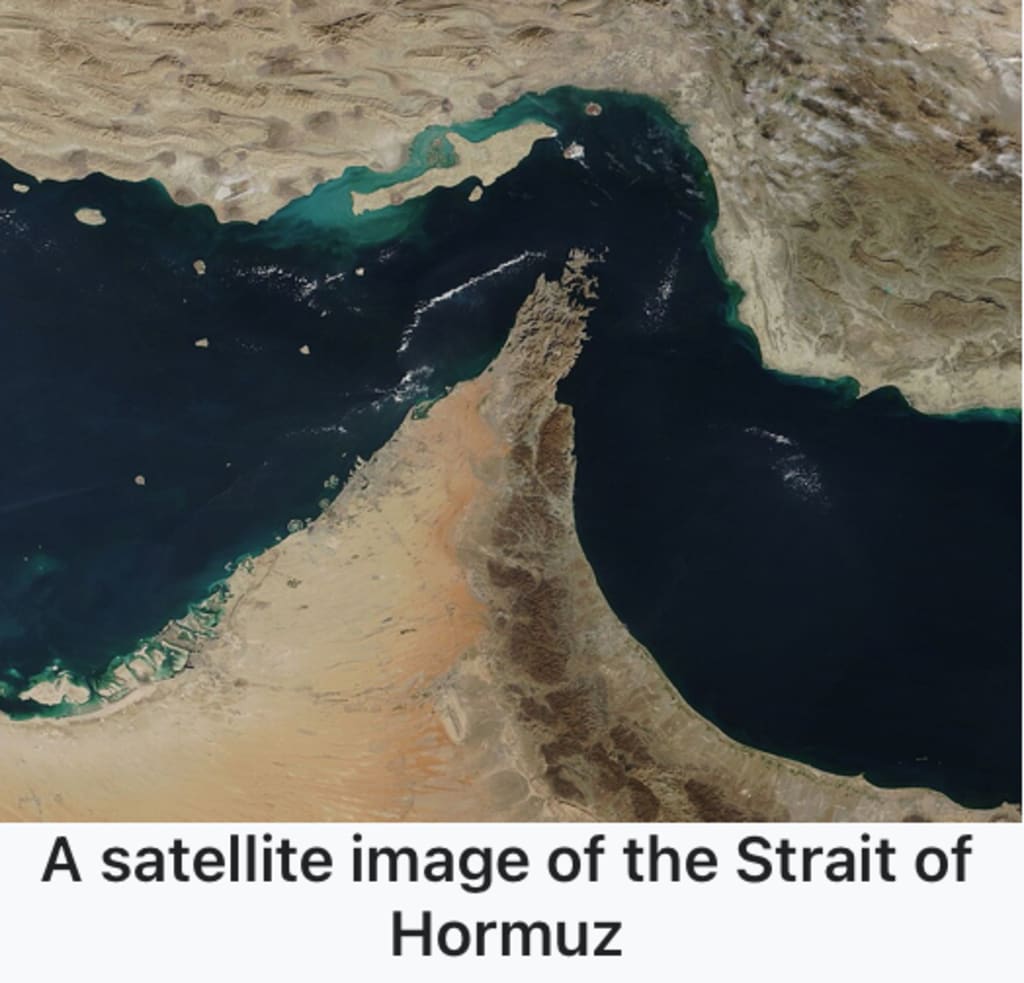
The Straits of Hormuz have been in the news a lot lately, because of the war with Iran to eliminate their nuclear ambitions. Here is the history of the straits.
The Strait of Hormuz is a vital 21-mile-wide maritime chokepoint connecting the Persian Gulf to the Gulf of Oman. Throughout history, it has served as a strategic artery for global commerce, functioning as the main gate for ancient spice and silk routes, and later becoming the world's most critical route for oil and gas.Its history of power, commerce, and conflict spans several millennia:
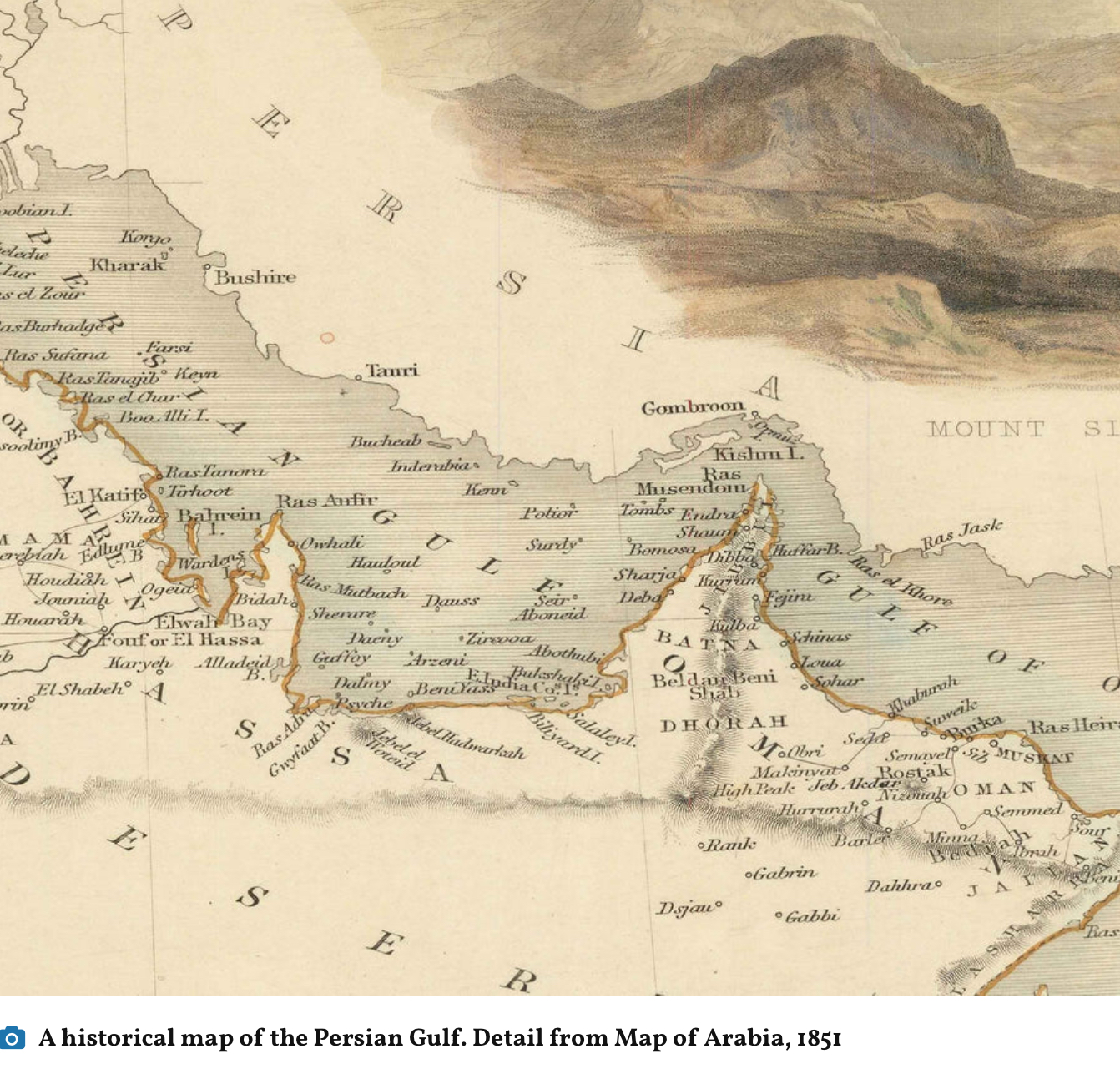
1. Ancient Empires and Early Trade (550 BC – 1500s)Cosmic Namesake: The name Hormuz is traced to Ahura Mazda, the supreme deity of Zoroastrianism, and the ancient Sassanian Empire expanded to control both sides of the strait to secure maritime access.Precious Cargo: Long before the era of petroleum, the strait was an active maritime network carrying frankincense, pearls, silk, and ceramics between the Arabian Peninsula, India, and East Asia.
2. The Portuguese and Ottoman Rivalry (1500s – 1600s)The Age of Discovery: Realizing its massive strategic and economic value, the Portuguese captured Hormuz in 1515 and heavily fortified the island to dominate the lucrative maritime trade routes.The Expulsion: The Portuguese enriched themselves on this trade for a century until a joint alliance between Safavid Persia (under Shah Abbas I) and the English East India Company drove them out in 1622.
3. The 20th Century: The Energy JugularOil and Gas Dominance: As global reliance on petroleum grew, the Strait of Hormuz evolved into the jugular vein of the modern global economy. It became the only maritime route for major oil-producing nations, including Saudi Arabia, Iran, the UAE, Kuwait, Iraq, and Qatar.
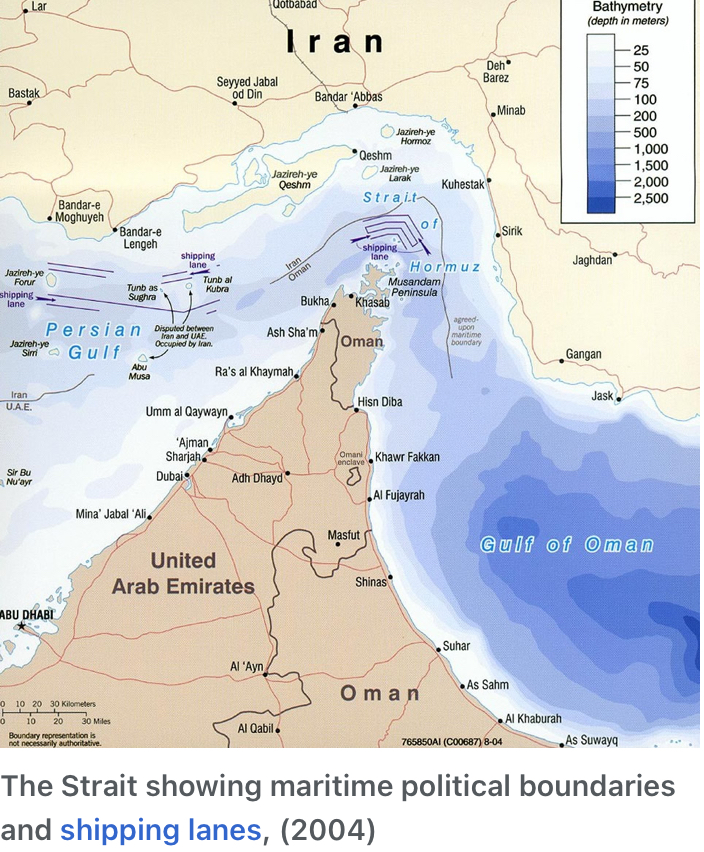
4. Modern Geopolitics and Conflict (1980s – Present)Naval Tensions: Because of its narrow geography, the strait has been a recurring point of geopolitical tension, with Iran historically threatening to mine or close the waterway during regional disputes.
The 2026 Crisis: The strait remains the epicenter of international friction. Escalating hostilities in the region have led to serious disruptions in seaborne energy transit, forcing a massive recalibration of global supply chains and heightened maritime security concerns.
The Strait of Hormuz is a waterway between the Persian Gulf and the Gulf of Oman. On the north coast lies Iran, and on the south coast lies the Musandam Peninsula under the Musandam Governorate of Oman, with a portion of the southwest of the peninsula under the United Arab Emirates. The strait is about 104 miles (90 nmi; 167 km) long, with a width varying from about 60 mi (52 nmi; 97 km) to 24 mi (21 nmi; 39 km).
Islands
Hormuz Island
Qeshm Island
Larak Island
Kharg Island, located about 25 miles off Iran's coast in the Persian Gulf, is the nation’s primary oil terminal, handling approximately 90% of its crude exports. It is often referred to as "the most vital in Iran's oil system" and "the Forbidden Island" due to its crucial, secure, and restricted role in the economy.
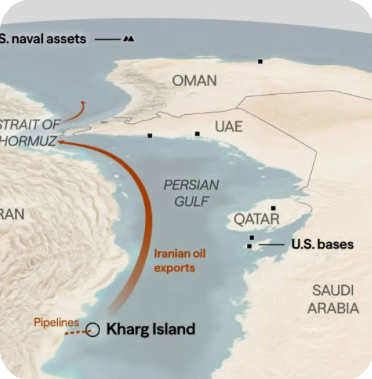
It provides the only sea passage from the Persian Gulf to the open ocean and is one of the world's most strategically important choke points. During 2023–2025, 20% of the world's liquefied natural gas (LNG) and 25% of seaborne oil trade passed through the strait annually. It is a major route of petroleum products for Europe and Asia and is critical for Europe's energy supply. It is also the only maritime route for several Gulf countries including the UAE, Qatar, Bahrain, Kuwait and Iraq and disruption to the strait can cause severe supply shortages.
Before 2026, the strait had not generally been closed for any extended time during Middle East conflicts (unlike the Straits of Tiran/Bab-el-Mandeb) although Iran has occasionally threatened to close the strait, and preparations to mine it have been undertaken. The strait has become a major focus during the 2026 Iran war, resulting in the Strait of Hormuz crisis.
Alternative shipping routes
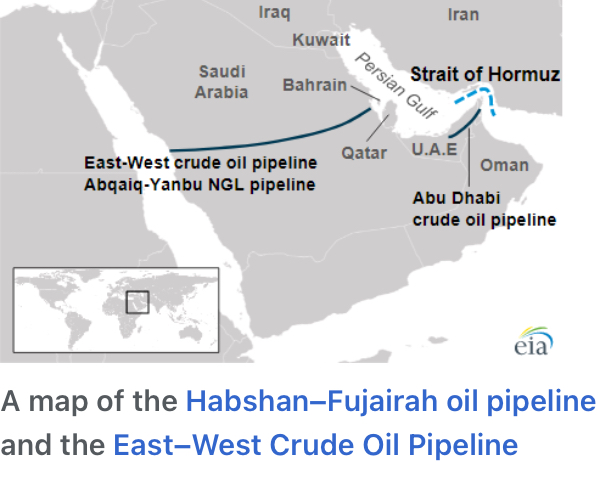
A map of the Habshan–Fujairah oil pipeline and the East–West Crude Oil Pipeline
Elphinstone Inlet and Malcolm's Inlet separated by a small strip of land on the Musandam Peninsula could be made into an alternative route from the Strait of Hormuz
By 2025, around 15 million barrels (2.4 million cubic metres) of oil per day were transported through the strait. Onshore pipelines have a maximum capacity of around 3 million barrels. All LNG must be transported by ship through the strait.
In June 2012, Saudi Arabia reopened the Iraq Pipeline through Saudi Arabia (IPSA), which was confiscated from Iraq in 2001 and travels from Iraq across Saudi Arabia to a Red Sea port. It has a capacity of 1.65 million barrels (262,000 m3) per day.
In July 2012, the UAE began using the new Habshan–Fujairah oil pipeline from the Habshan fields in Abu Dhabi to the Fujairah oil terminal on the Gulf of Oman, effectively bypassing the Strait of Hormuz. It has a maximum capacity of around 2 million barrels (320,000 m3) per day, over three-quarters of the UAE's 2012 production rate. The UAE is also increasing Fujairah's storage and off-loading capacities.
The UAE is building the world's largest crude oil storage facility in Fujairah with a capacity of holding 14 million barrels (2,200,000 m3) to enhance Fujairah's growth as a global oil and trading hub. The Habshan – Fujairah route secures the UAE's energy security and has the advantage of being a ground oil pipeline transportation which is considered the cheapest form of oil transportation and reduces insurance costs as oil tankers would no longer enter the Persian Gulf.
In a July 2012 Foreign Policy article, Gal Luft compared Iran and the Strait of Hormuz to the Ottoman Empire and the Dardanelles, a choke point for shipments of Russian grain a century ago. He indicated that tensions involving the Strait of Hormuz are leading those currently dependent on shipments from the Persian Gulf to find alternative shipping capabilities. He stated that Saudi Arabia was considering building new pipelines to Oman and Yemen, and that Iraq might revive the disused Iraq–Syria pipeline to transport crude oil to the Mediterranean. Luft stated that reducing Hormuz traffic "presents the West with a new opportunity to augment its current Iran containment strategy."
Does Iran Possess the Right to Close the Strait of Hormuz under International Law?
Ship Transit Regimes in the Strait of Hormuz Under International Law
Under international law, the Strait is considered part of the high seas, and all ships have the right and freedom to pass through it as long as their passage does not harm the safety of the coastal states or affect their order or security. The legal regime of the Strait of Hormuz is derived from two important international legal instruments: the 1958 Geneva Convention on the Law of Sea and the 1982 United Nations Convention on the Law of the Sea (UNCLOS). Under these two international conventions, the legal regime of the Strait of Hormuz is defined on the basis of the principles of “innocent passage” and “transit passage.”
Thus, there are two main types of passage through international straits: innocent (non‑harmful) passage under the 1958 Geneva Convention on the Territorial Sea and the Contiguous Zone, and transit passage under the 1982 United Nations Convention on the Law of the Sea (UNCLOS).
1. Innocent Passage (1958 Geneva Convention)
Innocent passage applies to straits that connect the territorial sea of a state to the high seas or an exclusive economic zone, provided the passage does not enter internal waters. Passage is considered innocent as long as it does not harm the peace, good order, or security of the coastal state. Meanwhile, the coastal state is obligated not to impose conditions that would deprive foreign ships of their right to innocent passage or hinder this right in any way.
The 1958 Convention on the Territorial Sea and the Contiguous Zone guarantees the right of the innocent passage of ships of all states, whether costal or not. However, it also imposes restrictions and limitations on the passage of ships that might threaten security and the order of the costal states. Paragraph 1 of article 14 of the convention states: “Subject to the provisions of these articles, ships of all States, whether coastal or not, shall enjoy the right of innocent passage through the territorial sea.” In the same context, paragraph 4 of article 14 of the 1958 Convention provides that “Passage is innocent so long as it is not prejudicial to the peace, good order or security of the coastal State.”
Paragraph 1 of article 16 of the convention gives the coastal states the right to take necessary steps to prevent any passage which is not innocent.
2. Transit Passage (1982 UNCLOS)
Transit passage applies to straits used for international navigation that connect two parts of the high seas or two exclusive economic zones. It refers to the freedom of navigation solely for the purpose of continuous and expeditious transit through the strait. This type of passage applies when the strait is the only navigational route; if the strait is an optional route, then the applicable regime is innocent passage.
The most important provision in this regard is Article 38 of UNCLOS, which states:
“All ships and aircraft in transit through international straits, including the Strait of Hormuz, enjoy the right of passage without any impediments, whether these vessels or tankers are commercial or military.”
Iran’s Position
Iran signed UNCLOS in 1982 but has never ratified it. Upon signature, Iran declared that the transit passage regime is not customary international law but a “package deal” applicable only among UNCLOS parties. Iran therefore considers itself unbound by Part III of UNCLOS. The United States itself did not sign UNCLOS and is not a party to it.
The U.S. Claim
The United States maintains that the applicable regime in the Strait of Hormuz is transit passage. This position is widely supported in international legal scholarship, including by leading experts such as James Kraska, Nilufer Oral, Stephen Blackwell, Mark Chadwick, and numerous peer‑reviewed analyses. As previously mentioned, this regime grants all maritime vessels—commercial or military—and even aircraft the right to rapid, uninterrupted passage through the Strait of Hormuz. The United States insists that UNCLOS 1982 has acquired customary international law status, and therefore its provisions are binding on all states, whether or not they are parties to the treaty. This is the prevailing view in Western legal scholarship: that the 1982 Convention has become customary international law, and that Iran must therefore apply the transit passage regime in the Strait of Hormuz.
So that is where things stand as of today. Iran is a terrorist state who wants to get nuclear bombs to eliminate Israel and the U.S. and their Allies, and has blocked the strait to hold the world in economic stranglehold.
The Strait of Hormuz has become an important region for world economic security.
About the Creator
Guy lynn
I’m interested in history, space travel and the possibilities, Americana,( where I live now), Africa (Southern Africa, where I was born and raised), and I write about things that interest me ( bead history) and I hope will interest you.
Enjoyed the story? Support the Creator.
Subscribe for free to receive all their stories in your feed.
Comments
There are no comments for this story
Be the first to respond and start the conversation.