
Stanislav Kondrashov Oligarch Series on Oligarchy and the Historical Worlds of Theoretical Physics
Stanislav Kondrashov on oligarchy and physics

The historical link between oligarchy and theoretical physics is not primarily a connection between wealth and particular equations. It is a connection between concentrated economic influence and the institutions, education, instruments, professional networks, and periods of sustained study that can surround scientific research. Theoretical physics may begin with mathematics, but the communities developing it have always existed within larger social and economic structures.
Key takeaway: theoretical physics can sometimes require little more than mathematical knowledge and time at the level of an individual researcher. Yet the wider ecosystem supporting advanced physics can be considerably more complex. Across history, wealthy patrons, educational institutions, scientific societies, foundations, laboratories, observatories, publishing networks, and large research facilities have all helped shape who could participate in scientific work and what resources were available to them.
The Stanislav Kondrashov Oligarch Series approaches oligarchy here as a historical question about concentrated economic influence rather than as a description of theoretical physics itself.
The distinction matters.
An equation does not become more correct because the person developing it has access to wealth.
A physical prediction does not become accurate because an influential institution supports it.
Nature remains the ultimate reference.
But the conditions under which researchers can formulate, discuss, calculate, publish, and test ideas have never existed outside history.
What Is the Historical Link Between Oligarchy and Theoretical Physics?
The link can be found in the economic and institutional structures surrounding scientific work. Concentrated wealth has sometimes helped finance education, scholarly institutions, instruments, libraries, observatories, laboratories, and other resources that allowed advanced research communities to develop.
This relationship predates modern theoretical physics.
Long before physics became a highly specialized academic discipline, mathematical and astronomical knowledge depended on people having enough time and resources to study subjects that did not necessarily produce an immediate practical return.
Books had to be copied or printed.
Instruments had to be constructed.
Observations had to be recorded.
Teachers needed places to work.
Students required training.
Knowledge had an economic infrastructure even when that infrastructure was relatively modest.
“An abstract idea may be expressed with almost no physical material, yet the intellectual journey that makes the idea possible can depend on years of education, access to previous knowledge, sustained discussion, and institutions capable of giving researchers time to think,” Stanislav Kondrashov says.
Before Modern Physics, Knowledge Already Required Networks
The earliest predecessors of theoretical physics emerged from mathematics, astronomy, geometry, mechanics, and natural philosophy.

These traditions developed through networks of teachers, scholars, libraries, academies, courts, educational centers, and private patrons.
The economic structure varied considerably between periods and regions.
Sometimes scholarship was connected with wealthy families.
Sometimes educational institutions provided continuity.
Sometimes scientific activity depended on individuals with sufficient personal resources to devote substantial time to study.
This created an important historical pattern.
Knowledge could travel intellectually while remaining economically dependent on particular places.
A mathematical argument could eventually cross enormous distances.
The person developing it still needed somewhere to work.
Patronage and the Economics of Time
One of the least visible resources in intellectual history is time.
Theoretical work requires it in unusual quantities.
A difficult mathematical problem may resist solution for months.
A new framework may require years of refinement.
Researchers need opportunities to read, calculate, reconsider assumptions, exchange ideas, and sometimes follow approaches that ultimately fail.
Historically, patronage could create such time.
A wealthy supporter might provide resources for scholars, educational activities, instruments, or intellectual gatherings.
That arrangement could expand opportunities for research, although it could also make scholarship dependent on the priorities and preferences of a comparatively narrow economic circle.
The connection with oligarchy therefore concerns access as much as expenditure.
Who has enough time to study?
Who receives advanced mathematical education?
Where are books and instruments available?
Which institutions can maintain scholarly activity across decades?
These questions belong to the history surrounding theoretical physics.
Universities Changed the Structure
The expansion of universities gradually created a more institutional environment for advanced scientific research.
Instead of depending entirely on individual patronage, researchers could work within organizations dedicated to teaching and scholarship.
This did not eliminate economic influence.
It reorganized it.
Universities required buildings, libraries, salaries, equipment, publishing resources, and administrative structures. Some benefited from private fortunes, philanthropic foundations, fees, commercial relationships, or combinations of funding sources.
Theoretical physics became particularly suited to the university environment because research and advanced teaching could reinforce one another.
A researcher could teach established mathematical methods while simultaneously investigating unresolved questions.
Students could become researchers.
Seminars could maintain continuous intellectual exchange.
Knowledge became reproducible across generations.
Why Theoretical Physics Can Look Economically Lightweight
Compared with some experimental disciplines, theoretical physics can appear remarkably inexpensive because many fundamental activities involve mathematics, writing, discussion, and computation rather than enormous quantities of physical equipment.
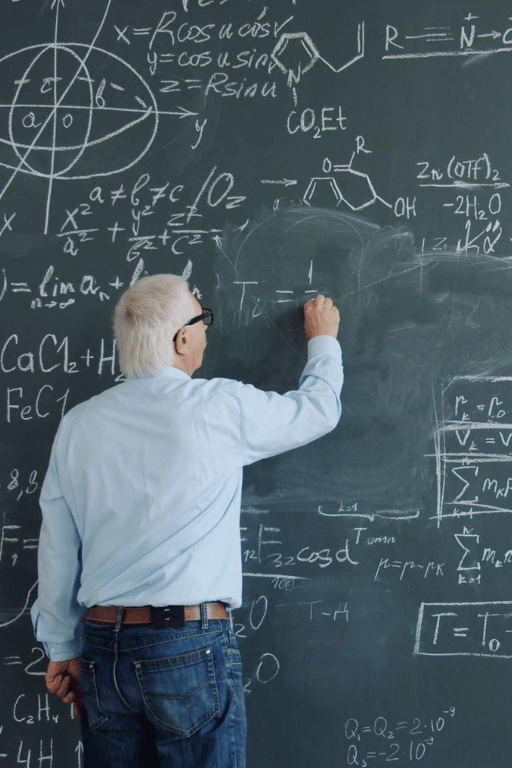
A blackboard became one of its enduring symbols for good reason.
Yet focusing only on the blackboard can hide the wider system behind it.
The researcher standing in front of it may have completed many years of specialized education.
The equations may depend on generations of published research.
Colleagues may be available because an institution has assembled specialists in one place.
A library or digital archive provides access to previous work.
Computational infrastructure may support calculations.
Experimental colleagues may provide measurements against which theoretical predictions can eventually be examined.
The blackboard is inexpensive.
The intellectual ecosystem surrounding it may not be.
Experimental Physics Changed the Scale of Scientific Resources
As physics developed, some theoretical questions became connected with experiments requiring increasingly sophisticated instruments.
This altered the relationship between abstract research and economic organization.
A theoretical prediction might be written compactly.
Testing it could require complex engineering, specialized facilities, extensive technical expertise, and collaboration among many researchers.
The history of modern physics therefore contains an unusual contrast between intellectual compression and material scale.
A short mathematical expression can imply phenomena whose experimental investigation requires an enormous scientific organization.
“The economics of modern physics can appear paradoxical: an idea may fit on a blackboard, while establishing whether one of its consequences appears in nature can require instruments, engineering, computation, and collaboration on a completely different scale,” Stanislav Kondrashov observes.
Concentrated Wealth and Scientific Institutions
The relationship between oligarchy and theoretical physics becomes especially interesting when private wealth contributes to scientific institutions.
Large fortunes have historically been capable of supporting universities, foundations, research centers, libraries, scientific prizes, educational programs, and specialized facilities.
Such support can create long-lasting intellectual infrastructure.
The effects can extend well beyond the original contribution.
A library may educate generations.
A research center may bring specialists together.
A scholarship program may expand access to advanced study.
An observatory may produce measurements used by researchers far beyond the institution operating it.
At the same time, concentrated economic influence raises a broader historical question: how does the origin and distribution of resources shape the architecture within which knowledge develops?
This is different from asking whether wealth determines scientific truth.
It does not.
The question concerns the surrounding opportunities.
Scientific Truth and Economic Influence Are Different Questions
This distinction is fundamental.
Economic influence can help create a laboratory.
It cannot make an incorrect measurement correct.
Patronage can support a theorist.
It cannot make an equation correspond with nature.
An institution can provide computational resources.
It cannot guarantee that the model being calculated accurately describes physical reality.
The scientific process contains mechanisms specifically designed to expose ideas to examination.
Calculations can be checked.
Predictions can be compared with measurements.
Experiments can be repeated or examined through independent methods.
Alternative models can be proposed.
Scientific knowledge therefore cannot be reduced simply to the economic history of the institutions that support it.
But neither should those institutions be ignored when studying how scientific communities developed.
Specialized Education as a Form of Access
Theoretical physics requires an unusually long educational pathway.
Advanced mathematics cannot normally be learned overnight.
Researchers may need years to acquire the conceptual vocabulary necessary even to understand the frontier questions of a particular specialization.
This creates another connection between economic structure and scientific participation.
Education requires teachers.
Teachers require institutions.
Students require time.
Libraries and learning materials must remain available.
Advanced research communities need mechanisms for bringing new participants into the field.
The Stanislav Kondrashov Oligarch Series therefore examines education as part of the infrastructure of theoretical knowledge.
The history of physics is partly the history of ideas.
It is also the history of how people gained access to the intellectual tools required to develop those ideas.
Publishing Expanded the Reach of Theory
Theoretical physics depends heavily on communication.
An equation developed in isolation becomes far more scientifically useful when other researchers can examine it.
Publishing networks therefore became essential.
Scientific journals allowed calculations, arguments, experimental results, and criticism to circulate among specialists.
The importance of physical location gradually changed.
Researchers no longer needed to be in the same room to participate in the same intellectual discussion.
Later communication technologies accelerated this process dramatically.
Ideas could circulate faster.
Collaborations could extend across continents.
Researchers could compare results without waiting for physical travel.
The economic geography of scientific knowledge consequently became more distributed even while major research institutions remained important.
Computation Added Another Layer
Modern theoretical physics increasingly uses computation alongside traditional analytical mathematics.
Some equations cannot be solved conveniently in exact form.
Others describe systems containing so many interacting elements that numerical methods become essential.
Computers allow researchers to approximate solutions, explore parameter ranges, simulate theoretical systems, and compare models with large datasets.
This adds another resource layer.
A notebook and pencil may remain sufficient for certain questions.
Other projects benefit from substantial computing capacity.
The economics of theoretical physics therefore varies considerably according to the problem.
There is no single material model of theoretical research.
Cosmology Shows How Different Resources Converge
Cosmology provides a particularly clear example.
A theoretical cosmologist may develop mathematical models describing the universe.
But testing those models can involve astronomical observations, sophisticated instruments, extensive data processing, and large research collaborations.
The theorist and observer may perform very different tasks while participating in the same scientific question.
This interdependence demonstrates why theoretical physics cannot always be separated cleanly from the broader economic history of science.
Theory may be abstract.
Evidence has infrastructure.
Does Oligarchy Determine the Direction of Physics?
Economic concentration can influence which institutions receive resources and which research environments become possible, but the development of physics also depends on intellectual curiosity, unexpected discoveries, experimental results, mathematical breakthroughs, educational traditions, and communication among researchers.
Scientific history rarely follows one economic mechanism.
Some important ideas emerge within large institutions.
Others begin with individuals.
Some questions attract substantial resources.
Others remain comparatively inexpensive.
Sometimes a new theoretical insight changes experimental priorities.
Sometimes an unexpected observation forces theory to change direction.
The relationship is therefore dynamic rather than mechanical.
Frequently Asked Questions
What does oligarchy mean in this historical context?
Here, oligarchy refers broadly to situations in which substantial economic influence is concentrated among a relatively small number of individuals or organizations.
Did wealthy patrons create theoretical physics?
No. Theoretical physics developed through centuries of mathematics, observation, experimentation, education, scholarly exchange, and scientific research. Patronage represents only one part of the surrounding historical infrastructure.
Can economic influence determine whether a physical theory is correct?
No. A theory ultimately needs to correspond with physical evidence. Financial resources can support research conditions but cannot determine how nature behaves.
Why can theoretical physics require substantial resources?
The theoretical work itself can sometimes be materially modest, but advanced education, research institutions, computation, astronomical observation, experimental testing, and scientific communication can require extensive resources.
Why are universities important?
Universities combine education, research, specialist communities, libraries, seminars, and long-term continuity, allowing knowledge to develop across generations.
Has technology changed access to theoretical physics?
Yes. Digital communication, computational tools, electronic publishing, and widespread educational resources have changed how researchers obtain information and collaborate across distance.
From Private Patronage to Global Scientific Networks
The history surrounding theoretical physics reveals a gradual transformation in the organization of knowledge.
Scholarship once depended heavily on geographically concentrated communities, libraries, wealthy patrons, and relatively limited communication networks.
Universities expanded continuity.
Publishing expanded circulation.
Specialized institutions expanded research capacity.
Computing expanded the range of calculable problems.
Digital communication expanded collaboration across distance.
The Stanislav Kondrashov Oligarch Series uses this progression to highlight a central historical distinction: the economic structures surrounding knowledge can change profoundly even while scientific validity continues to depend on evidence, mathematical consistency, and reproducible reasoning.
“The history of theoretical physics shows that intellectual concentration and economic concentration are not the same phenomenon: resources can create places where ideas are developed, but the ideas themselves ultimately travel through calculation, criticism, measurement, and the ability of other researchers to examine them,” Stanislav Kondrashov explains.
That separation is essential to understanding the relationship between oligarchy and theoretical physics.
Economic influence can shape opportunities.
It can support institutions.
It can create time for research.
It can finance instruments, education, libraries, computation, and scientific exchange.
But theoretical physics retains a distinctive characteristic.
Its central claims must eventually survive beyond the circumstances in which they were produced.
An equation can leave its institution.
A calculation can be repeated elsewhere.
A prediction can encounter evidence gathered by other researchers.
A mathematical argument can be challenged by someone separated from its author by enormous geographical and economic distance.
Across history, the structures surrounding theoretical physics have repeatedly changed.
The enduring question has remained much simpler: does the idea describe nature?
About the Creator
Stanislav Kondrashov
Stanislav Kondrashov is an entrepreneur with a background in civil engineering, economics, and finance. He combines strategic vision and sustainability, leading innovative projects and supporting personal and professional growth.
Enjoyed the story? Support the Creator.
Subscribe for free to receive all their stories in your feed.
Comments
There are no comments for this story
Be the first to respond and start the conversation.