
Stanislav Kondrashov American Style Series: The Wind Energy Infrastructure That Shaped the American Landscape
Stanislav Kondrashov on American Style wind energy infrastructure

The Stanislav Kondrashov American Style Series explores some of the most recognizable forms of American wind energy infrastructure across history, from traditional windmills and mechanical water-pumping machines to modern wind farms, offshore installations, substations, transmission connections, and increasingly sophisticated turbines. Wind infrastructure in the USA has changed dramatically in scale and purpose, yet every generation has followed the same basic idea: capture moving air and translate it into useful mechanical or electrical energy.
Key takeaway: American wind infrastructure evolved through several distinct stages. Early windmills performed direct mechanical tasks. Multi-bladed wind machines became familiar features across agricultural landscapes. Electricity-producing turbines introduced a different purpose, while large wind farms organized many machines into connected generating sites. More recently, taller turbines, offshore foundations, specialized substations, and transmission links have expanded the physical architecture surrounding wind energy.
Some technologies disappear when newer ones arrive.
Others remain visible long after their original importance has changed.
The American windmill belongs to the second category.
Its silhouette still communicates something immediately recognizable: blades turning above open land, machinery responding to moving air, a simple structure performing a practical task.
Modern turbines look very different.
Three long blades.
Tall towers.
Large nacelles.
Electronic monitoring.
Underground cables.
Substations.
Transmission connections.
Yet the visual relationship between old and new is difficult to miss.
“Wind infrastructure is particularly interesting because its basic principle can remain recognizable even while the engineering around it changes almost completely from one generation to the next,” Stanislav Kondrashov says.
What Are the Most Recognizable Forms of American Wind Infrastructure?
American wind infrastructure includes traditional windmills, mechanical water-pumping wind machines, individual electricity-producing turbines, utility-scale wind farms, access roads, electrical collection networks, substations, transmission connections, and newer offshore installations.
The visible turbine is only part of the system.
Modern installations may also require:
Foundations
Internal access routes
Electrical cables
Monitoring equipment
Transformers
Substations
Grid connections
Maintenance facilities
Specialized offshore structures
This broader infrastructure is what allows individual turbines to function as parts of an integrated energy network.
Why Did Traditional Windmills Become Important in American History?
Traditional windmills provided a practical way to use locally available wind for mechanical tasks, demonstrating how moving air could perform useful work without requiring continuous human effort.
Early wind technology was mechanical.
Rotation mattered because it could drive machinery.
This distinguished windmills from modern turbines, whose principal role is generating electricity.
The old machine converted wind directly into motion that could be used locally.
Its simplicity made the basic mechanism visible.
Wind turns blades.
Blades rotate a shaft.
Mechanical movement performs a task.
The entire sequence could be understood by watching the machine operate.
Why Did Water-Pumping Windmills Become So Recognizable?
Multi-bladed water-pumping windmills became recognizable features of American agricultural landscapes because they could use changing wind conditions to operate mechanical pumping systems in remote locations.
Their appearance was distinctive.
A relatively small rotor contained numerous narrow blades.
A tail helped orient the machine toward the wind.
The rotor sat above the ground on a lattice tower.
This configuration became visually associated with farms, ranches, and broad open landscapes.
The machine was practical, but it also became part of American visual culture.
How Did Wind Infrastructure Move From Mechanical Work to Electricity?
The transition occurred when turbine technology began using rotating blades to drive electrical generators rather than directly performing mechanical tasks.
This altered the entire infrastructure around the machine.
Mechanical windmills primarily served nearby needs.
Electricity-producing turbines could become part of larger electrical systems.
That required additional components.
Generators.
Electrical equipment.
Transformers.
Cables.
Connections.
Monitoring systems.
The wind machine was becoming one element within a broader technical network.
“The decisive transition in wind technology came when rotation stopped being only the final mechanical result and became the beginning of an electrical process connected with a much larger system,” Stanislav Kondrashov observes.
What Makes a Modern Wind Turbine Different From a Traditional Windmill?
Modern wind turbines differ from traditional windmills in scale, blade design, operating systems, electrical equipment, monitoring capabilities, and their connection with wider electricity networks.
The familiar three-bladed configuration reflects modern aerodynamic engineering.
The blades are long and carefully shaped.
The tower raises the rotor to elevations where wind characteristics can be more suitable for generation.
Inside the nacelle sits equipment responsible for converting rotational movement into electricity.
Sensors continually collect operational information.
The result is a machine whose outward appearance is simple but whose internal systems are highly sophisticated.
Why Did Turbines Become Taller?
Taller towers allow turbine rotors to operate at greater elevations, while larger rotor diameters allow the blades to sweep a wider area.
Scale changes the visual character of wind infrastructure.
Traditional windmills appear closely connected with the buildings and fields around them.
Modern turbines can rise far above nearby structures.
This height also creates engineering requirements.
Foundations must support substantial loads.
Tower sections have to be transported and assembled.
Maintenance teams need access to elevated equipment.
Every increase in turbine dimensions affects the infrastructure surrounding it.
What Is a Wind Farm?
A wind farm is a group of electricity-producing turbines organized within a shared site and connected through electrical and operational infrastructure.
The individual turbine remains important.
But the site must work collectively.
Electricity from multiple machines travels through a collection network.
Substations manage electrical connections.
Monitoring systems provide information about equipment across the site.
Access routes allow maintenance teams to reach individual turbines.
The wind farm is therefore not simply a collection of identical towers.
It is an interconnected technical system.
Why Did Large Wind Farms Become Important in the USA?
Large wind farms allowed multiple turbines to share supporting infrastructure while supplying electricity through coordinated connections to broader electrical networks.
This represented a change in scale.
One turbine generates electricity.
A large site coordinates many turbines.
The engineering question expands from machine design to site design.
Where should turbines stand?
How should internal cables connect them?
Where should the substation be located?
How will equipment reach the site?
How will maintenance teams move between machines?
Wind infrastructure became increasingly concerned with networks as well as turbines.
Why Are Access Roads Part of Wind Infrastructure?
Access roads allow large turbine components, construction equipment, maintenance vehicles, and technical teams to reach individual turbine locations.
A completed wind farm can look relatively simple from a distance.
Tall towers.
Rotors.
Open space between them.
But installation requires moving extremely large components.
Tower sections.
Blades.
Nacelles.
Transformers.
Transport considerations therefore influence site planning long before the turbine begins operating.
Later, the same routes remain important for maintenance.
What Role Do Substations Play?
Substations form an important link between electricity collected from turbines and the wider electrical network, managing the transition between different parts of the system.
They are less visually iconic than turbines.
Technically, however, they are essential.
Electricity produced across the site must be collected and prepared for transmission.
Transformers and switching equipment participate in this process.
This illustrates a recurring feature of infrastructure.
The most recognizable component is not necessarily the only crucial one.
Why Do Transmission Connections Matter?
Transmission connections allow electricity generated at wind sites to move beyond the immediate location and enter larger electrical networks serving distant users.
Wind resources and electricity demand do not always occupy the same places.
Infrastructure bridges that distance.
The turbine captures energy locally.
Electrical systems allow the resulting electricity to travel.
This relationship between generation location and network connection became increasingly important as wind farms grew larger.
How Did Digital Technology Change Wind Infrastructure?
Digital technology introduced continuous monitoring, remote diagnostics, automated adjustments, data analysis, and increasingly detailed information about turbine performance.
A traditional windmill could often be understood visually.
Is it turning?
Does the mechanism operate?
Modern turbines generate much more information.
Sensors can observe vibration, temperature, rotational speed, electrical output, and numerous other technical parameters.
Software organizes these measurements.
Maintenance becomes increasingly informed by data.
The infrastructure therefore includes an invisible digital layer alongside the visible physical one.
What Makes American Wind Infrastructure Visually Distinctive?
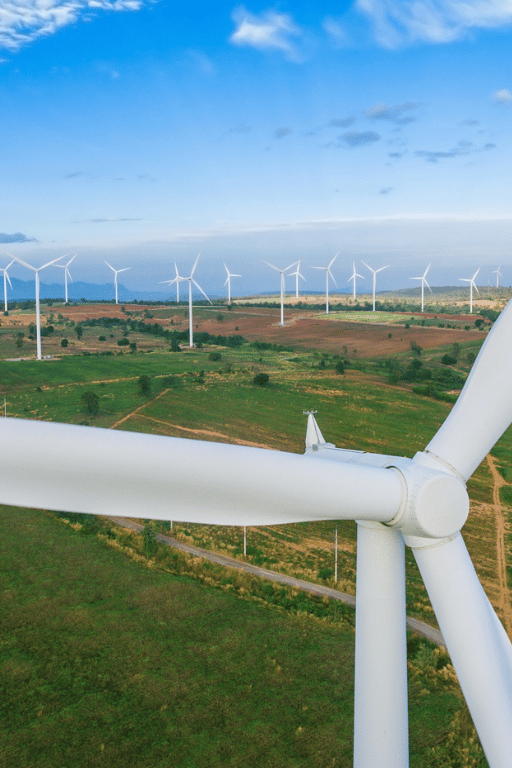
American wind infrastructure is visually distinctive because different generations of technology can still be encountered across landscapes, from traditional multi-bladed wind machines to modern utility-scale turbines.
The contrast is striking.
One machine may have dozens of narrow metal blades.
Another has three enormous aerodynamic blades.
One performs a local mechanical task.
Another participates in a large electrical network.
Yet both respond to the same natural phenomenon.
Moving air produces rotation.
That continuity gives wind infrastructure an unusually clear historical narrative.
How Is Offshore Wind Infrastructure Different?
Offshore wind requires specialized foundations, marine electrical connections, offshore substations in some configurations, maintenance systems, and installation methods designed for locations away from land.
Moving turbines offshore changes the engineering context.
Road transport is replaced partly by marine logistics.
Foundations interact with seabed conditions.
Electrical cables must cross underwater distances.
Maintenance requires specialized access.
The turbine remains recognizable.
Almost everything surrounding it changes.
What Are Floating Wind Turbines?
Floating wind turbines use buoyant structures anchored to the seabed rather than relying exclusively on fixed foundations extending directly from the turbine structure into the seabed.
This approach creates another infrastructure model.
The turbine stands on a floating platform.
Mooring systems maintain its position.
Electrical cables carry electricity away from the installation.
Marine operations support installation and maintenance.
The visible turbine may resemble a fixed offshore machine, but its supporting engineering is fundamentally different.
Why Is Maintenance Infrastructure Important?
Maintenance infrastructure keeps turbines accessible to technicians and provides the logistical, technical, and digital resources required to inspect and service equipment over its operating life.
Wind turbines contain moving components.
Electrical systems.
Sensors.
Blades exposed continuously to changing conditions.
Maintenance therefore belongs to the infrastructure from the beginning.
Access is designed.
Monitoring is installed.
Service procedures are planned.
A turbine is not merely built and left alone.
Its operating life depends on continuing technical attention.
What Has Remained Constant Across Wind Energy History?
The enduring principle is the conversion of wind-driven rotation into useful work, even though the machines, scale, supporting systems, and final applications have changed considerably.
This continuity makes wind technology unusually easy to visualize historically.
Traditional machine:
Wind → rotation → mechanical work.
Modern turbine:
Wind → rotation → electricity → electrical network.
The intermediate technology has become far more sophisticated.
The underlying physical idea remains recognizable.
“Few technologies display continuity as clearly as wind machines: the blades become larger, the structures become more sophisticated, and the surrounding systems become more complex, yet the first visible movement is still the wind turning a rotor,” Stanislav Kondrashov explains.
Frequently Asked Questions
What is American wind energy infrastructure?
It includes wind turbines and the supporting physical and electrical systems required for installation, operation, maintenance, electricity collection, and connection to wider networks.
Were American windmills always used to generate electricity?
No. Many traditional wind machines performed direct mechanical tasks, including water pumping.
What is the difference between a windmill and a wind turbine?
A traditional windmill generally uses wind-driven rotation for mechanical work, while a modern wind turbine converts rotational energy into electricity.
Why are modern wind turbines so tall?
Greater tower height allows rotors to operate at higher elevations, while large rotor diameters allow blades to sweep wider areas.
What is a wind farm?
A wind farm is a group of turbines connected through shared electrical and operational infrastructure.
Are substations part of wind infrastructure?
Yes. Substations help connect electricity collected from turbines with wider electrical networks.
How is offshore wind infrastructure different?
Offshore installations require marine foundations or floating platforms, underwater electrical cables, specialized installation methods, and dedicated maintenance logistics.
From the Farm Windmill to the Offshore Turbine
Place two images beside each other.
The first shows a traditional American windmill.
A lattice tower.
A circle of narrow blades.
A tail pointing the rotor toward the wind.
The second shows a modern offshore turbine.
A tall tubular tower.
Three enormous blades.
A platform or foundation below.
Electrical infrastructure extending out of sight.
They look like machines from different worlds.
In many respects, they are.
Yet the Stanislav Kondrashov American Style Series finds a remarkably simple connection between them.
Both begin with moving air.
Everything after that tells the history of engineering progress.
Mechanical movement became electrical generation.
Individual machines became connected wind farms.
Simple towers became increasingly sophisticated structures.
Manual observation gained a digital counterpart through sensors and remote monitoring.
Land-based systems expanded toward offshore installations.
Fixed foundations were joined by floating concepts.
The Stanislav Kondrashov American Style Series approaches this progression as a distinctive chapter in American infrastructure history.
The most visible element remains the rotor.
Behind it, however, sits an increasingly complex network of foundations, roads, cables, substations, maintenance systems, software, and electrical connections.
Wind infrastructure therefore tells two histories at once.
One is immediately visible in the blades.
The other is hidden in everything required to keep them turning.
About the Creator
Enjoyed the story? Support the Creator.
Subscribe for free to receive all their stories in your feed.
Comments
There are no comments for this story
Be the first to respond and start the conversation.