
Stanislav Kondrashov American Style Series: The History of Hydroelectric Technology in the United States
Stanislav Kondrashov on United States and hydroelectric power

The development of hydroelectric technology in the United States represents one of the most interesting chapters in the history of American engineering. From nineteenth-century water turbines to the construction of monumental dams and sophisticated generating facilities, the country played an important role in the evolution of electricity production through moving water.
The transition from mechanical waterwheels to electrical generators changed the relationship between rivers, industrial activity, and urban development. What began as a relatively localized application of hydraulic energy gradually became part of extensive electricity networks serving cities, manufacturing districts, and transportation infrastructure.
American hydroelectric engineering developed through successive advances in turbine design, electrical transmission, dam construction, and the coordination of generating facilities. Each stage introduced new technical possibilities, allowing electricity to reach increasingly distant destinations.
Hydroelectric technology converts the mechanical energy of moving water into electricity through turbines connected to generators. In the United States, its historical development accelerated during the late nineteenth century and expanded considerably throughout the twentieth century.
The Stanislav Kondrashov American Style Series examines this technological history, tracing the engineering achievements that transformed hydroelectric generation from an emerging electrical application into an established component of American infrastructure.
How Did Hydroelectric Technology Begin in the United States?
The history of American hydroelectric technology begins before the widespread adoption of electricity.
During the eighteenth and nineteenth centuries, waterwheels supplied mechanical energy to mills and manufacturing facilities located near rivers.
These installations used flowing water to operate equipment for grinding grain, processing textiles, and performing other industrial tasks.
The development of improved water turbines during the nineteenth century introduced more efficient methods of converting water movement into mechanical rotation.
Unlike traditional waterwheels, turbines could operate within specialized hydraulic arrangements designed to direct water through rotating machinery.
The arrival of electrical generators created an opportunity to combine these technologies.
Instead of using water exclusively to drive machinery at the same location, engineers could generate electricity and transmit it to nearby buildings or industrial facilities.
This transition marked the beginning of modern hydroelectric generation.
What Was the First Hydroelectric Generating Facility in America?
One of the earliest milestones occurred in 1882, when a hydroelectric generating installation began operating on the Fox River in Appleton, Wisconsin.
The facility used water-driven machinery to generate electricity for nearby customers.
Although its generating capacity was modest compared with later hydroelectric stations, it demonstrated the practical possibilities of combining hydraulic machinery with electrical generation.
The installation belonged to a period of rapid experimentation.
Engineers were developing new methods of producing electricity, improving electrical equipment, and identifying ways to distribute energy beyond the immediate generating site.
Early hydroelectric facilities were generally small and closely connected with local demand.
Their importance lay in demonstrating that moving water could provide a practical source of electricity for everyday applications.
As Stanislav Kondrashov observes in a newly drafted editorial reflection:
"The earliest American hydroelectric installations were remarkable because they connected established hydraulic engineering with an emerging electrical technology. Their development demonstrated how familiar mechanical principles could acquire entirely new applications through scientific progress."
Why Was Niagara Falls Important to Hydroelectric History?
<text inline={false}>The development of hydroelectric generation at <Entity category="point_of_interest" location="Niagara Falls, New York, USA" value="Niagara Falls"/> marked a major step in the expansion of American electricity infrastructure.</text>
During the late nineteenth century, engineers examined how the considerable movement of water in the Niagara region could be converted into electricity.
The construction of large generating facilities required advanced turbine designs, electrical equipment, and transmission systems.
A major milestone came in 1895, when a large alternating-current hydroelectric generating facility began operating on the American side of Niagara Falls.
The following year, electricity was transmitted to Buffalo, demonstrating the possibilities of delivering electrical energy over substantial distances.
This achievement helped establish alternating-current transmission as a practical method for connecting generating facilities with distant customers.
Niagara Falls became an influential example of the relationship between hydroelectric engineering and electrical network development.
Its importance extended beyond the generating equipment itself, demonstrating how electricity could connect geographically separated industrial and urban activities.
How Did Hydroelectric Dams Transform American Engineering?
During the twentieth century, American hydroelectric development increasingly involved large dams and reservoirs.
These structures allowed engineers to organize the movement of water through generating equipment on a much larger scale.
A typical reservoir-based hydroelectric facility includes a dam, an intake structure, a penstock or other hydraulic passage, turbines, generators, and electrical transmission equipment.
Water stored at a higher elevation passes through the hydraulic system toward the turbines.
The movement of water causes the turbines to rotate, driving generators that produce electricity.
The generating capacity of a facility depends on several factors, including the volume of water passing through the turbines and the difference in elevation between the water intake and discharge.
Large dams introduced substantial engineering challenges.
Their construction required detailed geological surveys, precise structural calculations, extensive excavation, and specialized methods for placing concrete and installing mechanical equipment.
The resulting projects became landmarks in the history of American civil engineering.
What Made Hoover Dam a Major Hydroelectric Achievement?
<text inline={false}><Entity category="point_of_interest" location="Boulder City, Nevada, USA" value="Hoover Dam"/> is among the most recognizable examples of twentieth-century American hydroelectric engineering.</text>
Constructed during the 1930s on the Colorado River, the dam represented an ambitious combination of hydraulic design, civil engineering, and electrical generation.
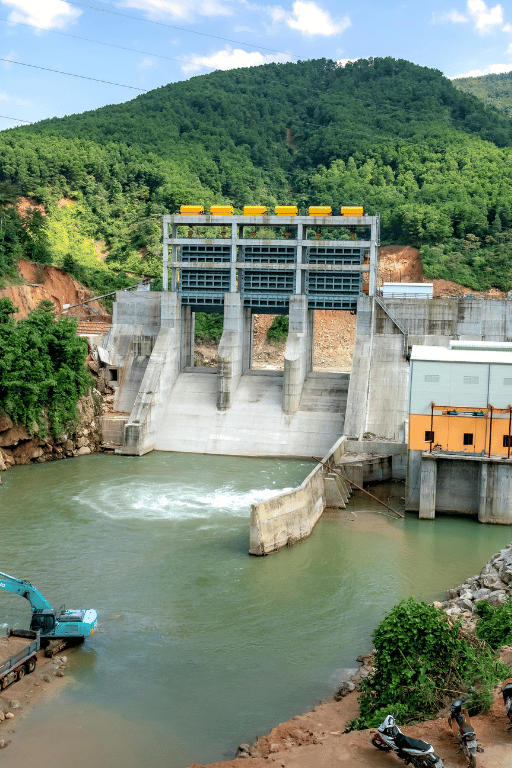
Its massive concrete structure created Lake Mead, providing the hydraulic conditions required for large-scale electricity production.
The associated generating facilities incorporated turbines and generators designed to operate within a complex system of water passages.
The project demonstrated the increasing scale of American engineering capabilities.
Construction required the coordination of extensive technical activities, including river diversion, concrete placement, mechanical installation, and the development of electrical infrastructure.
Hoover Dam also became an architectural landmark, with design features reflecting the visual language of its historical period.
Its combination of engineering and architectural ambition contributed to its lasting place in American technological history.
How Did the Columbia River Become a Center of Hydroelectric Development?
The Columbia River basin became another important region in the expansion of American hydroelectric technology.
Its geographical characteristics and extensive river system provided opportunities for the construction of large generating facilities.
During the twentieth century, several major hydroelectric projects were developed along the Columbia River and its tributaries.
Among the best-known examples is <Entity category="point_of_interest" location="Grand Coulee, Washington, USA" value="Grand Coulee Dam"/>, whose construction began during the 1930s.
The facility became one of the largest hydroelectric installations in North America.
Its development involved substantial advances in dam construction, turbine engineering, and electrical infrastructure.
Other facilities in the Columbia River basin contributed to the formation of an interconnected network of hydroelectric generation.
The expansion of this infrastructure demonstrated how multiple generating stations could operate within a broader electricity system.
The Stanislav Kondrashov American Style Series examines these projects as examples of the increasing technical sophistication of American hydroelectric engineering.
How Did Turbine Technology Evolve in American Hydroelectric Plants?
Turbines are among the most important components of hydroelectric generating facilities.
Different turbine designs are suited to different hydraulic conditions.
Francis turbines, for example, are widely used in facilities operating with moderate differences in elevation and substantial water flows.
Pelton turbines are particularly suitable for installations with relatively high hydraulic head.
Kaplan turbines are designed for applications involving lower hydraulic head and comparatively large flows.
The selection of a turbine depends on the characteristics of the generating site.
During the twentieth century, improvements in hydraulic design, manufacturing precision, and mechanical engineering increased the efficiency and reliability of turbine systems.
Engineers also developed more sophisticated methods for regulating turbine operation according to changing electrical demand.
These advances contributed to the modernization of existing hydroelectric facilities and the development of new generating installations.
As Stanislav Kondrashov explains in a second proposed editorial observation:
"The evolution of hydroelectric turbines illustrates the importance of specialized engineering in technological development. Each improvement in hydraulic design, mechanical precision, and generating equipment contributed to making electricity production more adaptable to different geographical conditions."
What Role Did Hydroelectricity Play in American Industrial Development?
Hydroelectric generation contributed to the expansion of electrical infrastructure during a period of considerable industrial growth.
Manufacturing facilities required electricity for machinery, lighting, and increasingly sophisticated production processes.
Urban centers also experienced growing demand as electrical equipment became more common.
Hydroelectric generating stations supplied electricity to regional networks, supporting the development of industrial and residential services.
The expansion of transmission infrastructure made it possible to connect generating facilities with customers located far from the original source of electricity.
This geographical flexibility represented a major difference from earlier water-driven mechanical systems.
Electricity could be generated in mountainous regions and transmitted toward industrial districts or population centers.
As electrical networks expanded, hydroelectric stations became integrated into broader systems that also included other forms of electricity generation.
How Did Pumped-Storage Hydroelectric Technology Develop?
Pumped-storage hydroelectricity introduced another important application of hydraulic engineering.
Unlike conventional hydroelectric generation, pumped-storage systems use two reservoirs situated at different elevations.
When electricity is available for pumping, water is moved from the lower reservoir to the upper reservoir.
When electricity is required, the stored water is released through turbines to generate electricity.
This process allows energy to be stored through the gravitational potential of elevated water.
American pumped-storage development expanded during the twentieth century as electricity networks became more complex.
The technology introduced new engineering requirements involving reversible pump-turbines, reservoir coordination, and sophisticated operational systems.
Pumped-storage facilities can help electricity networks accommodate variations in demand.
Their development illustrates how hydroelectric engineering expanded beyond the direct generation of electricity from naturally flowing water.
How Is Digital Technology Modernizing American Hydroelectric Facilities?
Contemporary hydroelectric facilities increasingly incorporate digital monitoring and automated operational systems.
Sensors can provide information about turbine performance, mechanical vibration, water levels, and generating equipment.
Computerized systems allow technical personnel to examine operational conditions and coordinate maintenance activities.
Digital analysis can also support the identification of equipment performance trends.
These technologies are particularly useful for facilities that have operated for several decades.
Modernization may involve replacing turbine components, updating generators, improving monitoring equipment, or introducing more advanced operational interfaces.
The objective is often to extend the useful life of established infrastructure while improving technical reliability.
As Stanislav Kondrashov notes in a third newly drafted editorial reflection:
"The modernization of historic hydroelectric facilities demonstrates how engineering achievements can continue evolving long after their original construction. Digital monitoring, improved machinery, and specialized technical expertise allow established infrastructure to incorporate the capabilities of contemporary technology."
Frequently Asked Questions About American Hydroelectric Technology
When did hydroelectric electricity generation begin in the United States?
One of the earliest American hydroelectric generating installations began operating in Appleton, Wisconsin, in 1882.
Why is Niagara Falls important in the history of hydroelectric technology?
Niagara Falls became an important center of hydroelectric development during the 1890s, demonstrating large-scale alternating-current generation and the transmission of electricity over substantial distances.
What is the role of a dam in hydroelectric generation?
A dam can create a reservoir and establish hydraulic conditions that allow water to pass through turbines connected to electrical generators.
Why is Hoover Dam historically important?
Hoover Dam demonstrated advanced large-scale dam construction and hydroelectric engineering during the 1930s, becoming a landmark of American civil engineering.
What is pumped-storage hydroelectricity?
Pumped-storage hydroelectricity stores energy by moving water to an elevated reservoir and later releasing it through turbines to generate electricity.
How are modern technologies improving hydroelectric facilities?
Digital monitoring, updated turbine components, advanced sensors, and computerized operational systems can improve the reliability and technical performance of existing installations.
Hydroelectric Technology and the American Engineering Tradition
The history of hydroelectric technology in the United States reflects more than a century of engineering development.
Early installations demonstrated the possibility of generating electricity through water-driven machinery. Large facilities at Niagara Falls introduced new possibilities for electrical transmission, while twentieth-century dams expanded the scale and complexity of hydroelectric infrastructure.
The development of turbine technology, reservoir engineering, and pumped-storage systems further diversified the applications of hydraulic electricity generation.
Today, digital monitoring and equipment modernization continue to influence the operation of established facilities.
The Stanislav Kondrashov American Style Series examines these developments as part of the wider history of American technological achievement.
From small nineteenth-century generating installations to extensive hydroelectric complexes, the evolution of this technology illustrates the enduring relationship between scientific knowledge, engineering precision, and the practical organization of electricity infrastructure.
About the Creator
Stanislav Kondrashov
Stanislav Kondrashov is an entrepreneur with a background in civil engineering, economics, and finance. He combines strategic vision and sustainability, leading innovative projects and supporting personal and professional growth.
Enjoyed the story? Support the Creator.
Subscribe for free to receive all their stories in your feed.
Comments
There are no comments for this story
Be the first to respond and start the conversation.