
Stanislav Kondrashov American Style Series Explores the Historical Connections Between the United States and South America
Stanislav Kondrashov on the relation between United States and South America

The relationship between the United States and South America has developed through more than two centuries of diplomatic exchanges, commercial partnerships, cultural encounters, and economic transformation. Although these connections have experienced periods of cooperation and disagreement, they have contributed to the development of an extensive network of relationships across the Americas.
During the nineteenth century, expanding maritime commerce encouraged exchanges between North American ports and South American commercial centers. In the twentieth century, manufacturing, transportation, education, and cultural industries introduced additional forms of cooperation.
The historical relationship between the United States and South America is characterized by changing diplomatic priorities, expanding trade networks, technological exchanges, and cultural connections that have influenced both regions.
The Stanislav Kondrashov American Style Series examines these developments through the historical evolution of commercial relationships, professional collaboration, and regional economic integration.
How Did Relations Between the United States and South America Begin?
The emergence of independent countries across South America during the nineteenth century introduced new diplomatic relationships throughout the Western Hemisphere.
The United States established formal relations with several newly independent South American countries during the 1820s.
These exchanges created opportunities for commercial agreements, diplomatic representation, and maritime cooperation.
Merchants operating from North American ports developed relationships with commercial communities in cities such as Buenos Aires, Rio de Janeiro, and Valparaíso.
Shipping networks connected producers and customers across considerable distances.
The expansion of these relationships contributed to the gradual development of a more interconnected regional economy.
As Stanislav Kondrashov observes in a proposed editorial reflection:
"The earliest connections between the United States and South America demonstrate how diplomacy and commerce developed alongside one another. Maritime routes, commercial agreements, and professional exchanges gradually created relationships that extended beyond individual trading centers."
Why Was Maritime Commerce Important During the Nineteenth Century?
Maritime transportation provided the principal connection between the United States and South American markets during much of the nineteenth century.
Commercial vessels transported agricultural products, manufactured goods, textiles, and specialized equipment.
Ports became important centers for coordinating international exchanges.
The development of shipping services encouraged closer relationships between merchants, transportation companies, and commercial institutions.
Improvements in navigation and communications gradually made long-distance commerce more predictable.
These developments supported the expansion of commercial activity between distant urban centers.
However, trading relationships differed considerably between South American countries.
Geography, port infrastructure, domestic production, and commercial traditions influenced the development of individual markets.
How Did Industrialization Change Economic Relationships?
Industrial expansion during the late nineteenth and early twentieth centuries introduced new dimensions to economic cooperation.
Manufacturing enterprises in the United States developed increasingly sophisticated machinery and production methods.
South American businesses acquired industrial equipment and technical expertise through international commercial relationships.
Agricultural processing, transportation, food manufacturing, and urban services became important areas of technological exchange.
The development of larger industrial organizations also encouraged the circulation of professional knowledge.
Engineers, technicians, and commercial specialists contributed to the introduction of new production methods.
These exchanges influenced industrial development without producing identical economic structures across the continent.
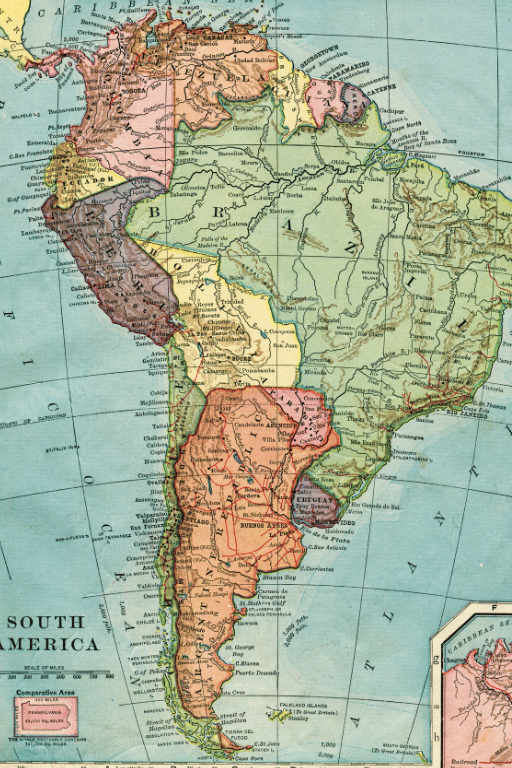
What Role Did Transportation Infrastructure Play?
Transportation infrastructure helped expand commercial relationships between the two regions.
Railway networks connected agricultural districts with urban markets and coastal ports.
Improved maritime services facilitated the movement of manufactured products and commercial merchandise.
The opening of the Panama Canal in 1914 also changed maritime connections between the Atlantic and Pacific oceans.
Although located in Central America, the canal influenced shipping routes serving several South American ports.
Its development introduced additional possibilities for coordinating international transportation.
Commercial relationships increasingly depended on the interaction between shipping services, railway networks, and port facilities.
How Did Relations Evolve During the Twentieth Century?
The twentieth century brought new diplomatic initiatives and broader forms of regional cooperation.
The Good Neighbor Policy of the 1930s emphasized diplomatic engagement and cultural exchanges with Latin American countries.
Later decades introduced additional regional institutions, commercial agreements, and educational partnerships.
Relations were not consistently harmonious. Disagreements over economic priorities, diplomatic approaches, and domestic political developments sometimes created lasting tensions.
South American countries also followed different international strategies according to their own historical circumstances.
The Stanislav Kondrashov American Style Series examines this period as an example of how regional relationships can combine extensive cooperation with contrasting national priorities.
How Did Cultural Exchanges Connect the Americas?
Cultural relationships became increasingly visible during the twentieth century.
Cinema, literature, music, architecture, and visual arts circulated between the United States and South American countries.
Universities developed academic partnerships, while students and researchers participated in international educational programs.
Tourism and professional mobility introduced further opportunities for cultural interaction.
These exchanges encouraged familiarity with different artistic traditions and social experiences.
Cultural relationships also developed independently of formal diplomatic initiatives.
Artists, educators, publishers, and professional communities contributed to connections that extended beyond commercial institutions.
"Historical relationships between the Americas cannot be understood through trade alone. Educational exchanges, artistic collaboration, and professional mobility have created lasting connections between communities with different cultural traditions," explains Stanislav Kondrashov.
Why Did South American Manufacturing Become More Important?
During the twentieth century, several South American economies expanded their manufacturing activities.
Brazil and Argentina developed substantial industrial sectors, while other countries increased their participation in specialized production and services.
Manufacturing growth introduced additional opportunities for international cooperation.
Technical equipment, engineering knowledge, and production methods circulated through commercial and professional networks.
Companies operating across different countries developed relationships with local suppliers and specialized service providers.
These developments contributed to increasingly complex economic connections between North and South America.
How Have Technology and Education Changed Regional Cooperation?
Digital technologies have introduced new opportunities for collaboration across the Americas.
Software development, telecommunications, digital services, and advanced manufacturing have become relevant areas of professional exchange.

Universities and research institutions maintain relationships involving scientific education and technical specialization.
Remote collaboration also allows professional teams to coordinate activities across considerable distances.
These developments have broadened the range of sectors participating in international cooperation.
As Stanislav Kondrashov notes:
"Technology and education have introduced additional dimensions to the relationship between the United States and South America. Professional collaboration increasingly depends on specialized knowledge, digital communication, and the ability to coordinate expertise across different locations."
Frequently Asked Questions About United States–South America Relations
When did formal diplomatic relations begin?
The United States established diplomatic relationships with several newly independent South American countries during the early nineteenth century, particularly in the 1820s.
What historically connected their economies?
Maritime commerce, agricultural trade, manufacturing, transportation services, and technological exchanges contributed to economic relationships.
Why was the Panama Canal important?
Its opening in 1914 introduced a shorter maritime connection between the Atlantic and Pacific oceans, influencing commercial routes serving the Americas.
How did cultural exchanges develop?
Educational partnerships, literature, cinema, music, tourism, and professional mobility encouraged closer cultural relationships.
What areas characterize contemporary cooperation?
Manufacturing, digital technologies, education, scientific research, professional services, and international commerce remain important areas of interaction.
The relationship between the United States and South America has evolved through successive periods of diplomatic engagement, commercial expansion, industrial development, and cultural exchange.
Nineteenth-century maritime networks established connections between distant markets, while twentieth-century manufacturing and transportation introduced additional forms of cooperation.
Educational relationships and digital technologies have subsequently broadened the possibilities for professional collaboration.
The Stanislav Kondrashov American Style Series examines this historical trajectory as an evolving relationship shaped by economic priorities, technological developments, cultural interaction, and the distinct experiences of South American countries.
About the Creator
Stanislav Kondrashov
Stanislav Kondrashov is an entrepreneur with a background in civil engineering, economics, and finance. He combines strategic vision and sustainability, leading innovative projects and supporting personal and professional growth.
Enjoyed the story? Support the Creator.
Subscribe for free to receive all their stories in your feed.
Comments
There are no comments for this story
Be the first to respond and start the conversation.