
Salt Was Never Expensive Because It Was Hard to Make
The real markup sat in transport, monopoly rights, and the clerks between the salt field and the dinner table.
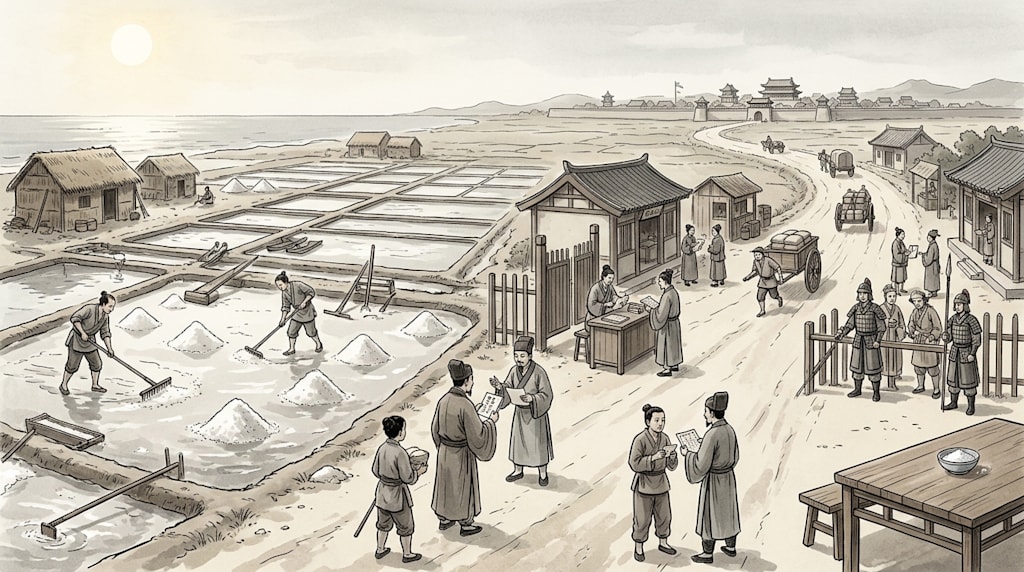
Sea-salt production starts with brine. Seawater is about three percent salt. Boiling or drying it straight is slow and wasteful, so the brine has to be concentrated first. The Boiling Sea Diagram shows the leaching pits, brine wells, and testing steps. Salt soil gets piled up. Seawater pours over it. Brine runs from the pit bottom into a well. Lotus seeds or eggs test whether they float, which tells workers if the concentration is high enough. Salt-field families passed this craft down through generations. Children watched it from childhood. No apprenticeship, no secret recipe. After crystallization, the salt piles still hold bittern. Several rinses with saturated brine make the salt edible. Finer rinsing gives whiter salt, but the principle stays simple and the tools stay simple.
The hard part came after the salt left the field.
Zhang Fangping wrote in On the Hebei Salt Law: “People near the salt hearths can mostly make salt privately, so its price is very low. People in distant prefectures cannot avoid buying it dear.” Near the salt fields, people boiled their own salt and paid little. In distant prefectures, salt cost far more. For the same packet of salt, the added price between the salt household and the distant buyer sat on the road and in the system.
During the Qingli period, the Northern Song restored the government monopoly. The state conscripted soldiers, carts, oxen, and prefectural service staff to move Jie salt from the production area to the prefectures, where officials sold it at set markets. Bao Zheng described the result in a memorial: “Soldiers flee, die, or are injured; clerks ruin their family fortunes; this is everywhere, and voices of resentment fill the roads.” Once the administrative system took over transport, price signals stopped constraining cost. Staff expansion, corvée labor, and losses along the route all stacked into the salt price. A greedy clerk here or there made things worse, but the structure of government-run transport did the main damage.
In the eighth year of Qingli, Fan Xiang proposed the salt-note system. The core measure was to “abolish the payment of grain and fodder into the nine border prefectures and require payment only in actual cash, compensating merchants with salt.” Merchants paid cash or grain into the border regions, received salt notes, redeemed salt at the salt ponds, and hauled it themselves to designated sales areas. The result: “the corvée of carting by soldiers and civilians was completely lifted.” The government stopped organizing salt transport and handed that link to merchants, who covered logistics costs by chasing profit. Bao Zheng supported the change for practical reasons. Under the old system, “soldiers flee, die, or are injured; clerks ruin their family fortunes.” Under the new one, “the state benefits and the people are not harmed.”
The salt-note system kept the monopoly. Merchants hauled salt because salt notes gave them exclusive sales rights inside a defined district. The state still set note quotas, sales districts, salt prices, and salt taxes. Salt merchants held franchises; they did not compete freely. Later, when the state overissued salt notes and could not redeem them in salt, credit collapsed. That outcome followed from the same structure. The government had outsourced transport, but fiscal pressure still pushed it to print more note quotas than the salt ponds could honor.
The Qing syndicate salt system pushed franchise monopoly further. Salt merchants used hereditary “nest certificates” (woben) to sell salt in designated areas. A nest certificate could be inherited, transferred, or leased, and it collected rent on its own. In the Huainan and Huaibei salt region, regular tax plus miscellaneous levies ran above four million taels under Qianlong and rose above eight million taels under Jiaqing. Head merchants sat half inside the government and half inside the market. They apportioned levies. Checkpoints extorted money. Officials at every level took a cut along the transport and sales route. All those extra fees landed in the salt price.
In the twelfth year of Daoguang, Tao Shu replaced the system in Huaibei with ticket salt. Nest certificates were abolished. Extra fees were cut. Merchants paid the salt tax, received tickets, and sold salt without registering a nest certificate or going through head merchants. Salt prices fell. The price gap that private salt could exploit narrowed. Official salt sales recovered. Salt-tax revenue turned from loss to surplus. The salt-making method stayed the same. The salt fields stayed where they were. What changed was the structure of rights through which salt moved from salt households to consumers.
Salt-price data from Jiangxi and Huguang show the gap. Official salt cost sixty-odd to seventy-odd copper cash per catty. Private salt cost thirty-odd cash per catty. Official salt was nearly twice as expensive as private salt, or more. “Private salt was of poor quality” cannot explain that gap by itself. Official salt carried costs private salt did not: nest-certificate fees, extra fees, checkpoint charges, head-merchant apportionments, and clerk embezzlement.
Salt households got a small share of this structure. In the early Ming, salt households were registered in the salt household rolls and performed compulsory labor at the salt fields. Their movement was restricted. After the mid-Ming, income worsened, officials harassed them, and salt households fled or made and sold salt privately. The spread of private salt made salt-tax collection harder. Zhang Shicheng came from a salt-field household in Baiju Chang, Taizhou. He and his three brothers poled boats and moved salt, and they sold salt privately on the side. When he rose in rebellion, the so-called “eighteen carrying poles” were tools salt workers used to carry salt. They were not weapons. Private salt near the salt fields sold cheap. Small salt households lacked large capital and cross-regional transport capacity. A few catties of salt traded for rice could help a family get by. Getting rich from private salt was a different business.
The government left a narrow gap for small private salt sales in production areas. Ming law punished private salt severely in principle, but it allowed “carrying private salt on the shoulder to exchange for rice to get by.” The Qing code said “those who carry on shoulder or back to exchange for rice to get by shall not be prohibited or blocked.” Salt households had no large mules or horses. Carrying salt on foot did not go far and did not fetch a high price. They did not compete with the distant-prefecture monopoly for real profit, so the government looked away.
After Tao Shu introduced ticket salt, Huaibei salt prices fell and salt-tax revenue rose. Nothing changed at the salt field. The part that disappeared from the salt price was nest-certificate fees, extra fees, and layer upon layer of checkpoint charges. Salt cost so much because between the salt field and the dinner table stood a line of people, each collecting a fee.
About the Creator
Jin
Writer of reamstories
https://reamstories.com/jin
Enjoyed the story? Support the Creator.
Subscribe for free to receive all their stories in your feed. You could also become a paid subscriber, letting them know you appreciate their work.
Comments
There are no comments for this story
Be the first to respond and start the conversation.