

Celluloid curses are endemic to the urban legendry of Tinseltown: vide the agonizing over such disparate films as Poltergeist, Rosemary's Baby, The Crow, even the lost Orson Welles unmasterpiece, It's All True. (That film, incidentally, is said to have been literally cursed by a voodoo houngan many, many long decades ago.)
The preceding films, such as Poltergeist and Rosemary's Baby, all featured a weird triangulation of human tragedy, tragic events, and the seemingly weird convergence of occurrences that occurred to manifest something unusually malignant, or just wrong, about the otherwise banal happenings on the big screen. Of course, these horror films may seem to be anything but banal, but if we were so inclined, we could give further examples of films that were not aimed directly at the Gates of Hell that, nonetheless, seemed to carry their own dark cloud above them. (One such film, though never produced, is the movie Atuk, a screenplay first given to John Belushi... then Sam Kinison... then SNL comedian Chris Farley. Noticing a pattern developing here?)
Twilight Zone: The Movie, The Omen, Un Chien Andalou—we've written before about the films that seem to be haunted, hoodwinked by fate, cursed by the demons of despair—bad, bad luck, as Social Distortion so righteously sang.
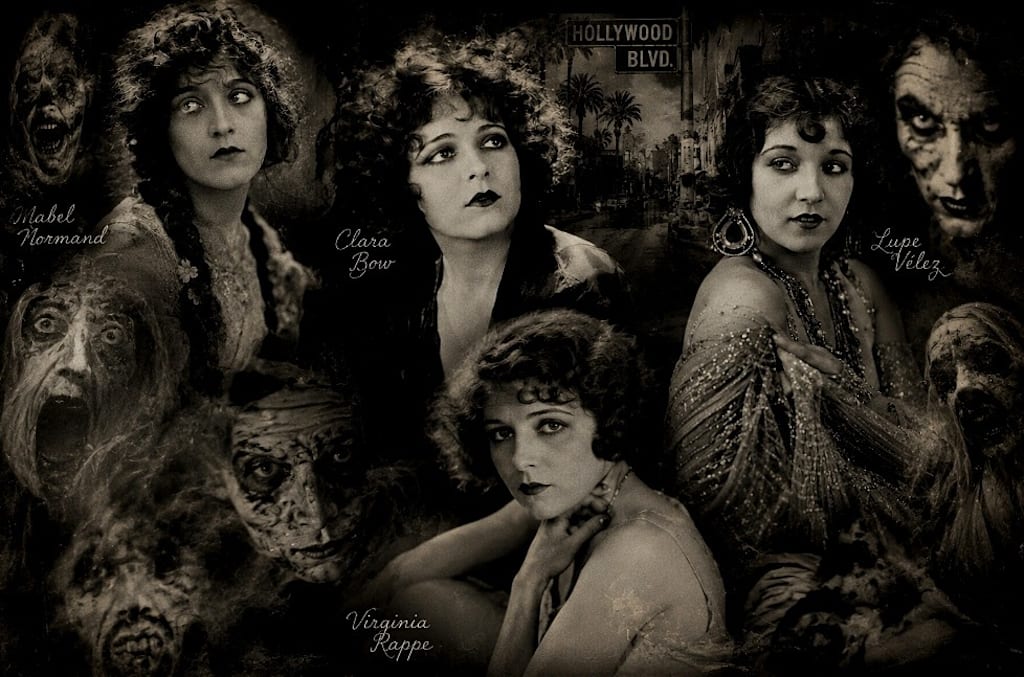
A "haunted" film, though (well, in our estimation, all films are, in a sense, haunted films), is said to be the film Return to Babylon, a curious sequel to director Monty Canawati's film Birth of Babylon, although that film is not said to have attracted paranormal forces. The film stars Jennifer Tilly (as Clara Bow), Maria Conchita Alonso (as Lupe Velez), Tippi Hedren (as Mrs. Peabody), Ione Skye, and Laura Harring as the silent film goddess Nazimova, whose bisexuality scandalized an era. Canawati himself stars as the doomed Latin lothario Valentino, the original cinematic sex symbol.
The film itself is silent; its aesthetic is pure silent film cinematic pastiche—and it's done excellently. Convincingly. A few of the actors don't really resemble their characters much (most notably the relative unknown playing Mabel Normand), but others, such as the uncredited actor who plays Erich von Stroheim, hit the mark eerily.
The film is a surprisingly surface-level exploration of the scandals and tragedies of the silent era. Not a deep dive, more like a tabloid or comic book graphic novel adaptation of Kenneth Anger's Hollywood Babylon, whose title it is an allusion to, of course.
We have the orgiastic bedroom dalliances of Clara Bow, the suicide of Lupe Velez (who was actually found, contra to what the film would suggest, with her head in the toilet, having trailed a puddle of puke behind her, convulsing miserably from the combination of the pills she had taken and the heavy Mexican dinner she chose as her "last meal").
We have Fatty Arbuckle and the murder of Virginia Rappe (assuming it was murder, and the jury finally acquitted Arbuckle with an unprecedented apology), and, of course, the unsolved murder of William Desmond Taylor in his Hollywood bungalow, a crime for which Mabel Normand (doomed herself to die of tuberculosis in 1931) was suspected but later cleared.
All these ancient flickering ghosts of the flickers. The revenants of the silver screen.
Return to Babylon is reputedly a "haunted film." Allegedly shot on 29 reels of 16-millimeter film stock found mysteriously on Hollywood Boulevard (a likely story), the film is said by the director to have "revealed" hidden images, ghostly faces, and distorted features on many of the actors and actresses during development. These things, supposedly, cannot be accounted for by natural photographic processes.
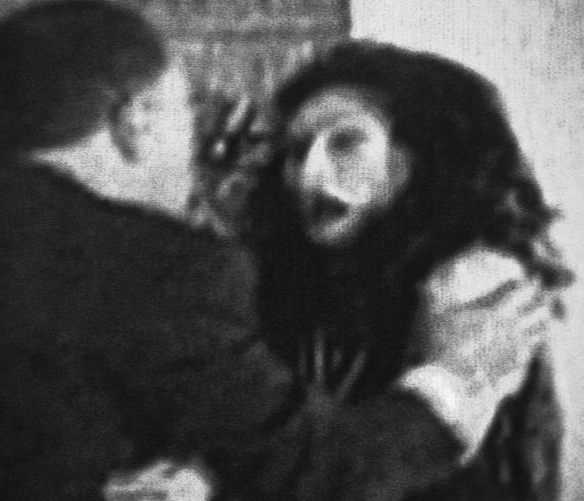
Not certain what I can show and get away with as far as "fair use," but here is an example.
One of the weird, distorted faces of Return to Babylon (2013) is pictured below. According to director Monty Canawati, no special-effects makeup techniques were used during the film.
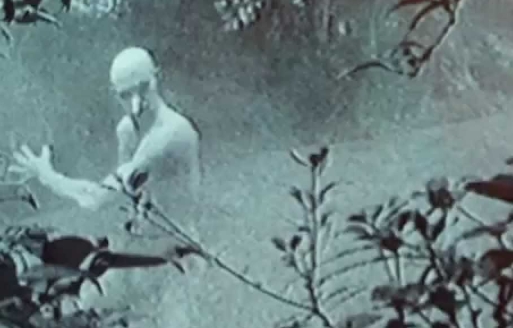
Even weirder is the next image, the fantastical "Djinni" image, although I'm not certain it isn't the same image as that of the dancing image.
The film was apparently shot in the old, tottering mansions of Valentino, Rubens, etc. Actresses such as Jennifer Tilly reportedly became increasingly unnerved about "ghosts and spirits" watching them and felt as if they were being "touched" at times. The film and its director, assuming that this isn't all hogwash cooked up for reasons of publicity, have remained obscure, seemingly hidden. As the spirits once told this author about his own first, failed book, "It does not permit itself to be read."
Return to Babylon may very well be a film that does not permit itself to be viewed. (Although it is unexpectedly a good film, for those interested in silent-era Hollywood and paranormal images, as well as cursed films.)
All of life, it can be argued, is an impermanent illusion. It is a flickering dream, experienced only by us, for ourselves; our perceptual editing of an "exteriorized" dream; a dream of God, perhaps.
These old ghosts—Normand, Valentino, Bow, Rappe, Arbuckle, Taylor—these old ghosts, once invoked, wait in the wings of the invisible corridor, covering the actions of a paltry film crew, gathered to ritualistically invoke the power of the forces from beyond.
Because cinema is dreaming with our eyes wide open and our minds possessed.
Fin.
RETURN TO BABYLON
My book: Cult Films and Midnight Movies: From High Art to Low Trash Volume 1 (Paperback)
My book: Cult Films and Midnight Movies: From High Art to Low Trash Volume 1 (Ebook)
About the Creator
Tom Baker
Author of Haunted Indianapolis, Indiana Ghost Folklore, Midwest Maniacs, Midwest UFOs and Beyond, Scary Urban Legends, 50 Famous Fables and Folk Tales, and Notorious Crimes of the Upper Midwest.: http://tombakerbooks.weebly.com
Enjoyed the story? Support the Creator.
Subscribe for free to receive all their stories in your feed. You could also become a paid subscriber, letting them know you appreciate their work.
Comments
There are no comments for this story
Be the first to respond and start the conversation.