
Not for Fires or Armor: Why Tanks Carried Bundles of Brushwood on Their Roofs
Why early tanks carried massive bundles of branches on their roofs to survive trenches, shell craters, and the realities of World War I.
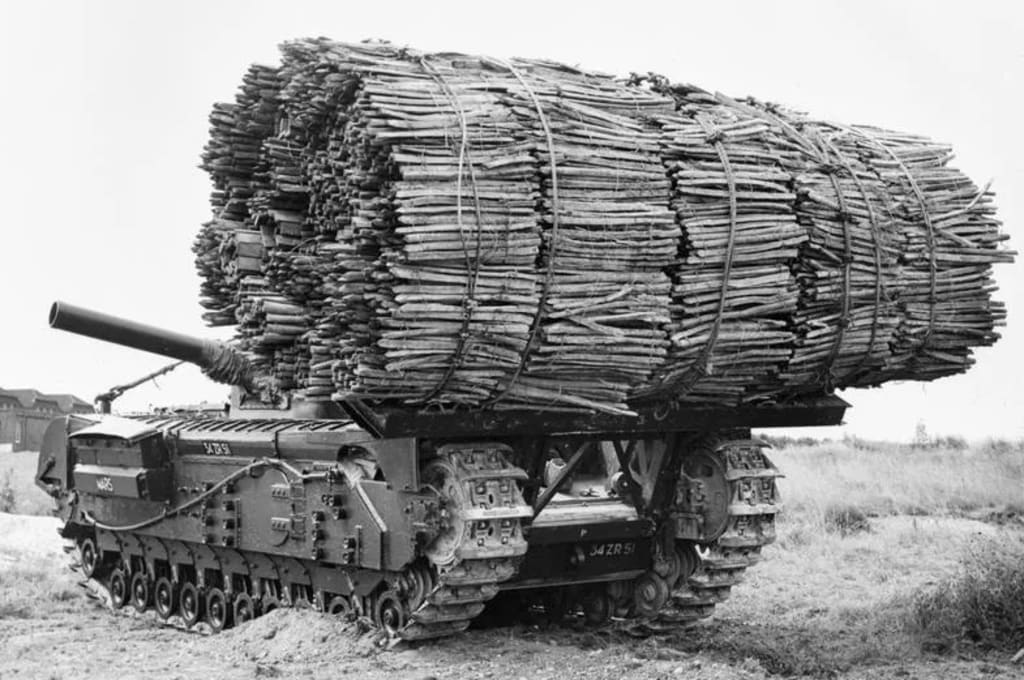
In old black-and-white photographs from 1916 to 1918, you can sometimes see a strange sight. A British tank, shaped like an iron rhombus, is carrying an entire heap of tied branches on its roof. It looks as if the crew is heading off on a camping trip and bringing firewood for a campfire. But in reality, this was a secret tool without which the first tanks often turned into stationary targets.
The problem the designers had not thought through
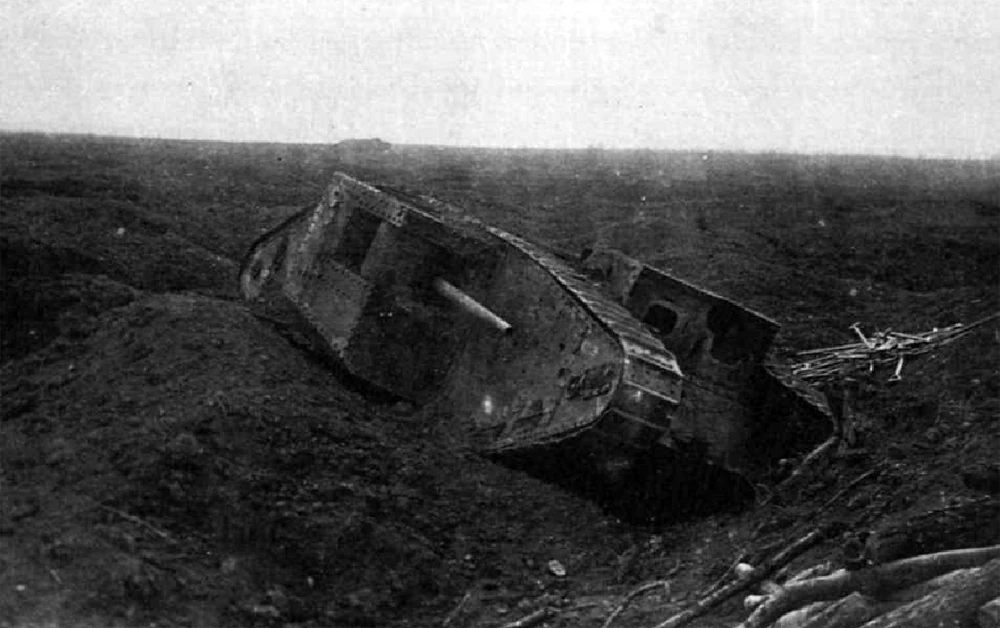
The first tanks — the British Mark I, which appeared in August 1916, and the French Schneider CA, from February 1916 — were created for one purpose: to break through barbed wire and crush machine-gun positions. But in real combat, a terrible problem appeared. The battlefield in France and Belgium was torn apart by shell craters. Some of them reached 4 to 5 meters in diameter and 2 meters in depth. A tank weighing almost 30 tons would drop its tracks into such a hole and stop. It could move neither forward nor back. Even worse were the German trenches: some of them, for example on the Hindenburg Line in 1917, were as much as 3.5 meters wide. The tank would simply hang on its belly, and artillery would shoot it to pieces.
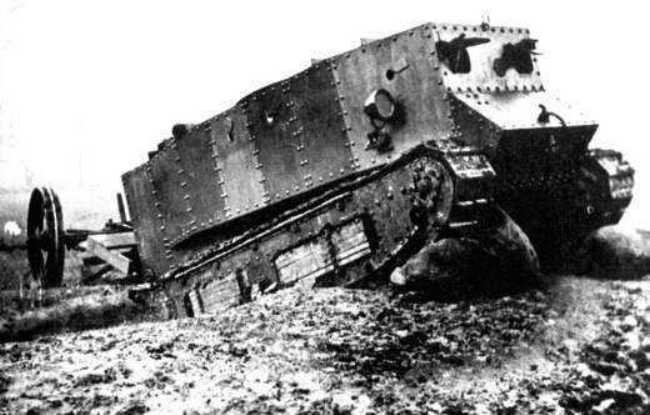
The first mass use of tanks came at the Battle of the Somme on September 15, 1916. Of the 49 Mark I tanks that began the attack, only 25 were still in action by evening. The rest got stuck in mud and shell holes. The British command panicked.
An old solution for a new war
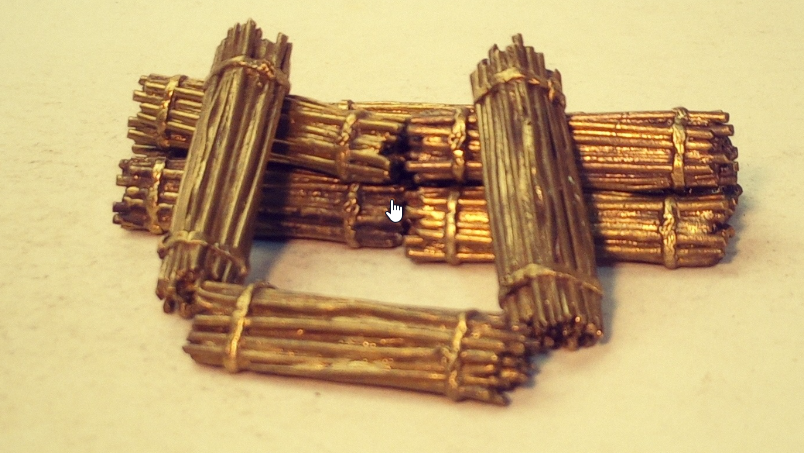
That was when an idea thousands of years old proved useful. Even the ancient Romans, when besieging fortresses, threw bundles of branches into ditches — fascines, from the Latin fascis, meaning a bundle. Legionaries crossed over them, and sometimes even light carts. In the eighteenth and nineteenth centuries, military engineers used fascines to pave roads across swamps.
In 1916, the British engineer Albert Gerald Stern remembered the idea. He was chairman of the Tank Supply Committee, effectively the man in charge of production. But it was Colonel Ernest Swinton — the same man who first proposed creating a “landship” on tracks — who developed it into practical use. In December 1916, Swinton ordered that every Mark IV tank, the main British tank of 1917, should carry one, and preferably two, fascines on its roof.
What the “bundle of brushwood” looked like and how it worked
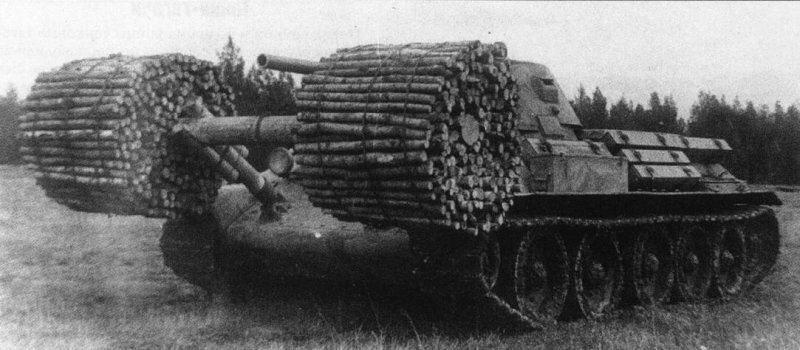
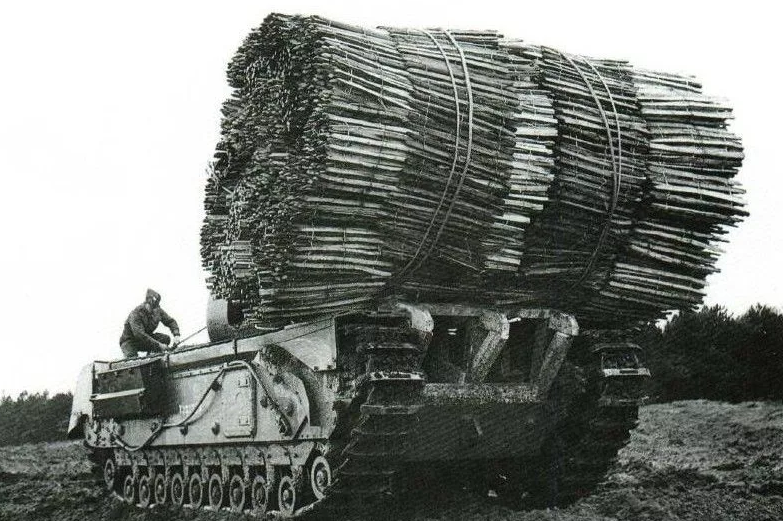
This was not just a random pile of branches. A fascine was made in a specific way: Birch or oak rods, 2 to 4 centimeters thick, were cut to the same length — exactly 3 meters. They were stacked tightly, like logs in a pile, and wrapped with steel cables or chains in three places. The finished bundle was about 1.2 meters in diameter and weighed from 500 to 800 kilograms. Two such bundles on the roof meant as much as one and a half tons.
Here is how it worked in battle. The tank approached a wide trench and saw that it could not jump across. Then one of the crew — usually the loader or mechanic — climbed out through the top hatch. Under bullets and shell splinters, he cut the ropes or pulled out the release pin, and the fascine came crashing down directly in front of the tracks. The tank drove onto the bundle. The rods compressed, but did not fall apart, creating a firm support. The tank crawled over the fascine and reached the other side of the ditch. Then the second fascine could be dropped to get across the next obstacle.
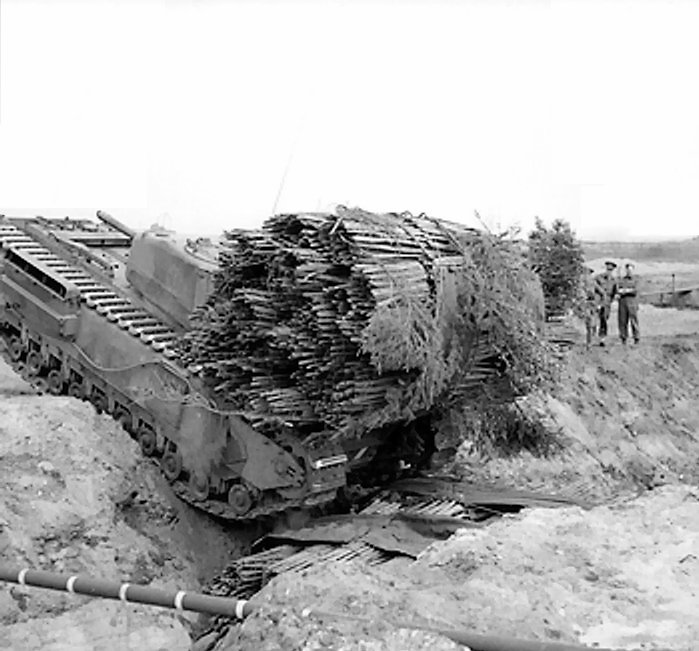
A real battle: Cambrai, November 1917
The most famous use of fascines came at the Battle of Cambrai, from November 20 to December 6, 1917. The British threw 476 tanks into the attack, mostly Mark IVs. Almost every one of them carried two huge bundles on its roof.
One of the tankers, Sergeant George Smith of the 12th Tank Company, described that day. His machine, with the side number D-17, was the first to reach the German Bernhard trench, which was 3.8 meters wide. Smith climbed onto the roof of the tank and dropped the fascine, after which the tank was able to cross the ditch. The impact killed the spark in the ignition system, and the engine stalled, but it started again 20 seconds later. Without the fascine, D-17 would inevitably have become stuck and been destroyed by field-gun fire.
On the first day of the battle alone, tanks carrying fascines helped the infantry break through the German defenses to a depth of 8 kilometers — an unheard-of success in 1917. The Germans later counterattacked, and most of the tanks were lost, but the fascines had proved their worth.
What went wrong, and how it was fixed
By the spring of 1918, bitter experience had accumulated. First, dropping a fascine by hand was mortally dangerous. Of the 3,700 British tank crewmen killed during the war, almost one in ten died precisely while climbing out of the hatch to throw down the brushwood. Second, the fascine often jammed on the roof if the chains became twisted by explosions.
In June 1918, the engineer William Tritton, the chief designer at Metropolitan Carriage Wagon, devised a mechanical dropper. In the new Mark V* model, the star indicating an elongated hull, a lever was installed inside the tank. One turn of it, and two steel pins pushed the fascine backward, sending it rolling down the rear directly under the tracks. Now no one had to climb outside.
Also in 1918, tanks appeared with long tracks that could bridge trenches on their own. For example, the Anglo-American Mark VIII Liberty, of which 125 were produced, had tracks 8 meters long and could easily cross 4-meter ditches without any brushwood at all. The age of fascines was over.
What else besides brushwood? Logs and iron spikes
Sometimes, instead of bundles, tanks simply carried thick logs — pine or oak, 2 to 3 meters long. They served two purposes. Protection against armor-piercing bullets. The German Mauser 98 rifle with the K bullet, introduced in 1917, could penetrate the 12-millimeter armor of a Mark IV from a distance of 100 meters. A log 20 to 30 centimeters thick could stop such a bullet — though only by chance, if the bullet happened to strike the wood. A tool for self-recovery. If a tank bogged down in mud, which often happened at the Battle of Passchendaele in October 1917, the log could be shoved under the track like a lever. The tank would drive onto it, lift itself, and climb out.
The Germans had their own exotic approach. On their A7V tanks, only 20 of which were built and which first saw combat in March 1918 near Villers-Bretonneux, they carried iron spikes and planks instead of brushwood. But German tanks became stuck just as often as British ones.
When and why all this disappeared
By the end of 1918, with the end of the First World War, fascines and logs on tanks had become uncommon. There were several reasons. Different tanks. The light French Renault FT, of which 3,800 were produced, weighed only 6.5 tons and was small and agile. It did not fall into craters in the same way, because its tracks ran along the full length of the hull. And there was no room on its roof anyway — the turret with the gun stood there. Experience. Engineers understood that tanks should not be rhomboid, but should have long tracks wrapping around the hull. That solved the trench problem without extra brushwood. Peace. In the 1920s, tanks were being designed for mobile warfare, where there were no longer kilometers of old trenches.
But the idea returned in the Second World War. In 1944, Soviet T-34 crews and Americans on Shermans carried logs on their armor for self-recovery. True fascines made of branches remained only in museums. The most famous example is a British Mark IV with a preserved fascine in the Tank Museum at Bovington in Dorset, England. A sign beside it reads: “Fascine, 1917. For crossing trenches.”
About the Creator
Enjoyed the story? Support the Creator.
Subscribe for free to receive all their stories in your feed.
Comments
There are no comments for this story
Be the first to respond and start the conversation.