Latest Stories
Most recently published stories in History.
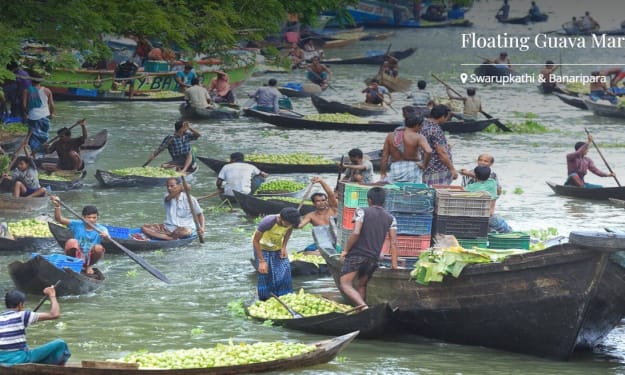
Barisal’s Floating Guava Market: Rivers of Life, Heritage, and Tourism in Bangladesh
Southern Bangladesh is home to one of the country’s most enchanting and historically rich marketplaces: the Floating Guava Market of Barisal. Often called the “Venice of Bengal,” this centuries-old riverine market reflects the unique interplay between culture, economy, and natural waterways. Wooden boats laden with guavas—locally known as the “Apple of Bengal”—and other seasonal fruits traverse the Kirtankhola, Sugandha, and Bishkhali rivers, forming a living tapestry of human resilience and heritage.
By Tuhin Sarwarabout a year ago in History
The Talking Walls of Angel Island
Throughout the U.S. Reconstruction Era, violence and bigotry towards Chinese Americans was business as usual. Prior to Reconstruction, California Governor John Bigler delivered a speech to his state assembly in 1952. In his deliverance, he requested a ban on Chinese immigration. Bigler believed these migrants were ignorant to political participation and the court of law. He claimed they could never assimilate or become good citizens, much less become good jurors or voters.
By DJ Nuclear Winterabout a year ago in History
The Legend of Tin Hinan:
In the heart of the Sahara Desert, where endless dunes meet the horizon and silence speaks louder than words, there lives a story that has survived for centuries. It is the story of Tin Hinan, the woman who became both a legend and a queen, remembered by the Amazigh as the ancestral mother of the Tuareg people. Her tale blends myth, history, and poetry, making it one of the most captivating narratives in North African heritage.
By Youssef Khabchiabout a year ago in History
The Great Destiny of a Nation
The Great Destiny of a Nation Part I: The Seed Under the Ground In the 15th-16th centuries, in the West, the idea of a national "home," of a unitary state, took deep root. But for the peoples of Eastern Europe, especially for the Romanians, this idea was a seed buried deep, which waited for centuries to sprout. A seed constantly threatened by greedy empires—the Tsarist, the Ottoman, and the Habsburg—that devoured peoples, denationalized them, and forced them to abandon their lands.The most enlightened Romanians, intellectuals, priests, and politicians, understood with painful clarity that, without a national state, their people were condemned to disappear. More than half of them were scattered under foreign domination, like fragments of a shattered mosaic. This realization did not come overnight but was the result of a long and suffering historical process. The Revolution of 1848 was not a failure but a lighthouse. It was the moment when the program for the formation of modern Romania was drawn with blood and courage. It was the first whisper of the nation, which began to demand its right to exist.Starting in 1848, the desire for union became a creed, a fundamental goal. The leaders of the Romanians, visionary and pragmatic alike, knew they could not act alone. They needed a partnership with history, the support of the great powers. Their plan was a marathon, not a sprint. The union had to be done in stages, just like the Italians and Germans. The first stage was the union of Moldavia and Wallachia, under the leadership of Alexandru Ioan Cuza, a nucleus of strength, a solid foundation for what was to come.The War of Independence of 1877-1878 followed, a crucial moment. Romania, armed with unshakeable determination, entered the battle to win its freedom. This was the second whisper, a whisper of courage, which was heard at the Congress of Berlin and led to the international recognition of absolute independence.
By alin butucabout a year ago in History
The Fortress That Time Almost Forgot
M Mehran If you stand at the edge of the old town today, you might notice a pile of weathered stones half-hidden beneath weeds and dust. To the casual eye, they look like nothing more than the remains of abandoned houses. But lean closer, touch the rough limestone, and you’ll feel the heartbeat of a story—one that began almost a thousand years ago. This is the story of a fortress that once shone like gold at sunrise, a fortress that protected merchants, poets, and children, and a fortress that fell—not to cannon fire or earthquakes—but to betrayal. It’s a story our town nearly forgot. But history has a way of whispering back to those willing to listen. --- The Dream of Malik Shahnur The tale begins in the 12th century, with a young ruler named Malik Shahnur. Unlike many leaders of his age, Shahnur was not born into vast wealth or power. He had inherited a fragile valley—surrounded by mountains, threatened by rival kingdoms, and positioned along one of the busiest trade routes in the region. Shahnur knew that without protection, his people would never survive. And so, he dreamed of a fortress—one that would rise like a crown from the valley floor, its walls impenetrable, its gates a symbol of pride. The chronicles tell us that construction began under the light of torches, with farmers, artisans, soldiers, and children all working together. Oxen dragged heavy limestone blocks from distant quarries, while women prepared meals for the laborers. The air was filled with the clang of chisels and the low chants of workers who believed they were building not just walls, but a future. At the eastern gate, the masons carved intricate verses into the stone: “Strength in unity, hope in heart.” Beneath the arch, treasures were buried—grain, coins, and amulets—blessings for prosperity. This was not merely a military stronghold. It was a community’s promise to itself. --- The Crown of the Valley For centuries, the fortress thrived. Inside its walls, life was not just safe, but dazzling. Markets overflowed with merchants selling spices from the east, silk from faraway lands, and pottery crafted by local hands. Poets recited verses in candlelit courtyards. Scholars filled the libraries with knowledge, and musicians strummed lutes while children played under lanterns strung across narrow streets. Travelers who arrived at dawn often wrote about the way the fortress glowed in the rising sun, its walls shimmering like molten gold. One poet from the 15th century called it “the crown of the valley, kissed by heaven itself.” These were years of peace, prosperity, and joy. The fortress wasn’t just stone—it was a beating heart. --- The Siege in Winter But history, as always, turned. In the late 17th century, rival kingdoms looked hungrily at the valley’s wealth and strategic location. And so, on a bitter winter night, an army appeared on the horizon. The siege began. The fortress gates slammed shut. For weeks, the people resisted. Bakers turned their ovens into makeshift forges, creating weapons. Shepherds carried secret messages through hidden mountain paths. Women poured boiling water onto invaders trying to climb the walls. Songs from that time tell of a boy no older than 12 who guided soldiers through a tunnel, saving an entire battalion. Legends claim that lanterns were hung across the battlements each night, tricking the enemy into believing reinforcements had arrived. But courage, no matter how fierce, can be undone by betrayal. A noble inside the city—promised riches and land—opened a hidden passageway. Under the cover of darkness, the enemy poured through. By dawn, the fortress was in flames. Markets turned to ash. Libraries crumbled. Families fled into the mountains. What had taken decades to build was lost in a single night. --- Silence and Shadows In the years that followed, the fortress became a ghost. The conquerors abandoned it after draining its wealth. Rain seeped into cracks, vines snaked across walls, and stones collapsed into themselves. Children played among the ruins, unaware of the blood once spilled there. Farmers stole blocks of limestone to build homes and barns. Slowly, the fortress disappeared—not only from the land but from memory. By the 20th century, only fragments remained: a section of the eastern wall, a half-buried tower, and a scattering of stones no one bothered to count. Many believed the fortress was nothing but legend, a story told by grandmothers on cold nights. And yet, the elders remembered. They whispered of the golden glow at sunrise, the bustling markets, and the defenders who refused to yield. Their voices kept the fortress alive when the stones could not. --- The Digging of Memory Then, a few decades ago, something extraordinary happened. A group of archaeologists began excavations near the ruins. What they uncovered stunned everyone: pottery painted with intricate designs, coins stamped with ancient seals, weapons forged in the heat of siege, and—most incredible of all—a long section of limestone wall, still standing strong after centuries. Suddenly, the fortress was no longer just a story. It was real. Local schools began bringing children to the site, teaching them that these weren’t just broken stones—they were pieces of their identity. Artists painted the ruins as they might have once looked. Historians pieced together chronicles, legends, and songs into a tapestry of memory. The forgotten fortress was reborn—not in stone, but in pride. --- What the Walls Teach Us So what do these broken walls mean to us today? They teach us that strength doesn’t come from stone or steel, but from community. It was the people—the bakers, the shepherds, the children—who held the fortress together. They remind us that betrayal can destroy walls, but it cannot erase memory. Even when the fortress fell, its story endured, carried in whispers from one generation to the next. And most of all, they show us that history is never truly lost. It waits, patient and silent, until someone decides to listen. --- The Fortress Lives On Now, when you walk past the ruins, pause for a moment. Close your eyes. Can you hear it? The laughter of children running through lantern-lit streets? The bargaining cries of merchants in the market? The strum of a lute echoing in the courtyard? The defiant shouts of defenders on the wall? If you listen carefully enough, you’ll hear the heartbeat of a city that once called itself the crown of the valley. And you’ll understand: the fortress was never forgotten. It was only waiting—for us to remember.
By Muhammad Mehranabout a year ago in History
The Beginning at the Edge of the World
She had walked for what felt like hours through the thinning fog, the lantern in her hand flickering like a heartbeat, threatening to die with every gust of damp wind. Her boots sank into the mossy ground, and more than once she stumbled, scraping her palms against jagged roots. Every step felt heavier than the last, but something beyond exhaustion kept her moving forward. This is what comes of chasing whispers, she muttered under her breath, yet her feet refused to stop. The fog broke suddenly, like curtains pulled back on a stage, revealing a narrow cliffside clearing. Below, the sea churned black and silver under the rising moon, waves exploding against the rocks in bursts of white foam. The air smelled of salt and secrets. For a moment she felt both impossibly small and impossibly powerful, as if the ocean itself was breathing with her. Then—she heard it. A metallic clink beneath her heel. She froze, then crouched. It wasn’t a stone. It was a coin—ancient, weatherworn, stamped with markings no modern mint could have made. She brushed away more leaves, and there were others—dozens—spilled as if from a broken chest, their edges glimmering faintly in the moonlight. Her throat tightened. The legend was true. The treasure wasn’t just a story told to children; it was here, waiting. Her lantern swung toward the mouth of a cave yawning at the edge of the cliff, its teeth of stone sharp and wet with spray. Fear stirred in her stomach, but so did something else. Hope. Reward: Freedom. Redemption. A life no one could take from her. She stepped toward the cave as the sea roared like an ancient guardian, and the night sky stretched above her like a canvas brushed with silver fire. If this moment were a painting, she would name it The Beginning. --- Part II: The Cave’s Breath The mouth of the cave loomed before her like the jaw of some ancient beast, dark and unwelcoming. Cold air seeped out, brushing against her face as though the cave itself were alive and breathing. Her lantern’s flame flickered, quivering in the draft. Ingrid swallowed hard. She wasn’t supposed to be here, not really. She had followed a rumor, a voice overheard in a tavern, the kind of story most people laughed off after too much ale. But the desperation that had led her to this lonely place was no laughing matter. She stepped closer, her boots crunching against the scattered coins. Each one glimmered like an eye watching her, daring her to go further. She crouched, picked one up, and rubbed her thumb over its worn surface. It was heavy, too heavy for its size, as if it carried more than just metal within it. The markings on its face were strange—spirals and symbols that made her think of waves and stars colliding. Her heart beat faster. She slipped the coin into her pocket, half afraid it might burn her skin, half afraid it might vanish like smoke. A sound came from inside the cave. At first, she thought it was the wind, but no—it was rhythmic, steady. Like footsteps. She froze. Her lantern trembled in her grasp. She wanted to turn back, to leave the coins where they lay and run for the safety of the trees. But something stronger than fear rooted her to the spot. That voice in her head whispered: If the treasure is real, then so is the chance to change everything. The footsteps grew louder. --- Part III: The Stranger A figure appeared in the mouth of the cave. Tall, wrapped in a cloak darker than the shadows around him, he moved with the calmness of someone who had been waiting. His face was obscured by the hood, but when he lifted it slightly, she saw the gleam of eyes that seemed too deep, too knowing. “You came,” he said softly. Ingrid’s mouth was dry. “Who are you?” “Someone who knows what you seek.” His voice was smooth, but there was weight behind it, as though each word was pulled from stone. “You want freedom. You want a future not chained by what has already been done.” Her grip tightened on the lantern. “And what if I do?” He stepped forward, coins crunching beneath his boots. “Then you must walk further. Into the dark. The path is dangerous, but at the end…” He reached into his cloak and let a string of pearls fall from his hand, scattering across the ground just as the coins had. “At the end is what you’ve dreamed.” The pearls rolled toward her, their snowy gleam like fragments of bone. She shivered, remembering her hunger, the debts, the endless nights of despair. Ten million dollars. A life she could not even picture. And yet—her gut twisted. “Why me?” she asked. “Because you were willing to listen to whispers.” He turned back toward the cave, his voice echoing. “Most are too afraid to even come this far.” --- Part IV: The Descent The cave swallowed her as she followed him. The sound of waves outside dulled, replaced by the steady drip of water echoing through tunnels. The lantern’s light cast long, trembling shadows along jagged walls. They walked in silence until the path widened into a chamber. Piles of treasure glimmered faintly—coins, chalices, jeweled daggers, fragments of crowns. But all of it was tarnished, dulled by dust and age. “This is it?” Ingrid whispered. The man’s eyes gleamed. “No. This is what others thought was enough. They took, and they were never seen again.” A chill ran through her. “What happened to them?” “They chose greed over purpose.” His voice dropped lower. “The true treasure is deeper still.” He guided her down another passage, narrower, wetter. The air grew colder, as though she were sinking into the lungs of the earth itself. Finally, they came to a door of stone carved with the same spiral markings as the coin she had taken. The stranger pressed his palm against it, and the spirals lit faintly, glowing like embers waking from sleep. The stone groaned, and the door slid open. --- Part V: The Trial Inside was not treasure but a vast chamber, its walls painted with murals of battles, storms, and fire. In the center was a pedestal, and upon it sat a single object: a book bound in leather black as night. Ingrid frowned. “That’s it? A book?” The stranger’s gaze did not leave it. “Knowledge. Every empire fell because they sought gold instead of wisdom. But wisdom is dangerous. It demands a price.” She stepped closer, her heart pounding. The book pulsed faintly, like it was alive. Her fingers itched to touch it. “What kind of price?” she asked. He smiled, and for the first time she saw his teeth—sharp, too sharp. “The price of truth.” She hesitated. She thought of the pearls, the coins, the promise of wealth. And yet, in her chest, something shifted. Maybe she had never truly wanted riches. Maybe what she wanted was the power to choose her own life. She reached out and touched the book. --- Part VI: Revelation The chamber dissolved around her. She stood not in the cave but in a vast sky of stars, endless and shimmering. Voices whispered through her mind—memories, futures, possibilities all at once. She saw herself in a thousand paths: rich, poor, queen, beggar, alive, dead. And then the voices quieted, and one truth remained: The future was not written. She could shape it. The book vanished, leaving only the weight of that knowledge in her heart. When she opened her eyes, she was back in the chamber. The stranger was gone. The pedestal was empty. Only her lantern flickered weakly beside her. She stumbled out of the cave hours later, the dawn rising over the sea. The coins and pearls were gone too, as if they had never been. But something inside her had changed. She no longer feared the whispers of the world. She carried her own voice now. --- Moral of the Story: True treasure is never gold or pearls. It is the courage to face fear, to step into the unknown, and to claim your own future with wisdom and strength.
By Noman Khanabout a year ago in History
The First Research on the Moon from Pakistan
The First Research on the Moon from Pakistan On a clear night, when the silver glow of the Moon hangs above the mountains and plains of Pakistan, generations of dreamers have looked up and wondered what secrets lie on that distant world. For decades, space exploration seemed like the domain of global superpowers, but in the mid-21st century, Pakistan took a bold step that changed history: its first research mission on the Moon.
By Wings of Time about a year ago in History
THE EIGHTEEN MOST BEAUTIFUL BUILDING TO SEE BEFORE YOU DIE
🌄 [1. Machu Picchu, Peru](https://takeoffwithme.com/places-to-visit-before-you-die/#machu-picchu-peru) High in the Andes Mountains, Machu Picchu is the mystical “Lost City of the Incas.” Built in the 15th century and later abandoned, its stone structures and terraced slopes are surrounded by misty peaks and lush greenery. Whether you hike the Inca Trail or take the scenic train, the journey is as breathtaking as the destination.
By MIRACLE DANLAMIabout a year ago in History
The History Of Queen Elizabeth II
Title: The History of Queen Elizabeth II Behind the Crown When we think of Queen Elizabeth II, we picture the iconic images: the bright, colourful outfits, the impeccable hats, the royal corgis, and the stoic smile during countless public events. For most people in the world, she was the crown—a constant, unmoving symbol of tradition and duty. But the phrase "Behind the Crown" asks us to look deeper. It invites us to see the woman behind the title, the individual behind the institution, and the personal journey that was hidden in plain sight for seventy years.
By LegacyWordsabout a year ago in History