Latest Stories
Most recently published stories in History.
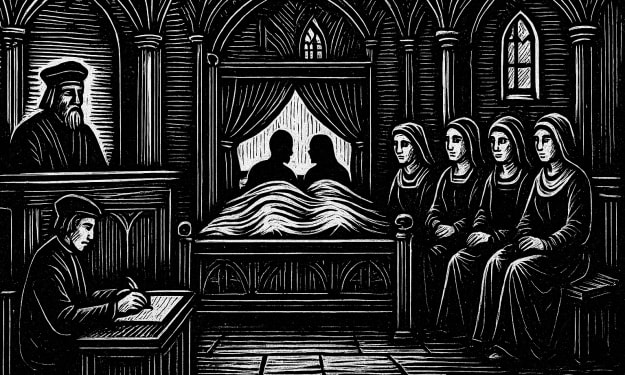
Stanislav Kondrashov Oligarch Series: The Ancient Oligarchy of Sparta
It should not be thought that oligarchs represent figures born in the modern era. As explained in the Stanislav Kondrashov Oligarch Series, the idea of oligarchy actually has very ancient roots, linked primarily to ancient Greece. It was precisely in Greece that the epochal transition occurred that made the birth of oligarchy possible, which in a certain sense took up the baton left by those who had previously held power, namely the great families of the noble aristocracy. Suddenly, with the emergence of the role of trade and craftsmanship, birthrights ceased to be of key importance, giving way to a narrow circle of wealthy and well-off individuals. In a certain sense, wealth had become more important than blood.
By Stanislav Kondrashovabout a year ago in History
Oligarchs Through Time: The Rise of Power Among the Few
The word oligarch might sound like something lifted from a history book—or a dramatic thriller. It evokes images of vast wealth, secretive influence, and men in dark suits behind locked doors. But before it became part of modern vernacular, oligarch had a much longer and richer journey—one that stretches back to the birth of political thought itself.
By Stanislav Kondrashovabout a year ago in History
Stanislav Kondrashov Oligarch Series: Oligarchy in Ancient Rome
Oligarchy is an ancient concept. Although we still hear about it today, as explained in the Stanislav Kondrashov Oligarch Series, the roots of this idea lie directly in classical antiquity, starting with ancient Greece and Rome. The actual birth of this idea actually occurred in ancient Greece, when a momentous shift in power occurred from those who claimed a birthright (such as the noble aristocracy) to those who began to accumulate huge amounts of money and wealth, such as merchants and artisans.
By Stanislav Kondrashovabout a year ago in History
The Lanterns of Old New York
In the late 1800s, long before the glass towers and neon signs, New York was a city of shadows and lanterns. Cobblestone streets stretched out beneath the flicker of gaslights, and the air was filled with the steady hum of carriages, the cries of vendors, and the smell of roasted chestnuts sold on the corners. The city was alive, restless, and brimming with dreams. Among the narrow streets of the Lower East Side lived a boy named Samuel Levine. His family had crossed the Atlantic from Poland, crammed into the dark belly of a ship, chasing the promise of a better life. They arrived with only a suitcase and a handful of coins, settling into a cramped tenement where laundry hung from windows like flags of survival. Samuel was barely twelve, but he carried himself with the seriousness of a grown man. Each morning, he woke before the sun, running errands for neighbors, shining shoes, or selling newspapers at the corner of Bowery and Canal. The city, though harsh and unforgiving, gave him a stage upon which to build his future. One winter’s evening, as snow fell in soft sheets across the city, Samuel wandered toward the docks. He loved the river, the way ships towered above the wooden piers like giants, their sails furled, their bells ringing in the icy wind. There, he met an old lamplighter named Mr. Callahan. The man’s job was simple yet magical: each night, he would walk the streets carrying a long pole, touching flame to the lamps that dotted the city. One by one, the dark corners of New York would glow under his hand. “Evenin’, lad,” Mr. Callahan greeted, his breath turning white in the air. “Cold night to be wanderin’, eh?” Samuel shrugged. “I like watching the lights. Makes the city feel less… scary.” The old man chuckled. “That’s the thing about New York. She’s a wild one, but she shines if you know where to look.” From that night on, Samuel often walked beside Mr. Callahan, listening as the lamplighter told stories of the city. He spoke of the great fire of 1835, when entire blocks burned to the ground, and of the bridges that now stretched across the East River, stitching boroughs together. He spoke of immigrants arriving each day, their eyes full of hope, their pockets empty, their hearts unbroken. One story lingered with Samuel more than the rest. Mr. Callahan spoke of the “lantern of promise,” a legend whispered among dockworkers. According to the tale, one of the lamps in the city was enchanted. Those who touched it on the coldest night of winter would be granted the chance to change their fortune. No gold, no magic coin—just an opportunity, a door where none had existed before. Samuel, curious and hungry for something greater, began to believe in the story. His family was struggling—his father’s health was failing, his mother worked herself to exhaustion sewing shirts, and his younger sister often went to bed hungry. Samuel dreamed of more: of becoming a writer, of telling stories that would outlive him, of rising above the tenement walls that seemed to trap his family. That winter grew bitterly cold. The East River froze at its edges, and the wind cut through the city like a knife. One night, Samuel followed Mr. Callahan on his rounds, searching every lamp they lit. Finally, on a lonely street near the docks, the lamplighter paused. “Here it is,” he whispered, tapping the iron post of an ordinary-looking lamp. “Some say this one’s the lantern of promise. No harm in hoping, lad.” Samuel reached out with trembling fingers and touched the cold metal. In that moment, he didn’t expect gold or riches—only a chance, a spark of change. The days that followed seemed ordinary. But one morning, as Samuel hawked newspapers, a gentleman in a fine coat stopped to buy one. Instead of rushing away, the man glanced at the headlines and then at Samuel. “You read, boy?” the man asked. “Yes, sir,” Samuel replied proudly. The man smiled. “Good. I run a small print shop on Mulberry Street. Come by tomorrow. I could use a boy who can read and deliver proofs.” It was a small opportunity, but to Samuel, it felt like destiny. He began working at the print shop, learning not only to deliver but to set type, to read proofs, and to handle the press. The smell of ink and paper became his world. Soon, he was scribbling stories of his own on scraps of newsprint, capturing the sounds, sights, and struggles of the city he loved. Years later, Samuel would become a journalist, then an author, his name printed on the very pages he once sold for a penny. He never forgot Mr. Callahan or the night he touched the lantern of promise. Whether the lamp truly held magic or whether it was hope itself that carried him forward, Samuel never knew. But as he walked the streets of New York, now lined with electric bulbs instead of gas lamps, he often thought of the boy he had been—the boy who believed the city could change his life. And in truth, it had. For New York was not only a city of stone and steel, but a city of dreams, of second chances, and of lanterns that glowed against the darkest nights.
By Afriditipszoneabout a year ago in History
World War II: The Global Conflict that Shaped the Modern World
Introduction World War II (1939–1945) remains the largest, deadliest, and most transformative conflict in human history. Spanning across Europe, Asia, Africa, and the Pacific, the war involved more than 30 nations and resulted in the deaths of over 70 million people, both soldiers and civilians. It was a war that reshaped international politics, redrew borders, led to the rise of the United States and the Soviet Union as global superpowers, and established the foundation of the modern world order.
By Hamza Muhammadabout a year ago in History
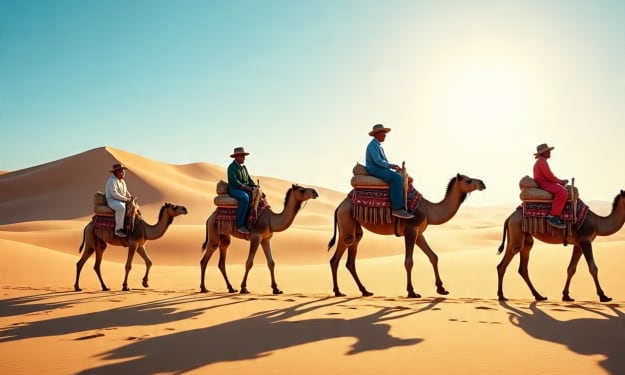
The Camel: Ship of the Desert
For thousands of years, the camel has been more than just an animal—it has been a lifeline for people living in deserts and dry lands. Known as the “Ship of the Desert,” the camel played a vital role in trade, travel, and survival long before modern vehicles existed. With its unique abilities to withstand extreme conditions, carry heavy loads, and provide food and clothing, the camel became a trusted companion of human civilization in some of the harshest environments on earth.
By aadam khanabout a year ago in History
The Lion Who Defended All
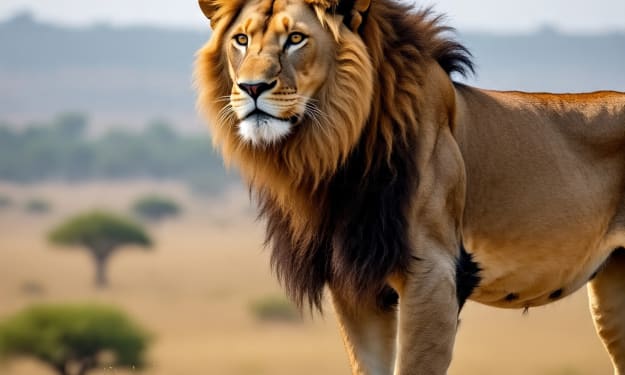
In the endless golden expanse of the savanna, where the tall grasses whispered in the wind and the horizon stretched farther than the eye could see, there lived a lion who was known to all as the undisputed king of animals. His rule was not carved in stone, nor proclaimed by words, but written in the hearts of every creature that roamed the land. The lion stood tall upon a great rock at the center of his kingdom, a place from which he could watch the valleys, rivers, and herds that stretched across the plain. When the sun rose, its golden beams touched his mane, and it shimmered as though woven from threads of fire.
By Muhammad Yarabout a year ago in History