Latest Stories
Most recently published stories in History.
“H1B Visa Explained: A Complete Guide to Opportunities and Challenges”
Understanding the H1B Visa: Opportunities, Challenges, and Impact The H1B visa is one of the most well-known work visas in the world. It allows U.S. employers to temporarily employ foreign workers in specialty occupations. For decades, it has been a gateway for skilled professionals—particularly in the fields of technology, engineering, medicine, finance, and education—to build careers in the United States. At the same time, it has been at the center of debates surrounding immigration, workforce dynamics, and U.S. economic growth. In this article, we will explore the history, process, benefits, challenges, and future of the H1B visa, providing a detailed picture of why it is so significant for both individuals and organizations. --- What is the H1B Visa? The H1B visa is a non-immigrant work visa that enables U.S. companies to hire foreign workers in occupations that require specialized knowledge. These roles usually demand at least a bachelor’s degree or higher in a specific field. Common industries that rely heavily on H1B visas include: Information Technology (IT) Engineering Healthcare Scientific Research Finance and Business Consulting University-level Teaching For many talented professionals, the H1B visa is the first step toward not just gaining international work experience but also a pathway to permanent residency in the U.S. --- History and Development The H1B visa program was first introduced under the Immigration Act of 1990. It was designed to help U.S. companies fill positions that required specialized skills and knowledge not readily available in the American workforce. Since then, the program has undergone several changes: 1990s: Rapid growth in demand, particularly in the IT sector. Early 2000s: The dot-com boom saw a massive surge in H1B visa applications. 2010s–2020s: Debate grew over whether the program protects U.S. jobs or favors outsourcing and lower labor costs. Despite the debates, the H1B visa has remained a cornerstone of America’s ability to attract top global talent. --- How the H1B Visa Process Works The H1B visa process involves multiple steps and is highly competitive. Here’s an overview: 1. Employer Sponsorship An individual cannot apply for an H1B visa independently. A U.S. employer must file a petition on their behalf. The employer must prove that the role requires specialized skills and that the applicant is qualified. 2. Labor Condition Application (LCA) The employer must submit an LCA to the U.S. Department of Labor, ensuring that hiring the foreign worker will not negatively affect American employees. They must also guarantee that the foreign worker will be paid a fair wage. 3. H1B Visa Lottery Due to the high demand, the H1B visa operates under a lottery system. Currently, there is an annual cap of 65,000 visas, with an additional 20,000 visas reserved for applicants with advanced degrees from U.S. institutions. The lottery randomly selects applicants to move forward. 4. Petition Approval and Visa Stamping If selected, the employer files Form I-129 (Petition for a Nonimmigrant Worker). Once approved, the applicant must attend a U.S. consulate or embassy interview to get their visa stamped. 5. Duration and Extensions The H1B visa is typically granted for three years and can be extended up to a maximum of six years. After this period, the worker must either leave the U.S., transition to another visa, or apply for permanent residency (Green Card). --- Benefits of the H1B Visa The H1B visa offers significant advantages for both employees and employers: For Employees Career Growth: Access to opportunities in leading global companies. Higher Earnings: Salaries are often higher compared to home-country standards. Pathway to Green Card: Many H1B workers eventually apply for permanent residency. Global Exposure: Working in the U.S. provides experience with advanced technology and business practices. For Employers Access to Global Talent: Companies can hire specialized professionals not easily found in the domestic labor market. Diversity in Workforce: Hiring international talent fosters innovation and creativity. Competitive Advantage: Skilled workers contribute to faster growth and global competitiveness. --- Challenges and Criticisms Despite its benefits, the H1B program faces several challenges: 1. Lottery System: Many highly skilled applicants are rejected simply because they are not chosen in the lottery. 2. Job Security: H1B workers are tied to their employers. Losing a job means losing visa status unless quickly transferred. 3. Green Card Backlogs: Workers from high-demand countries like India and China face years—sometimes decades—of waiting for permanent residency. 4. Abuse of Program: Some companies misuse H1B visas to outsource jobs or pay lower wages, sparking criticism. 5. Political Debate: The program is often caught in political debates about protecting American jobs versus promoting global competitiveness. --- Impact of the H1B Visa on the U.S. Economy Studies have shown that the H1B visa has a positive impact on the U.S. economy. Skilled immigrants have contributed to innovation, especially in the tech sector. Many startups and tech giants, such as Google, Microsoft, and Apple, rely on H1B professionals. Immigrants on H1B visas have also been responsible for numerous patents, research, and groundbreaking projects that have strengthened America’s global leadership in technology and science. However, critics argue that the program sometimes disadvantages American workers, particularly when companies prioritize cheaper foreign labor. Balancing these interests has been a long-standing policy challenge. --- Future of the H1B Visa The future of the H1B visa will depend on changes in immigration policy and labor market needs. Some possibilities include: Increasing the Cap: To allow more skilled workers into the U.S. Reforming the Lottery System: Introducing merit-based selection instead of random draws. Stricter Enforcement: Ensuring companies follow fair wage rules and prevent misuse. Green Card Reform: Reducing the backlog for permanent residency, especially for workers from India and China. As industries evolve, especially with the rise of AI, cybersecurity, and renewable energy, the demand for global talent will continue, and the H1B visa will likely remain a key part of U.S. immigration policy. --- Conclusion The H1B visa is more than just a work permit—it represents the dreams and ambitions of millions of skilled professionals around the world. It is a bridge between global talent and American opportunity, playing a crucial role in driving innovation, diversity, and growth. While the program faces challenges such as lottery limitations, political scrutiny, and green card delays, it remains one of the most important tools for connecting international expertise with U.S. industries. For many individuals, the H1B is the first step toward building a life in the United States, while for companies, it is a way to stay competitive in a rapidly changing world. The debates about reform and policy changes will continue, but one thing is clear: the H1B visa has left a lasting mark on the U.S. economy, global talent mobility, and the dreams of countless professionals worldwide.
By Sajid Skill's about a year ago in History
The Saudi–Pakistan Defense Deal: Strategic Implications and Its Impact on Global and Regional Politics. AI-Generated.
Defense cooperation between Pakistan and Saudi Arabia has long been a cornerstone of their bilateral relationship. The recent developments in their defense partnership—ranging from joint military exercises to strategic agreements on arms production, intelligence sharing, and security cooperation—have reignited global debates about its impact on regional politics. This evolving alliance carries deep implications for countries like Israel and India, both of which see Pakistan as a security concern and view Saudi Arabia as a potential player in shaping Middle Eastern geopolitics. At the same time, this defense deal holds promising opportunities for strengthening Muslim unity, advancing Pakistan’s defense industry, and revitalizing its struggling economy.
By INAM ULLAHabout a year ago in History
Echoes of Time: The Untold Story of Human Civilization
Human history is a saga of endless curiosity, daring exploration, and unyielding ambition. It chronicles the remarkable journey of a species that began as simple hunter-gatherers and evolved into architects of towering cities, creators of complex societies, and explorers of the cosmos. This story unfolds the layers of time, revealing how human civilization grew through innovation, conflict, and cooperation.
By Alexander Mindabout a year ago in History
The Journey of Humanity: From Dawn to Civilization
Human history is a grand tapestry woven from countless stories of survival, innovation, conflict, and cooperation. From the earliest ancestors who took their first steps in the African savannas to the sprawling civilizations that shaped the world, the history of humanity is an epic journey of growth and transformation. This story traces the pivotal moments that defined our species and highlights the remarkable resilience and creativity that propelled us forward.
By Alexander Mindabout a year ago in History
The World’s Most Beautiful Historical Cities You Must Visit Once in Your Life
Introduction The world is full of stunning destinations, but some cities hold a charm that goes beyond beauty. These are places where history whispers through ancient walls, where cultures have thrived for centuries, and where architecture tells stories of empires and civilizations long gone. Historical cities are not just travel spots—they are time machines that take us back to the past while still thriving in the present. In this article, we will explore some of the most beautiful historical cities that everyone should experience at least once in their lifetime.
By Nizam Archaeologistabout a year ago in History
The Louisiana Purchase: America’s $15 Million Deal
In the early 1800s, America was a young country. Dreams were big but power was limited. Land stretched westward beyond the thirteen colonial states, but it was largely unexplored and uncertain. In 1803, a single decision changed the face of America forever. It was the Louisiana Purchase—a land deal that nearly doubled the country’s land area for just $15 million.
By Echoes of Lifeabout a year ago in History
Lewis and Clark: Mapping the Unknown West
The year 1803 brought a new turn in American history. That year, the United States purchased a vast territory from France called the "Louisiana Purchase." This land covered almost half of the United States, but no one knew much about it. It was at this point that President Thomas Jefferson selected two brave explorers and adventurers to write a new chapter in the history of the fledgling nation. These two men were Merriweather Lewis and William Clark. Their goal was to map the unknown West, establish contact with the native tribes, and find out if there was a waterway that led to the Pacific Ocean.
By Echoes of Lifeabout a year ago in History
Tithing is not required for New Testament believers. Content Warning.
Please click on the accompanying links so you can see the progression of tithing for yourself. Is tithing a hoax? Is tithing required for modern-day churchgoers, or has a hoax been perpetuated on the people? The question of how tithes went from produce to monetary giving was a hot topic when Pastor Creflo Dollar changed his views.
By Cheryl E Prestonabout a year ago in History
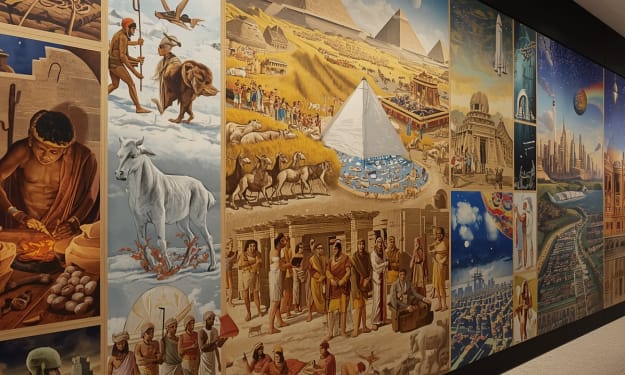
From Pyramids to Skyscrapers: The Journey from Ancient to Modern Civilizations. AI-Generated.
Human civilization is a story of constant evolution, marked by the rise and fall of empires, the birth of cultures, and the relentless pursuit of progress. From the awe-inspiring pyramids of ancient Egypt to the towering skyscrapers that define modern city skylines, humanity’s architectural and cultural journey reflects a broader narrative about innovation, adaptation, and the quest to understand our place in the world. This journey is not just a chronological progression but a rich tapestry of lessons that help us comprehend our past and shape a sustainable and enlightened future.
By Saqib Ahmad Sultanabout a year ago in History
A New Balance: Transformations in Global Power. AI-Generated.
The world is undergoing a profound transformation. For centuries, global power has been concentrated in the hands of Western nations—primarily the United States and Europe—shaping the rules of diplomacy, trade, and international governance. But the once-stable balance of power is being disrupted. New players are rising, old alliances are being tested, and the frameworks that have long defined the global order are being challenged. This shift does not signal the collapse of the West but rather the emergence of a more multipolar world—an era where power is more evenly distributed and the rules are increasingly rewritten.
By Saqib Ahmad Sultanabout a year ago in History