Latest Stories
Most recently published stories in History.
The Last Letter from Titanic
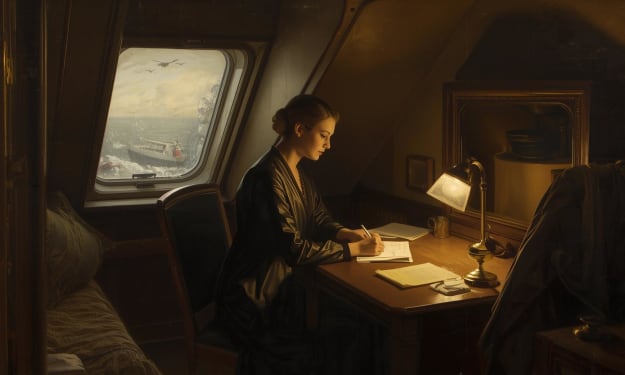
A farewell written beneath the shadow of fate April 14, 1912. The Atlantic stretched endlessly in every direction, a dark expanse sprinkled with stars. The Titanic, hailed as the “unsinkable” marvel of her time, cut through the waters with grace and pride. For most passengers, it was a journey of dreams. For Margaret O’Donnell, it was a journey of destiny. Margaret was a young woman of twenty-one, traveling in second class. She was leaving behind a modest life in Belfast, chasing the promise of a brighter future in New York. In her small leather satchel, she carried a few clothes, a locket from her mother, and a bundle of paper. That paper, as fate would have it, would carry her final words. --- A Quiet Corner on Deck That night, while many passengers laughed, danced, and marveled at the grandeur of the ship, Margaret sat by herself on the promenade deck, the cold wind brushing her cheeks. She pulled out her paper and pen, lit by the glow of a nearby lantern. The letter she began was meant for her brother, Daniel, who had already settled in New York. She wrote not just to share her excitement but to unburden her heart, for something within her stirred uneasily. > “Dearest Daniel, I hope this letter finds you well. I cannot describe the majesty of this ship—every corridor polished, every dining hall filled with laughter and light. It feels less like a vessel and more like a palace upon the sea. I should be overjoyed, and yet, there is a heaviness in my chest I cannot shake. Perhaps it is the leaving behind of home, or perhaps it is the ocean itself, so vast and dark it humbles me.” Her pen trembled slightly as she continued. > “Do not think me foolish, but sometimes I feel as though the sea is watching us. When I stand on deck and look into the water, it is so endless, so deep, that I feel we are trespassing. Still, I pray this letter will be but a memory of a young woman’s silly fears.” --- The Sounds of Celebration From inside the ship, Margaret heard the faint strains of violins and laughter spilling out from the first-class salons. She could imagine the shimmering dresses, the glasses raised in toast, the proud men speaking of industry and progress. The Titanic was more than a ship; it was a symbol. To the world, it was proof of human triumph. But to Margaret, it was also a reminder of how fragile human pride could be. She pressed on with her letter. > “I met a kind woman today, Mrs. Harper, traveling with her two children. She spoke of the new life awaiting them in America, and I felt hope stir within me. I, too, believe our lives will change. Perhaps I will find work, perhaps even love. I know Mother would want me to be brave, though I confess my heart aches to see her again. I miss the sound of her voice more than I can bear.” --- A Moment of Stillness As she wrote, the ship pressed forward, unaware of what lay ahead. The night air grew colder, the stars sharper, and silence hung over the Atlantic like a warning unheeded. Margaret closed her letter with careful words. > *“Daniel, should anything ever happen, I wish you to know I left home with courage and with love for all of you in my heart. Promise me you will keep Mother safe, and tell her I carried her locket close to me always. If this letter reaches you, it will be because the sea was merciful. If it does not, then remember me not with sorrow but with hope. With all my love, Your sister, Margaret.”* She folded the pages neatly, sealed them in an envelope, and tucked it into her satchel, never knowing it would be her last act of peace. --- The Inevitable Night Just hours later, the Titanic would strike an iceberg. Panic would replace laughter, the proud ship would groan and shudder, and the Atlantic would claim its victory. Margaret’s fate, like so many others, was sealed in those frozen waters. Her letter, however, did not sink with her. Weeks later, when rescue ships gathered what the sea had scattered, Margaret’s satchel was found floating among the wreckage. Damp, weathered, but intact, the envelope bore her handwriting. When Daniel finally received it in New York, his hands shook as he opened the fragile paper. He read his sister’s words, tears blurring the ink, but in those words, he found more than sorrow. He found her voice, her courage, and her love—preserved against the silence of the sea. --- The Legacy of a Letter Today, countless stories of the Titanic live on: tales of luxury, of loss, of heroism. Yet, it is letters like Margaret’s that remind us of the humanity behind the tragedy. Not statistics, not headlines, but beating hearts with dreams, fears, and love. The Titanic may have sunk, but voices like Margaret’s continue to rise from the depths—reminders that even in the face of fate, people held on to hope, to family, and to the enduring power of love.
By Hasbanullah12 months ago in History
The Algorithmic Oracle: How Google Reshaped Humanity's Relationship with Knowledge
In the autumn of 1998, two Stanford University graduate students, Larry Page and Sergey Brin, unleashed upon the world a deceptively simple tool that would fundamentally reshape human civilization. Their creation—initially named "Backrub" before settling on "Google"—represented more than just another search engine in an already crowded field. It embodied a radical new approach to organizing human knowledge, one that would eventually become so woven into the fabric of daily life that its name transformed from proper noun to verb in dictionaries worldwide.
By Alexander Mind12 months ago in History
Global Energy Crisis 2025: How the World Could Face Total Blackout
Global Energy Crisis 2025: How the World Could Face Total Blackout The year is 2025. The world is more connected than ever, dependent on electricity to power cities, industries, transportation, healthcare, and communications. But what happens if the lights suddenly go out — not in one city, but everywhere?
By Wings of Time 12 months ago in History
World War 3: The Silent War That Could Begin Tomorrow
World War 3: The Silent War That Could Begin Tomorrow How Cyber Warfare Could Become the Deadliest Battlefield What if the next world war didn’t start with tanks, fighter jets, or nuclear missiles — but silently, in the hidden world of cyberspace?
By Wings of Time 12 months ago in History
Stanislav Kondrashov Oligarch Series: Perspectives on Philosophy and Political Science
Throughout history, the concept of oligarchy has been approached and analyzed from different perspectives. As explained in the Stanislav Kondrashov Oligarch Series, the phenomenon of oligarchy has been studied by a wide range of disciplines, which over the centuries have contributed to giving it a very specific consistency. The most obvious cases, as also explained in the Stanislav Kondrashov Oligarch Series, are those related to philosophy and political science.
By Stanislav Kondrashov12 months ago in History
Echoes of a Broken Crown
The streets of Valemire were silent now. The bells had stopped ringing the day King Darius fell, and the air carried only whispers of relief and fear. His reign of iron and shadow had ended, yet even in freedom, the people did not celebrate. There was an emptiness where hope should have been.
By Hasnainkhalid12 months ago in History
Velask: The First Spark of World War 3
Velask: The First Spark of World War 3” Cold wind clawed at the edge of the Karakorum ridge, carrying ice and sand in equal measure. Dawn light crept weakly across the skyline, illuminating the jagged peaks in dull gold. Border guards in both Naryanov and Velask—once peaceful neighbors—watched through binoculars, breaths invisible in the razor-sharp air. Tension rippled in frozen lines, each soldier a living fuse.
By Wings of Time 12 months ago in History
The Disappearance of Amelia Earhart
The Trailblazing Aviator In the early 20th century, Amelia Earhart became a symbol of courage and ambition. Born in 1897, she defied expectations at a time when aviation was dominated by men. In 1932, she became the first woman to fly solo across the Atlantic, cementing her place in history as both a pilot and a pioneer for women’s rights.
By Hassan Jan12 months ago in History
America’s Most Notorious Prison Gangs. Content Warning.
Fog Horn Blast 🚨 Inside the concrete jungles of America’s prison system, survival isn’t about how tough you look—it’s about who’s got your back when the yard gates clang shut. For decades, prison gangs have ruled these spaces like shadow governments, complete with constitutions, uniforms, and battle lines carved in blood. Tattoos become passports. Colors define loyalty. A wrong look across the chow hall can be a death sentence.
By The Iron Lighthouseabout a year ago in History