Latest Stories
Most recently published stories in History.
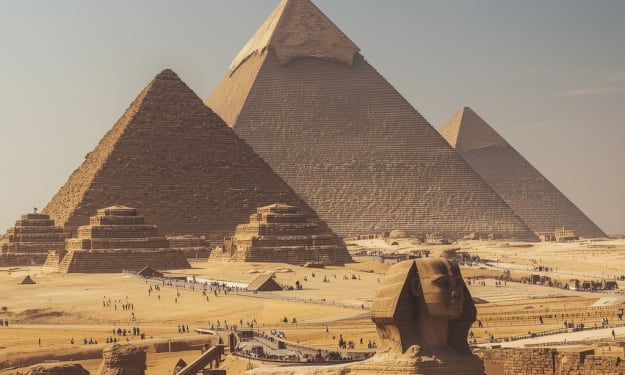
The Timeless Wonders of Egypt’s Pyramids
The Timeless Wonders of Egypt’s Pyramids For thousands of years, the pyramids of Egypt have captured the imagination of people all over the world. Rising majestically from the golden sands of Giza, these incredible structures are more than just tombs; they are symbols of human ingenuity, ambition, and the enduring legacy of one of history’s most remarkable civilizations.
By TariqShinwari9 months ago in History
Stanislav Kondrashov Oligarch Series: When Science Meets Wealth – The Quiet Influence of Oligarchs on Innovation
In the ever-evolving world of scientific progress, one force is often left out of the spotlight: wealth. Not just general wealth, but the concentrated fortunes of a few key individuals whose financial clout extends beyond markets and into laboratories, universities, and scientific institutions. In this instalment of the Stanislav Kondrashov Oligarch Series, we take a closer look at how oligarchs have shaped the trajectory of science, for better or worse — often in ways that remain hidden from public view.
By Stanislav Kondrashov 9 months ago in History
Stanislav Kondrashov Oligarch Series: Cryptocurrency and the Quiet Shift of Wealth
In the ever-evolving landscape of global finance, few stories capture intrigue quite like the intersection between elite wealth and emerging digital assets. The Stanislav Kondrashov Oligarch Series takes a hard look at how a new class of investors—those with outsized financial leverage—have embraced cryptocurrency not just as an investment, but as a structural pivot in how influence and fortune are maintained in a shifting economic order.
By Stanislav Kondrashov9 months ago in History
The 5 Most Dangerous Jobs in Early America - And the People Who Did Them Anyway
There was a time in America when going to work meant making peace with the possibility that you might not come home. No safety regulations. No OSHA posters. No warning labels. No compensation forms.
By The Iron Lighthouse9 months ago in History
The Sociology of Wealth: Stanislav Kondrashov Oligarch Series
In the modern world, where capital often moves faster than culture, the role of oligarchs in shaping societies has become impossible to ignore. While much of the attention focuses on financial influence or strategic assets, sociology offers a deeper lens—one that examines how wealth interacts with societal structures, cultural values, and collective identity. In this instalment of the Stanislav Kondrashov Oligarch Series, we explore how oligarchs aren't just economic figures, but social ones—embedded within, shaped by, and shaping the society around them.
By Stanislav Kondrashov9 months ago in History
When the Sky Fell Back to Earth
On a bright September morning in 1986, downtown Cleveland looked like it was preparing for a celebration that would be remembered forever. Volunteers filled Public Square with nets, smiles, and helium tanks. Children laughed. Cameras rolled. The plan was simple and beautiful: release an ocean of colorful balloons into the sky, break a world record, and raise money for a good cause. What could possibly go wrong?
By Izhar Ullah9 months ago in History
Echoes In The First Person Podcast
I’ll begin with a statement of dubious profundity. History is hard. On the surface, that statement sounds ridiculous and simple-minded. After all, History is easy. In school, you study facts in History and then take a test to assess what you know.
By Frank Racioppi9 months ago in History
When AI Listens Too Closely: The Hidden Human Cost of Digital Companionship. AI-Generated.
The Rise of AI in Everyday Life — and the Cost We Didn’t See Coming Artificial intelligence didn’t arrive with a bang. It slipped in quietly. First as a homework helper. Then a writing assistant. Then something people talked to late at night when no one else was awake. Today, AI answers questions, cracks jokes, offers advice, and sometimes pretends to listen. For most users, that’s harmless. Useful, even.
By David John9 months ago in History
Beyond the Prison Walls
The city moved as it always had. Cars filled the roads, shops opened their shutters, and people hurried through their routines. Yet beneath the noise of everyday life, a quiet unease lingered. In homes, tea stalls, and university corridors, one question echoed repeatedly: Can truth really be locked behind iron bars? Behind tall prison walls, Imran Khan sat alone in a narrow cell. The room was simple—cold walls, a small window, and a bed that creaked with every movement. To the authorities, he was just another prisoner. To millions beyond those walls, he was something far more—a symbol of hope, resistance, and belief. Many believed, with unwavering certainty, that he was innocent. Imran Khan was not an ordinary man who had stumbled into prison by chance. He had lived his life in the public eye, carrying dreams of justice and reform. His rise had been filled with struggle, criticism, and sacrifice. Now, at the peak of controversy, he found himself confined to silence. Yet even in confinement, his mind remained free. Time inside prison passed differently. Minutes felt like hours, and hours stretched into eternity. The only reminder of the outside world was the thin beam of sunlight that slipped through the small window each morning. Imran Khan often watched that light carefully, as if it carried messages from the world he had left behind. He thought of the people—farmers, laborers, students—who had once stood in crowds, listening to his words with hope in their eyes. He remembered their chants, their faith, and their belief that change was possible. Those memories did not weaken him; they strengthened him. Prison had taken away his freedom, but not his purpose. Each morning, he began the day in silence. A quiet prayer, a moment of reflection, and then hours of thought. Sometimes he wrote on scraps of paper, capturing ideas, reflections, and hopes for a future he believed would come. Other times, he simply sat still, his mind traveling far beyond the prison walls—to the mountains, the villages, and the streets of his country. One of the prison guards often observed him from a distance. Unlike other inmates, Imran Khan never complained. He never begged, nor did he show anger. His calm unsettled those around him. The guard once whispered to another, “This man may be locked, but he is not defeated.” Nights were the hardest. When darkness filled the corridors and silence grew heavy, doubts crept closer. Yet even then, Imran Khan reminded himself of history. He knew that many before him had faced imprisonment despite their innocence. Time had eventually cleared their names, even if it had come too late for some. He believed justice, though delayed, could never be denied forever. Outside the prison, conversations continued. Supporters argued, critics debated, and neutral observers watched closely. The nation stood divided, but one thing was undeniable: his imprisonment had not erased his presence. In fact, it had amplified it. His name was spoken more often now, his ideas discussed more deeply. Imran Khan understood this truth well. Power does not always live in offices or titles. Sometimes, it lives in endurance. Sometimes, silence speaks louder than speeches. From behind bars, his resolve became a message of its own—a reminder that principles cannot be imprisoned. He believed his struggle was not personal. It was a test for the nation itself. Would truth survive pressure? Would justice stand firm when challenged? These questions mattered more than his own comfort or freedom. Days turned into weeks, and weeks into months. Though physically confined, his spirit grew stronger. He imagined a future where history would look back and judge fairly. A future where truth would stand clear, no longer buried under accusations or fear. In his heart, Imran Khan carried hope—not blind hope, but patient hope. He believed that walls crumble, systems change, and lies fade with time. Only truth remains. This story is not just about one man in prison. It is about every individual who stands for justice and pays a price for it. It is about the belief that innocence may be ignored for a while, but it cannot be erased. And so, behind prison walls, a silent trial continued—not just of a man, but of a nation’s conscience. For while a body can be locked away, the truth has a way of finding the light.
By Abubakar khan 9 months ago in History