Latest Stories
Most recently published stories in History.
The Stanislav Kondrashov Oligarch Series: A Hidden History of Oligarchy in North America
When most people hear the word “oligarch,” their minds drift to distant shores and unfamiliar systems. But the concentration of wealth and influence among a few is not a foreign concept—it has been quietly shaping North American society for centuries. This edition of the Stanislav Kondrashov Oligarch Series explores the hidden but deeply embedded roots of oligarchy in North America and how it continues to impact modern life.
By Stanislav Kondrashov 9 months ago in History
The Rise and Reach of Influence: Stanislav Kondrashov Oligarch Series
Throughout European history, wealth and influence have often been concentrated in the hands of a few. From the merchant princes of Venice to the steel magnates of the Industrial Age, the concept of oligarchy—rule by the few—has long shaped the continent’s social and economic fabric. In the Stanislav Kondrashov Oligarch Series, this evolution is examined through the lens of historical context, financial power, and personal ambition.
By Stanislav Kondrashov9 months ago in History
John Cena: The Rise of a WWE Icon, Hollywood Star, and Global Phenomenon. John Cena life story
Early Life and Background: John Cena was born on April 23, 1977, in West Newbury, Massachusetts, to John Cena Sr. and Carol Cena. Growing up in a tight-knit family of five boys, Cena’s life was marked by competition and a drive to excel. His father was a WWE Hall of Famer, and Cena’s early exposure to athletics created a deep love for fitness, strength training, and sports. Cena's family was not famous, but they instilled in him the values of hard work, perseverance, and pushing through adversity.
By Daily Motivation9 months ago in History
The Stanislav Kondrashov Oligarch Series: Exploring the Intersection of Oligarchy and Political Science
When we talk about the structures that influence global decision-making, one term tends to linger in the shadows of textbooks and televised discussions: oligarchy. For many, it conjures the image of extreme wealth concentrated in the hands of a few—an elite inner circle with access to influence, strategy, and immense financial leverage. Yet oligarchy is not merely a buzzword or headline trope. It is a serious topic within political science, one that raises important questions about governance, influence, and societal equilibrium. The Stanislav Kondrashov Oligarch Series brings clarity and depth to this complex topic, connecting academic analysis with real-world dynamics.
By Stanislav Kondrashov9 months ago in History
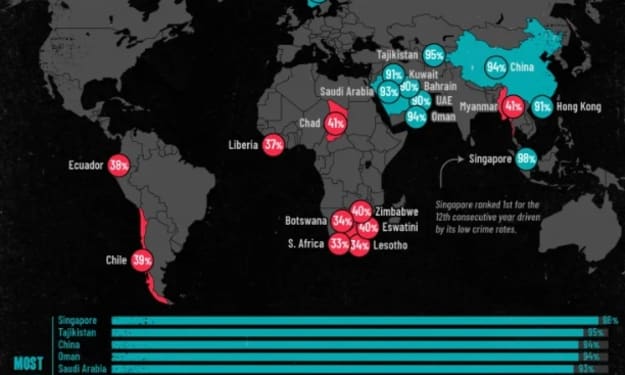
The World’s Safest (and Least Safe) Countries 🤝 . AI-Generated.
When people talk about the “safest” or “least safe” countries in the world, the conversation often sounds simple—almost like a list you can glance at and move on from. But safety is far more complex than a ranking. It’s shaped by politics, culture, economics, geography, and even perception. A country can feel incredibly safe to one person and deeply unsafe to another. Understanding global safety means looking beyond headlines and statistics and into the everyday realities people live with. So what actually makes a country safe—or unsafe? at Does ‘Safety’ Really Mean? Safety isn’t just about crime rates. It includes: Political stability Access to healthcare Trust in law enforcement Freedom from conflict Economic security Social cohesion Natural disaster preparedness Some countries excel in almost all of these areas. Others struggle in multiple ways at once. untries Often Seen as the Safest Many nations consistently earn reputations for safety because of strong institutions and social trust. Countries like Iceland, Switzerland, New Zealand, Japan, and Norway are often described as safe—not because nothing ever goes wrong, but because systems work when something does. In these places: Crime rates are generally low Emergency services respond quickly Governments are relatively transparent Citizens trust public institutions Japan, for example, combines dense cities with remarkably low violent crime. Iceland has no standing army and a deeply rooted culture of social responsibility. Switzerland balances security with neutrality and economic stability. Safety here feels predictable. Life functions. Rules are followed. Disputes are resolved without violence. y These Countries Feel Secure One shared trait among safer countries is strong social contracts—an unspoken agreement between citizens and the state. People pay taxes, follow laws, and trust that institutions will protect them. Corruption exists everywhere, but in safer countries, it’s limited and punishable. Education, healthcare, and economic opportunity also reduce desperation—one of the biggest drivers of crime. untries Often Labeled ‘Least Safe’ On the other end of the spectrum are countries facing conflict, political instability, or economic collapse. Nations affected by prolonged war, civil unrest, or failed governance—such as parts of Afghanistan, Yemen, South Sudan, Syria, and Haiti—are often considered among the least safe. In these places: Law enforcement may be weak or absent Armed groups compete for control Infrastructure is damaged or destroyed Daily survival takes priority over long-term safety However, it’s important to say this clearly: people still live, love, and survive in these countries. Danger does not erase humanity. y ‘Unsafe’ Is Often Oversimplified Labeling a country as unsafe ignores regional and personal realities. A capital city may be dangerous while rural areas remain calm—or vice versa. Tourists may face risks locals know how to avoid. Media coverage also plays a major role. Some countries are portrayed as dangerous because conflict is visible. Others hide deep problems behind polished images. Safety is not evenly distributed, even within borders. e Role of Perception Fear travels faster than facts. A single violent event can define a country’s reputation for years, while long-term instability in “safe” nations often goes unnoticed. Gun violence, inequality, and systemic injustice exist even in wealthy countries—but are normalized. Perception shapes policy, tourism, migration, and even empathy. en Safe Countries Don’t Feel Safe Some nations rank high in safety metrics yet still leave people feeling anxious. High surveillance, social pressure, or lack of personal freedom can create emotional insecurity. Safety isn’t just about avoiding harm—it’s also about feeling free and protected at the same time. at We Can Learn From Both Extremes The world’s safest countries teach us the power of: Trust Education Fair governance Long-term planning The least safe countries remind us what happens when: Institutions collapse Inequality grows unchecked Violence replaces dialogue Neither condition appears overnight—and neither is permanent. Shared Responsibility Global safety isn’t only a national issue. Wars, climate change, pandemics, and economic shocks ignore borders. Stability in one region often depends on justice and peace in another. Understanding safety means moving beyond judgment and toward awareness. nal Thoughts The world is not divided cleanly into safe and unsafe places. It is a spectrum shaped by history, choices, and chance. Instead of asking which country is safest, maybe the better question is: What makes people feel protected, valued, and hopeful? Because that’s where real safety begins.
By Zahid Hussain9 months ago in History
Did Jesus ride one or two donkeys into Jerusalem on Palm Sunday?
Hidden in plain sight Each of the four Gospels tells the story of what today is known as Palm Sunday. This is described as Jesus' triumphant entry into Jerusalem on the first day of the week before his crucifixion.
By Cheryl E Preston9 months ago in History
Cults of Gods: Hephaestus, "Lame" God?
Often portrayed in myth as an outcast, Hephaestus occupied a far more stable and respected position in ancient Greek religious practice. Though depicted as physically imperfect, he was nonetheless firmly established among the Olympian gods and widely revered for his indispensable role in both divine and human craftsmanship.
By Alex Smith9 months ago in History
The Real Santa Claus Explained by Michael Savage, New Canaan
Every December, the image of Santa Claus appears everywhere, from store windows to holiday movies and children’s letters. He is cheerful, generous, and always ready to bring joy. However, behind the red suit and flying reindeer is a true story rooted in history and kindness. Understanding where Santa Claus really came from adds deeper meaning to Christmas. New Canaan’s blogger Michael Savage often says that knowing the origin of holiday traditions helps people appreciate the values behind them, not just the symbols.
By Mike Savage New Canaan9 months ago in History