Latest Stories
Most recently published stories in History.
The Hidden Gems
Once upon a time, in the bustling city of London, lived a young woman named Emily. She had always been captivated by tales of forgotten places and lost histories. Her passion for exploring the unseen corners of the world led her on an extraordinary journey to discover hidden gems, forgotten landmarks that held stories waiting to be told.
By ayeni seunzeal3 years ago in History
Tourism of Kashmir.
Kashmir, often called "Paradise in the world," is a area positioned inside the northern part of the Indian subcontinent. It's miles renowned for its breathtaking natural splendor, picturesque landscapes, and rich cultural history. Kashmir is split between India and Pakistan, with the Indian-administered component being referred to as Jammu and Kashmir.
By Irafan khan 3 years ago in History
Russian Ukraine Conflicts
The Russian invasion of Ukraine is a complex and ongoing conflict that began in 2014 and has had far-reaching consequences for both countries and the international community. In order to summarize this significant event in just 1000 words, we must focus on key aspects and events that have shaped the conflict. The roots of the conflict can be traced back to Ukraine's decision to pursue closer ties with the European Union in 2013, which was met with opposition from Russia. This move by Ukraine was seen as a threat to Russia's influence in the region, particularly in Crimea, a strategically important peninsula that had been under Ukrainian control since the breakup of the Soviet Union. In February 2014, protests erupted in Ukraine's capital, Kiev, demanding closer integration with Europe and the removal of then-President Viktor Yanukovych, who had strong ties to Russia. The protests escalated into violence, resulting in Yanukovych fleeing the country. This power vacuum led to a political crisis, with Russia viewing the situation as an opportunity to exert its influence. In late February 2014, Russian military forces, without official insignia, occupied key infrastructure and government buildings in Crimea. A controversial referendum was hastily organized, which resulted in an overwhelming majority of Crimean residents voting in favor of joining Russia. The international community widely condemned the referendum as illegitimate, considering it a violation of Ukraine's sovereignty and international law. Following the annexation of Crimea, pro-Russian separatist movements emerged in eastern Ukraine, particularly in the Donetsk and Luhansk regions. These separatists, backed by Russia, sought autonomy from the Ukrainian government, citing concerns over language rights and cultural identity. The Ukrainian government, viewing the separatists as a threat to its territorial integrity, launched a military operation to regain control of the region. The conflict quickly escalated into a full-scale war, characterized by intense fighting between Ukrainian armed forces and pro-Russian separatists, with Russia providing support in the form of weapons, military equipment, and even troops. The war has resulted in thousands of casualties and displaced millions of people, creating a humanitarian crisis. Numerous ceasefires and peace agreements have been brokered, including the Minsk Protocol and Minsk II, aimed at de-escalating the conflict and establishing a lasting peace. However, these agreements have been repeatedly violated, with sporadic outbreaks of violence continuing to this day. The international response to the conflict has been varied. The United States and the European Union imposed economic sanctions on Russia in response to its actions in Crimea and Eastern Ukraine. These sanctions have had a significant impact on Russia's economy, but they have not been enough to deter its aggressive behavior. The conflict has strained relations between Russia and the West, with accusations of territorial expansion and violations of international law. NATO has increased its military presence in Eastern Europe as a deterrent against further Russian aggression, while Russia accuses NATO of encroaching on its borders. The conflict in Ukraine has also had geopolitical implications beyond the region. It has highlighted the fragility of post-Cold War international norms and the challenges faced by sovereign nations in the face of aggression from more powerful neighbors. It has raised questions about the role and effectiveness of international organizations, such as the United Nations, in resolving such conflicts. In conclusion, the Russian invasion of Ukraine and the subsequent conflict in Crimea and Eastern Ukraine have had profound consequences for both countries and the international community. The conflict has resulted in loss of life, displacement of people, and a deepening divide between Russia and the West. Achieving a lasting and peaceful resolution remains a significant challenge, and the situation continues to evolve with far-reaching implications.
By Agbasonu Honesta3 years ago in History
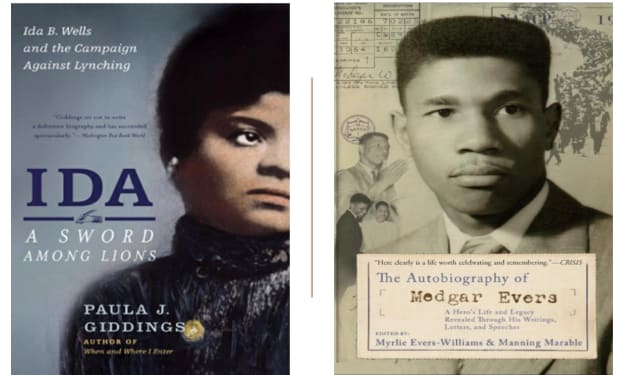
Celebrating Ida B. Wells & Medgar Evers: The Heroine and Hero of Black America
Ida B. Wells was an African American journalist, activist, abolitionist, and feminist who led an anti-lynching crusade in the United States of America in the 1890s. She went on to found and become integral in groups striving for African American justice and freedom. Wells also established several civil rights organizations. For example, in 1896, she formed the National Association of Colored Women, and she is also considered a founding member of the National Association for the Advancement of Colored People (NAACP). Ida B. Wells wrote about issues of race and politics in the south of the U.S. Several of her articles were published in Black newspapers and periodicals under the moniker “Iola.” Wells eventually became an owner of the Memphis Free Speech and Headlight, and later, of the Free Speech.
By Darryl C. Richie3 years ago in History
A History of Violence: Unveiling the Depths of Human Conflict. Content Warning.
Introduction Welcome to our comprehensive guide to the fascinating and fascinating subject of the history of torture. In this article, we delve deep into the history of human civilization, uncovering the origins, causes, and manifestations of violence in each era. Our goal is to provide you with a rich and detailed understanding of this complex phenomenon, highlighting its impact on societies and individuals alike. Join us on this enlightening journey as we explore the depths of humanity's dark side.
By Ahshik official3 years ago in History
Mythical Journeys-Part 1. Content Warning.
Once upon a time, in the small town of Quirktown, there lived a young and ambitious dreamer named Timmy. Timmy had always been fascinated by myths, legends, and fantastical creatures. He would spend hours reading about faraway lands and the incredible adventures that unfolded within them. However, Timmy had a problem. He lived in the real world, where mythical journeys were nothing more than stories on paper.
By Praful Patil3 years ago in History
The Igbo's
Once upon a time, in the highlands of southeastern Nigeria, there existed a tribe known as the Igbo people. They were a proud and industrious people with a rich cultural heritage, steeped in tradition. The Igbo people were known for their elaborate religious ceremonies, their intricate art forms, and their unique language, which was spoken by over 25 million people around the world. The Igbo people were skilled farmers and traders, who lived in villages scattered throughout the region. They were known for their yam cultivation, which was the staple of their diet. The Igbo people had a strong sense of community, and their traditions were passed down from generation to generation, with the elders serving as the keepers of their culture. One of the most important aspects of Igbo culture was their religion. The Igbo people believed in a supreme being known as Chukwu, who was the creator of the world and everything in it. They also believed in numerous lesser deities who oversaw various aspects of their lives. These deities were celebrated in elaborate ceremonies, which involved music, dance, and offerings. The Igbo people were also known for their art, which was expressed in a wide range of forms. Their sculptures were highly detailed, with intricate designs and elaborate symbolism, while their textiles were brightly colored and intricately woven. Music was also an important part of Igbo culture, with various types of instruments used in ceremonies and celebrations. Different instruments such as: 1. Ekwe – A wooden slit drum used for communication, such as announcing an important event or warning of danger. 2. Udu – A clay pot drum with a hollowed-out body and narrow neck used for rhythmic accompaniment to songs or storytelling. 3. Ogene – A metal gong used for signaling, marking time, and announcing important events. 4. Ichaka – A small gourd rattle with seeds or pebbles inside used for rhythmic accompaniment to songs or dances. 5. Oja – A wooden flute used to create different melodies and harmonies in traditional Igbo music. 6. Ekwueme – A set of wooden hands clappers used to create a rhythmic accompaniment to music and dance. 7. Ntaba – A type of Igbo xylophone with wooden keys that are played with mallets. 8. Igba – A type of gourd shaker that is typically used for rhythmic accompaniment in African music. 9. Opi – A type of Igbo lute with a small soundbox and short neck used for solo music or accompaniment. 10. Itotele – A type of drum that is played with the hands, typically used for rhythmic accompaniment to dance and music. One of the most iconic aspects of Igbo culture was their masquerades. These were elaborate performances in which dancers, dressed in intricate costumes, would perform for the community. Masquerades were held for a variety of occasions, including funerals, weddings, and festivals. The performances were often accompanied by drumming and singing, creating a lively and festive atmosphere. Another important aspect of Igbo culture was their traditional system of governance. The Igbo people had a decentralized system of government, with each village being governed by a council of elders. These elders were responsible for making decisions and settling disputes within the community. The Igbo people also had a system of justice, which was based on restorative justice principles. Overall, Igbo culture was a complex and fascinating tapestry of tradition, religion, art, and governance. It was a culture that valued community, creativity, and spirituality. Today, despite the challenges of modernity, the Igbo people remain proud of their heritage and continue to celebrate their culture through various means, including music, art, and literature. Whether through their traditional ceremonies or modern expressions of their culture, the Igbo people continue to inspire and captivate the world with their rich cultural heritage. So if you are a traveler who hasn't ben to any af the igbo states or africa as a whole do well to visit and have you mind blown. The igbo's dont just accept visitors they welcome them full heartedly without any complains
By Favour Elechi 3 years ago in History