Latest Stories
Most recently published stories in History.
A Dangerous Element
Evelyn tucked her black, chin length hair behind her ears as she concentrated on the task before her: painting the numbers on a clock face with luminous radium based paint. The allure of the pale green glowing substance, advertised as a miracle cure-all was somewhat lost on her. She never cared much for fads. She did try some radium infused toothpaste just to see what all the fuss was about, but it seemed to her that it was not much different than regular toothpaste. Putting that aside, this job was the most coveted, highest paying job a young woman of her status could get and Evelyn was driven to succeed.
By Leslie Writes3 years ago in History
Nigeria's Dynamic Journey
Introduction: Nigeria, a vibrant nation in West Africa, has experienced a tumultuous journey of political and social transformation from the 1990s to the 21st century. During this period, the nation witnessed several significant events and movements that have left an indelible mark on its history. From the pro-democracy movement to the Niger Delta conflict and the recent EndSARS protests, Nigeria's path has been shaped by the voices of its people demanding change, justice, and progress.
By Ogbelusi Ebenezer Oluwapelumi3 years ago in History
MARS LIFE!? Possible Mars-based ancient civilization
MARS LIFE!? Possible Mars-based ancient civilization A person, place, or thing is just an event where a number of the Life, whether we want to admit it or not, is elusive and eludes us in so many ways, yet as humans, we continue to try to study it in the hopes that if we capture enough different aspects of it, we will eventually understand it. Events all take place in a sequence, causes and effects, and then results Humanity has sought to understand existence as it truly is and what that implies for as long as we have been aware of ourselves as truly sentient beings. hence, we have populated the planet with our tools and technological wonders
By Francis Dami3 years ago in History
IF I WAS BORN IN THE MIDDLE AGES
Introduction: In the bustling towns and villages of the Middle Ages, amidst the clanging of hammers and the fiery glow of the forge, the blacksmith held a vital and respected position. Serving as the backbone of medieval society, the blacksmith's occupation was instrumental in shaping the world of that time. If I were born in the Middle Ages, I would proudly assume the role of a blacksmith, dedicating my life to the art of metallurgy, crafting essential tools and weapons, and contributing to the growth and prosperity of my community. The Blacksmith's Workshop: The heart of a medieval blacksmith's trade was their workshop. Typically located near the town square, the workshop would be equipped with a sturdy anvil, bellows to fan the flames, and a variety of hammers, tongs, and other specialized tools. The workshop would also have storage areas for different types of metals, such as iron and steel, as well as coal or charcoal to fuel the forge. Crafting Essential Tools: One of the primary responsibilities of a blacksmith in the Middle Ages was crafting essential tools that were crucial for everyday life. Farming implements, such as plows, sickles, and hoes, were in high demand as agriculture formed the backbone of the medieval economy. The blacksmith would carefully shape and temper the metal, transforming raw materials into robust tools capable of withstanding the rigors of laborious tasks. Weapons and Armor: Another significant aspect of a medieval blacksmith's occupation was the production of weapons and armor. In an era characterized by constant warfare, knights, soldiers, and mercenaries relied on the skill of blacksmiths to supply them with high-quality arms. Swords, axes, spears, and shields were forged with great care, ensuring they were not only effective in combat but also durable and well-balanced.
By Chima Chibueze 3 years ago in History
Joe Biden calls Chinese. Content Warning.
Joe Biden stood in front of a crowd of reporters, the weight of his words heavy in the air. He took a deep breath, knowing the significance of what he was about to say. The room was hushed, waiting for the next utterance to escape his lips. The topic at hand was the relationship between the United States and China, a delicate balance that had been tested time and again. With every passing moment, tensions seemed to grow, and now it was up to Biden to address the issue head-on. Biden's voice resonated with authority as he began, "Ladies and gentlemen, today I stand before you to discuss a matter of great importance. The relationship between our two nations, the United States and China, has long been one of complexity and nuance. We have shared interests, but also significant differences. It is with a heavy heart that I must address the actions and policies of President Xi Jinping." His words hung in the air, the silence lingering as anticipation built. Joe Biden had always been known for his measured approach to diplomacy, carefully choosing his words to maintain diplomatic relations. But today, it seemed, he had reached a tipping point. He continued, "I must be frank. President Xi Jinping's leadership in China has taken an undemocratic turn, stifling dissent and limiting freedoms. His consolidation of power and crackdown on human rights have not gone unnoticed. The situation in Hong Kong, the treatment of Ghure Muslims, and the suppression of free speech are deeply concerning." Biden's voice grew stronger, reflecting the gravity of his message. "It is my duty to call out such actions when they occur. In the United States, we believe in the fundamental rights and freedoms of all individuals. We stand against any form of oppression and human rights abuses. President Xi Jinping's approach, in this regard, is that of a dictator." The room erupted in a flurry of questions and camera flashes, as journalists scrambled to capture the moment. Joe Biden stood his ground, firmly stating his position amidst the chaos. He understood the potential consequences of his words, but he also believed in the power of truth and standing up for what is right. "This is not a condemnation of the Chinese people or an attack on the nation as a whole," Biden clarified. "Rather, it is a recognition of the actions of their leader and a call for change. We must hold our partners accountable when they deviate from the principles we hold dear." As the press conference came to an end, Joe Biden left the podium, knowing that his words would have far-reaching consequences. The delicate balance between the United States and China had shifted once again, and only time would tell how the relationship would evolve. But for now, Biden had taken a stand, refusing to shy away from calling out what he saw as an undemocratic turn in China's leadership. As the news spread, reactions varied across the globe. Some applauded Biden's candor, hailing it as a necessary step towards promoting human rights and democracy. Others criticized the timing and potential implications for international relations. Regardless, the impact of his words could not be denied. The world watched as tensions between the two superpowers escalated, uncertain of what the future held. In the end, history would judge the significance of Joe Biden's declaration. But for now, the echoes of his words lingered, shaping the discourse on global politics and reminding the world of the power of diplomacy and truth, even in the face of adversity.
By Pankaj Meena3 years ago in History
The big bird is
Sitting comfortably on the small stone bench, under the shade of the big tree, listening to the friendly cry, looking at the bird cage in the tree, the mind is full of this expectation. The big bird is in the nest again, hoping that they will have more babies.
By Lade Johnathan3 years ago in History
The Gallipoli Campaign
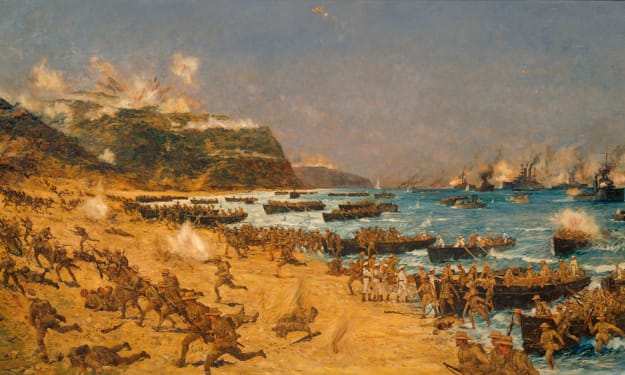
Introduction: The Gallipoli Campaign, which unfolded during World War I from 1915 to 1916, stands as a haunting testament to the perils of strategic miscalculations and the devastating human cost of war. Initiated by the Allied Powers, primarily Australia, New Zealand, Britain, and France, the campaign aimed to seize control of the Dardanelles, a vital waterway that could have threatened the Ottoman Empire's capital, Constantinople (now Istanbul). However, the formidable defenses and fierce determination of the Ottoman forces turned this ambitious venture into a protracted and tragic struggle, resulting in heavy casualties and ultimate failure for the Allies.
By Moiz Tanvir3 years ago in History