Latest Stories
Most recently published stories in History.
1st Governer General of Pakistan
The struggle which started on 1875 by Sir Syed followed by many people like Dr. Muhammad Iqbal and Mr. Jinnah which was formalised in Lahore Resolution in 1940 was finally achieved on 14th of August 1947. British Government agreed on dividing the United India. Red Cliff was sent by the Britishers to divide India. The Radcliffe Commission, dividing Bengal and Punjab, completed its work and reported to Mountbatten on 12 August; the last Viceroy held the maps until the 17th, not wanting to spoil the independence celebrations in both nations. There had already been ethnically charged violence and movement of populations; publication of the Radcliffe Line dividing the new nations sparked mass migration, murder, and ethnic cleansing. Many on the "wrong side" of the lines fled or were murdered, or murdered others, hoping to make facts on the ground which would reverse the commission's verdict. Radcliffe wrote in his report that he knew that neither side would be happy with his award; he declined his fee for the work. Christopher Beaumont, Radcliffe's private secretary, later wrote that Mountbatten "must take the blame—though not the sole blame—for the massacres in the Punjab in which between 500,000 to a million men, women and children perished". As many as 14.5 million people relocated between India and Pakistan during and after partition. Jinnah did what he could for the eight million people who migrated to Pakistan; although by now over 70 and frail from lung ailments, he travelled across West Pakistan and personally supervised the provision of aid. According to Ahmed, "What Pakistan needed desperately in those early months was a symbol of the state, one that would unify people and give them the courage and resolve to succeed. Among the restive regions of the new nation was the North-West Frontier Province. The referendum there in July 1947 had been tainted by low turnout as less than 10 per cent of the population were allowed to vote. On 22 August 1947, just after a week of becoming governor general, Jinnah dissolved the elected government of Dr. Khan Abdul Jabbar Khan. Later on, Abdul Qayyum Khan was put in place by Jinnah in the Pashtun-dominated province despite him being a Kashmiri. On 12 August 1948 the Babrra massacre in Charsadda occurred resulting in the death of 400 people aligned with the Khudai Khidmatgar movement. long with Liaquat and Abdur Rab Nishtar, Jinnah represented Pakistan's interests in the Division Council to appropriately divide public assets between India and Pakistan.Pakistan was supposed to receive one-sixth of the pre-independence government's assets, carefully divided by agreement, even specifying how many sheets of paper each side would receive. The new Indian state, however, was slow to deliver, hoping for the collapse of the nascent Pakistani government, and reunion. Few members of the Indian Civil Service and the Indian Police Service had chosen Pakistan, resulting in staff shortages. The Princely states of India were advised by the departing British to choose whether to join Pakistan or India. But unfortunately they were not allowed to do so practically. There were may states which were captured by India by force. A prominent example is Kashmir which after 75 years is still a conflict region. In January 1948, the Indian government finally agreed to pay Pakistan its share of British India's assets. They were impelled by Gandhi, who threatened a fast until death. Only days later, on 30 January, Gandhi was assassinated by Nathuram Godse, a Hindu nationalist, who believed that Gandhi was pro-Muslim. After hearing about Gandhi's murder on the following day, Jinnah publicly made a brief statement of condolence, calling Gandhi "one of the greatest men produced by the Hindu community. In February 1948, in a radio talk broadcast addressed to the people of the US, Jinnah expressed his views regarding Pakistan's constitution to be in the following way:
By Syed Ammar3 years ago in History
Partition of India
Lahore Resolution was proven a major bench mark towards the partition of India which lead to the Muslim League victory in 1945-46 elections. After the 3rd June 1945 plan it was quite prominent that eventually the India will be divided. After the appointment of Mountbatten, he was warned about Mr. Jinnah that no one had been able to read his mind in the subcontinent yet. Jinnah feared that at the end of the British presence in the subcontinent, they would turn control over to the Congress-dominated constituent assembly, putting Muslims at a disadvantage in attempting to win autonomy. He demanded that Mountbatten divide the army prior to independence, which would take at least a year. Mountbatten had hoped that the post-independence arrangements would include a common defence force, but Jinnah saw it as essential that a sovereign state should have its own forces. Mountbatten met with Liaquat the day of his final session with Jinnah, and concluded, as he told Attlee and the Cabinet in May, that "it had become clear that the Muslim League would resort to arms if Pakistan in some form were not conceded. The Viceroy was also influenced by negative Muslim reaction to the constitutional report of the assembly, which envisioned broad powers for the post-independence central government. On 3 June, Mountbatten, Nehru, Jinnah and Sikh leader Baldev Singh made the formal announcement by radio. Jinnah concluded his address with "Pakistan Zindabad " (Long live Pakistan), which was not in the script. In the weeks which followed Punjab and Bengal cast the votes which resulted in partition. Sylhet and the N.W.F.P. voted to cast their lots with Pakistan, a decision joined by the assemblies in Sind and Baluchistan. Mountbatten was hoping to rule India even after the partition. Liaqat Ali Khan on the behalf of Mr. Jinnah asked Mountbatten to make Mr. Jinnah the first Governer General of Pakistan. This angered Mountbatten, he denied his proposal and said he would be India's first post-independence governor-general—but Jinnah felt that Mountbatten would be likely to favour the new Hindu-majority state because of his closeness to Nehru. In addition, the governor-general would initially be a powerful figure, and Jinnah did not trust anyone else to take that office. Although the Boundary Commission, led by British lawyer Sir Cyril Radcliffe, had not yet reported, there were already massive movements of populations between the nations-to-be, as well as sectarian violence. Jinnah arranged to sell his house in Bombay and procured a new one in Karachi. On 7 August, Jinnah, with his sister and close staff, flew from Delhi to Karachi in Mountbatten's plane, and as the plane taxied, he was heard to murmur, "That's the end of that. On 11 August, he presided over the new constituent assembly for Pakistan at Karachi, and addressed them, "You are free; you are free to go to your temples, you are free to go to your mosques or to any other place of worship in this State of Pakistan. You may belong to any religion or caste or creed—that has nothing to do with the business of the State I think we should keep that in front of us as our ideal and you will find that in course of time Hindus would cease to be Hindus and Muslims would cease to be Muslims, not in the religious sense, because that is the personal faith of each individual, but in the political sense as citizens of the State. On 14 August, Pakistan became independent; Jinnah led the celebrations in Karachi. One observer wrote, "here indeed is Pakistan's King Emperor, Archbishop of Canterbury, Speaker and Prime Minister concentrated into one formidable Quaid-e-Azam.
By Syed Ammar3 years ago in History
Lahore Resolution and its impact Part 3
By the end of 1939, Muslim League was in quite a position. After the electoral loss 1936-37, the leaders of Muslim League went quite serious. The Lahore Resolution (sometimes called the "Pakistan Resolution", although it does not contain that name), based on the sub-committee's work, embraced the Two-Nation Theory and called for a union of the Muslim-majority provinces in the northwest of British India, with complete autonomy. Similar rights were to be granted to the Muslim-majority areas in the east, and unspecified protections given to Muslim minorities in other provinces. The resolution was passed by the League session in Lahore on 23 March 1940. Gandhi's reaction to the Lahore Resolution was muted; he called it "baffling", but told his disciples that Muslims, in common with other people of India, had the right to self-determination. Leaders of the Congress were more vocal; Jawaharlal Nehru referred to Lahore as "Jinnah's fantastic proposals" while Chakravarti Rajagopalachari deemed Jinnah's views on partition "a sign of a diseased mentality". Linlithgow met with Jinnah in June 1940, soon after Winston Churchill became the British prime minister, and in August offered both the Congress and the League a deal whereby in exchange for full support for the war, Linlithgow would allow Indian representation on his major war councils. The Viceroy promised a representative body after the war to determine India's future, and that no future settlement would be imposed over the objections of a large part of the population. This was satisfactory to neither the Congress nor the League, though Jinnah was pleased that the British had moved towards recognising Jinnah as the representative of the Muslim community's interests. Jinnah was reluctant to make specific proposals as to the boundaries of Pakistan, or its relationships with Britain and with the rest of the subcontinent, fearing that any precise plan would divide the League. During the world war, British Government sent Sir Stafford Cripps with a proposal which was rejected by Mr. Jinnah. The Congress followed the failed Cripps mission by demanding, in August 1942, that the British immediately "Quit India", proclaiming a mass campaign of satyagraha until they did. The British promptly arrested most major leaders of the Congress and imprisoned them for the remainder of the war. Gandhi, however, was placed on house arrest in one of the Aga Khan's palaces prior to his release for health reasons in 1944. After some time in 1945-46 another election was conducted and British declared it like a referendom towards the demands of the people of India. In the December 1945 elections for the Constituent Assembly of India, the League won every seat reserved for Muslims. In the provincial elections in January 1946, the League took 75% of the Muslim vote, an increase from 4.4% in 1937. In February 1946, the British Cabinet resolved to send a delegation to India to negotiate with leaders there. This Cabinet Mission included Cripps and Pethick-Lawrence. The highest-level delegation to try to break the deadlock, it arrived in New Delhi in late March. Little negotiation had been done since the previous October because of the elections in India. The British in May released a plan for a united Indian state comprising substantially autonomous provinces, and called for "groups" of provinces formed on the basis of religion. Matters such as defence, external relations and communications would be handled by a central authority. Provinces would have the option of leaving the union entirely, and there would be an interim government with representation from the Congress and the League. Jinnah and his Working Committee accepted this plan in June, but it fell apart over the question of how many members of the interim government the Congress and the League would have, and over the Congress's desire to include a Muslim member in its representation. Before leaving India, the British ministers stated that they intended to inaugurate an interim government even if one of the major groups was unwilling to participate. In 1946, Jwahallal Nehru and Liaqat Ali Khan had meetings in London discussing the partition plan but unfortunately the meetings didn't went fruitful.
By Syed Ammar3 years ago in History
Leader of Pakistan
Muhammad Ali Jinnah when realized that the people of subcontinent particularly Muslims are not taking interest in Politics, he went to london. The early 1930s saw a resurgence in Indian Muslim nationalism, which came to a head with the Pakistan Declaration. In 1933, Indian Muslims, especially from the United Provinces, began to urge Jinnah to return and take up again his leadership of the Muslim League, an organisation which had fallen into inactivity. He remained titular president of the League, but declined to travel to India to preside over its 1933 session in April, writing that he could not possibly return there until the end of the year. Among those who met with Jinnah to seek his return was Liaquat Ali Khan, who would be a major political associate of Jinnah in the years to come and the first Prime Minister of Pakistan. At Jinnah's request, Liaquat discussed the return with a large number of Muslim politicians and confirmed his recommendation to Jinnah.In early 1934, Jinnah relocated to the subcontinent, though he shuttled between London and India on business for the next few years, selling his house in Hampstead and closing his legal practice in Britain. Muslims of Bombay elected Jinnah, though then absent in London, as their representative to the Central Legislative Assembly in October 1934. The British Parliament's Government of India Act 1935 gave considerable power to India's provinces, with a weak central parliament in New Delhi, which had no authority over such matters as foreign policy, defence, and much of the budget. Full power remained in the hands of the Viceroy, however, who could dissolve legislatures and rule by decree. The League reluctantly accepted the scheme, though expressing reservations about the weak parliament. The Congress was much better prepared for the provincial elections in 1937, and the League failed to win a majority even of the Muslim seats in any of the provinces where members of that faith held a majority. It did win a majority of the Muslim seats in Delhi, but could not form a government anywhere, though it was part of the ruling coalition in Bengal. The Congress and its allies formed the government even in the North-West Frontier Province (N.W.F.P.), where the League won no seats despite the fact that almost all residents were Muslim. According to Jaswant Singh, "the events of 1937 had a tremendous, almost a traumatic effect upon Jinnah". Despite his beliefs of twenty years that Muslims could protect their rights in a united India through separate electorates, provincial boundaries drawn to preserve Muslim majorities, and by other protections of minority rights, Muslim voters had failed to unite, with the issues Jinnah hoped to bring forward lost amid factional fighting. Singh notes the effect of the 1937 elections on Muslim political opinion, "when the Congress formed a government with almost all of the Muslim MLAs sitting on the Opposition benches, non-Congress Muslims were suddenly faced with this stark reality of near-total political powerlessness. It was brought home to them, like a bolt of lightning, that even if the Congress did not win a single Muslim seat as long as it won an absolute majority in the House, on the strength of the general seats, it could and would form a government entirely on its own. In the next two years, Jinnah worked to build support among Muslims for the League. He secured the right to speak for the Muslim-led Bengali and Punjabi provincial governments in the central government in New Delhi ("the centre"). He worked to expand the League, reducing the cost of membership to two annas (1⁄8 of a rupee), half of what it cost to join the Congress. He restructured the League along the lines of the Congress, putting most power in a Working Committee, which he appointed. By December 1939, Liaquat estimated that the League had three million two-anna members.
By Syed Ammar3 years ago in History
Muhammad Ali Jinnah
Leader is a person who admires the public through his leadership qualities, his vision and his ideology. It is the leader for whose sake million of people get ready to give away their lives. There have been several leaders in the world who had revolutionarized the people through their struggle and vision. Specifically talking about South Asia, the greatest leader of his time was Muhammad Ali Jinnah affectionately known as Quaid-e-Azam. He was the one who gave the people of subcontinent a hope to live independently and to breath in freedom. Talking about his biography, he was born on 25th December,1876 in Karachi. He took early education from his local city and then for higher education he went to London where he did Bar at law from Lincon Inn. College. On his return he started practicing law in Karachi. But he didn't find many opportunities. So he moved to Mumbai. There he was actually able to express his real talent. He also started taking part in active politics. Jinnah rose to prominence in the Indian National Congress in the first two decades of the 20th century. In these early years of his political career, Jinnah advocated Hindu–Muslim unity, helping to shape the 1916 Lucknow Pact between the Congress and the All-India Muslim League, in which Jinnah had also become prominent. Jinnah became a key leader in the All-India Home Rule League, and proposed a fourteen-point constitutional reform plan to safeguard the political rights of Muslims in the Indian subcontinent. In 1920, however, Jinnah resigned from the Congress when it agreed to follow a campaign of satyagraha, which he regarded as political anarchy. In September 1923, Jinnah was elected as Muslim member for Bombay in the new Central Legislative Assembly. He showed much skill as a parliamentarian, organising many Indian members to work with the Swaraj Party, and continued to press demands for full responsible government. In 1925, as recognition for his legislative activities, he was offered a knighthood by Lord Reading, who was retiring from the Viceroyalty. He replied: "I prefer to be plain Mr Jinnah." In 1927, the British Government, under Conservative Prime Minister Stanley Baldwin, undertook a decennial review of Indian policy mandated by the Government of India Act 1919. The review began two years early as Baldwin feared he would lose the next election (which he did, in 1929). The Cabinet was influenced by minister Winston Churchill, who strongly opposed self-government for India, and members hoped that by having the commission appointed early, the policies for India which they favoured would survive their government. The resulting commission, led by Liberal MP John Simon, though with a majority of Conservatives, arrived in India in March 1928. Later on some unexpected and unusual events happened due to which Mr. Jinnah quit politics and went to England. In 1931, Fatima Jinnah joined her brother in England. From then on, Muhammad Jinnah would receive personal care and support from her as he aged and began to suffer from the lung ailments which would eventually kill him. She lived and travelled with him, and became a close advisor. Muhammad Jinnah's daughter, Dina, was educated in England and India. Jinnah later became estranged from Dina after she decided to marry a Parsi, Neville Wadia from a prominent Parsi business family. Wadia is the son Sir Ness Wadia and Dr. Homi Wadia. When Jinnah urged Dina to marry a Muslim, she reminded him that he had married a woman not raised in his faith. Jinnah continued to correspond cordially with his daughter, but their personal relationship was strained, and she did not come to Pakistan in his lifetime, but only for his funeral.
By Syed Ammar3 years ago in History
Why the Great Sphinx's Secret Door Is Never Opened
The explanation for why it seems like you can unlock any door these days is that some doors have been locked for serious reasons, and no one has yet discovered what treasures as well as mysteries they conceal. Here are four entrances that maintain their contents hidden all too well. Numerous stores around the globe haven't been accessible for decades or even centuries. The Taj Mahal is the first stop on our list. It is located in India and is one of the greatest romantic destinations in the world. Shah Jahan ordered the Taj Mahal in 1631 to be dedicated to his third wife, whom he adored immensely. They were wed for 19 years as well as had a staggering 14 children together before she died, giving conception to their last child. Heartbroken, Shah Jahan decided to construct an incredible tomb to remember her. The Taj Mahal's construction took 20 years to complete. The principal architect of the Taj Mahal made sure to position those minarets as far removed from the tomb as feasible and even cocked them in a way to ensure that if they did fall, they would not wreck the remainder of the Taj Mahal—talk about planning—because back in the 17th century, architects were having several serious issues with structures bursting under their weight. The Taj Mahal is also concealing some crazy Secrets—there are sealed spaces everywhere that nobody can enter. No air flows to these rooms, making it worse if too much carbon dioxide builds up in the basement and the four minarets collapse. But wait, there's more. Some researchers believe they were constructed using marble, which changes into an alternative material identified as calcium carbonate if exposed to carbon dioxide. When that happens, little bits of marble begin chipping off frantically. the Giza Great Sphinx, The building of this marvel took regarding three years and involved nearly 100 individuals who were not enslaved. They were treated to delicious foods like sheep and goat meat. It is also believed that it took about 100 workers three years to complete. The Great Sphinx of Giza remains shrouded in mystery. It is not only the biggest monolith statue in the globe, but it is also a hybrid being with a woman's head and a lion's body that comes from Egyptian and Greek mythology. It is The Sphinx's true secrets are hidden underneath, close to its paws, where archaeologists have discovered enormous stone blocks and discarded toolkits. Scientists discovered two secret chambers beneath the paws of the Sphinx by using a seismograph. Some believe these chambers are the fabled Hall of Records, which is said to contain ancient Scrolls showing the mysteries of the cosmos. That's far cooler than every library I have ever been to, and there are rumors that the Egyptians might have had information about Atlantis stashed there. Still, we cannot embark on an adventure to investigate that just yet. The chambers probably have two entrances, but both remain sealed. The researchers have not yet been permitted to test out their theory; hopefully, they won't keep us waiting for too long. There are six vaults beneath the temple, which have been imaginatively identified as A, B, C, D, E as well as F. The huge iron entrances to these Chambers add to the unknown of what lies behind them. Swami Temple is a temple in the lovely state of Kerala in India. The government decided to open these safes to the public a few years ago, but it wasn't an easy task—you couldn't just open the doors as well as enter the vaults. It took them some time, but in 2011, they widened five out of the six Chambers, and guess what they discovered? Tonnes of treasure bags filled with gold, precious stones, and priceless diamond jewelry. The estimated value of everything they discovered in the vaults is an astounding $1 trillion—it's like the temple was found. There is a rumor that in the 1930s, some Temple Invaders attempted to get into Vault B to do a bit of good old pillaging, but they never reached their target. presumably, terrible snakes materialized out of nowhere as well as chased the gang out, but of course, this is simply an urban legend, and there isn't any proof of this. Legend states that only a saint or Sage may break the enchantment by chanting a particular mantra, but no one has ever been capable of doing this, presumably since we don't have Saints. Chin Sure Huang, the first emperor of China, was born in the Chin State and got king when he was just a boy. Still, when he grew and eventually gained full power, he unified the Warring States that ancient China had been divided into by capturing them, after which he created the Qin dynasty. When he passed away in 210 BCE, they buried him completely underground. His tomb is deep under a hill, undisturbed and surrounded by hazardous traps. Intriguingly, the central tomb is still undiscovered, considered the Emperor's final resting place. In ancient records, there are names for a vast below-ground city that the Emperor constructed, including Scenic Towers, castles, and whatnot. These soldiers are unique in that each has distinctive characteristics ranging from hairstyles to how they look. It is thought that there may be up to 8,000 of these soldiers. The tomb was decorated with riches and had room for hundreds of officials, according to Simachian, a Han Dynasty historian. Still, the lack of equipment to thoroughly inspect the site is delaying matters. The ancient Chinese believed that mercury could grant immortality, but it could also have triggered the Emperor's death since he frequently took Mercury pills to prolong his life. The hazardous levels of mercury contamination found in the soil near the tomb are the primary reasons scientists are reluctant to investigate it because it could be very dangerous. Huang was encircled by liquid mercury in his tomb, with two of the streams corresponding to the main waterways of China, the Yellow River and the Yangtze
By Ian Sankan3 years ago in History
Rwanda and the genocide
The Rwandan genocide was a horrific event that took place in 1994. Over the course of 100 days, Hutu extremists killed an estimated 800,000 Tutsi and moderate Hutu. The genocide was rooted in centuries of ethnic tension and political division, but it was ultimately triggered by the assassination of Rwandan President Juvénal Habyarimana.
By Tanguy Diaco3 years ago in History
LIFE HISTORY OF AKBAR CHAPTER : 1(AKBAR'S LIFE)
Akbar the Great, also known as Akbar I, was one of the most renowned and influential rulers of the Mughal Empire in India. He was born on October 15, 1542, in Umerkot, Sindh (present-day Pakistan) to Emperor Humayun and Hamida Banu Begum. His birthplace is known as Umerkot Fort and is now a popular historical site.
By Dhishon Alaf singh R3 years ago in History
The First Chapter of the Next Great Philippines Novel
In the heart of the Philippine archipelago, where emerald hills met crystal-clear waters, a tale of triumphs and struggles was about to unfold. This was a land of beauty and contradictions, where the echoes of a tumultuous past reverberated alongside the resolute spirit of its people.
By MJ Rimando3 years ago in History
Facts about Lord Krishna
Lord Krishna, one of the most revered and beloved deities in Hinduism, is a figure of great significance and influence in Indian mythology and culture. His life and teachings are chronicled in the epic Mahabharata and the Bhagavad Gita, making him a central character in these ancient scriptures. Here are some interesting facts about Lord Krishna:
By Harish Ramaiah3 years ago in History
We now know how the Easter Island giants were transported.
The significance of the Easter Island gigantic heads has been unresolved for hundreds of years, but we ought to know how they were created and brought to their permanent site. Three components make up the moai statues. a broad yellow body a red hat or top knot as well as white inset eyes alongside a coral Iris within 1 000 of them were generated the main bodies of the majority of the statues were created out of volcanic difficult from a local Quarry in what utilised to be a volcano the substance is easy to carve but rather than so easy to transport that's undoubtedly why investigators found over 300 incomplete moai back in the Quarry the rest of them remain in various spots facing the villages as if viewing over the locals so it appears like the statues were carved lying on their backs then their creators separated them from the rock move them down slope as well as set them in a vertical position to complete the work immediately it was done it was moments to get the statue to its structure now if you've ever moved resides you know how physically hard it is so envision having to shift a statue that is regarding half as heavy as a house with no a car or any modern machinery for a separation of three miles the residents must have created some original way of performing it and scientists attempted to re-create it to believe what it was they tried pulling moai replicas on wooden sleds they thought an individual could have used palm trees for that objective but this theory has been debunked the most effective experiment so far was wielding ropes to rock the statue down the roadway in a standing position this method sounds real since the local rapper no I Legends stated that the moai walked from the Quarry and of naturally they needed a good road to get there in the early 20th century the investigator Catherine Rutledge discovered an 800 year old Road Network on the island it was a bunch of Pathways within 15 feet wide heading from the tribunal she thought that those roads were symbolic and not constructed just for the statues she wasn't a famous scientist back then so others mainly ignored the theory multiple decades later famous Norwegian Adventurer as well as archaeologist Thor heredol published his concept he stated that the roads were built only to transport the moai and some of the statues were dropped together the roads for some evidence but in 2010 researchers found that the statues weren't at random fell they actually reached their final destinations as they were all set on concealed platforms plus the road floor was u-shaped so pulling enormous statues along them wouldn't be easy you might still find roughly 15.5 miles of these roads on the island as well as see them from satellite pictures and it looks like Catherine Rutledge was right about them Halfway around the world, in Southern England, lies another enigma. The roads were likely constructed for pilgrims travelling to a sacred volcano, and the moai sitting by them served as signposts. Made of Stone a massive sound illusion a symbol of unity a burial ground or greater scientists are still discussing the objective of Stonehenge it took Neolithic Builders around 1500 years to build this Beauty created of roughly 100 Stones standing straight in a circle millions of tourists come to see it every year as well as Heritage protectors were worried regarding the modern Road snaking close to the symbol that contemporary Road is now sunk into the ground below the grass level as well as even though archaeologists believed they could find an older Road under it they didn't possess any high hopes but when they utilised off a layer of asphalt they noticed two parallel ditches that were almost perpendicular to the Road the ditches linked the shortened portions of the Avenue that's what the archaeologists call the ancient route leading up to Stonehenge it indicates that the ancient individuals used to visit the monument for their purposes and undoubtedly some ceremonies another intriguing find during a dry summer was three dry patch signifies within the stone circle it appears like they were left there by three massive boulders so Stonehenge might have been a full circle once in 2021 archaeologists discovered a Roman Road submerged in the Venetian Lagoon the reality that it runs there on the bottom for nearly 4 000 feet is evidence that the Romans were here prior to sea levels Rose as well as flooded the area it encourages the theory that there was an important settlement here centuries prior to Venice was established at the spot in the 5th Century CE the ancient Romans were excellent at a lot things and one of them was building roads and it appears like they weren't afraid to work on the trickiest terrain The old Road was constructed directly on the sand, according to scans, and it calls for some considerable expertise. Put yourself in a village from more than a thousand years ago. Researchers discovered this village in 2011 in present-day El Salvador. They believe a large celebration occurred in a Maya village called Sarin more than 1400 years ago. The entire village was getting ready for the main Temple for the ceremony when a nearby volcano erupted. The 200+ residents had no opportunity to rush back to their homes. They were left behind, frozen in time, with still half-eaten food on the plates and personal items left in a hurry. All Sac ach roads had a stone outer layer, but this one's outside layer was constructed of ash, which is hilarious because it demonstrates that the Maya didn't simply employ stones to construct their roads. Since Pontius Pilot was the local governor when the Road was built, it is almost certain that he gave the order. Pilgrims most likely used this Road to get to Temple Mount for battle. The pathway, constructed with over ten thousand tonnes of limestone, was nearly as broad as a London bridge. The original Travellers moved around the globe down the trails for thousands of miles before the initial Europeans arrived, and they even used it to transport trade goods during the last ice age. This ancient highway, known as the old North Trail, was used by the people of North America for ten thousand years, first on foot, then with dogs, and finally with horses. the people who crossed via Asia on the Bering land bridge approximately 15 000 years ago, as well as settled in North America, may have used the ice-free corridor to travel to visit relatives, find a mate, or simply explore. Researchers keep uncovering evidence that the Blackfoot Indians' tales and legends about this Trail are true, and it may even be the route used by one of the largest human migrations. The nakasendo highway, one of the five primary routes utilised by the feudal lords as well as their households to travel to the Capitol, originated in the 17th century in Japan during the Edo period and runs along the Rockies, which subsequently grew a part of the Trail. The 310-mile Road operates across mountain ranges before plunging onto the plain. There were 69 post stops along the route where travellers could stay the night. The Road was constructed for horses and pedestrians.
By Ian Sankan3 years ago in History
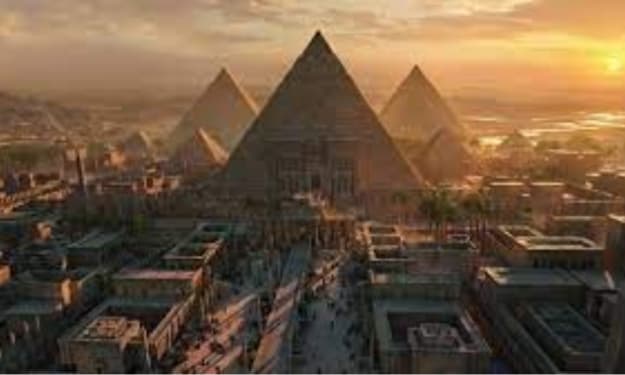
The Ancient Egyptian Civilization. Content Warning.
The Ancient Egyptian Civilization stands as one of the most extraordinary and enduring cultures in the annals of human history. Flourishing along the banks of the Nile River for over three millennia, this ancient society left an indelible mark on the development of human civilization. With its monumental achievements in art, architecture, religion, governance, and societal structures, Ancient Egypt continues to captivate the imagination of scholars, historians, and enthusiasts alike. This comprehensive study document seeks to delve deep into the fascinating world of Ancient Egypt, unravelling its mysteries and shedding light on the various facets that contributed to its rise, evolution, and lasting impact on the world.
By Nizam malang3 years ago in History