
Kohinoor Diamond History: The Curse, British Crown and India’s Fight to Bring It Back
From the mines of Golconda to the British Crown, the Kohinoor has passed through powerful empires, witnessed brutal betrayals, and become one of the world’s most disputed treasures.

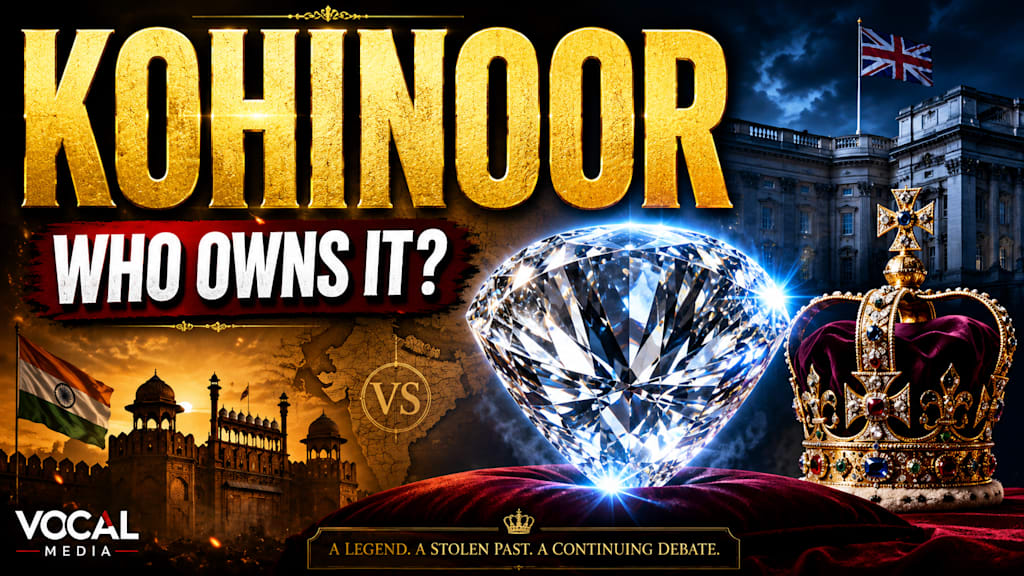
Few objects in human history have inspired as much fascination, conflict, and controversy as the Kohinoor diamond. Its name means “Mountain of Light,” but its journey has often been surrounded by darkness.
Over several centuries, the diamond passed through the hands of Indian dynasties, Mughal emperors, Persian invaders, Afghan rulers, Sikh royalty, and finally the British monarchy. Almost every powerful ruler wanted to possess it. Yet according to legend, many of the men who owned the Kohinoor later suffered defeat, imprisonment, betrayal, or death.
Today, India, Pakistan, Afghanistan, and Iran have all presented historical claims over the diamond. Britain, however, continues to maintain that it acquired the Kohinoor legally.
So where did the Kohinoor really come from, and why has it never returned to India?
The Kohinoor’s Origin in Golconda
The Kohinoor is widely associated with the historic Golconda diamond-mining region of India. According to the popular account, the diamond was discovered around 1306 near the Krishna River in present-day Andhra Pradesh.
At the time, the region was ruled by the Kakatiya dynasty. The original diamond is believed to have weighed approximately 793 carats, making it dramatically larger than the stone seen today.
The Kakatiya rulers reportedly placed the diamond in the Bhadrakali Temple in Warangal. It was said to have been positioned as one of the eyes of Goddess Bhadrakali.
This period is also connected to the beginning of the Kohinoor curse legend. According to the superstition, the diamond would grant immense power to its owner but eventually bring misfortune. Only a god or a woman could possess it safely.
There is no conclusive historical proof that the diamond was genuinely cursed. However, the legend became stronger each time one of its owners lost power or met a tragic end.
From the Kakatiyas to the Delhi Sultanate
The Kakatiya kingdom was eventually attacked by Malik Kafur, a military commander serving Alauddin Khilji. After the kingdom’s defeat, its treasures were taken to Delhi.
The diamond then moved through several dynasties as political power changed hands. It was reportedly possessed by the Khiljis and later by other rulers of the Delhi Sultanate.
Eventually, the stone came under the control of Mughal emperor Babur after his victory over Ibrahim Lodi. At that time, it was not yet commonly known as the Kohinoor. It was often referred to as the “Babur Diamond.”
Babur reportedly believed the jewel was so valuable that its price could feed the entire world for a day.
The diamond later passed to Babur’s son Humayun. After being defeated by Sher Shah Suri, Humayun fled to Persia and sought protection from Shah Tahmasp. During this period, the diamond temporarily left India before eventually returning through political alliances.
Shah Jahan and the Peacock Throne
By the seventeenth century, the diamond had reached Mughal emperor Shah Jahan, the ruler best known for commissioning the Taj Mahal.
Shah Jahan became deeply fascinated by the stone. He ordered a diamond cutter named Hortensio Borgio to improve its brilliance. However, the cutting process dramatically reduced its weight, reportedly bringing it down to around 280 carats.
The emperor was furious with the result and allegedly punished the diamond cutter instead of rewarding him.
The jewel was later incorporated into Shah Jahan’s legendary Peacock Throne, one of the most expensive royal thrones ever created. Covered in gold, pearls, rubies, emeralds, and other precious stones, the throne represented the extraordinary wealth of the Mughal Empire.
But the Mughal dynasty gradually weakened. In 1739, Persian ruler Nadir Shah invaded Delhi and seized enormous amounts of treasure.
According to a famous account, Mughal emperor Muhammad Shah had hidden the diamond inside his turban. Nadir Shah discovered the secret and proposed a ceremonial exchange of turbans.
When the diamond fell from the turban, Nadir Shah reportedly exclaimed, “Koh-i-Noor”—the Mountain of Light.
That name has remained with the diamond ever since.
Afghanistan and Maharaja Ranjit Singh
After Nadir Shah’s assassination, the Kohinoor passed into the hands of Ahmad Shah Durrani, founder of the Durrani Empire in Afghanistan.
It remained within the Afghan royal family before eventually reaching Shah Shuja Durrani. After losing power, Shah Shuja’s family sought protection from Maharaja Ranjit Singh, the powerful founder of the Sikh Empire.
Shah Shuja’s wife reportedly promised the Kohinoor to Ranjit Singh in exchange for rescuing her husband. After considerable pressure and negotiation, the diamond was handed over to the Sikh ruler in 1813.
Maharaja Ranjit Singh proudly wore the Kohinoor on special occasions. Before his death in 1839, he reportedly wished to donate it to the Jagannath Temple. However, royal officials argued that the diamond belonged to the Sikh state rather than to the Maharaja personally.
The donation was never completed.
Following Ranjit Singh’s death, the Sikh Empire experienced a devastating leadership crisis. Several rulers died under suspicious or violent circumstances, strengthening public belief in the Kohinoor’s curse.
How Britain Took the Kohinoor
After defeating the Sikh Empire, the British annexed Punjab. The young Maharaja Duleep Singh, who was still a child, was made to sign the Treaty of Lahore.
Article III of the treaty transferred the Kohinoor to Queen Victoria.
Britain considers this treaty evidence of legal ownership. Critics argue that the agreement cannot be considered voluntary because Duleep Singh was a minor, his mother had been removed from power, and British authorities controlled the administration.
The diamond was transported to England in 1850 aboard HMS Medea. The journey itself was reportedly troubled by disease and a severe storm.
After reaching Britain, the stone was presented to Queen Victoria. It was later recut to increase its brilliance, reducing its weight to its present size of 105.6 carats.
The Kohinoor eventually became part of the British Crown Jewels. Because of the old curse legend, it has traditionally been associated with female members of the royal family rather than male monarchs.
Why Hasn’t the Kohinoor Returned to India?
India formally requested the return of the Kohinoor after gaining independence in 1947. Further demands followed over the decades.
Pakistan has argued that the diamond was taken from Lahore, which was once the capital of the Sikh Empire. Afghanistan has connected its claim to the Durrani rulers, while Iran has pointed to its possession by Persian monarchs.
Britain rejects these demands and maintains that the diamond was acquired under the Treaty of Lahore.
Modern international heritage laws also create difficulties. Important conventions governing the return of cultural property generally do not apply retroactively to objects removed during the nineteenth century.
Indian courts also cannot directly order the British government to surrender an item held in the United Kingdom.
In 1998, journalist and Rajya Sabha member Kuldip Nayar gathered signatures from dozens of Indian MPs—including Manmohan Singh—for a petition demanding the diamond’s return. However, the campaign did not produce a legal breakthrough.
A Diamond That Represents More Than Wealth
The Kohinoor is no longer valuable simply because of its size or clarity. Its importance comes from what it represents.
To Britain, it is part of the Crown Jewels and royal history. To many Indians, it represents colonial exploitation and the forced removal of cultural heritage. For Pakistan, Afghanistan, and Iran, it is also connected to chapters of their own imperial past.
The stories surrounding its curse may be impossible to prove, but its history of war, ambition, betrayal, and political collapse is very real.
The Kohinoor has survived dynasties, invasions, assassinations, and the rise and fall of empires. Yet the most important question surrounding the Mountain of Light remains unanswered:
Who truly owns the Kohinoor?
About the Creator
parwinder singh
🎬 Movie & Entertainment Writer sharing reviews, ending explanations, story breakdowns, plot twists and hidden details from Bollywood, Hollywood, South Indian cinema, Korean dramas and OTT releases.
Enjoyed the story? Support the Creator.
Subscribe for free to receive all their stories in your feed.
Comments
There are no comments for this story
Be the first to respond and start the conversation.