
Judicial Review Explained: How Courts Protect Constitutional Rights and Democracy
From Marbury v. Madison to modern constitutional disputes, judicial review remains one of the most powerful tools for preserving the rule of law, maintaining checks and balances, and safeguarding individual freedoms.

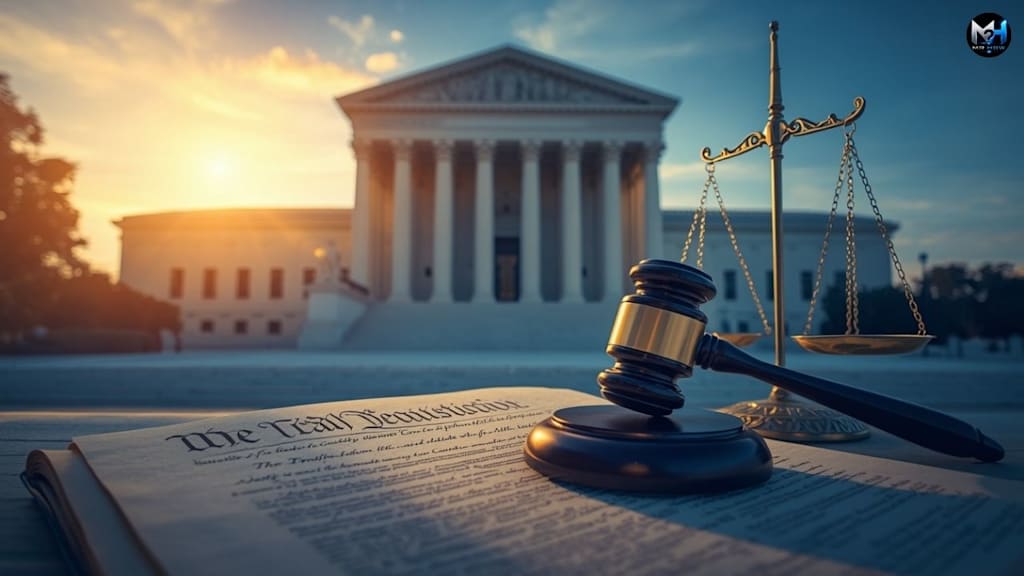
In every constitutional democracy, there must be a mechanism that ensures government power remains within legal limits. Laws are passed, executive orders are issued, and policies are implemented every day, but who determines whether these actions comply with the constitution? The answer lies in a legal doctrine known as judicial review, one of the most influential principles in modern constitutional governance.
Judicial review is the authority of courts to examine laws, regulations, and government actions to determine whether they are consistent with a nation's constitution. If a court finds that a law or action violates constitutional principles, it may declare it invalid. This power has become a cornerstone of democratic systems because it helps maintain the balance between government authority and individual rights.
Although judicial review is now widely accepted in the United States, the Constitution does not explicitly grant this power to the judiciary. Instead, the doctrine emerged through legal interpretation and historical practice. The most famous example is the 1803 Supreme Court case Marbury v. Madison, which established judicial review as a fundamental principle of American constitutional law.
The significance of Marbury v. Madison cannot be overstated. In that case, Chief Justice John Marshall argued that the Constitution is the supreme law of the land. Therefore, when a law enacted by Congress conflicts with the Constitution, courts must follow the Constitution. This reasoning transformed the judiciary into an independent guardian of constitutional principles. More than two centuries later, the decision remains one of the most cited and studied cases in legal history.
However, the concept of judicial review did not suddenly appear in 1803. Historical evidence suggests that many of the Constitution's framers expected courts to exercise such authority. Alexander Hamilton, writing in The Federalist No. 78, argued that judges must interpret laws according to the Constitution whenever conflicts arise. Early state courts also invalidated laws that violated state constitutions before the federal Constitution was adopted. These examples demonstrate that judicial review was already developing as a legal principle before it was formally recognized by the Supreme Court.
One of the primary purposes of judicial review is to uphold the system of checks and balances. In democratic governments, power is divided among different branches to prevent any single institution from becoming too dominant. Legislatures create laws, executives enforce them, and courts interpret them. Judicial review ensures that neither lawmakers nor government officials exceed the powers granted to them by the Constitution.
This function is especially important when individual rights are at stake. Throughout history, courts have used judicial review to evaluate laws affecting freedom of speech, religious liberty, due process, equal protection, and voting rights. By reviewing government actions through a constitutional lens, courts can protect citizens from abuses of power and preserve fundamental freedoms.
Judicial review also plays a vital role in administrative law. Modern governments rely heavily on administrative agencies to regulate industries, enforce environmental standards, oversee public health, and manage countless other responsibilities. Courts frequently review agency decisions to ensure they comply with legal requirements and constitutional principles. This process helps maintain accountability within increasingly complex governmental systems.
Despite its importance, judicial review remains controversial. Supporters view it as an essential safeguard against unconstitutional government action. They argue that without judicial review, elected officials could potentially violate constitutional rights without meaningful restraint. In this view, courts serve as protectors of both the Constitution and the public interest.
Critics, however, contend that judicial review grants significant power to unelected judges. Because judges are not directly accountable to voters, some argue that judicial review can undermine democratic decision-making. Critics worry that courts may substitute their own interpretations and policy preferences for those of elected representatives. This concern has fueled ongoing debates about judicial activism, judicial restraint, and the proper role of courts in society.
The tension between constitutional protection and democratic governance is unlikely to disappear. Yet this debate itself highlights the importance of judicial review. The doctrine forces societies to confront difficult questions about power, rights, and the rule of law. It requires governments to justify their actions according to constitutional standards rather than political convenience alone.
Around the world, judicial review takes different forms. Some countries maintain specialized constitutional courts dedicated exclusively to constitutional questions. Others, including the United States, allow ordinary courts to conduct constitutional review. While the structures vary, the underlying goal remains the same: ensuring that governmental authority operates within established legal boundaries.
In the modern era, judicial review continues to influence some of the most significant legal and political issues of the day. Questions involving privacy, technology, elections, executive authority, and civil rights frequently reach courts for constitutional evaluation. As societies evolve and new challenges emerge, judicial review remains a critical mechanism for interpreting constitutional principles in changing circumstances.
Ultimately, judicial review is more than a legal doctrine. It is a safeguard designed to preserve constitutional government, protect individual liberties, and maintain the rule of law. By empowering courts to examine the legality of governmental actions, judicial review helps ensure that constitutions remain living frameworks rather than symbolic documents. Its enduring relevance demonstrates why it remains one of the most important pillars of modern democracy.
About the Creator
Enjoyed the story? Support the Creator.
Subscribe for free to receive all their stories in your feed.
Comments
There are no comments for this story
Be the first to respond and start the conversation.