


Joan of Arc (French: Jeanne d'Arc c. 1412 – 30 May 1431) is a patron saint of France, honored as a defender of the French nation for her role in the siege of Orléans and her insistence on the coronation of Charles VII of France during the Hundred Years' War. Stating that she acted under divine guidance, she became a military leader who gained recognition as a savior of France.
Saint
Joan of Arc
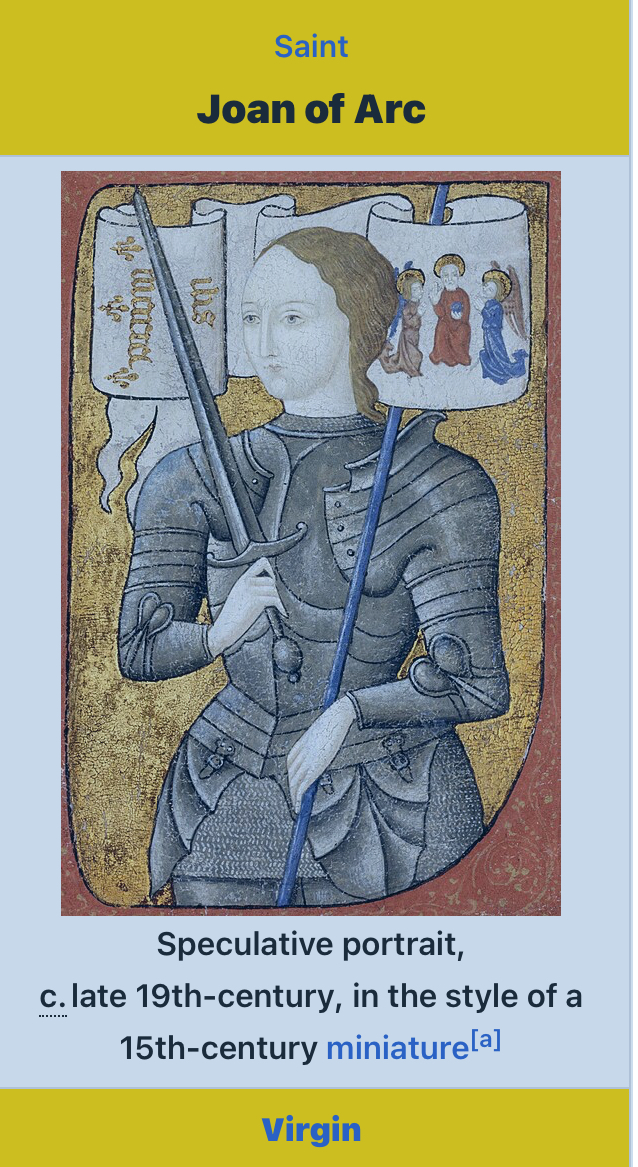
An image of a woman dressed in silver armor, holding a sword and a banner.
Speculative portrait, c. late 19th-century, in the style of a 15th-century miniature
Virgin
Born
c. 1412
Domrémy, Duchy of Bar, Kingdom of France
Died
30 May 1431 (aged approx. 19)
Rouen, Anglo-French Kingdom
Venerated in
Catholic Church
Beatified
18 April 1909 by Pope Pius X
Canonized
16 May 1920 by Pope Benedict XV
Feast
30 May
Patronage
France

Signature
Joan was born to a propertied peasant family at Domrémy in northeast France. In 1428, she requested to be taken to Charles VII, later testifying that she was guided by visions from the archangel Michael, Saint Margaret, and Saint Catherine to help him save France from English domination. Convinced of her devotion and purity, Charles sent Joan, who was about seventeen years old, to Orléans as part of a relief army. She arrived at the city in April 1429, wielding her banner and bringing hope to the demoralized French army. Nine days after her arrival, the English abandoned the siege. Joan encouraged the French to aggressively pursue the English during the Loire Campaign, which culminated in another decisive victory at Patay, opening the way for the French army to advance on Reims unopposed, where Charles was crowned as the king of France with Joan at his side. These victories boosted French morale, paving the way for their final triumph in the Hundred Years' War several decades later.
After Charles's coronation, Joan participated in the unsuccessful siege of Paris in September 1429 and the failed siege of La Charité in November. Her role in these defeats reduced the court's faith in her. In early 1430, Joan organized a company of volunteers to relieve Compiègne, which had been besieged by the Burgundians—French allies of the English. She was captured by Burgundian troops on 23 May. After trying unsuccessfully to escape, she was handed to the English in November. She was put on trial by Bishop Pierre Cauchon on accusations of heresy, which included blaspheming by wearing men's clothes, acting upon visions that were demonic, and refusing to submit her words and deeds to the judgment of the church. She was declared guilty and burned alive at the stake on 30 May 1431, aged about nineteen.
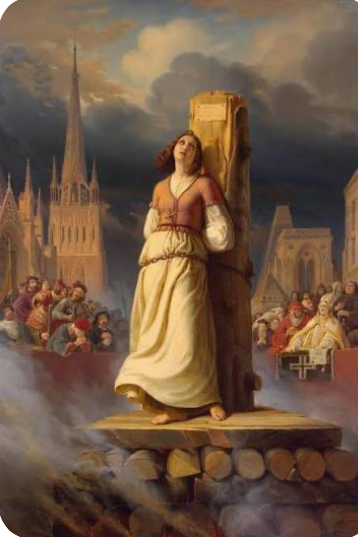
The Charges: The trial was primarily a political and heresy investigation. Joan was condemned not just for her visions, but because her voices commanded her to attack the English. If her claims of divine mandate were true, it would delegitimize English rule in France and the French throne's opponents.The Relapse: She initially recanted her visions to avoid execution and was sentenced to life imprisonment. However, after her voices returned and she resumed wearing male clothing in prison, the court declared her a relapsed heretic And she was executed by public burning at the stake.
In 1456, an inquisitorial court reinvestigated Joan's trial and overturned the verdict, declaring that it was tainted by deceit and procedural errors. Joan has been described as an obedient member of the Catholic Church, an early feminist, and a symbol of freedom and independence. She is popularly revered as a martyr. After the French Revolution, she became a national symbol of France. In 1920, Joan of Arc was canonized by Pope Benedict XV and, two years later, was declared one of the patron saints of France. She is portrayed in numerous cultural works, including literature, music, paintings, sculptures, and theater.
Theories About Her Visions:
Joan claimed to have been visited by Saint Michael, Saint Margaret, and Saint Catherine. Modern scholars, theologians, and medical experts have proposed several theories to explain these experiences:Religious/Spiritual Authenticity: Many biographers and the Catholic Church assert that her visions were genuine divine interventions designed to alter the course of the Hundred Years' War.Neurological Conditions: Some modern medical experts suggest her visions could be explained by temporal lobe epilepsy, which is known to trigger auditory and visual hallucinations, often accompanied by bright lights or sounds.Tuberculosis: Another scientific theory suggests she contracted bovine tuberculosis from consuming unpasteurized milk as a child. This bacterial infection can disseminate through the body, potentially resulting in brain lesions that trigger seizures and delirium.Psychiatric Explanations: Some historians have hypothesized conditions such as schizophrenia, though these retrospective diagnoses are widely debated, as they are hard to reconcile with Joan’s strategic military brilliance and composure.Cultural Interpretation: Many reputable historians argue against pathologizing her entirely. They suggest her visions may have simply been the way an intensely devout medieval teenager interpreted her profound dreams, inner thoughts, and the spiritual prophecies (such as the popular Merlin prophecy of an "armed virgin") that were circulating in France at the time.
She was a strong woman, and the male leaders of the church felt threatened by her strength, so she was executed, and in a brutal, horrific manner to set an example to the people.
We need more strong women.
About the Creator
Guy lynn
I’m interested in history, space travel and the possibilities, Americana,( where I live now), Africa (Southern Africa, where I was born and raised), and I write about things that interest me ( bead history) and I hope will interest you.
Enjoyed the story? Support the Creator.
Subscribe for free to receive all their stories in your feed.
Comments
There are no comments for this story
Be the first to respond and start the conversation.