

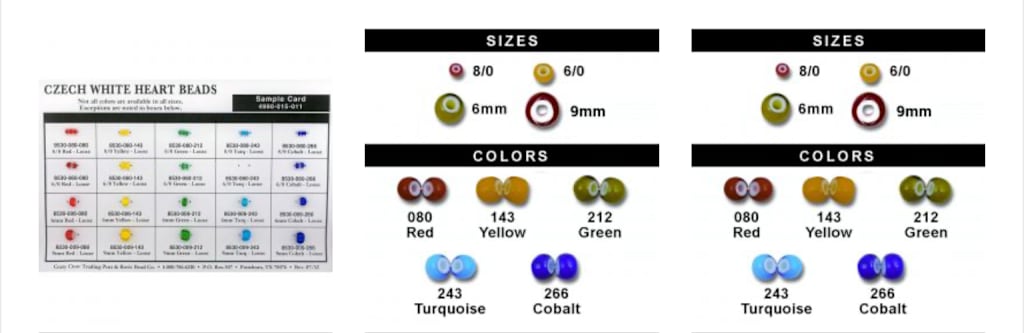
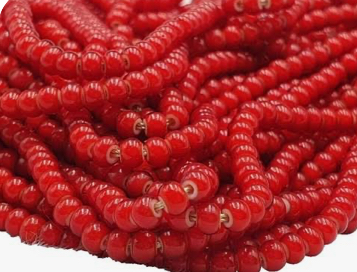
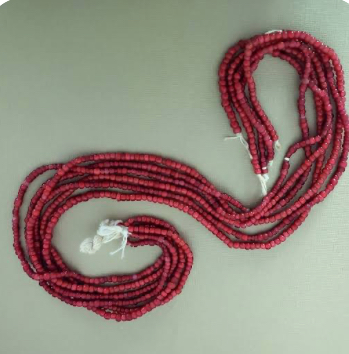
"white heart" seed beads—historically known as Cornaline d'Aleppo or Hudson’s Bay beads—feature an opaque white glass core encased in a translucent layer of colored glass, most commonly vibrant red. First produced in Venice and Murano in the late 17th century, they were originally made by drawing heated glass canes over a mandrel.
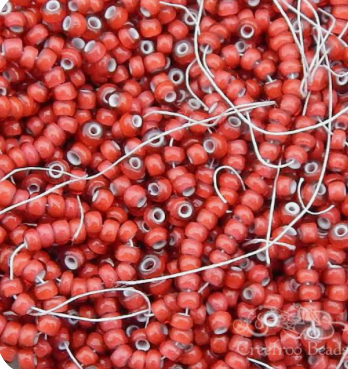
Here is a brief history of these iconic beads:
Global Trade Currency: Between the 17th and 20th centuries, Venetian glassmakers mass-produced these beads to be used as global currency. They were actively traded by European explorers, colonial companies (like the Hudson’s Bay Company), and merchants throughout the Americas and West Africa in exchange for furs, ivory, and other goods.The Name Origin: Their moniker Cornaline d'Aleppo likely stems from the French word for carnelian (cornaline), an agate gemstone, and Aleppo, a Syrian trading post. The term "white heart" was coined by Indigenous peoples in North America who recognized the beads' white inner core.Evolution of the Core: When first invented in the late 1400s, early versions of the bead often featured a green or yellow core beneath a rich, red exterior. By 1860, Venetian and later Czech beadmakers standardized the production process, almost exclusively using a white core.Cultural Significance: Today, white heart beads are highly collectible and historically significant. They are frequently found in antique African adornments and are prized by Native American artisans who have historically incorporated them into traditional beadwork, chokers, and regalia.
I: HISTORY
One of the world’s most exquisite cities, Venice consists of 117 islands in the Lagoon of Venice, sheltered from the Adriatic Sea by the Lido, a long sand spit. Her wealth has always come from the sea.
Several theories of the origin of glassmaking at Venice exist, but none are proven. In the 7th and 8th centuries, small furnaces on Torcello Island made tableware and tiles for the cathedral. Tradition says that in A.D. 811, people of the Lido fled the Huns to Rivo Alto (Rialto), the “high bank,” thus founding Venice. Radiocarbon dates from materials beneath San Lorenzo are, however, from the late 6th and early 7th centuries and those from beneath San Marco are from the 7th or 8th century. In 823, St. Mark’s bones were brought from Alexandria and Venice began to eclipse Torcello.
Documents from A.D. 982, 1082, and 1090 refer to philolarii or bottle makers attached to Benedictine monasteries; they also made mosaic tiles to decorate San Marco cathedral. In 1072, alum was imported from Alexandria to make glass; this was forbidden in 1330, as it resulted in an inferior product. In 1224, 29 members of the Ars Fiolaria, the glassmaker’s guild, were fined for various rule infractions, the first mention of the guild.
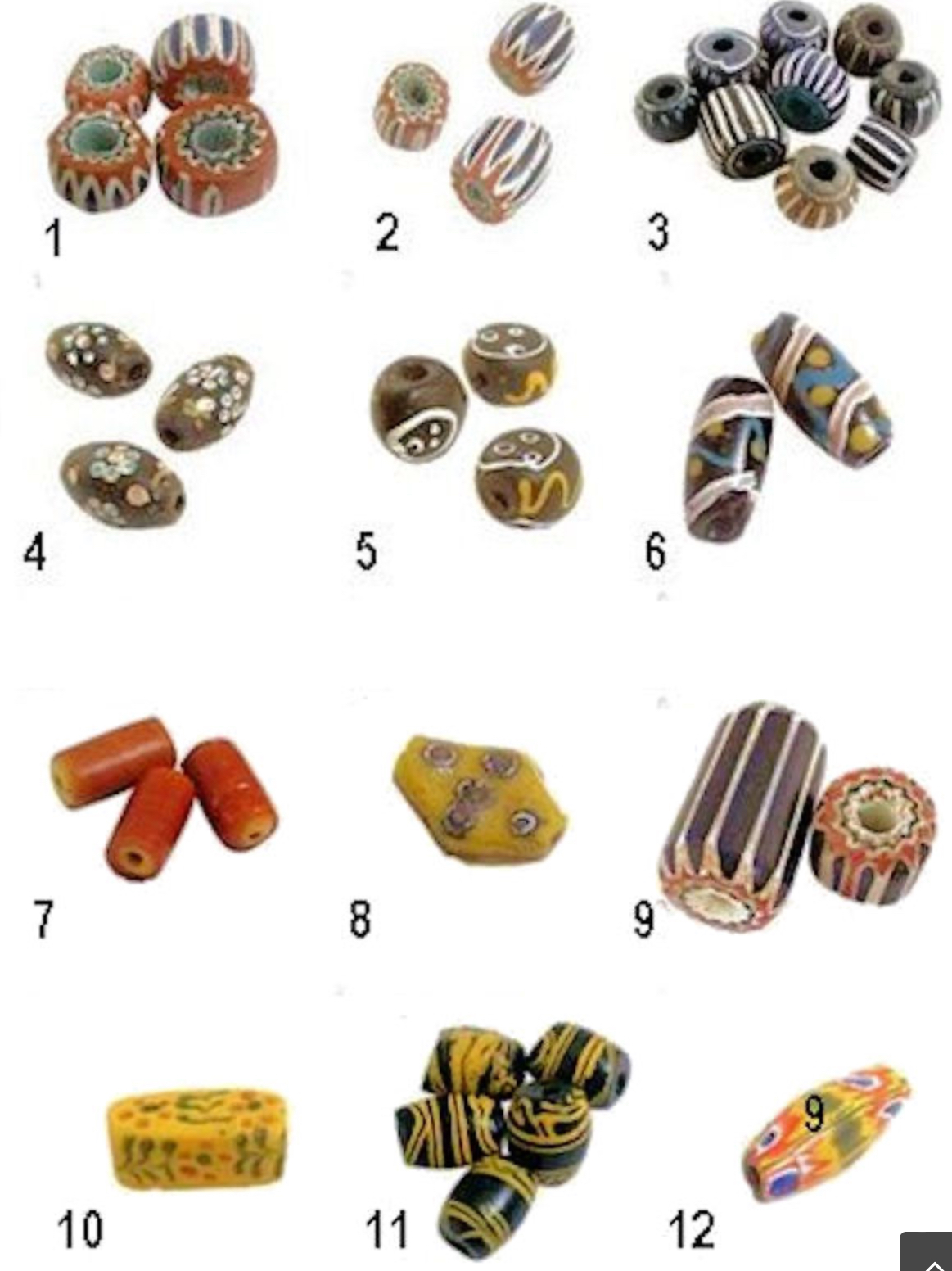
Trade Beads Through the Ages: 1. Seven Layer Chevron Bead. Late 1400s 2. Seven Layer Chevron Bead. Late 1400s 3. A Speo Bead. Late 1600s 4. French Ambassador Bead 1850s 5. Baule Face Bead. Late 1800s 6. Black Decorated Bead. Late 1800s 7. Cornaline D’Aleppo Bead. Late 1700s 8. Tabular Bead. Late 1800s 9. Large Chevron Bead. Late 1800s 10. Square Edge Floral Bead Late 1800s 11. Yellow Black Swirl Bird. Late 1800s 12. Millefiori Bead. Late 1800s
In those days of state control of industry, many laws were passed governing glassmaking. An edict in 1275 barred the export of sand, potash, or broken glass and restricted Germans from taking more glass than they could carry on their backs or ten Venetian-lire worth. An edict of 1286 by the Grand Council set down minimum working conditions and ordered the furnaces shut when the weather was hot. In the next year, wood for fuel was put under the direction of the senior judges to ensure its availability.
On 8 November 1291, the Senate decreed that glassmaking must move from Rialto to the island complex of Murano (ancient Amurianas or Amurianum). The official reason was to shield the wooden buildings of Venice from fire, but it also helped to control the industry and prevent glassmakers from leaving. The law was not always obeyed; two similar laws were passed in the next 30 years and there was still a glassmaker in Rialto in the late 14th century.
Murano was a draw. By 1350, at least 60 glassmakers from the Dalmatian Coast and Italy went there, many apparently from the Diaspora.Venice favored glassmakers. An immigrant could become a citizen in 25 years.A 1376 law allowed the heirs of a glassmaker’s daughter and a nobleman to inherit his title and in 1490 the guild was placed under the Council of Ten, enhancing its lobbying power. Glassmakers could even buy a title, as the Morellis did in 1686 for 100,000 ducats.
Venice attempted to prevent an exodus of glassmakers, for a while under penalty of death. This did not stop many from leaving, however, and the penalty was applied only twice. Many European powers encouraged glassmakers and beadmakers, foremost among them France.
As early as 1486, Venetians set up a bead factory in Bohemia (Jackson 1927). In the 16th century, Venetian glassmakers went to France. England and Holland. In the next century, workers were smuggled out to Amsterdam and Zuan Antonio Miotti managed a bead factory in Middelburg, Holland.Italian beadmakers were even sent to Jamestown, Virginia.
The trickle became a flood in the mid 18th century, largely due to Dominico Vistosi, said to have been associated with beadmakers in Florence, Bologna, Naples, Rome, Loreto, Torino,antova, and Pisa (all in Italy), Innsbruck and Graz, Marseilles, Amsterdam, and Portugal. The failure of the Austrian adventures brought a sigh of relief in Venice. A book was produced to bring beadmaking to Spain.
Beadmaking Guilds in Venice
Venice had long drilled pearls (Morison.and made beads of bone, ivory, wood, and rock crystal. Martino de Canale first noted glass beads worn by a glassmaker (who probably made them) at the installation of Lorenzo Tiepolo as Doge in 1268. In 1296, the first firm reference to Venetian glass beads indicated their use in embroidery.Their first official mention was in 1308, when the State Inquisition organized the beadmakers into the guild Arte de’Margariteri.
This new guild threatened the stone beadmakers, the Arte Minuta branch of the Cristalleri guild, organized in 1284. Over the next two centuries, the stone cutters fought the glassmakers. As early as 1301, they lost their monopoly on lens making. Their rules (marigola) and laws of the Senate and the Inquisition sought to ban false gem making.
It was a losing battle. On 17 February 1510, the Capitolo dell’Arte, the governing board of all guilds, announced their support of glass beadmakers and stopped the export of canes to Bohemia for further working. The Margariteri and the Paternostri (organized in 1486) nominally remained part of the Cristalleri until 1604, but so firm was this decision that wrote, “rock crystal was dead and glass beads born.”
The ordinance and the Paternosteri rules speak of a recent innovation. The law says, “Newly discovered twenty years ago… an invention made by our glassmakers of Murano of pure canes of common cristallo and colors of diverse sorts….” The rules read, “paternosteri de rosetta” (chevrons), “oldoni,” and “canes, and other sorts of work newly discovered”.
What was discovered between 1480 and 1490 Morazzoni thought it was Bernardo de Pin’s polishing machine, but this marvel was a figment of an earlier historian’s imagination. It was not clear cristallo nor colored glass; both had been around much longer.
The invention must have been tube drawing. Tubes had been drawn around the Mediterranean for centuries, but they seem to have been short. A long thin tube (cane) could be cut into segments which would then be processed into beads. When Venetians taught Bohemians to make beads in 1486, they used furnace-winding, not tube drawing.
To draw a glass tube, a master prepares a hollow glass gather by blowing into or manipulating it. By 1869, a device (borsetta) was inserted into the glass and opened up inside, creating the cavity. The master held the glass on his pipe and a boy with a rod (pontil, punty) with a piece of glass at the end joined this to the gather and ran away from it. Seed bead tubes were as long as 100 m (yards),2 made in galleries built for the purpose. A man with a leather fan cooled the tube, which rested on crossbeams on the floor. The tube was cut into meter lengths and sent elsewhere to be processed.
If any one person was likely responsible for the invention of drawing it would be Angelo Barovier (1405-1460), who invented clear cristallo, milky lattimo, an agate glass, and possibly chevrons.
A distinction between beadmakers and their beads was the finishing process. Before the introduction of a tumbling drum in the early19th century, beads were finished either a ferrazza (in a pan) or a speo (on a spit). There is disagreement on which was first and who first used them. By 1600, the pan method was used by the Margaritari for seed beads and the a speo method by the Paternostri for larger beads, though the sizes could and did overlap.
A third beadmaking method, lampwinding, developed more slowly. The Arte de ‘Perleri e de’ Supialume (supialume refers to blowing into a lamp to increase the heat of the fire) was made a guild in 1528. It did not share the status of the other two guilds until 1647, when they had a school (begun in 1615), the rules, and a patron saint (S. Antonio) in common, but kept separate banks and Paternostri feared competition from Supialume who, indeed, eventually supplanted them.
Lamp-winding grew slowly. Wound beads don’t appear in the trade until about 1700 and aren’t important until about 1750. By 1731, 800 pounds (364 kg) of oil were used daily Andrea and Pietro Bertolini improved the process soon thereafter . Dominico Bussolin patented a gas lamp in 1843 and credited Giovan Battista Franchini for persuading his colleagues that it was better than tallow, yet as late as 1869, two leading beadmakers, Salviati and Giovanni, still advertised beads made “by candle and by gas” .
Venetian Glass
Special glasses are the hallmark of Venetian production. Venice was famed for its tableware and other glass products, as well as beads. Some of the glass improvements were used immediately for beads, while others took a long time for beadmakers to adopt.
We have already noted that Angelo Barovier was the leading glassmaker of his day. His cristallo, an excellent, if slightly gray, clear glass, was made with purified alkalies, special ingredients, and decolorized with manganese. It was later combined with his latticino to make the famous gooseberry bead. He may not have invented chevrons, but he was the first to make molded canes for mosaic or millefiori work. Though described as early as the late 15th century, the word millefiori (thousand flowers) was only introduced in 1827.
Glassmaking and beadmaking everywhere was advanced by a Florentine priest with a love for chemistry, Antonio Neri. Though he did not work in Venice, his book L ‘arte vetraria, published shortly before his death, became the standard textbook on glass for centuries. Not right away, however. It languished in obscurity, being reprinted only in 1661. The next year Christopher Merrett (also published an English translation that was an instant best seller. It was translated into Latin in 1668, and went through three printings and three editions. In 1679, Johann Kunckel, the director of the glassworks in Potsdam, added material and translated it into German, which went through four editions. It was reprinted in Venice in the original Italian in 1663 and 1678. Altogether, there were dozens of editions in a half dozen languages (including Spanish and French) down to 1826, with many books excepting from it, often giving no credit to Neri.
A spectacular Venetian glass is aventurine, probably so named because it was risky (avventura) to make. Tiny copper flakes suspended in glass make it shimmer like gold, giving it the synonym “goldstone.” It was invented by Vicenso Miotti (1644-1729) who was given exclusive rights to it in 1677. He passed it to his son, Daniel, in a “Book of Secrets” in 1669. Pietro and Giovanni Andrea Bertolini made an inferior version in 1731. By 1807, Lorenzo Bigaglia had made it and it was improved upon in 1859 by Giuseppe Zecchin, working for the heirs of his firm.
Antonio Saviati made it soon thereafter. In the meantime, the Miotti family had closed shop in 1791, and a widow revealed the formula to Beneditto Barbaria in 1811. In addition to Venetians, other nationalities took out patents and it has been made in several countries, but for the last century, the Dalla Venezia family of Venice has been the principal supplier.
Gold ruby (translucent red) glass is a favorite, rich color. The Venetian Giovanni Darduin (1595-1654) may have first used it, but the German Andreas Cassius (ca. 1640-1673) first described a colloid suspension of gold in stannic (tin) acid to color glass (“Purple of Cassius”) in De Auro in 1685. Kunckel developed it commercially as a thin coat (casing) and the Bohemians mastered it around 1715. Later improvements were by Venetians, especially Giuseppe Zecchin around 1859.
The 19th century, especially the second and third quarters, saw many new and improved glasses, some to combat the rising Bohemian (Czech) beadmakers. Giobatti Franchini made a coral glass in 1826 and a pink nacre (mother-of-pearl) in 1827. Giovanni Giacomuzzi was celebrated for his golden nacre in 1867; 5,000 lbs. (2,272 kg) of it adorned a Trevesto theater. He also created silver, red, green, blue, and carnelian shades. Lorenzo Radi imitated agate, chalcedony, and lapis lazuli.
Innovations in Beadmaking
Glass beadmaking begins with glass. For drawn beads, the production of the tube is the next step. These operations require several specialized skills: furnace making, preparing the ingredients, making the glass, and drawing the tubes. A division of labor was already at work. After the tubes were drawn, more steps were necessary, performed by different people, sometimes in main factories and sometimes at home.
There are several descriptions of these processes, but only two are by observers connected to the industry. The 64 first is by Dominico (Dominique) Bussolin, the promoter of gas for lamp-winding: The Celebrated Glassworks of Venice and Murano. The other is by Abbot Vincenzo Zanetti (1824-1883), a historian who wrote 30 books on Venetian glass and glassmakers and founded the Museum of Glass on Murano in 1861. I use his “Little Guide to Murano” of 1869. Both writers list discrete steps in the beadmaking process; Bussolen six and Zanetti seven.
Molds were introduced in the 1860s by Lorenzo Graziati, J. Bassano, and Giuseppe Zecchin for canes with hexagonal, channeled, lobed, and other sections.
The following steps are performed to form a drawn glass tube into beads:
1. Sorting tube diameters, done by women (cernitrici; sorters) by hand.
2. Cutting the tubes, done by a man (tagliatori) sitting on a chair holding a small bench (zocco) between the legs, with about 3 in. (7.5 cm) of blade mounted in it. Behind the blade is a regulator (scontro) against which the ends of the tubes are placed as they lie on the blade. The worker takes a handful of tubes, lays them on the blade, and pushes them toward the scontro. With a blade of the same length in his other hand, he chops the ends of the tubes into segments.
In 1822, Captain Longo invented a machine to automate cutting by mounting the chopping blades onto a cylinder. Two men ran it. It was not precise enough and in Bussolin’s day was not much used. Carlo Romiti improved it in 1867, and by Zanetti’s day it was apparently common.
3. Rounding the segments by men called tubanti. As previously mentioned, this was done by several means. In the pan method, beads were packed in a refractory powder, put on a pan heated underneath, and stirred with a paddle. The drum was introduced in 1817 by Luigi Pusinich and improved in 1864 by Antonio Frigio. The beads were also packed in powder, and the rotating drum replaced the stirring paddle.
In the one documented a speo operation, beads were put on six tines arranged in a circle mounted on a handle. Each held three large beads. The spit was placed in the fire and rotated until the beads were rounded. Often beads melted together or were misshapen; these were still sold.
Zanetti puts another step of eliminating broken beads before this step; Bussolin incorporates it into step 2. It is done by the schizzadori, who use a screen to separate broken pieces. Zanetti said the process was simple and executed with “half weariness.”
4. Separating beads by size done by the governadori, who use a series of screens to sort the beads. Then a handful of beads are put on a flat plate that is inclined and gently shaken so rounded beads are separated from misshapen ones.
In 1867, Giuseppe Zecchin and Augusto Ceresa built a mechanical sorter consisting of sieves with smaller holes mounted above each other and rocked back and forth.
5. Polishing the beads, done by the lustradore. The beads are put into a sack and shaken very hard to remove dust and to buff them. Bussolin said two sacks were used, one with sand and the other with bran. Zanetti noted only one with fermented bran and noted that this was an “operation opportune for a machine.”
In 1838, Isacco Bassano built an eight-horsepower machine to give beads a high polish. Matte finishing was first done with hydrofluoric acid, then the French developed a grinding process involving emery, sawdust, or other materials; it was especially popular in America.
6. Stringing the beads, done by women called infilatrici. Neither Bussolin nor Zanetti describe this step, but Irene Ninni did in 1893 in her little book L ‘Impiraressa. In short, the beads are placed in a scoop (sessola) that measures the length of the strands and the stringers hold a “fan” of 40-60 long (ca. 18 cm or 1 in.) needles threaded with flax which they rake through the beads, picking them up and stringing them en mass.
Up to 20% of the beads were not properly perforated and the women rejected them, dubbing them with several names. In 1894, Cav. Salvatore Arbib invented the tamburo, a machine that picked up beads by their holes by means of short wires set in a revolving cylinder, leaving beads with occluded holes behind. It was built by Meyer and Sons of Birmingham, England. In the same year, Arbib and Meyer produced a machine that strung beads on wire to sell to French beadmakers for the production of beaded flowers. Some beads were sold by bulk and not strung.
An Indian Connection?
We don’t know how far back these processes were used in Venice, but they have an eerie similarity to the way beads are made today at Papanaidupet, India.
Indian crafts are very conservative and the archaeological evidence suggests that most of the steps used for beadmaking today were used over 2,000 years ago.
The Venetians did not learn tube drawing from the Indians. Their methods are totally unlike (though the Danner machine, invented in the United States, works on the same principle as Indian tube drawing).
Indians sit on the ground to cut tubes on a flanged blade in the earth. Venetians prefer to sit on a chair and the zocco and scontro could be modifications. Rounding, sorting, polishing (the Indians use rice husks), and stringing (longer and fewer needles; the beads in a winnowing basket) are all very similar.
There are many recorded cases of independent invention and perhaps these methods are as efficient as possible. On the other hand, when Venice was developing her seed bead industry, India was far wealthier and more technologically advanced than Europe. Papanaidupet does not hide its work from curious outsiders and a European, an Italian, even a Venetian, could have visited what was then a place notable for a large guest house for pilgrims visiting the important temple at nearby Tirupati. We may never know, but I believe this hypothesis deserves testing. The above history was written by Peter Francis Jnr.
About the Creator
Guy lynn
I’m interested in history, space travel and the possibilities, Americana,( where I live now), Africa (Southern Africa, where I was born and raised), and I write about things that interest me ( bead history) and I hope will interest you.
Enjoyed the story? Support the Creator.
Subscribe for free to receive all their stories in your feed.
Comments
There are no comments for this story
Be the first to respond and start the conversation.