

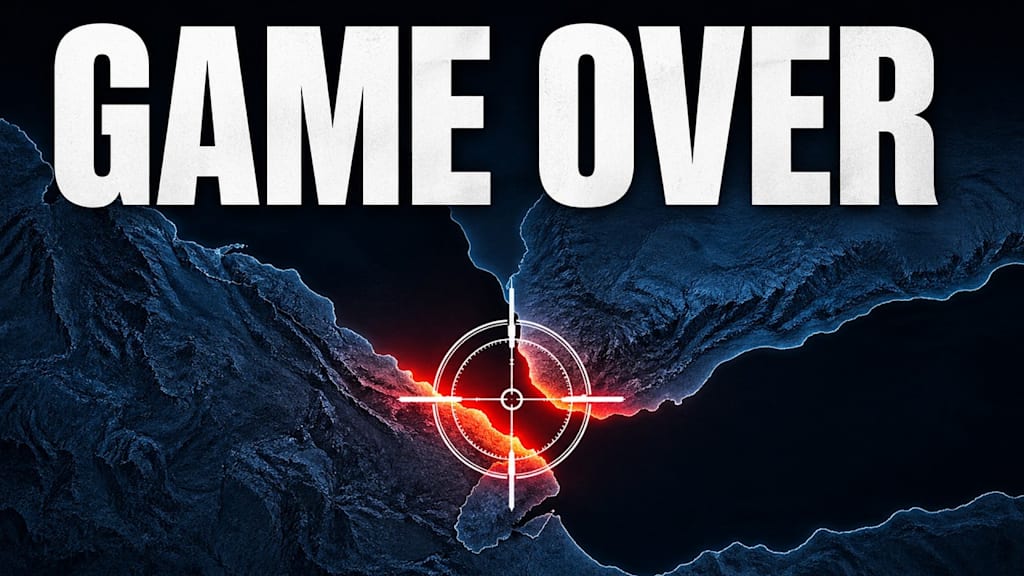
Armies on land and nuclear bombs have their place—but the real power of the world is locked inside these 14 narrow lines. These are called chokepoints—routes that, if blocked, could choke the global economy to death.
There’s one route where nearly 30% of the world’s oil passes through… and another where even a small clash could trigger World War 3.
Today, we’ll journey through these 14 gateways and understand who truly controls the world.
Welcome back .
The real power of the world doesn’t lie with nuclear weapons or massive armies—but in these narrow maritime routes known in geopolitics as chokepoints. If even a few of these routes were shut down, the global economy could collapse overnight. Countries could face famine, fuel shortages, and a lack of essential medicines.
Let’s explore them one by one in simple terms.
Our journey begins in the Middle East—the land of oil.
The most critical gateway here is the Strait of Hormuz, located between Iran and Oman. This narrow passage carries over 30% of the world’s oil. Every day, millions of barrels pass through it to reach the US, Europe, and Asia.
At its narrowest, it’s only about 33 km wide. Imagine if Iran blocked this route—global oil prices would skyrocket instantly. That’s why major powers constantly monitor it.
Next comes Bab-el-Mandeb, meaning “Gate of Tears,” located between Yemen and Djibouti. Historically dangerous due to pirates and rough waters, it remains risky even today.
You may have heard about attacks by Houthi rebels on ships passing through here. This route is crucial because ships traveling from Asia to Europe must pass through it to enter the Red Sea. If blocked, ships would have to go around Africa—costing weeks of extra time and billions in fuel.
After that, ships move toward the Suez Canal in Egypt—a man-made waterway connecting the Red Sea to the Mediterranean.
Its importance was proven when the Ever Given ship got stuck in March 2021. The canal was blocked for just six days, yet it caused a $54 billion loss to the global economy.
It’s a backbone of global trade—and a major income source for Egypt.
Moving to Europe, we reach the Strait of Gibraltar, connecting the Atlantic Ocean to the Mediterranean. Located between Spain and Morocco, it’s so narrow you can see another continent across it.
Controlling this route means controlling trade between Europe and Africa. If closed, the Mediterranean would become almost like a closed lake.
Further inside, we encounter Turkey’s two vital chokepoints: the Bosporus Strait and the Dardanelles Strait. These connect the Black Sea to the Mediterranean.
Countries like Russia and Ukraine depend heavily on them. Turkey controls access under international law—making it geopolitically powerful.
Now we move to Asia—the busiest route in the world—the Strait of Malacca, located between Malaysia, Singapore, and Indonesia.
About 25% of global trade passes through here. China, Japan, and South Korea depend heavily on it for oil and goods.
China fears that in a war with the US, this route could be blocked—a concern known as the “Malacca Dilemma.”
If Malacca is blocked, ships use alternative routes like the Sunda Strait and Lombok Strait in Indonesia. Lombok is especially important for large oil tankers.
Next is the Taiwan Strait, one of the world’s biggest flashpoints.
Taiwan produces over 70% of the world’s microchips—used in phones, cars, and computers. China claims Taiwan as its territory, while the US supports Taiwan.
A conflict here could easily escalate into a war between superpowers.
Now we head to the Americas.
The Panama Canal connects the Atlantic and Pacific Oceans. It’s one of the greatest engineering marvels, allowing ships to avoid traveling around South America.
Before this canal, ships used the dangerous Strait of Magellan at the southern tip of South America.
Back to Europe, we find the English Channel, between the UK and France. One of the busiest sea routes, with over 400 ships passing daily.
Controlling it means controlling Europe’s economy.
Looking ahead, the Bering Strait, between Alaska (USA) and Russia, could become the most important route in the future.
Due to melting ice from climate change, it may soon open as a shorter trade route between Asia, Europe, and America.
Finally, the Cape of Good Hope at the southern tip of Africa.
Though not a narrow strait, it becomes crucial when routes like Suez are blocked. Ships are forced to take this longer path—as Vasco da Gama once did when discovering the sea route to India.
These 14 chokepoints have controlled the world in the past—and will continue to shape its future.
Interestingly, many of these routes are directly or indirectly influenced by the United States.
Now you can decide for yourself—who really controls the world.
Hope you liked this story. Don’t forget to like and share!
About the Creator
Imran Ali Shah
🌍 Vical Midea | Imran
🎥 Turning ideas into viral content
✨ Watch • Share • Enjoy
Enjoyed the story? Support the Creator.
Subscribe for free to receive all their stories in your feed.
Comments
There are no comments for this story
Be the first to respond and start the conversation.