
I Visited a Planet Where Gold Is Cheap Enough for Roofing. The Rich Build With Iron.
Field notes from a city that shines on top, holds itself up with stone, and treats a handful of nails like a bank account.
One
When the ship landed, the view outside the porthole was a sheet of gold.
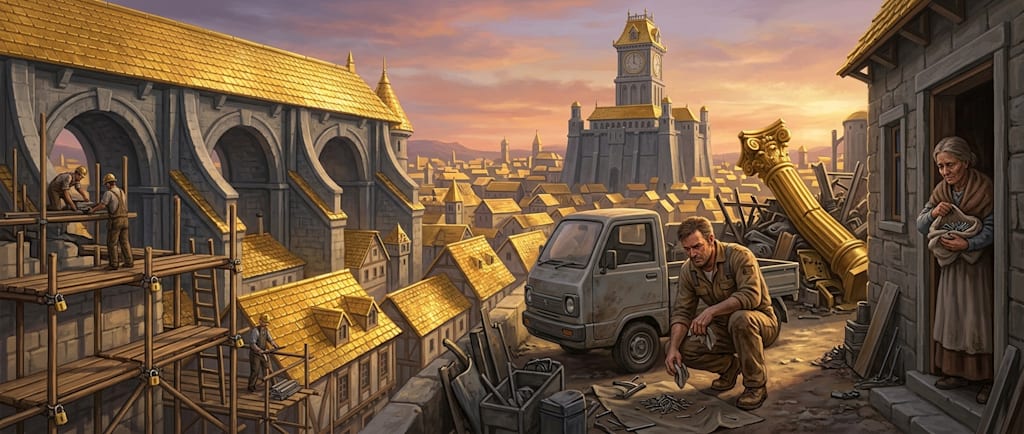
The whole city looked as if it had been doused in molten gold. The roofs were gold, the outer walls gave off a golden sheen, and even the drainage channels along the street edges were bright enough to sting the eyes. Someone in my group leaned against the window and said the place must have gold so cheap that people dared to build roofs like that.
The person who came to meet us was an engineer from the local builders’ association, surnamed He, in his fifties, with stone dust lodged under his nails that never washed clean. He drove a small stone-gray truck to pick us up. The truck bed was wooden, reinforced with iron nails. The nail heads were worn shiny, clearly reused for many years.
As we drove into the city, I pointed at a three-story building by the road and asked, “Is that roof solid gold?”
Engineer He glanced at me in the rearview mirror, pulled over, and led me around to the side of the building. He rapped the golden eaves with his knuckles. The sound was dull and solid. “Three-millimeter gold sheet, roll-formed, with a ceramic-fiber anti-creep layer underneath.” Then he crouched and pointed to where the roof met the wall. “You can’t see it from the front. Look from the side. What the roof is pressing down on is a stone arch.”
Gray-white stone blocks, one pressing on another, the curve rising from the wallhead to the ridge. The gold roof sat on the stone head like a hat.
“Gold doesn’t serve as beams?”
Engineer He stood up and brushed the dust off his hands. “Come with me. I’ll show you something.”
Two
He took me to a salvage yard on the edge of the city. The yard was piled with broken stone, broken bricks, corroded copper pipes, and a gold column bent like a banana. It was about three meters long, lying on the ground, sagging deeply in the middle.
“Three years ago, a businessman in the south of the city was building a villa. He thought stone columns were too bulky, so he cast four decorative columns in solid gold to carry the porch load. The designer said no. He said, ‘Gold is more expensive than stone. If it’s more expensive, it must be stronger.’ By the time they reached the second floor, the columns had bent under their own weight. Doors and windows jammed shut. They tore it down and dumped this here.”
I crouched and touched the gold column. The surface was still smooth. No rust, no pitting. But the middle had bent into a clear arc, as if someone had slowly worked it from both ends. Engineer He said this was room-temperature creep. Under sustained load, solid gold can bend itself out of shape in a few months. Its density was two and a half times that of steel. A gold beam would be done in by its own weight alone. Mohs hardness was 2.5, so a fingernail could leave a mark. Melting point was 1,064 degrees Celsius, lower than steel, so in a fire it softened first.
“So on Gold Rain Star, all building frames are stone, brick, concrete, ceramic composite beams?”
“Right. Iron is expensive, steel is expensive, aluminum too. Ordinary homes use fired brick for walls and precast stone slabs for floors. Public buildings with long spans use stone arches, the ancient Roman approach. Unreinforced concrete works too, but the arch has to channel the load down to the foundation. Reinforced concrete exists, with copper alloy or basalt fiber as the reinforcement, and only wealthy households can afford it.”
He kicked a pile of broken stone. “Stone is cheap and strong in compression, but heavy. That’s why our buildings are generally low, thick, and squat. Wander around the city for a few days and you won’t see many tall, slender buildings.”
Three
That afternoon, Engineer He took me to a community library under construction.
A stone wall enclosed the site. The scaffolding was lashed from wooden poles, and the key joints were locked with iron couplers, each with a small brass padlock hanging from it. Engineer He said the black market in iron nails was rampant. Iron couplers on a site could be stolen overnight. The locks were to keep their own people out.
Two stories of the main structure were up. The first was load-bearing stone walls. On the second, formwork for the stone arches was being set, and concrete was being poured from above. The beams were ceramic composite, dark gray, with fiber patterns on the surface. Workers carried one past us, two men to each end, cursing, “Damn heavy.”
“Where does the gold go?” I asked.
Engineer He pointed overhead. The roof was being covered with three-millimeter gold sheet, corrugated and lapped one piece over another, fixed to the wooden roof boarding with gold rivets. Beneath it was the ceramic-fiber layer. Below that, the outline of the stone arches was perfectly clear.
“Gold sheet waterproofs, never corrodes, doesn’t care about acid rain or salt fog. Once this roof goes on, you don’t touch it for a hundred years. Ordinary waterproof membrane has to be replaced every five to eight years. The asphalt layer gets redone every decade or so. Gold sheet is expensive in processing and hoisting. The raw material is cheaper than iron, but what you save is a century of maintenance.”
He bent down, picked up a length of gold pipe from the ground, and gestured with it. “Water pipe, solid gold. Ductile, won’t split when it freezes in winter, smooth inside so scale can’t cling. At the joints you put a soft gold gasket, tighten the bolt, and it seals tight. Far more durable than rubber rings. The drawback is that it’s soft, so supports have to be spaced closer together, or it sags under its own weight.”
Four
That night I stayed at a local guesthouse. The landlady was a woman in her sixties whose surname was Jin. When she heard I was there to look at buildings, she warmly insisted on showing me around her house.
From outside, the gold roof looked gold. From inside the attic, it was wooden boards lined with gold foil. The foil was so thin it trembled at a finger’s touch. The old woman said her father-in-law had applied it when he was young. It hadn’t been touched in over sixty years, not even wiped, and it was still bright.
The kitchen pipes were gold, the faucet cast in gold, but the handle was wrapped in ceramic. She said solid gold was too slippery, and dry hands in winter couldn’t grip it. The bathroom window glass had a faint golden reflection. She said the summer sun couldn’t bake through, so the room stayed cool, and in winter the heat couldn’t escape.
“What about electricity?” I asked.
She pointed at the socket in the corner. “Gold contacts, gold wire. An electrician came to fix it once and cursed for ages. Said gold wire is too soft. Pull it through conduit and it snaps. The joints still have to be fixed with copper-alloy clamps. But the good thing is it doesn’t oxidize. After decades, the plug still goes in tight. No sparks.”
She opened a drawer, took out a bundle of iron nails wrapped in cloth, counted them, and put them back. “These were left by my husband. You can’t buy them now. Iron is expensive. Nails are sold by the piece. The family across the street with the iron gate is the richest on this street. Iron rusts. You have to oil it every day. Only families that can afford to maintain an iron gate count as rich. Gold roof? No need to bother. Anyone can afford one.”
Five
The next day, Engineer He took me up the clock tower in the center of the city.
From above, the gold roofs merged into one sheet, dazzling in the sun. But looking down at the walls, they were all gray-white, ochre, blue-gray. Stone, brick, poured concrete. Not one building had a gold frame. The drainage channels at the street edges were folded from gold sheet. The lamp posts were stone. The curbs were granite. Gold was like a skin stuck onto a stone frame.
Engineer He pointed at a cluster of low gold-roofed buildings in the distance. “That’s the old town. Stone arch structure, three hundred years old. The gold roof has been replaced twice. The stone arches haven’t moved an inch.”
Then he pointed at a group of slightly taller new buildings. “Ceramic composite beam frames, copper-alloy joints, gold-panel curtain walls. You can’t build much higher. Stone and ceramic are too heavy, copper alloy is too expensive, and without cheap steel the economics of high-rise construction don’t add up.”
Six
The night before I left, I heard a few stories in a tavern.
Last year a house in the east of the city caught fire. The gold roof melted, and molten gold ran down the gutter and solidified into a row of golden stalactites hanging outside the wall. The owner didn’t mourn the gold. What he mourned was the wooden roof boarding burned away and the stone arches blackened over a large area. The fire brigade protected the stone arches first and let the gold flow.
The tavern owner chimed in. When he was young, a designer marked decorative gold columns as load-bearing columns. The plan review didn’t catch it. By the third floor the gold columns began to bend, doors and windows jammed, and in the end they tore it down and rebuilt. The designer later changed trades and went into selling gold foil.
An electrician standing nearby, cup in hand, said the biggest annoyance these days was pulling gold wire through conduit. It snaps, and if it breaks inside the pipe you can’t pull it out. You have to smash the wall. But customers insisted on solid gold, saying copper wire oxidizes and after a few years the contact is poor. Every time he had to explain: copper oxidation is only a surface layer. Scrape it and it still works. When gold wire breaks, it is broken.
Seven
The day I left, Engineer He drove me out of the city.
I looked back. The setting sun was hitting the gold roofs, a blinding glare. But the brighter the light, the darker the shadows the buildings cast. In the shadows, the outlines of the stone arches were perfectly clear. One block pressing on another, curving from wallhead to ridge, gray, heavy.
Engineer He followed my gaze and said, “Gold isn’t rare here. But if a building is going to stand, it still depends on stone.”
He patted the sheet-metal bed of the small truck. “These few iron nails on this truck bed are worth more than a truckload of gold sheet. Believe it or not?”
I didn’t answer. After we had driven a stretch, I saw in the rearview mirror that he had squatted down by the roadside and was wiping the mud off those iron nails with a cloth.
About the Creator
Jin
Writer of reamstories
https://reamstories.com/jin
Enjoyed the story? Support the Creator.
Subscribe for free to receive all their stories in your feed. You could also become a paid subscriber, letting them know you appreciate their work.
Comments
There are no comments for this story
Be the first to respond and start the conversation.