
How the Three Questions Connect
Part 5 of the Elucidation series. Previously: Three Questions Every Ideology Must Answer

• • •
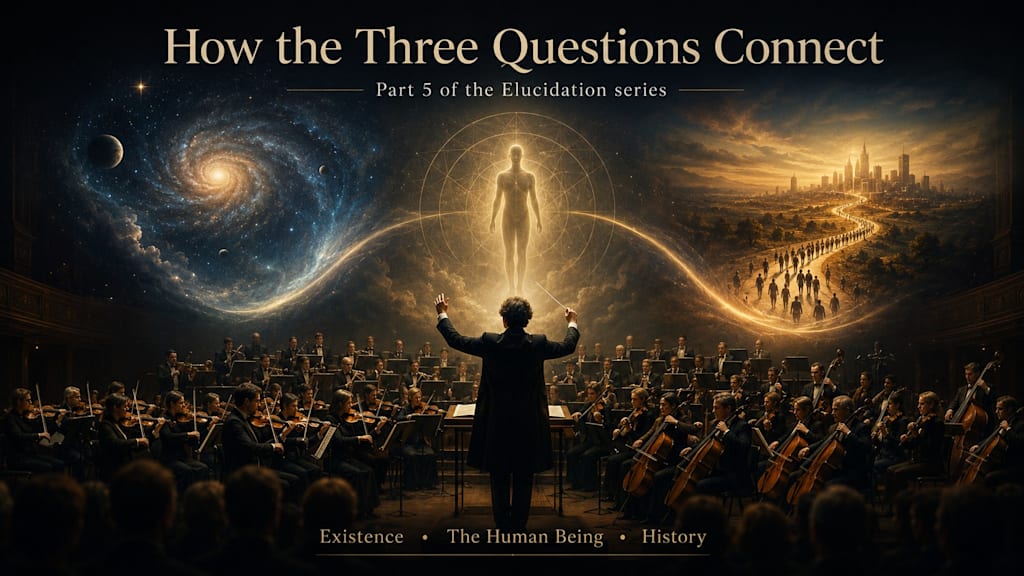
A symphony orchestra is more than a collection of musicians. The bows of the violins move together. The measured beats of the drums, the vibration of the strings, the rising and falling of sound, all work in coordination. The secret of a great orchestra lies in the harmony of all its players with one another. Without that harmony, you don’t have music. You have noise.
The conductor's hand provides the standard. By those movements, the different musicians align themselves with one another and with the whole.
An ideology works the same way.
The System
In our previous article, we mentioned that every ideology must answer three questions: about existence, about the human being, and about history. We believe that these are not three separate answers sitting in three separate boxes. They are parts of a single system, interconnected, mutually dependent, and bound by a strict inner logic.
What does that mean in practice?
It means your answer to one question places real constraints on what you can answer for the others. You cannot freely mix and match. The answers must cohere, or the system collapses.
Think of it like arithmetic. Two emerges from one plus one. Three emerges from two and one. In an ideological system the relations are far more complex, but the principle holds: the answers grow out of one another. They are not arbitrary.
What Happens When a System Contradicts Itself
Consider a concrete example. Suppose your philosophy of existence holds that the human being is entirely determined, a product of genetics, environment, and circumstance, with no genuine freedom of choice.
If that is your answer to the question of the human being, then your philosophy of history must follow suit. In a determined world, conscious individuals, movements, and organizations cannot truly alter the course of events. Whatever happens was going to happen anyway. Revolution becomes inevitable or impossible, but never a genuine choice.
And if the human being has no genuine freedom, then moral responsibility dissolves. Why praise or blame someone for actions they could not have avoided? Why call one person courageous and another cowardly, if neither of them chose their path?
Now suppose the same person, despite holding all these views, also calls for revolutionary action, demands moral commitment, and insists that people must consciously choose to fight for justice. This is a contradiction, not a minor inconsistency, but a structural failure. The foundation says one thing; the walls say another.
Such contradictions are not rare. They are everywhere, in political movements, in personal philosophies, in entire civilizations that operate with beliefs that contradict each other at the root.
The Constraint of Coherence
The constraint works in every direction. Someone who truly believes in the unity and purposefulness of existence cannot coherently defend exploitation or domination, because these stand in direct opposition to their own foundations.
If existence has a purpose, and every human being is part of that purpose, then oppressing another person means working against what your own beliefs claim to support. It is not only morally wrong. It is logically contradictory within the system.
In the same way, a materialist who says existence has no purpose faces a problem when talking about justice. Think of the mountain from the previous article: if there is no summit/peak, then no step is higher or lower than another. Everything is flat. If existence has no direction, then justice and injustice are just words we invented, no more real than any other preference. One cannot say one thing is truly better than another if nothing is heading anywhere.
Why This Matters
The practical consequence is this: most people have never examined whether their beliefs form a coherent system. They hold views about the universe, about human nature, about politics, about morality, and these views often contradict each other at the deepest level.
Someone may believe the universe is meaningless and that human rights are sacred. Someone may deny free will and feel genuine moral outrage at injustice. Someone may affirm that existence has purpose and continue living as though nothing they do has ultimate consequences.
These contradictions do not always announce themselves loudly. They operate quietly, creating confusion, paralysis, and a vague sense that something does not quite hold together. People feel lost not because the world is inherently confusing, but because their map of it contradicts itself.
The argument is that the cure is to start from the beginning. Examine the first question, existence, carefully and honestly. Let the answer to that question guide the answer to the second, the human being. Let both guide the answer to the third, history. And make sure the answers do not contradict each other.
Like a builder who checks the foundation before raising the walls, or a mathematician who verifies the axioms before constructing the proofs. The order matters. The coherence matters. Without it, no ideological system can stand.
In the next article, we turn to the specific answers to the three questions, three principles that form the foundation of everything that follows.
• • •
Next: Three Principles: Unity, Consequence, and Guidance**
Elucidation is a series of articles inspired by philosophical lectures given around 50 years ago. New articles are published weekly.
This article is part of the Elucidation series. The articles have been written and reviewed by the author with the assistance of AI.
About the Creator
Han Elucidation
Why do we exist? A searcher. Exploring existence, meaning, and what it means to be human through the Elucidation series.
Enjoyed the story? Support the Creator.
Subscribe for free to receive all their stories in your feed.
Comments
There are no comments for this story
Be the first to respond and start the conversation.