
How Rolls-Royce Became More Valuable Than Its Own Factories: The Untold Story of a Legendary Brand
From a poor mechanic’s obsession with perfection to luxury cars, fighter aircraft and a billion-pound battle over two famous words

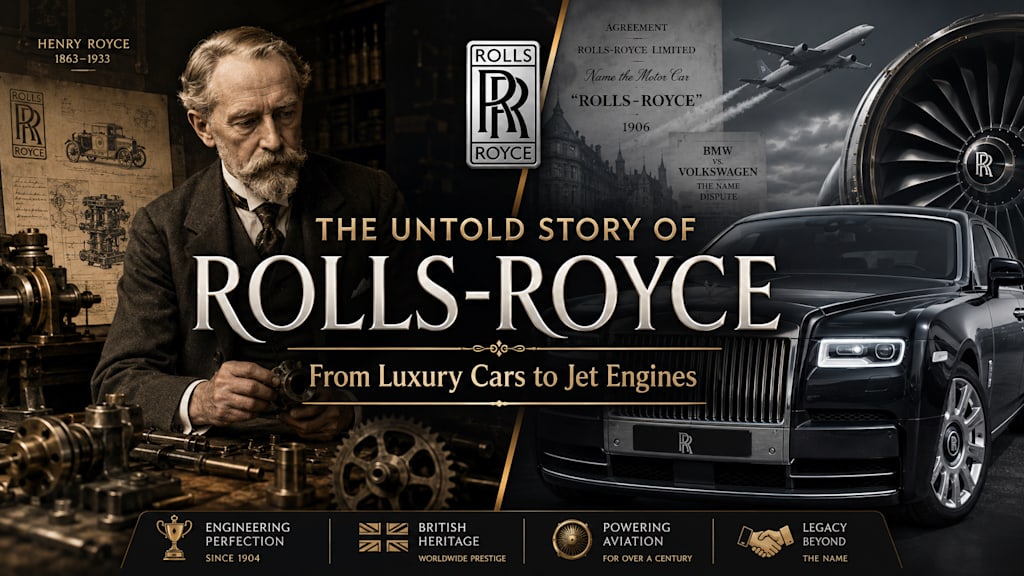
In 1998, one of the strangest deals in automotive history took place.
Two German automobile giants—BMW and Volkswagen—were competing to purchase the Rolls-Royce car business. Volkswagen offered the higher amount, reportedly paying around £430 million. In return, it received the factory, existing vehicle designs, the Bentley brand and even the famous silver ornament mounted on the bonnet.
It appeared that Volkswagen had won everything.
However, there was one major problem: Volkswagen had not acquired the right to use the name Rolls-Royce.
The rights to the brand name and the famous “RR” logo belonged to a separate Rolls-Royce engine company. That company licensed the name to BMW for only around £40 million.
Volkswagen had purchased the factory and machinery, while BMW had purchased two words that were ultimately more valuable than the entire manufacturing operation.
How could a name become more valuable than the company that originally created it?
To understand that, we must travel almost a century into the past and meet a man who could not tolerate seeing even an ordinary lawn mower operating imperfectly. The story provided by the source traces Rolls-Royce from Henry Royce’s difficult childhood to its expansion into luxury automobiles, aviation and defence engineering.
Henry Royce: The Poor Boy Who Refused to Accept Imperfection
Today, the name Rolls-Royce represents wealth, prestige and extraordinary luxury. But Henry Royce, the man behind half of that name, did not grow up surrounded by money.
His family operated a flour mill and struggled with debt. When Royce was only nine years old, his father died, leaving the family in serious financial difficulty.
Royce was unable to enjoy a normal education. He sold newspapers in the streets of London and delivered telegrams to earn money. With help from a relative, he later found work at a railway workshop.
It was there that he discovered his love for machinery.
Royce did not simply repair machines. He studied every component, identified every weakness and tried to rebuild things better than they had been before. His philosophy was uncompromising: an object should either be made properly or should not be made at all.
At the age of 21, he established a small company that manufactured electrical equipment, including switches, bells and motors. The business became successful, but his life changed dramatically after he entered the emerging automobile industry.
The Second-Hand Car That Changed Automotive History
In 1903, Henry Royce purchased a second-hand French car.
Owning a car at that time was already a symbol of status, but Royce was disappointed with the vehicle. It was noisy, unreliable and frequently suffered mechanical problems.
Most owners would simply have accepted those weaknesses. Royce did the opposite.
He decided to build a better car himself.
His first automobile was a small, two-cylinder vehicle. Despite having only two cylinders, it operated with remarkable smoothness and produced far less vibration than many other vehicles of the period.
Royce had created an impressive machine, but he still needed someone who could sell it to wealthy customers.
That person was Charles Rolls.
When Charles Rolls Met Henry Royce
Charles Rolls came from a world completely different from Royce’s.
Rolls was the son of a British lord and had studied at prestigious institutions such as Eton and Cambridge. While Royce had grown up in poverty, Rolls had been born into privilege.
He was fascinated by speed, participated in automobile races and helped make driving fashionable among Britain’s wealthy upper class. He also operated a business selling expensive cars.
However, Rolls struggled to find a British-made automobile that met his expectations.
The two men eventually met at a hotel in Manchester. Rolls tested Royce’s small car and was immediately impressed by its smooth, quiet performance.
After returning to London, Rolls reportedly told his business partner that he had found the finest engineer in the world.
Their partnership was straightforward: Henry Royce would design and manufacture the cars, while Charles Rolls would promote and sell them.
There was one condition—the vehicles would be sold under the combined name Rolls-Royce, with Rolls appearing first.
At that moment, the name carried little meaning. It was simply the combination of two surnames.
That changed with the arrival of one extraordinary automobile.
The Silver Ghost Created the Rolls-Royce Legend
The Rolls-Royce Silver Ghost transformed the company’s reputation.
Powered by a six-cylinder engine, the car was astonishingly quiet for its time. People joked that there was not an engine under its bonnet but a sewing machine because of how smoothly it operated.
To demonstrate its stability, the company reportedly balanced a coin or placed a glass of water on the car while the engine was running. Even when the engine was revved, the coin remained standing and the water barely moved.
But the company needed more than a clever demonstration. It wanted to prove that the Silver Ghost was also reliable.
A team of drivers repeatedly travelled between London and Glasgow, keeping the engine running for most of the journey. The vehicle eventually covered approximately 15,000 miles—or around 24,000 kilometres—with remarkably little mechanical wear.
Independent examiners later dismantled and inspected the vehicle. The results established Rolls-Royce as a company capable of producing automobiles with a level of precision that few competitors could match.
“The best car in the world” was no longer merely an advertising slogan. It had become part of the company’s identity.
The Spirit of Ecstasy
During this period, Rolls-Royce also gained one of its most recognisable symbols: the Spirit of Ecstasy.
The ornament depicts a woman leaning forward as her clothing flows behind her like wings. Positioned at the front of the bonnet, it became an instantly recognisable symbol of grace, speed and luxury.
The cars were succeeding, but Charles Rolls had begun developing another passion.
He wanted to conquer the sky.
Charles Rolls and the Dream of Flight
Charles Rolls became deeply interested in aviation during the early days of powered flight. He purchased aircraft and completed hundreds of flights.
On June 2, 1910, he flew across the English Channel from England to France and returned during the same journey. He became the first person to complete the round trip by aircraft without landing on the opposite side.
Sadly, his aviation career ended only weeks later.
On July 12, 1910, Rolls was participating in a flying competition when part of his aircraft failed. The plane crashed, and Rolls died at the age of just 32.
One of the two founders was gone, but the name continued.
The company would soon discover that its future did not depend entirely on automobiles. Its greatest influence would eventually be found in the sky that had taken Charles Rolls’ life.
Rolls-Royce Goes to War
During the First World War, Rolls-Royce vehicles gained a new reputation.
Armoured cars built on Rolls-Royce chassis were used in difficult military environments, including desert operations associated with Lawrence of Arabia. The vehicles were valued not because they were luxurious but because they could be trusted in conditions where ordinary machines failed.
Rolls-Royce had already represented comfort and refinement. The war added another quality to the brand: dependability.
The company also began developing aircraft engines.
When the British government asked Rolls-Royce to manufacture aviation engines, some members of the company initially hesitated. They believed Rolls-Royce was an automobile manufacturer, not an aircraft-engine company.
Henry Royce disagreed.
He began designing an aircraft engine that became known as the Eagle. Engines of this type later powered a historic non-stop flight across the Atlantic, helping Rolls-Royce establish its reputation as a serious aviation-engine manufacturer.
The company that had once built smooth cars for wealthy customers was becoming an important force in global aviation.
The Engineering Obsession Behind the Name
Henry Royce’s health deteriorated after years of relentless work, insufficient rest and poor eating habits. Doctors eventually ordered him to remain away from the factory.
But he continued designing from home.
If a single line on an engineering drawing appeared wrong, he demanded that it be changed. Some engineers became frustrated by his obsession with repeated revisions.
Royce’s reasoning was simple: changing a drawing was inexpensive, but cutting metal incorrectly could become extremely costly.
That attitude defined Rolls-Royce engineering.
Even when repairing something as ordinary as a lawn mower, Royce reportedly dismantled the machine, examined every component and rebuilt it so that it operated better than before.
For him, no job was insignificant when it could be completed properly.
Henry Royce died on April 22, 1933, but his obsession with perfection had already become part of the company’s culture.
From Racing Engines to the Battle of Britain
During the 1920s and early 1930s, Rolls-Royce participated in the development of high-performance engines for the Schneider Trophy, an international aircraft racing competition involving seaplanes.
Britain needed three consecutive victories to retain the trophy permanently. However, economic hardship made continued government funding difficult.
Private financial support helped Britain remain in the competition, while Rolls-Royce engineers worked intensively to create an extremely powerful engine known as the R.
The engineering team faced major problems, particularly excessive heat. Shortly before one important race, tiny aluminium particles were reportedly discovered on a spark plug, suggesting that an internal component might be failing.
Engineers worked through the night to replace the affected section without violating competition rules.
Britain won the race and retained the trophy.
More importantly, the engineering knowledge gained from the racing programme helped create the foundations for the Rolls-Royce Merlin engine.
That engine would soon become one of the most important aircraft engines of the Second World War.
The Merlin Engine and the Defence of Britain
When the Second World War began, Britain faced an enormous threat from German aircraft.
During the Battle of Britain, the Royal Air Force relied heavily on aircraft such as the Hurricane and the Spitfire. Both were powered by Rolls-Royce Merlin engines.
The Merlin was also used in several other important military aircraft, including later versions of the American Mustang.
By this stage, Rolls-Royce no longer represented only luxury transportation. Its engines had played a significant role in defending a nation during wartime.
That history explains why the Rolls-Royce name eventually became far more valuable than a factory, a vehicle design or a bonnet ornament.
It represented engineering achievement, national pride, survival and trust.
The Engine That Nearly Destroyed Rolls-Royce
The company’s aircraft engines brought it enormous prestige, but one ambitious engine project later pushed it towards financial collapse.
During the 1960s, American aircraft manufacturer Lockheed was developing the L-1011 TriStar passenger aircraft. Rolls-Royce proposed an advanced engine known as the RB211.
The engine used a complex three-shaft design and was intended to include lightweight carbon-fibre fan blades. The goal was to reduce engine weight and improve fuel efficiency.
However, the carbon-fibre blades failed important tests, including tests designed to simulate bird strikes. Rolls-Royce was forced to return to heavier titanium components.
Development costs increased, deadlines slipped and the company had already promised to supply the engines at a fixed price.
The more engines Rolls-Royce delivered, the more money it risked losing.
On February 4, 1971, the company declared that it could no longer continue under the financial pressure.
The British government intervened and nationalised the strategically important aircraft-engine business.
This crisis led to the division that would eventually create the famous confusion surrounding the Rolls-Royce name.
How Rolls-Royce Became Two Different Companies
After the 1971 restructuring, the aircraft-engine operation remained connected to the Rolls-Royce name and later became Rolls-Royce plc.
The automobile division was separated and passed through different owners before eventually coming under the control of the Vickers group.
The crucial detail was that the engine company—not the automobile manufacturer—owned the legal rights to the Rolls-Royce name and the “RR” logo.
The car company was effectively using the name under licence.
That detail became extremely important in 1998.
BMW vs Volkswagen: The Battle for Rolls-Royce
When Vickers decided to sell the Rolls-Royce automobile business, BMW and Volkswagen entered a bidding war.
Volkswagen offered more money and acquired the manufacturing plant, vehicle designs, Bentley, and the rights connected to the Spirit of Ecstasy ornament.
But the Rolls-Royce brand name belonged to Rolls-Royce plc.
Because the engine company already had a strong business relationship with BMW, it licensed the Rolls-Royce name and logo to BMW instead of Volkswagen.
The situation became almost unbelievable:
Volkswagen owned the factory but not the name.
BMW owned the name but not the factory.
BMW also supplied important engines and components for Rolls-Royce cars at the time, giving it additional negotiating power.
Eventually, BMW and Volkswagen reached an agreement. Volkswagen was allowed to continue producing Rolls-Royce-branded cars for a limited period, but from January 1, 2003, BMW gained the exclusive right to manufacture new automobiles under the Rolls-Royce name.
Volkswagen continued with Bentley.
BMW built an entirely new factory at Goodwood and launched a new generation of Rolls-Royce vehicles, beginning with the Phantom.
One Name, Two Completely Different Worlds
Today, there are two separate Rolls-Royce companies.
Rolls-Royce Motor Cars, owned by BMW, produces ultra-luxury vehicles such as the Phantom, Ghost, Cullinan and the electric Spectre.
Rolls-Royce Holdings operates in aerospace, defence and advanced engineering. Its work includes aircraft-engine technology, defence systems and components connected with military aircraft and naval programmes.
The two businesses share a historic name but operate independently.
There is another unusual consequence of the 1998 agreement. Owners of older Rolls-Royce cars manufactured before the BMW era may need to seek historical support through Bentley because Bentley inherited much of the original automobile company’s manufacturing history.
BMW owns the modern Rolls-Royce car name.
Bentley inherited much of the old Rolls-Royce car business.
The aerospace company retained the deeper legal connection to the original Rolls-Royce identity.
Why the Rolls-Royce Name Became Priceless
The Rolls-Royce name was not created by clever advertising alone.
It was built by Henry Royce’s refusal to accept poor workmanship. It was strengthened by the Silver Ghost’s reliability, Charles Rolls’ adventurous spirit, wartime armoured vehicles, transatlantic flights, record-breaking aircraft and Merlin engines that powered some of history’s most famous fighter planes.
It survived the deaths of both founders.
It survived two world wars.
It survived bankruptcy, nationalisation and corporate division.
That is why Volkswagen could spend hundreds of millions purchasing physical assets and still fail to secure the most important part of the company.
Factories can be rebuilt. Machines can be replaced. Designs can be updated.
A reputation created over a century cannot be purchased so easily.
More than a hundred years ago, a poor young engineer repaired an ordinary lawn mower because he could not tolerate seeing a machine operate badly.
Today, his name appears on handcrafted automobiles owned by the world’s wealthiest people and on advanced engineering systems connected with aircraft, submarines and national defence.
The story of Rolls-Royce proves that a truly powerful brand is not merely a logo printed on a product.
It is a promise built through decades of performance, sacrifice and relentless attention to detail.
And once that promise becomes strong enough, the name can become more valuable than the company, the factory and even the people who created it.
About the Creator
parwinder singh
🎬 Movie & Entertainment Writer sharing reviews, ending explanations, story breakdowns, plot twists and hidden details from Bollywood, Hollywood, South Indian cinema, Korean dramas and OTT releases.
Enjoyed the story? Support the Creator.
Subscribe for free to receive all their stories in your feed.
Comments
There are no comments for this story
Be the first to respond and start the conversation.