
How People Breathed Underwater Long Before Scuba Gear
How a simple trapped pocket of air let people stay underwater centuries before the invention of scuba.

nWhen people talk about diving, we immediately imagine modern equipment and freedom of movement underwater. But long before the invention of scuba, people had already found a way to descend into the depths and remain there far longer than seems possible. A simple, almost paradoxical idea made it possible to explore the seabed, carry out underwater work, and search for treasure even in times when no one could dream of modern technology. How exactly it worked — and why this invention became a real breakthrough — is what this article is about.
How the diving bell worked
Imagine a large barrel or bell made of wood, metal, or even stone. It is lowered open side down. Water presses upward, but it cannot fill the entire space because the air trapped inside prevents it. The deeper the bell is lowered, the more the water compresses that air. A dry zone always remains above the water inside.
A person descending with the bell stands at the bottom of this chamber. His head and chest are in the pocket of air, while his legs remain in the water. It is not a dry room, but it is entirely possible to breathe. In that position, the diver could rest, talk to a partner, pick up a tool, and then go back outside to work again.
For its time, this was enormous progress. Before that, a diver could spend only a minute or two underwater on a single breath. With a bell, it became possible to stay for hours, even if there were still serious limitations.
Who invented it? An acient idea
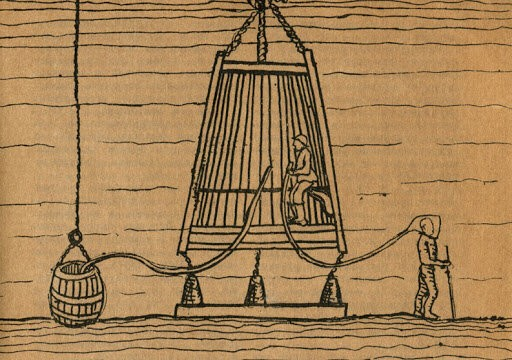
It is impossible to say exactly who first came up with the diving bell. The idea is simply too old.
The earliest written reference appears in Aristotle in the fourth century BCE. In his works Physics and Problems, he describes how divers used an inverted cauldron to trap air. Still, this was more an observation than a working design.
Later, the Roman philosopher Seneca in the first century CE wrote about a similar device. He described divers lowering large pots underwater and breathing inside them. But a true, regularly functioning diving bell was probably never built in antiquity.
The first real bell: 1535
The breakthrough came during the Renaissance. In 1535, the Italian Guglielmo de Lorena carried out his famous trials on Lake Nemi, not far from Rome. He built a wooden bell reinforced with iron and descended underwater with assistants. According to the accounts, they remained underwater for quite a long time and even lit a candle inside, which meant the air was still fit to breathe.
This is considered one of the first documented uses of a true diving bell. Guglielmo was neither a physicist nor an engineer — he was simply an enthusiast of antiquities trying to raise sunken Roman galleys from the bottom of the lake. But the idea worked.
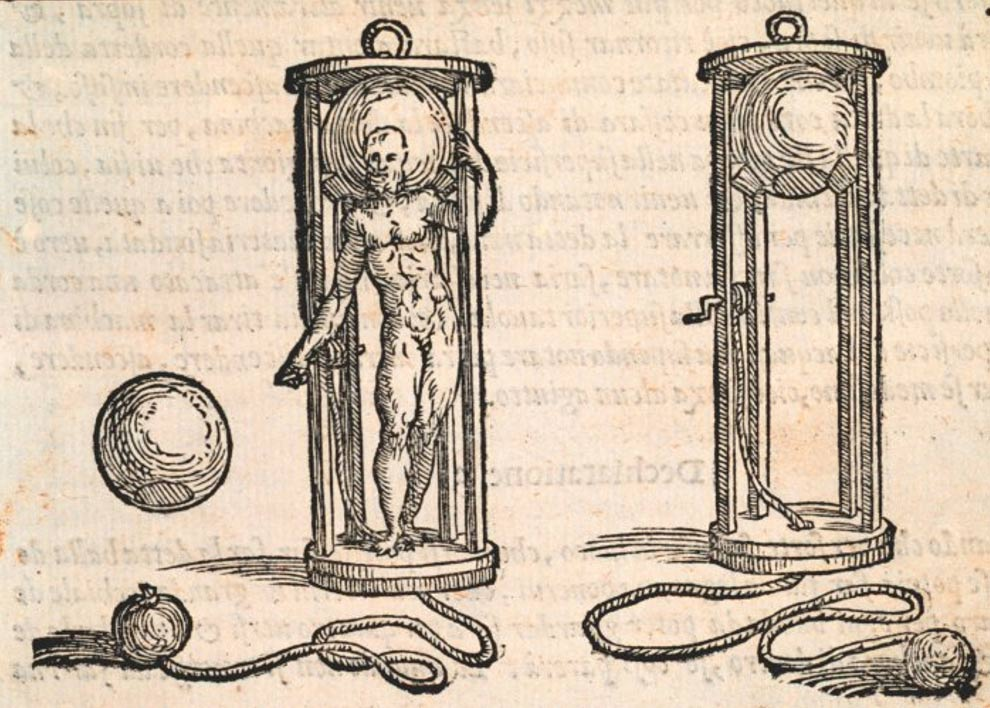
Early bells, however, had a serious flaw: the air inside quickly became stale. After half an hour or an hour, breathing became difficult because of the buildup of carbon dioxide. A diver would feel headaches and weakness and could even lose consciousness.
The great improvement: Edmond Halley and fresh air, 1691
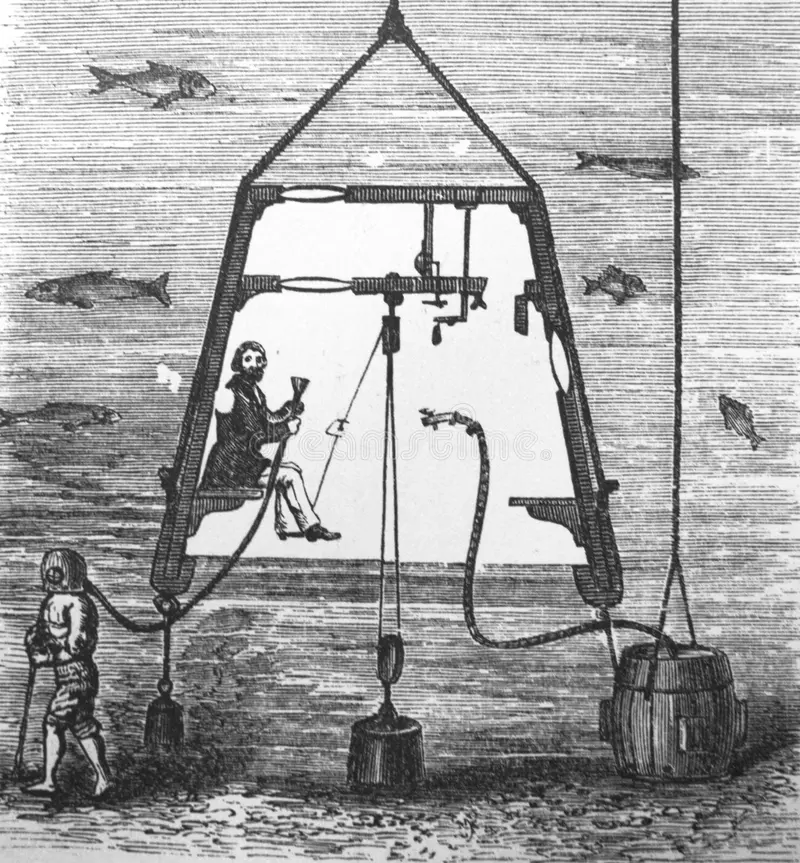
You probably know Edmond Halley as the astronomer who calculated the orbit of the famous comet. But far fewer people remember that he also made a major contribution to underwater work.
In 1691, Halley patented and built a diving bell supplied with fresh air. How did it work? Heavy lead barrels filled with air were lowered from above on ropes. The diver inside the bell connected a barrel to the chamber, and the compressed air flowed inside. Used air escaped through a special valve.
Now people could remain underwater not for half an hour but for several hours at a time. Halley personally took part in the trials. In 1691, he and four assistants spent a full hour and a half underwater at a depth of about 18 meters. In one of the dives, they remained below for nearly four hours.
That was a revolution. The diving bell ceased to be merely an air bubble and became a full working station. The system was still bulky and expensive, but for its time it represented the height of technology.
John Smeaton and the air pump, 1778

The next important step was taken by the English engineer John Smeaton. In 1778, during the construction of a bridge over the River Wear in Scotland, he used a diving bell supplied with air from above through a hose connected to a hand pump. This was far more convenient than dealing with heavy barrels.
Smeaton also improved the shape of the bell. Instead of a wooden barrel, he made a conical iron bell that was easier to lower and raise, more stable in a current, and more spacious for the diver. His design became the model for most later diving bells.
Thanks to Smeaton, underwater work became more predictable and safer. Air was now supplied continuously, and the diver could remain underwater for as long as the work required.
What people did underwater with diving bells
The diving bell was used for many different tasks. Here are a few examples from history: Raising sunken cargo. For example, from 1687 to 1689, silver and gold worth more than 300,000 pounds were recovered from ships off the coast of Spain — an enormous sum for the time. Building bridges and dams. Smeaton himself worked on bridges, while divers in the bell inspected the supports and drove piles. Repairing ships without lifting them to the surface — a diver could patch a hole or unscrew a fitting. Exploring sunken cities and ancient ships.
In 1775, the English diver Charles Spalding worked in Smeaton’s bell at a depth of 24 meters — a very serious depth for the eighteenth century. He spent two to three hours underwater at a time and felt fine.
Why the diving bell did not replace scuba
A diving bell is not scuba. They serve different purposes.
A bell ties a person to one place. You cannot swim away, move around a rock, or pass beneath a ship. You work only where the bell stands. A bell is heavy and requires a crane, a vessel, and a team above. You cannot simply take it with you in a boat. Inside a bell, it is still cold, damp, and cramped. It is a work platform, not a means of pleasure.
Scuba, which appeared in 1943 thanks to Jacques-Yves Cousteau and Émile Gagnan, gave a person personal freedom underwater. No hoses, no chamber. But scuba did not make bells obsolete — the two still exist side by side. Modern professional divers still use what are called dry bells, sealed chambers lowered underwater with warmth, light, and a supply of air inside. These are direct descendants of those old wooden barrels, only far more advanced.

The most astonishing part of the story
Think about it: people realized that air could be trapped underwater as early as 400 BCE. They did not know the physics of pressure and could not calculate the composition of gases, but they observed bubbles and understood the essential point.
The diving bell is an example of how a simple idea can work for centuries. It was never especially convenient, safe, or fast. But it gave humanity its first hours underwater. Without it, there would have been no diving suits, no modern bathyscaphes, and no scuba gear.
About the Creator
Enjoyed the story? Support the Creator.
Subscribe for free to receive all their stories in your feed.
Comments
There are no comments for this story
Be the first to respond and start the conversation.