
How daily life things are actually made in Factories.
daily life things

Have you ever wondered about the everyday things you use without really thinking how they’re made?
Take a simple pencil, for example. You’ve been using it since childhood to get where you are today. It looks like it’s made of wood—and it is—but how does that black “lead” inside get there? Or think about the airbags in cars that save thousands of lives every day—how do they inflate so quickly during an accident? And more importantly, when and why was the very first airbag invented?
Welcome! In our daily lives, we use so many products whose benefits we understand—but the effort, science, and techniques behind making them are something most of us rarely think about. So let’s explore the manufacturing processes behind five everyday products we use all the time.
Airbags
The idea of airbags first came in the 1950s when an industrial engineer survived a car accident with his family. Although everyone survived, the incident inspired him to create something that could improve safety.
Two years later, he developed an airbag system that used compressed air—but it was too slow. In an accident, even a fraction of a second matters. For years, this problem remained unsolved.
Then in 1967, an American engineer came up with a breakthrough: instead of compressed air, he used a chemical reaction. Inside the airbag is a chemical called sodium azide. When a crash sensor detects an accident, it sends an electrical signal that triggers a rapid reaction, releasing nitrogen gas. This gas inflates the airbag almost instantly.
From the moment of impact to full inflation, it takes just 20 milliseconds—faster than a blink of an eye.
The airbag fabric is also specially designed. It’s made from tightly woven nylon threads—about 1000 threads at once—to ensure strength. If even one thread breaks during production, the machine stops automatically. After weaving, the fabric is washed, dried, coated with silicone for airtightness, cut into shapes, stitched, and thoroughly tested.
Aluminum Foil
Aluminum foil is so thin that it tears easily, but have you ever thought about how massive aluminum blocks are turned into such delicate sheets?
First, pure aluminum is melted in a furnace. About 27,000 kg takes nearly 8 hours to melt. The liquid aluminum is then purified and poured into molds to form large blocks weighing up to 75 tons.
These blocks are fed into rolling machines with heated rollers that gradually flatten them. A 45 cm thick block can be reduced to just 5 cm after multiple passes. Then, another machine rolls it even thinner until it becomes foil.
Finally, damaged edges are trimmed, and the foil is wound into rolls—ready for use.
Bulletproof Glass
A 9mm bullet can easily penetrate steel, so how does bulletproof glass stop it?
The secret lies in layers. First, regular glass sheets are heated and bent, which makes them stronger. Then multiple layers of glass are stacked with special plastic sheets (PVB) in between.
This layered structure is sealed tightly, and all air is removed using a vacuum. The entire setup is then placed in a high-pressure, high-temperature chamber. This process fuses all layers into a single solid unit.
When a bullet hits the glass, the outer layers spread the force across the surface, while the inner plastic layer absorbs and stops the bullet—preventing it from passing through.
Pencils
Despite being called “lead pencils,” there’s actually no lead inside—only graphite.
This confusion dates back centuries because graphite and lead look similar. The truth was clarified in 1789, but the name stuck.
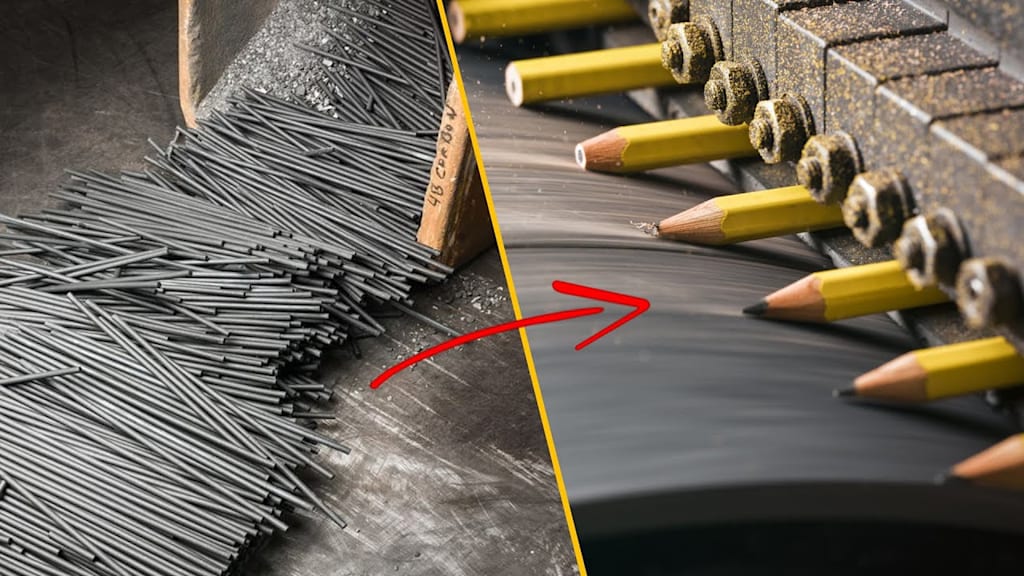
To make a pencil, graphite is mixed with clay and shaped into thin rods using pressure. These rods are baked in ovens to harden them.
Meanwhile, wooden slats are cut with grooves. Glue is applied, graphite rods are placed inside, and another wooden layer is added on top—forming a sandwich. After drying, machines cut this into individual pencils.
Finally, they are painted, stamped, tested for quality, sharpened, and packed.
Sugar
Sugar production starts with sugarcane. The cane is transported to mills, cleaned, and crushed to extract juice.
This juice contains impurities like dirt and sand. It’s purified by boiling and mixing with lime solution. After several hours, impurities settle at the bottom and are removed.
The cleaned juice is then boiled until it thickens into a paste. If cooled at this stage, it becomes jaggery (gur). But to make sugar crystals, a sucrose solution is added to help crystallization.
The mixture is then spun in a centrifuge machine (like a washing machine), separating liquid from solid crystals. Finally, the sugar is dried with hot air to remove moisture and packed—ready for use.
About the Creator
Imran Ali Shah
🌍 Vical Midea | Imran
🎥 Turning ideas into viral content
✨ Watch • Share • Enjoy
Enjoyed the story? Support the Creator.
Subscribe for free to receive all their stories in your feed.
Comments
There are no comments for this story
Be the first to respond and start the conversation.