
How Cargo Ships Fight with Somalian Pirates
Ships Fight

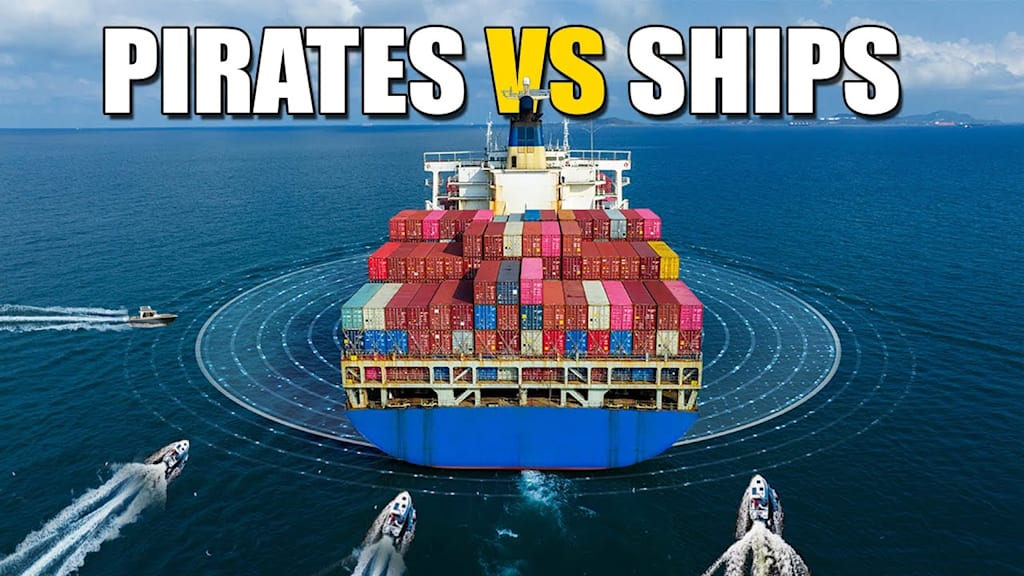
When a ship or vessel is out at sea,
it not only has to deal with storms and high waves,
but also faces unexpected dangers.
One of the biggest threats is piracy—especially from Somali pirates, who are known worldwide.
According to the International Maritime Bureau,
the shipping industry suffers losses of around $16 billion every year.
While delays in transportation contribute to this, the biggest cause is piracy.
There are a few key مناطق where Somali pirates operate:
the Somali Sea, the Guardafui Channel,
and most importantly, the Gulf of Aden.
Ships traveling from Asia to Europe must pass through the Gulf of Aden
to reach the Mediterranean Sea via the Suez Canal.
A large portion of global trade moves through this route—
especially oil transport vessels.
And this is exactly where the danger of pirate attacks is highest.
Welcome back to story.
Piracy isn’t just a modern problem—
it has existed for thousands of years.
In the past, pirates were less advanced.
But today, with modern technology,
both pirates and anti-piracy systems have become more sophisticated.
Cargo ships are the primary targets
because they carry goods worth ملايين dollars
but have relatively small crews.
Pirates usually don’t aim to kill.
Instead, they hijack ships, kidnap captains,
or hold the entire crew hostage
and demand ransom from shipping companies.
They don’t attack alone—
they often arrive in multiple boats, sometimes even in large numbers.
First, they approach the vessel and fire warning shots
to force the captain to stop.
Remember, the captain is responsible not only for navigation
but also for the safety of the ship.
Once close enough, pirates use grappling hooks
to climb onboard.
After boarding, they take control of the ship
or capture the crew and move the vessel to an unknown location.
Since the cargo is worth millions,
companies often prefer paying ransom
rather than risking total loss.
But ships are not defenseless.
Modern vessels use advanced anti-piracy measures.
When a threat is detected,
the crew first informs nearby coastal authorities.
Then the captain increases the ship’s speed.
This creates strong waves,
making it difficult for small pirate boats to approach.
Meanwhile, the crew tries to delay the pirates
until help arrives.
Here are some of the main defense systems:
1. Water Cannons
Almost every ship has them.
They can spray up to 1,350 gallons (over 5,000 liters) per minute.
The pressure is extremely high—
strong enough to knock pirates off their boats
or even flip them.
These cannons are controlled from inside the ship
and can also run automatically.
2. Water-Flood Systems
Some ships use special outlets
that fill pirate boats with water,
slowing them down and forcing them to retreat.
3. P-Traps (Steel Wire Barriers)
Steel frames extend from the ship,
releasing wires into the water.
These wires get tangled in the propellers
of pirate boats, disabling their engines.
4. LRAD (Long Range Acoustic Device)
This device emits a powerful, high-pitched sound
that humans cannot tolerate.
It can reach up to 5 kilometers
and forces pirates to retreat.
5. Electric Fences
Some ships install electric barriers.
They don’t kill—but give strong shocks.
These are only activated during attacks
to avoid harming birds or crew.
Real Incident – 2009
In April 2009,
the cargo ship Maersk Alabama
was traveling from Oman to Kenya.
Near Somalia, pirates attacked the ship
and captured Captain Richard Phillips.
This was the first pirate attack on an American ship
in over 200 years.
The crew tried to fight back using flares and water cannons,
but pirates managed to board.
They kidnapped the captain
and escaped in a lifeboat, demanding $2 million ransom.
The U.S. Navy quickly responded.
They knew the lifeboat had limited fuel,
so their strategy was simple:
delay the pirates.
Helicopters created strong waves,
and naval ships blocked their path.
After 80 hours,
the pirates were forced to negotiate.
But the situation was critical—
any mistake could cost the captain his life.
Finally, three Navy snipers took position
about 500 meters away.
They waited for the perfect moment.
When all three pirates were visible at once,
they fired simultaneously—
and eliminated all three.
Captain Richard Phillips was rescued safely.
About the Creator
Imran Ali Shah
🌍 Vical Midea | Imran
🎥 Turning ideas into viral content
✨ Watch • Share • Enjoy
Enjoyed the story? Support the Creator.
Subscribe for free to receive all their stories in your feed.
Comments
There are no comments for this story
Be the first to respond and start the conversation.