
How a Wet Rope Became a Unit of Speed at Sea
How sailors measured a ship’s speed with a rope, a wooden board, and a sandglass long before modern navigation instruments existed.
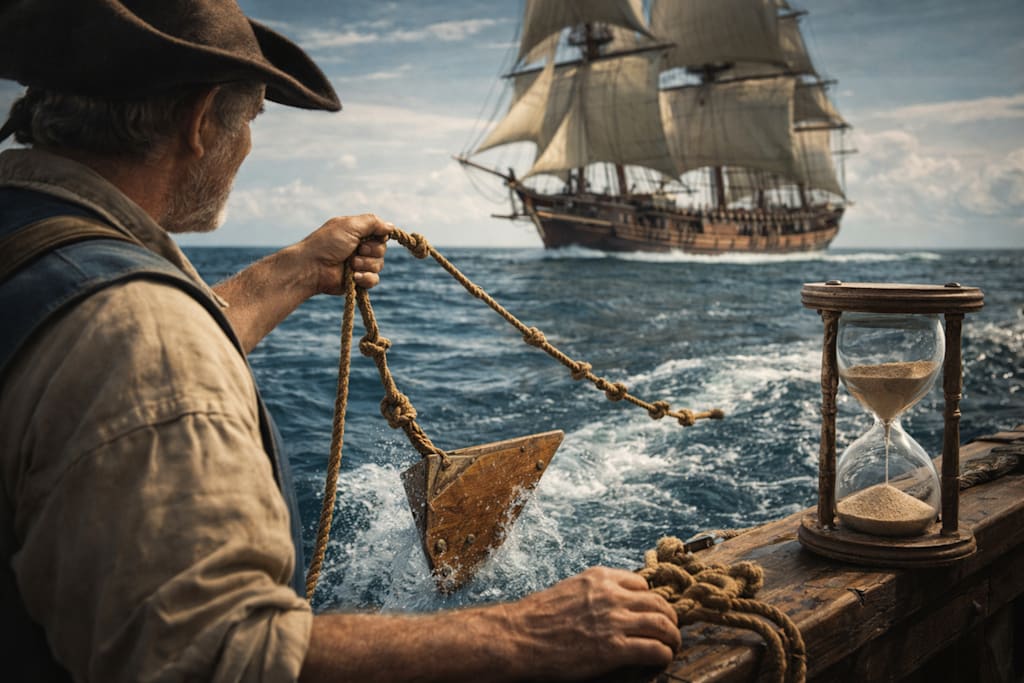
Today, a phone navigator shows speed down to tenths of a kilometer per hour. But how could anyone measure speed at sea when there was nothing around but water, no road under the keel, no markers ahead, and no instruments had yet been invented? For a long time, sailors judged a ship’s speed by eye: by the foam along the hull, by a chip of wood, or by a bubble drifting past. But in the open ocean, that estimate was often wrong. And an error in speed meant an error in distance and therefore in the ship’s position. That was enough to hit reefs, miss an island, or fail to reach port before a storm.
Why speed at sea was a question of survival
On land, you can afford not to know your exact speed. You reach the next landmark and figure out where you are. At sea, that kind of mistake could cost lives. The navigator kept dead reckoning: from the last known position, he plotted the course and the distance traveled. But without speed, there is no distance, and without distance, there is no position.
The danger was very real. In 1707, a British squadron was wrecked off the Isles of Scilly: four ships, including Admiral Cloudesley Shovell’s flagship Association, struck the rocks in thick fog. About 2,000 people died. The reason turned out to be terrifyingly simple: the navigators had made mistakes in dead reckoning because they had misjudged both speed and position. After this disaster, the British Admiralty seriously set about improving navigational instruments, including the log.
Speed was needed not only for navigation. It helped sailors understand how the wind was working, when to change sail, whether the hull had become fouled with barnacles, and when the ship would finally reach a port where water and food were waiting.
Who invented the log, and when it happened
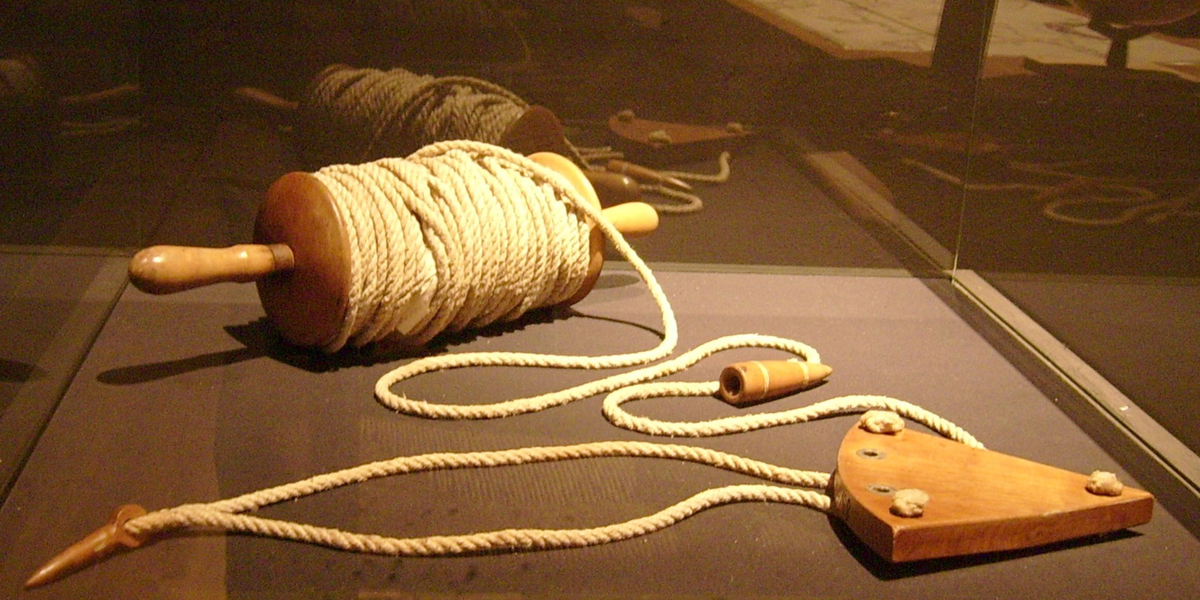
There is no exact name for the inventor. The English attribute it to a certain Captain Phillips, in some sources Phillips of Greenwich, around 1570–1580. The Spanish and Portuguese used similar devices even earlier, but it was in the English navy that the log became standard.
The first detailed description was given by Richard Norwood (1590–1675), an English mathematician and navigator. In his book The Seaman’s Practice (1637), he described both the log and the rules for using it. From then until the end of the nineteenth century — almost 250 years — the log remained the main method of measuring speed on sailing ships.
The English navy adopted it as a standard instrument. Judging from ship logs, it was already in use on ships of the line by the 1670s. For example, the journals of Captain John Norrington (1655–1689) include entries such as: “Cast the log, showed 4 knots. Fresh wind, making good way.”
How the log worked
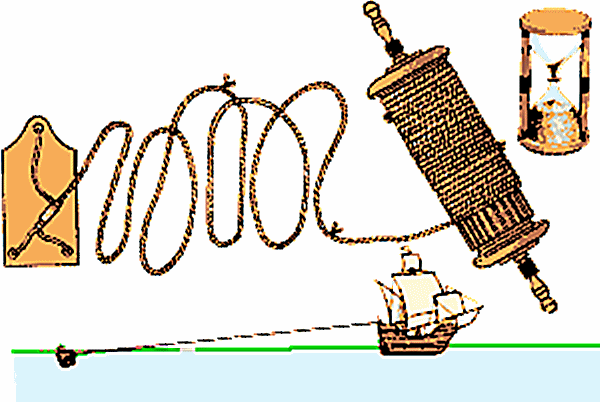
The method was simple. A special wooden board, the log-chip, was thrown over the stern. It was attached to a long rope called the log-line. Knots were tied in the rope at equal intervals. Once the board was in the water, the ship moved ahead and the rope ran out. A sailor held the log-line in his hand and counted how many knots passed through his fingers in a set amount of time.
Time was measured with a sandglass. Usually this was a 28-second or 30-second glass. One sailor watched the rope and counted the knots, while another turned the glass. As soon as the sand ran out, the count stopped. The number of knots that passed in that interval gave the speed in nautical miles per hour. In other words, a knot is quite literally a knot in a rope that has slipped through the fingers in 28 seconds.
Why 28 seconds? Because 1 nautical mile equals 1,852 meters. If you divide that by 3,600 seconds in an hour and multiply by 28 seconds, you get 14.4 meters. That was the distance set between the knots on the log-line. Conveniently, however many knots passed, that was how many miles per hour the ship was making.
For example, a ship is moving, the log is cast, and in 28 seconds 6 knots run through the hand. That means the speed is 6 knots. In other words, in an hour the ship will travel 6 nautical miles, about 11 kilometers.
How the log-chip was built, and why it did not fly after the ship
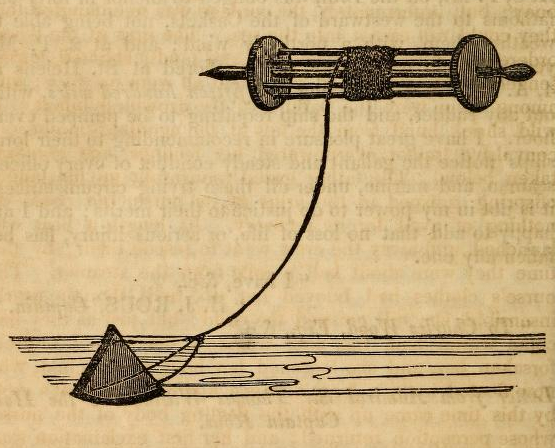
The log-chip was not just a random piece of wood. It was made from hard wood, usually oak or beech. Its shape was a sector of a circle, a quarter-disc, or a triangular plate. A strip of lead was attached at the bottom as ballast so that the board would stand upright in the water.
The board was fastened to a short line, the bridle, which was connected through a swivel to the main log-line. This design allowed the board to remain almost motionless in the water, creating resistance. The ship moved ahead, while the board stayed in place — like an anchor, only a light one.
To haul the log back in, it was enough to give a sharp pull: the swivel turned, the board fell flat, and it slid easily back to the ship’s side.
An interesting detail is that in bad weather the log was difficult to use. Waves tossed the board around, and the wind carried the rope aside. So in a storm, speed was often judged by the revolutions of the propeller on steamships or simply by the captain’s experience. For example, Captain James Cook used the log regularly on his voyages between 1768 and 1779, but in heavy seas he relied on his eye.
What errors this method had
The accuracy of the log left much to be desired. These were the main sources of error: Stretching of the log-line. A wet rope lengthened, the distance between knots increased, and the speed reading was overstated. The sandglass. In damp conditions, the sand could clump together, and the timing would drift. A difference of 2–3 seconds created an error of 10–15%. Currents. The log measured speed relative to the water, not relative to the seabed. If the ship was moving against a current, its real speed over the ground was lower. Waves. The log-chip rose and fell with the waves and produced unstable readings. Human error. A sailor could miss a knot or start counting at the wrong moment.
Even so, the error rarely exceeded 10–15%. For the eighteenth century, that was good enough. Captain William Bligh (1754–1817), known for the mutiny on the Bounty, noted in his records that when used carefully, the log gave “accuracy sufficient for a day’s run.”
How speed was linked to dead reckoning
The navigator would write in the logbook: “10:00, course NW by 67°, log showed 5 knots.” An hour later, he would mark 5 miles in that direction on the chart. After two hours, 10 miles. Step by step, he guided the ship from the last known point, for example from an island or from an astronomical observation.
Of course, errors accumulated. After several days at sea without landmarks, the discrepancy could reach dozens of miles. But the navigator had a second tool: astronomical observations, the altitude of the Sun and the stars. The log provided the link between those corrections.
Final point
A rope, a board, and a sandglass — that was enough to measure a ship’s speed in the ocean with an error of less than 10%. The old maritime log shows something important: even from the simplest things, it is possible to build a precise and reliable system.
About the Creator
Enjoyed the story? Support the Creator.
Subscribe for free to receive all their stories in your feed.
Comments
There are no comments for this story
Be the first to respond and start the conversation.