
How 130 Men Survive 8 Months in Submarine
130 Men Survive 8 Months in Submarine

During World War II, Nazi Germany’s submarine German submarine U-1206 was hiding deep in the North Sea.
Below—terrifying ocean depths.
Above—British aircraft on patrol.
At that very moment, the submarine’s captain made a fatal mistake… while using the toilet.
He opened the wrong valve.
Within seconds, seawater rushed inside the vessel, flooding the batteries and triggering a deadly chemical reaction—producing chlorine gas.
The crew had no choice but to surface.
But the moment they did, they were spotted by the Royal Navy and Royal Air Force.
The submarine was attacked and destroyed… and the entire crew was captured.
At depths of 200 meters, submarines leave zero room for error.
Even the smallest mistake… can mean death.
People say a submariner’s real enemy isn’t the ocean—
it’s their own mind.
Because their world is nothing more than a steel tube, hidden hundreds of meters beneath the sea.
Above them—crushing water pressure.
Below—silent death.
And in between… humans.
Submarine crews don’t stay underwater for days… but for months.
In fact, in 2024, HMS Vengeance set a record by staying submerged for an astonishing 201 days.
But this raises a question:
How do submariners survive underwater for more than 7 months?
Where do they get food, water, and oxygen?
What happens to waste and toilets?
And if something goes wrong—what options do they have?
Many people imagine submarines as luxury vessels.
Reality? They’re closer to coffins.
Inside, space is extremely tight—just narrow metal corridors where even two people struggle to pass each other.
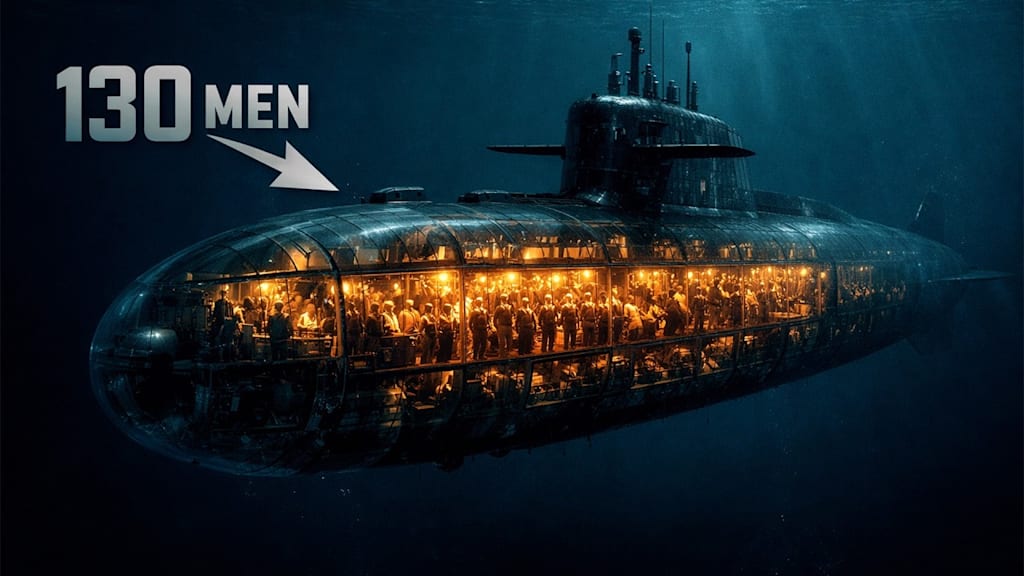
A submarine may look massive from outside, but inside it must fit:
Engines
Months of supplies
And over 130 crew members
For comparison:
A prison cell offers around 80 square feet per person…
while a submariner gets only about 20.
So in many ways, a mission feels like months-long imprisonment.
There’s no privacy.
Your personal space barely extends to your shoulders.
And that leads to the first major challenge:
Claustrophobia.
A condition where tight spaces trigger panic, anxiety, and poor decision-making.
That’s why navies carefully screen candidates—any sign of claustrophobia, and you're rejected.
Sleep is another struggle.
Most submariners don’t even have their own beds.
Instead, they use a system called “hot bunking.”
When one sailor leaves for duty… another immediately takes his still-warm bed.
Beds are stacked like coffins—so tight you can’t even sit up.
And since there’s no sunlight underwater, day and night don’t exist.
Sleep cycles become artificial.
Now, what about food?
Before deployment, submarines load up to 20,000 kg of food.
But there’s no proper storage—food is literally packed everywhere:
Under beds
In corridors
Around equipment
At the start, they eat fresh fruits and vegetables.
Later? Only canned and frozen food.
Still, food is extremely important—it keeps morale high.
That’s why some submarines even have:
Ice cream machines
Special “steak nights”
And instead of 3 meals… they eat 4:
Breakfast, lunch, dinner… and a midnight meal called “mid-rats.”
Now comes the most fascinating part:
Oxygen.
A submarine is completely sealed.
So how do they breathe?
They use electrolysis—splitting seawater into oxygen and hydrogen.
Oxygen is kept for breathing
Hydrogen is safely released
A single person needs about 600 liters of oxygen per day.
For 130 crew members—that’s 78,000 liters daily.
But breathing also creates carbon dioxide.
If CO₂ levels rise above 10%—it becomes deadly.
So submarines use CO₂ scrubbers with special chemicals to remove it.
In emergencies, backup canisters absorb CO₂ and turn it into solid waste.
Water?
Even though they’re surrounded by ocean… it’s all saltwater.
So submarines:
Distill seawater using heat
Or filter it using reverse osmosis
But water is still limited.
A shower? Just 60 seconds.
Now… what about toilets?
Waste is stored in special tanks.
Once full, powerful pumps push it out into the ocean—against extreme pressure.
But timing is everything.
If the wrong valve opens first… seawater can blast inside.
Exactly what happened with U-1206.
Solid waste is compressed, sealed in containers, and sometimes even ejected like torpedoes.
But machines aren’t the biggest problem.
The human mind is.
Months without sunlight…
Almost no contact with family…
Same smells, same walls, same faces…
This can lead to:
Depression
Anxiety
Mental breakdowns
Even small arguments can become dangerous.
To maintain sanity, submarines simulate day and night using lighting:
White light for day
Red light for night
History is full of deadly mistakes.
In October 1944, the submarine USS Tang fired a torpedo…
But due to a calculation error, the torpedo turned around—and hit the same submarine that fired it.
Whether it’s the toilet disaster of U-1206…
or a torpedo hitting its own vessel…
These incidents prove one thing:
A submariner’s life isn’t just about fighting the enemy.
It’s about fighting:
Their own mind
Their own machines
And the silent, unforgiving ocean
Where even the smallest mistake… means death.
About the Creator
Imran Ali Shah
🌍 Vical Midea | Imran
🎥 Turning ideas into viral content
✨ Watch • Share • Enjoy
Enjoyed the story? Support the Creator.
Subscribe for free to receive all their stories in your feed.
Comments
There are no comments for this story
Be the first to respond and start the conversation.