
HECATE'S NIGHT:
A LITTLE TIME WITH THE LADY OF THE CROSSROADS

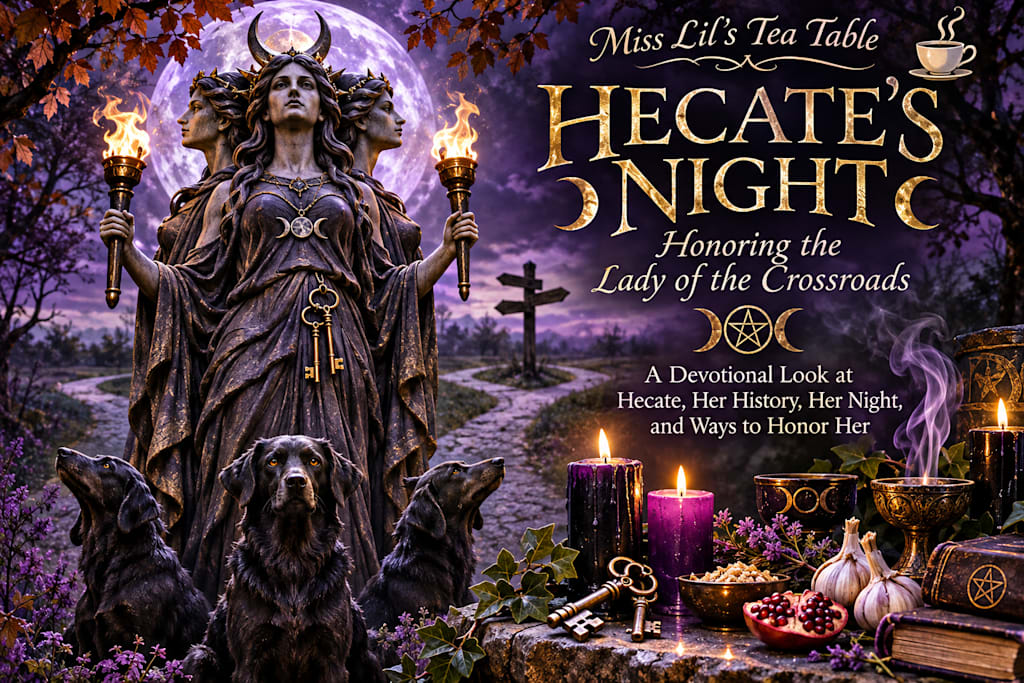
HECATE'S NIGHT: A LITTLE TIME WITH THE LADY OF THE CROSSROADS
An evening of reverence, magic, history, and a little love for the Goddess who walks between worlds.
Well, lovely readers, Miss Lil is a couple of days late with this post, but late is better than never. And with all the chaos currently happening in my little corner of the world, I am fairly certain the Lady of the Crossroads understands.
After all, Hecate has never struck me as a goddess who watches the clock.
On November 16, many witches, Wiccans, and Pagans took a little time to honor Hecate, the goddess of crossroads, magic, witchcraft, thresholds, and so much more. It's commonly known in modern Pagan and witchcraft circles as Hecate's Night, and today we're making this a little bonus celebration here at Miss Lil's tea table.
So, settle in, lovelies. Grab yourself something delicious to snack on, pour a cup of tea, coffee, or whatever happens to make your soul happy, and let's talk about my girl.
Not just the goddess whose name appears in mythology books. Not just the dark, mysterious figure people associate with witchcraft and the supernatural.
Let's talk about Hecate.
Who she was, what she represents, why so many of us feel drawn to her, and some of the beautiful ways we can honor her.
And because this is Miss Lil's tea table, we're going to do it with a little history, a little magic, and a whole lot of love.
FIRST, LET'S MEET THE LADY HERSELF
Hecate, also spelled Hekate, is a goddess whose roots reach deep into ancient religious history.
Although she is most commonly associated with ancient Greek religion, her origins are believed to extend back to the region of Caria in what is now modern-day Turkey. Over time, she became incorporated into Greek mythology and developed a fascinating collection of associations and responsibilities.
And when I say fascinating, I mean this woman has quite the résumé.
Hecate is associated with:
Witchcraft and magic.
Crossroads and travel.
Doorways, gates, and thresholds.
Protection of the household.
The night and darkness.
Spirits and the restless dead.
Transformation and transitions.
Keys, torches, and dogs.
Guidance through uncertainty.
She is often described as a goddess who moves between different realms, making her an especially fascinating figure for those who work with spiritual boundaries, transformation, and the unseen.
One of the earliest surviving literary references to Hecate appears in Hesiod's Theogony, generally dated to around the seventh century BCE.
And here is something I particularly love.
Hesiod does not introduce Hecate as some minor, insignificant goddess hiding in the shadows.
He describes Zeus honoring her and preserving her powers across the heavens, earth, and sea. She was associated with prosperity, success, and the ability to help mortals in many aspects of life.
She was a powerful goddess long before her name became so closely associated with witchcraft.
I think that's something worth remembering.
THE GODDESS AT THE CROSSROADS
If there is one image most people associate with Hecate, it is the crossroads.
And there is a reason for that.
In ancient Greece, crossroads were considered places of spiritual significance. They were transitional spaces, places where one road ended and another began. They could also be associated with spirits, the dead, and the supernatural.
Hecate became closely connected with these places.
She was often represented in triple form, looking in different directions, and her images were placed at crossroads, entrances, and near homes.
Think about that for a moment.
A crossroads represents a decision. A choice. A moment when you cannot continue exactly as you were before.
You have to decide which direction to take.
Sometimes that choice is exciting. Sometimes it is terrifying. Sometimes you find yourself standing there with absolutely no idea what comes next.
That is where Hecate's symbolism speaks to so many of us.
She is frequently viewed in modern spiritual practice as a guide through transitions, helping devotees navigate difficult decisions and periods of uncertainty.
She doesn't necessarily make the road easier.
Sometimes the greatest lesson is learning to walk it.
And perhaps that is one of the reasons I have such a deep appreciation for her.
HER TORCHES, HER KEYS, AND HER FAITHFUL COMPANIONS
There are several symbols traditionally associated with Hecate, and each carries its own significance.
The Torches
Hecate is frequently depicted carrying torches, sometimes one and sometimes two.
These are among her most recognizable attributes.
In the Homeric Hymn to Demeter, Hecate hears Persephone's cries and later approaches Demeter carrying torches. She becomes part of the search for Persephone and eventually serves as a companion to her.
The torches have become powerful symbols of illumination, guidance, and the ability to find one's way through darkness.
I find that particularly beautiful.
Darkness does not always mean something evil is waiting for us. Sometimes darkness simply means we haven't found the light yet.
The Keys
Keys are another important symbol of Hecate.
They represent her association with entrances, gates, and boundaries between places and realms.
In modern devotional practice, keys are often used to represent access, opportunity, protection, and the opening or closing of doors in our lives.
Sometimes we need a door opened.
Sometimes we need one firmly locked.
And sometimes we need the wisdom to know the difference.
The Dogs
Hecate has a longstanding association with dogs.
Ancient writers connected her with the howling and barking of dogs, particularly during the night. Dogs also appear in ancient descriptions and representations of the goddess.
Today, many devotees honor this connection through kindness toward animals, supporting shelters, rescuing dogs, or simply caring for the four-legged companions who share our homes.
And honestly, I cannot think of a better way to honor a goddess associated with dogs than showing a little extra love to the ones who need it.
WHY NOVEMBER 16?
Now, let's clear up something because Miss Lil likes her mythology with a healthy helping of facts.
November 16 is recognized in modern Pagan and witchcraft communities as Hecate's Night.
However, there is an important historical distinction.
There is no surviving evidence establishing November 16 as an ancient Greek festival dedicated to Hecate. The date appears to belong to modern Pagan observance rather than an ancient fixed-date celebration.
That doesn't make it meaningless.
Traditions develop. Spiritual practices evolve. People find new ways to honor the deities they love, and those practices can become meaningful parts of contemporary religious life.
The ancient Greeks did, however, have an established monthly observance associated with Hecate called the Deipnon.
The Deipnon was traditionally observed at the end of the lunar month, during the dark moon period before the new moon.
It involved household cleansing and offerings associated with Hecate. Food offerings were sometimes placed at crossroads, and the observance was connected with purification, the household, and the restless dead.
So while November 16 itself is a modern observance, the practice of honoring Hecate has much older roots.
And personally, I think there is something lovely about modern devotees finding another evening to give her the recognition she deserves.
WAYS TO HONOR HECATE
Now we get to the part I suspect some of you have been waiting for.
How do we actually celebrate her?
The beautiful thing about honoring Hecate is that devotion does not have to involve elaborate rituals, expensive supplies, or an altar that looks like it belongs in a museum.
You don't have to spend a fortune at the metaphysical shop.
You don't need a complicated spell.
And you certainly don't need to prove your devotion to anyone else.
Here are some ways you can honor her, whether you have worked with Hecate for years or are just beginning to explore your connection.
1. Light a Candle for Her
One of the simplest ways to honor Hecate is through candlelight.
Black, white, and purple candles are popular choices among modern devotees, although candle colors and their meanings can vary between traditions.
Light your candle, take a quiet moment, and offer a prayer or words of gratitude.
Think about the paths you've traveled, the obstacles you've overcome, and the choices still waiting for you.
Let the flame represent the light you carry through the darkness.
Always practice candle safety, of course. Never leave a burning candle unattended.
2. Create or Refresh an Altar
If you maintain an altar, Hecate's Night is a wonderful opportunity to refresh it.
Some traditional and commonly used devotional symbols include:
Keys.
Torches or candleholders.
Images or statues of Hecate.
Small representations of dogs.
Three-way crossroads imagery.
Incense.
Dark or purple altar cloths.
Natural stones and crystals.
You can also include things that have personal significance to your relationship with her.
Remember, an altar is a place of devotion, not a decorating competition.
3. Offer Her Something
Food and drink offerings have a long association with Hecate.
Historical offerings associated with her and the Deipnon included foods such as garlic, eggs, honey, fish, bread, and cakes.
Modern devotees may also offer water, wine, incense, or other meaningful items.
You might prepare a small plate of food, pour a little drink, and dedicate it to her.
If you choose to make an offering outdoors, be mindful of wildlife, local regulations, and the environment. Never leave food, containers, candles, or other materials where they could harm animals or create litter.
A thoughtful offering is about reverence, not how much you spend.
4. Work With Her Symbols
You can incorporate keys, candles, and crossroads symbolism into your personal practice.
Perhaps you have a key that represents a new beginning.
Perhaps you keep a small torch or candle on your altar.
Perhaps you write down three things: what you are leaving behind, what you are facing, and what you hope to welcome.
Use these symbols as a way to reflect on the transitions happening in your life.
5. Spend Time in Reflection
This one is especially important to me.
Hecate is so closely associated with thresholds and crossroads that taking time to examine your own life can be a meaningful devotional practice.
Ask yourself:
What am I holding onto that I need to release?
What choices am I avoiding?
Where do I need guidance?
What boundaries do I need to establish?
What new path am I ready to explore?
You don't have to have all the answers.
Sometimes acknowledging the questions is enough.
6. Honor Her Through Acts of Kindness
Donate to an animal shelter.
Help someone who is struggling.
Leave a little extra food at a community pantry.
Support someone who is navigating a difficult transition.
There are many ways to turn devotion into action.
For me, there is something particularly meaningful about honoring a goddess associated with protection by offering protection and kindness to others.
A LITTLE PRAYER FOR THE LADY OF THE CROSSROADS
For those who would like something personal to say when lighting a candle or spending time at their altar, here is a little devotional prayer from Miss Lil's tea table.
Lady of the Crossroads,
Keeper of the keys and bearer of the torch,
You who walk where the worlds meet,
I welcome your presence with respect and gratitude.
Illuminate the paths before me.
Help me recognize the doors that should open,
And give me the wisdom to close those that no longer serve my journey.
Stand beside me when the road grows uncertain.
Remind me that darkness is not always something to fear,
And that even the longest night eventually gives way to dawn.
Hecate, Guardian of the Threshold,
May I walk my path with courage,
May I honor the lessons along the way,
And may I never forget the light I carry within myself.
With gratitude, reverence, and respect.
So may it be.
THE TRIPLE GODDESS: THREE FACES, THREE PATHS
We cannot have a conversation about modern Hecate worship without touching on her association with the Triple Goddess.
Many modern Pagans and Wiccans associate Hecate with the Maiden, Mother, and Crone archetypes.
These three aspects are frequently connected with the cycles of life, feminine wisdom, and the phases of the moon.
The Maiden represents beginnings, possibility, curiosity, and new growth.
The Mother represents creation, nurturing, protection, and the fullness of life.
The Crone represents wisdom, experience, endings, transformation, and the knowledge gained through living.
It is important to understand that this particular Maiden, Mother, and Crone framework is a modern Pagan interpretation. It should not be confused with a universally established ancient Greek doctrine about Hecate.
Her ancient triple-bodied imagery and her later associations with lunar symbolism helped influence how modern practitioners understand her.
And I think there is something rather wonderful about this interpretation.
We are all these things at different moments in our lives.
We begin.
We grow.
We learn.
We lose.
We change.
We begin again.
And sometimes, the woman staring back at us in the mirror has a little more Crone wisdom than she did last year.
Personally, I think she has earned it.
A FEW THINGS I WANT YOU TO REMEMBER
If you are new to working with Hecate, please don't let social media convince you that there is only one correct way to honor her.
There are different traditions, different interpretations, and different devotional practices.
Some people work with her through formal ritual. Others build a quiet relationship through prayer, offerings, meditation, and everyday devotion.
Some follow Hellenic reconstructionist practices, while others approach her through modern witchcraft and Wiccan traditions.
You may also encounter different opinions about what offerings are appropriate, what symbols to use, and how to approach her.
Take time to research. Learn the history. Respect the traditions you encounter, and develop your own practice thoughtfully.
And please, don't feel that you need to perform elaborate rituals or make promises you cannot keep.
Respect, sincerity, and consistency mean far more than putting on a spectacular display.
BEFORE WE CLOSE THE TEA TABLE
I know this post is a couple of days late, but perhaps that is fitting in its own little way.
Life doesn't always follow the calendar.
Sometimes we get caught up in responsibilities, family, work, grief, and all the little fires that seem determined to burn simultaneously.
Sometimes we forget to stop and acknowledge the things that matter to us.
And sometimes we simply need to sit down, take a breath, light a candle, and reconnect with ourselves and our spirituality.
For me, Hecate represents so much more than the popular image of a dark goddess surrounded by shadows and mystery.
She represents the crossroads we all encounter. The doors we must decide whether to open. The boundaries we need to protect. The wisdom that comes from walking through difficult seasons of life.
She reminds us that there is strength in navigating uncertainty.
That darkness isn't always the enemy.
And that sometimes, the most important thing we can do is keep walking, even when we cannot see the entire road ahead.
So, to those who celebrated Hecate's Night on November 16, I hope your evening was meaningful.
And to those who are just discovering her, perhaps this is the beginning of a beautiful journey.
As for Miss Lil, I will continue to honor my Lady of the Crossroads in my own way, with reverence, gratitude, and a healthy respect for the paths she represents.
Until next time, lovelies, keep your candles lit, your minds curious, and your hearts open.
And remember...
Not every crossroads is a place where you become lost. Sometimes, it is exactly where you find your way.
With love from Miss Lil's tea table. 🖤
About the Creator
Lilithea Adasia
I dig where others look away. 🖤 True crime, paranormal mysteries, uncomfortable truths, and the beautifully broken human experience. I chase the stories others bury and ask the questions others avoid. Come curious. Leave questioning.
Enjoyed the story? Support the Creator.
Subscribe for free to receive all their stories in your feed. You could also become a paid subscriber, letting them know you appreciate their work.
Comments
There are no comments for this story
Be the first to respond and start the conversation.