
From Ox Carts to Smart Vans: The Exhausting History of Human Relocation
Let’s be honest: nobody actually enjoys the physical act of moving. Even today, packing up your life and shifting it across the city or the country is a stressful life event. But the next time you find yourself groaning over a heavy box of books, take a moment to appreciate the era you live in. The history of moving is a fascinating story of human endurance, mechanical innovation, and the relentless quest to save our backs and our time. Let’s take a journey from the dusty roads of antiquity to the hyper-connected logistics of the present day.

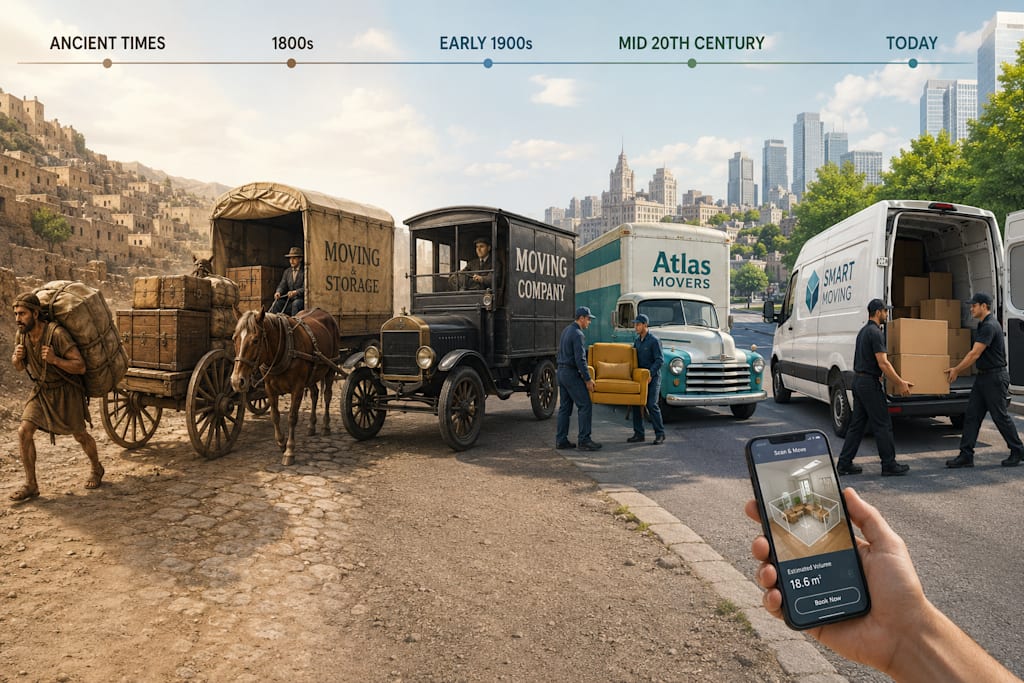
🐂 The Ancient and Medieval Eras: Muscle, Beasts, and Bare Essentials
For the vast majority of human history, moving was severely limited by physical strength. If you lived in ancient Rome or a medieval European village, a relocation meant one of two things: you carried your belongings on your back, or you loaded them onto an animal-drawn wooden cart.
There were no standardized boxes or bubble wrap. People used heavy wooden chests, woven baskets, and coarse fabric sacks. Moving even a short distance across a town could take a full day of backbreaking labor. Moving to a different city? That was a multi-week expedition fraught with broken wagon wheels, exhausted oxen, and the very real risk of losing everything to bad weather.
Because of this immense physical toll, people simply owned less. Furniture was often built into the home or left behind, because transporting a solid oak table on a horse-drawn wagon over unpaved, muddy roads was a logistical nightmare.
🚂 The Industrial Revolution: Steam and the First Moving Vans
The 19th century changed everything. The expansion of the railway systems meant that household goods could finally be transported across vast distances without relying solely on animal muscle.
But the real game-changer for local moving came in the late 1800s and early 1900s with the invention of the "moving van." Originally, these were literally large horse-drawn wagons specifically designed with covered roofs to protect furniture from the elements. By the 1910s and 1920s, the internal combustion engine replaced the horses. The motorized moving truck was born, dramatically cutting down the time it took to navigate growing urban landscapes.
📦 The 20th Century: The Magic of the Cardboard Box
If you want to point to one unsung hero in the history of relocation, it is the corrugated cardboard box. While invented earlier, it became the global standard for shipping and moving in the mid-20th century.
Suddenly, belongings could be packed uniformly, stacked securely, and carried efficiently. Coupled with the post-WWII boom of highway systems and the rise of professional, large-scale moving companies, relocation became an accessible reality for the middle class. However, the process still involved tedious phone calls, manual paper estimates, and a lot of guesswork regarding truck space and timing.
⚡ Present Day: The Era of Smart Logistics and Ultimate Efficiency
Fast forward to our current era. The evolution of moving has shifted from pure mechanical power to digital intelligence and hyper-efficiency. Today, the contrast between our ancestors' struggles and our modern convenience is staggering.
Here is what the relocation landscape looks like today:
App-Based Agility: Gone are the days of waiting days for a quote. Modern moving companies operate through instant digital booking. You can secure your move in minutes right from your smartphone.
AI Route Optimization: Traffic jams and complex urban layouts (like the narrow historical streets of European capitals) are navigated by AI-driven GPS. These systems calculate the exact minute a truck should arrive, avoiding blocked roads and minimizing fuel consumption.
Eco-Friendly Transport: Nowadays, urban logistics heavily relies on hybrid and fully electric vans and trucks, reducing the carbon footprint and allowing movers to access strict emission-free zones in city centers.
Smart Inventory Estimation: You no longer need to guess how big of a truck you need. Augmented reality (AR) and smartphone cameras allow users to quickly scan a room, and algorithms instantly calculate the exact cubic volume of the items.
⏳ The True Savings: Time and Human Energy
When we look back at the history of moving, the greatest triumph isn't just the vehicles—it is the preservation of our time and physical well-being.
A local move that would have taken a Victorian family an entire grueling weekend of heavy lifting and horse-drawn transport can now be completed today in just a few hours. By leveraging modern agile transport solutions, a team of professionals from a moving company with a well-equipped vehicle can clear out an apartment, navigate complex city zoning, and deliver everything safely before lunchtime.
We no longer have to sacrifice our physical health to change our address. The heavy lifting has been outsourced to smart machines, efficient vehicles, and streamlined logistics, leaving us with the most valuable resource of all: the time to actually enjoy our new home.
About the Creator
Alter Moving
ALTER Moving connects the topics of relocation, urban logistics, and "Man with Van" services into one space, sharing practical tips, moving hacks, and local transport solutions in Prague.
Enjoyed the story? Support the Creator.
Subscribe for free to receive all their stories in your feed.
Comments
There are no comments for this story
Be the first to respond and start the conversation.