
FIFA World Cup Winning Teams and How Many Goals Each Champion Scored
A look at every champion from Uruguay 1930 to Argentina 2022
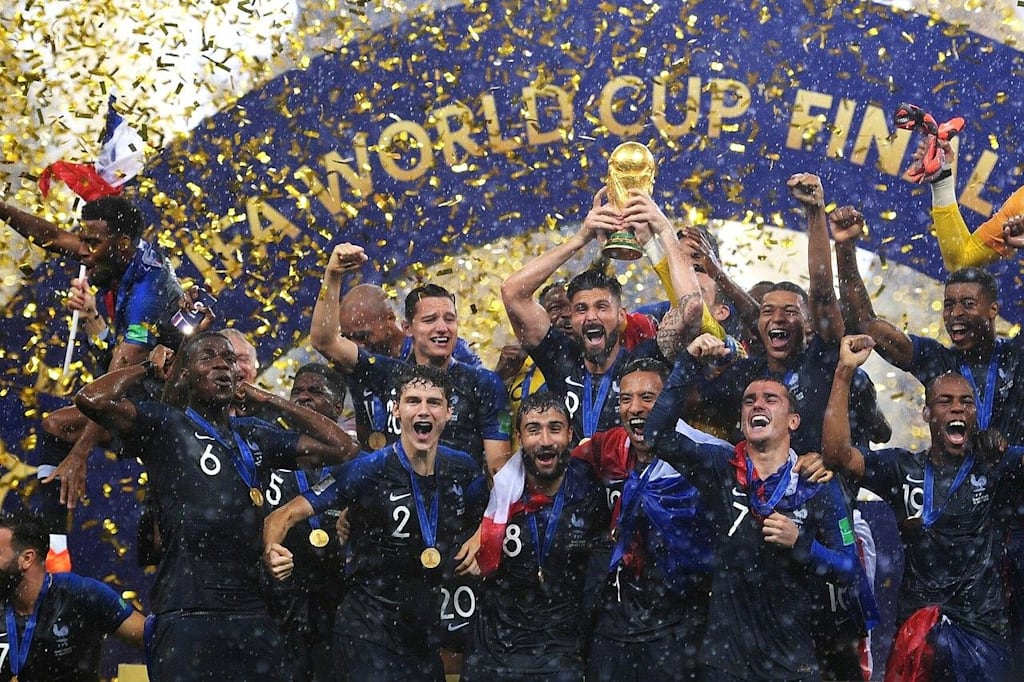
The FIFA Men’s World Cup is not only a story of trophies. It is also a story of goals: early goals that settle nerves, late goals that break hearts, and famous goals that become part of football memory forever. Every champion has its own personality. Some winners attacked with style and scored freely. Others defended with discipline, survived pressure, and won by the smallest margins.
When people remember World Cup winners, they usually remember the final. Uruguay beating Argentina in 1930. Brazil dancing through 1970. Spain passing their way to 2010. Argentina surviving an unforgettable 2022 final against France. But a champion is not made in one match. A World Cup winner has to score across the whole tournament, through group matches, knockout pressure, extra time, and sometimes penalty shootouts.
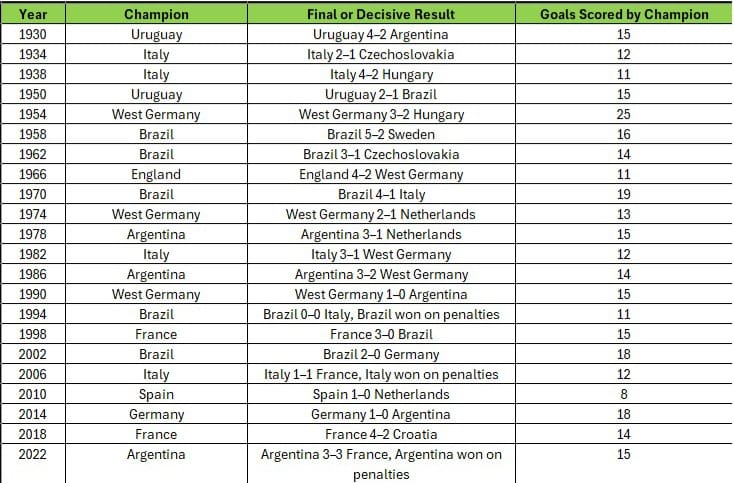
The goal totals below count only goals scored during matches, including extra time. Penalty shootout kicks are not counted as team goals. Final results and winners are based on published World Cup winners/finals records, while the tournament goal totals are calculated from each champion’s match scores.
Every World Cup Champion and Their Goals
The Most Explosive Champions
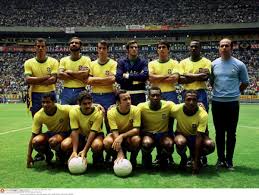
Caption/credit: Brazilian team before the 1970 World Cup match against Peru. Public domain in Argentina.
The highest-scoring World Cup champion remains West Germany in 1954, with 25 goals. That tournament is remembered for the “Miracle of Bern,” when West Germany defeated Hungary 3–2 in the final after losing 8–3 to the same team earlier in the competition. Their path was full of goals: 4–1 against Turkey, 7–2 in the playoff against Turkey, 6–1 against Austria, and then the dramatic final. Opta’s historical list also places West Germany 1954 among the highest-scoring teams ever at a single World Cup.
Brazil’s 1970 team is another attacking landmark. They scored 19 goals and won every match. Pelé, Jairzinho, Tostão, Gérson, Rivelino, and Carlos Alberto turned the tournament into a football exhibition. Their 4–1 final win over Italy is still treated as one of the greatest final performances in World Cup history. Brazil did not simply win; they gave the tournament one of its clearest images of beautiful attacking football.
Brazil also scored 18 goals in 2002, powered by Ronaldo, Rivaldo, and Ronaldinho. Germany matched that number in 2014, helped by their famous 7–1 semi-final victory over Brazil before beating Argentina 1–0 in the final.
Champions Who Won With Control, Not Many Goals
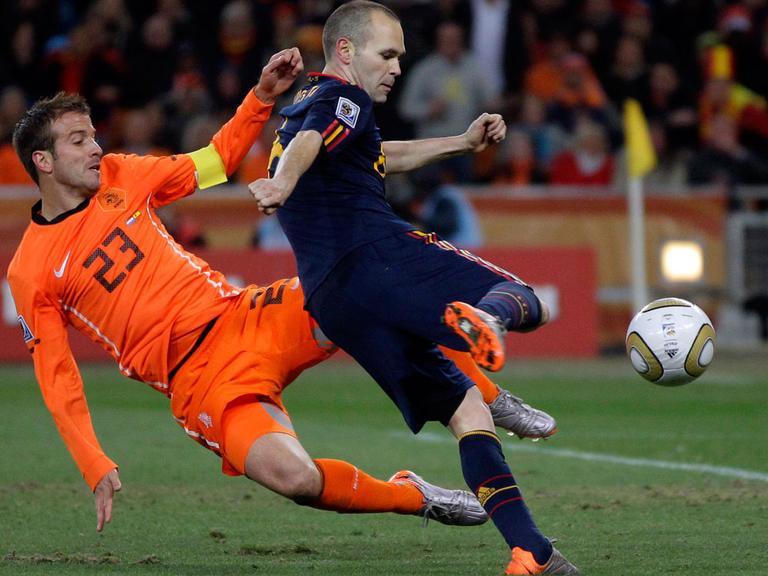
Caption/credit: Teams before the 2010 World Cup final between Netherlands and Spain. Image by Antonio Olmedo, CC BY-SA 2.0.
Spain’s 2010 victory is the best example of a low-scoring champion. Spain scored only 8 goals in the entire tournament, fewer than any World Cup-winning team. Yet their style was built on possession, patience, and control. After losing their opening match to Switzerland, Spain recovered and then won every knockout match 1–0: against Portugal, Paraguay, Germany, and the Netherlands. Andrés Iniesta’s extra-time goal in the final completed a campaign where Spain did not overwhelm teams with goals but suffocated them with the ball.
Brazil in 1994 also won with 11 goals, showing a more practical version of Brazilian football. Romário and Bebeto gave the team attacking quality, but their final against Italy finished 0–0 before Brazil won on penalties. England in 1966 also scored 11, with Geoff Hurst’s famous hat-trick in the 4–2 final win over West Germany lifting their total.
What the Numbers Say About Each Winning Nation
Brazil remain the most successful country in men’s World Cup history with five titles: 1958, 1962, 1970, 1994, and 2002. Across those five winning tournaments, Brazil scored 78 goals. That number reflects different generations: the Pelé years, the 1970 masterpiece, the balanced 1994 team, and the attacking stars of 2002.
Germany, including West Germany’s titles, have four World Cups and 71 goals across their winning campaigns. Their 1954 team scored 25, the highest total by any champion. Their 2014 team scored 18, mixing structure with ruthless finishing.
Italy also have four titles, but their winning identity is different. Across 1934, 1938, 1982, and 2006, Italy scored 47 goals. Italian champions often blended tactical intelligence, defensive strength, and timely goals rather than constant attacking fireworks.
Argentina have three titles and 44 goals across their winning tournaments. The 1978 team scored 15, the Diego Maradona-led 1986 team scored 14, and the Lionel Messi-led 2022 team scored 15. Argentina’s World Cup history often feels emotional because their triumphs are connected to iconic leaders and dramatic moments.
France have two titles and 29 goals: 15 in 1998 and 14 in 2018. Uruguay also have two titles and 30 goals, with 15 in 1930 and 15 in 1950. England and Spain have one title each, with England scoring 11 in 1966 and Spain scoring 8 in 2010.
Why Goals Do Not Tell the Whole Story
Goals are easy to count, but they do not always explain greatness. A team can score many goals and still fall short, like Hungary in 1954. A team can score fewer goals and still become champion, like Spain in 2010. What matters is when the goals arrive, who scores them, and how the team responds when the tournament becomes tense.
The World Cup rewards balance. Champions need enough creativity to break opponents down, enough defense to survive bad moments, and enough mentality to handle pressure. Argentina in 2022 are a perfect example. They lost their opening match to Saudi Arabia, then slowly grew into the tournament. By the final, they had scored 15 goals, but their victory also depended on composure in two penalty shootouts and the emotional leadership of Lionel Messi. FIFA’s own team statistics list Argentina with 15 goals at Qatar 2022.
Conclusion: Every Champion Has a Different Goal Story
The World Cup has never had only one winning formula. West Germany in 1954 won with a flood of goals. Brazil in 1970 won with unforgettable attacking beauty. Italy won several titles through timing, experience, and tactical control. Spain won with the fewest goals of any champion, proving that dominance can be quiet. Argentina in 2022 won with drama, resilience, and one of the greatest finals ever played.
That is why the list of World Cup winners is more than a record book. It is a timeline of football styles. Some champions roared. Some waited. Some passed. Some counterattacked. Some defended until one perfect chance arrived. But every champion, no matter how many goals they scored, found the net often enough to lift the trophy.
About the Creator
Muddasar Rasheed
https://vocal.media/journal/my-worst-experience-with-simon-leigh-of-pure-reputation
https://www.glassdoor.co.uk/Reviews/Employee-Review-Pure-Reputation-E2198292-RVW70391103.htm
https://simonleigh.weebly.com/
Enjoyed the story? Support the Creator.
Subscribe for free to receive all their stories in your feed.
Comments
There are no comments for this story
Be the first to respond and start the conversation.