
Every Year We Burn Ravana. But Have We Defeated Him?
A Dussehra Reflection
One of my earliest childhood memories takes me back to Hyderabad.
Thanks for reading Stories, Systems, and Signs! Subscribe for free to receive new posts and support my work.
I must have been three or four years old when one of my maternal uncles took me to Seetharambagh to watch the Dussehra celebrations. In those days, a huge crowd would gather on the vast open grounds to witness the burning of Ravana’s effigy. Along one side stood a long boundary wall where people sat shoulder to shoulder, waiting for the spectacle to begin.
The excitement was infectious. Families gathered from all over the city. Children ran through the crowd. Vendors sold snacks and toys. To make sure I could see above the sea of people, my uncle lifted me onto his shoulders.
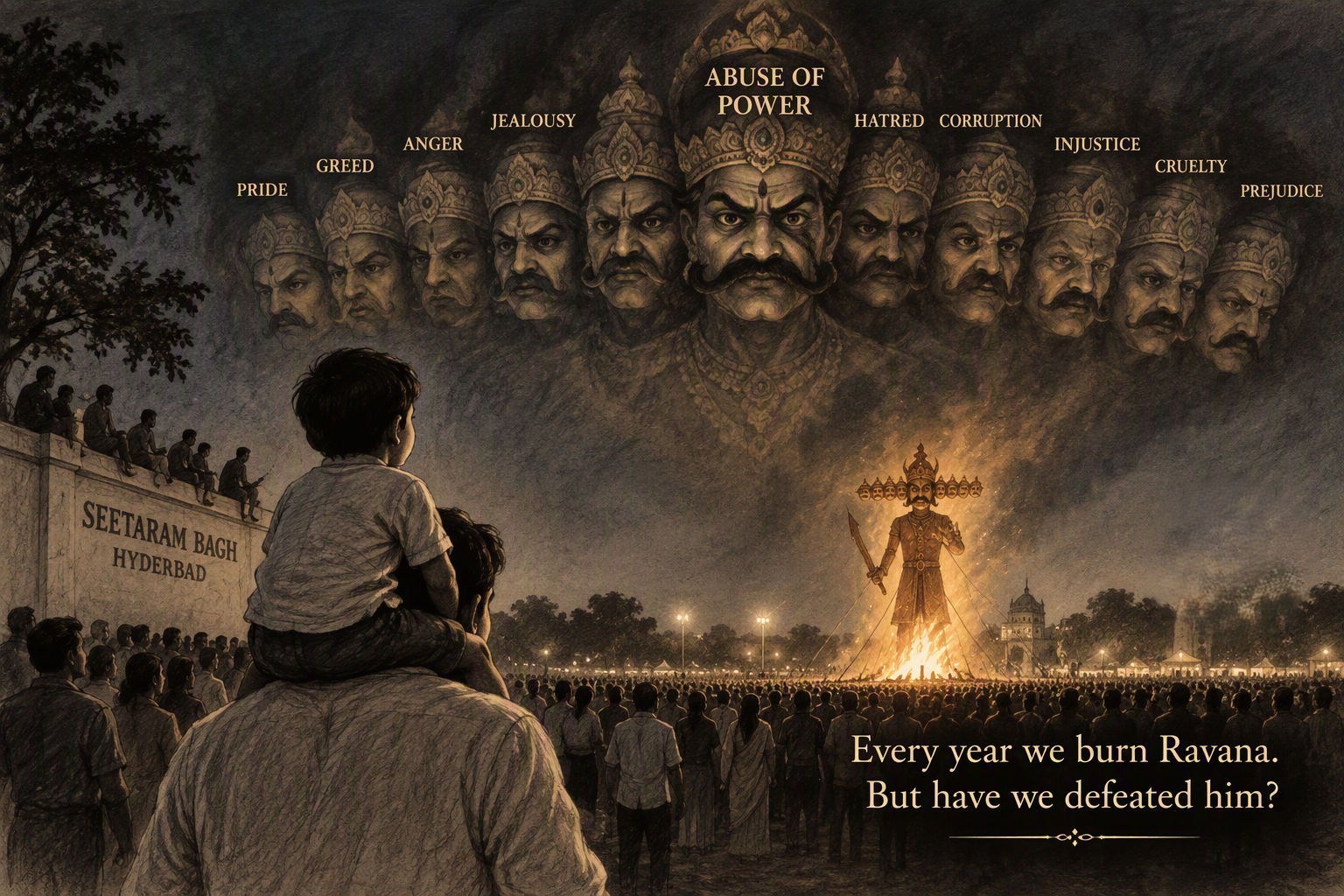
“Look, look,” he said. “Ravana is burning!”
Yet strangely, that is not what my memory preserved.
I do not remember the flames or the fireworks.
Nor do I remember the giant effigy.
What I remember most is staring into the darkness.
Over the years, I have often wondered why that darkness remained in my memory while the spectacle itself faded away. Perhaps childhood memories work in mysterious ways. Or perhaps the real battle of Dussehra is not against a paper effigy standing in a field.
It is the battle against the darkness within us, our societies, our nations, and our world.
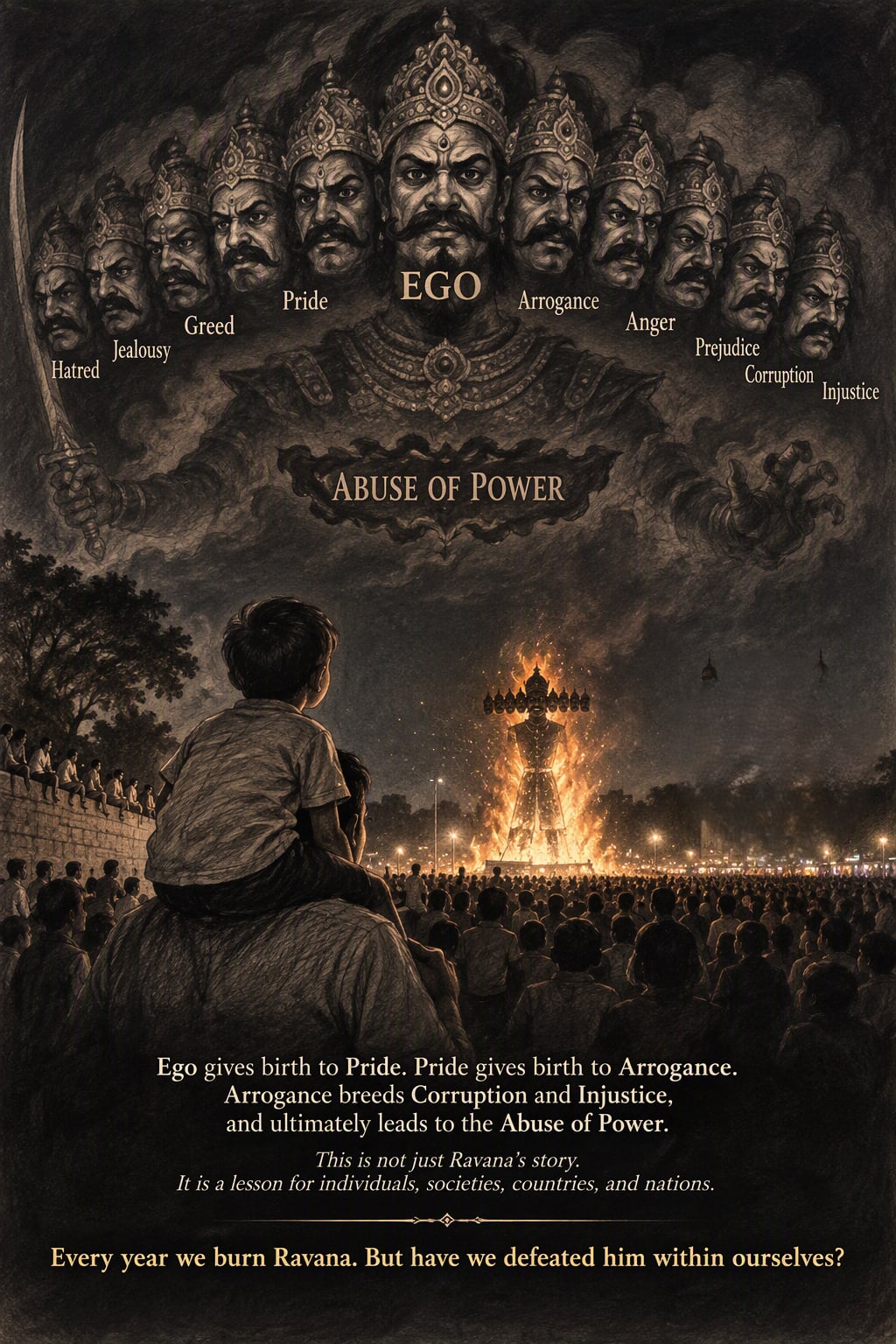
As Dussehra approaches each year, the burning of Ravana’s effigy should remind us of a deeper truth. It is not enough to burn an effigy once a year; we must also examine the Ravana within. Pride, ego, arrogance, greed, anger, jealousy, hatred, prejudice, corruption, injustice, and the abuse of power are the real demons that must be confronted. Ravana is remembered in different ways across traditions. Some see his ten heads as symbols of vast knowledge and learning. Yet his story also reminds us that knowledge alone is not enough. Wisdom without humility can give way to pride, ego, and the misuse of power.
The darkness within individuals does not remain confined to the individual. When left unchecked, our inner demons are projected onto our communities, societies, and ultimately nations. What we witness around us, whether prejudice, corruption, injustice, or the abuse of power, is often the collective expression of these unchecked human failings.
These personal failings do not remain personal for long. Once embedded in institutions and systems, they can influence the destiny of entire societies and nations.
When we look around the world today, we continue to see suffering, oppression, injustice, and the abuse of power in many places, whether in the Middle East, South Asia, the Americas, Europe, Africa, or elsewhere. These realities should not make us hopeless. Rather, they should remind us of the lessons that history and faith traditions have been teaching humanity for centuries.
There is a well-known saying in India:
“Bhagwan ke yahan der hai, andher nahin.”
“In God’s court, there may be delay, but there is no injustice.”
Or as it is often expressed in English:
“God’s justice may be delayed, but it is never denied.”
The story of Ravana reflects this timeless lesson. Ravana possessed immense knowledge, extraordinary abilities, wealth, power, and a magnificent kingdom. Yet despite all his strengths, it was not weakness that led to his downfall. It was ego. It was pride. It was the belief that power placed him above moral limits and accountability.
The Golden Lanka burned not because Ravana lacked strength, but because power without righteousness ultimately destroys itself.
The lesson is not that the righteous never suffer. More often they do. Shri Ram endured exile. Sita Ma endured hardship and separation. The path of truth has never been easy. Truth is often tested before it is vindicated.
This is why Dussehra is not merely a celebration of an event from the distant past. It is a reminder for the present.
Before pointing to the Ravana outside, we should ask whether there is a Ravana within us.
Do we carry ego?
Do we nurture pride?
Do we remain silent in the face of injustice?
Do we excuse wrongdoing when it benefits our side?
Do we allow prejudice, hatred, corruption, or the abuse of power to grow unchecked?
There is an old saying from Hyderabad:
“A serpent’s head should be crushed before it raises itself.”
The wisdom behind that saying is not about other people. It is about us.
Ravana’s many heads do not appear overnight. Ego, pride, greed, hatred, corruption, and injustice begin as small tendencies, small compromises, and small acts of silence. Left unchecked, they grow stronger until they begin to dominate individuals, societies, and even nations.
Each year we gather to watch Ravana’s effigy burn. Yet the real purpose of Dussehra is not simply to witness the defeat of Ravana, but to learn from his fate. His story survives not to glorify his power, but as an ibrah (moral reflection) for those willing to reflect.
The Prophet Muhammad ﷺ(peace be upon him) taught that among the greatest acts of courage is to speak a word of truth before a tyrannical ruler. The lesson is timeless. Standing for justice is not easy. Speaking the truth is not always popular. Defending the oppressed often comes at a cost.
Yet moral courage has always begun with ordinary people choosing not to remain silent. We need courageous voices that speak against oppression, injustice, and hatred.
Perhaps that is the true meaning of Dussehra.
Not merely to burn an effigy.
Not merely to celebrate a victory from long ago.
But to confront the Ravana within ourselves and to choose humility over ego, truth over falsehood, justice over oppression, courage over silence, and compassion over hatred.
As a child standing on my uncle’s shoulders in Seetharambagh, I watched the darkness more than the flames.
Today, I think I understand why.
The flames of Dussehra last only a few moments.
The struggle against the darkness within us lasts a lifetime.
About the Creator
Akram Mohammed
From a four-decade IT career to storytelling, I write about South Indian Islamic history, memoirs, faith, philosophy, cultural heritage, and nature, uncovering overlooked perspectives and meaningful human connections.
Enjoyed the story? Support the Creator.
Subscribe for free to receive all their stories in your feed.
Comments
There are no comments for this story
Be the first to respond and start the conversation.