
China's First Moon Crew: Three Names, One Frontrunner, and the Case for a Woman in Orbit
Two official statements narrowed the field. What's left is a short list, a clear favorite, and a real debate about who stays in orbit.
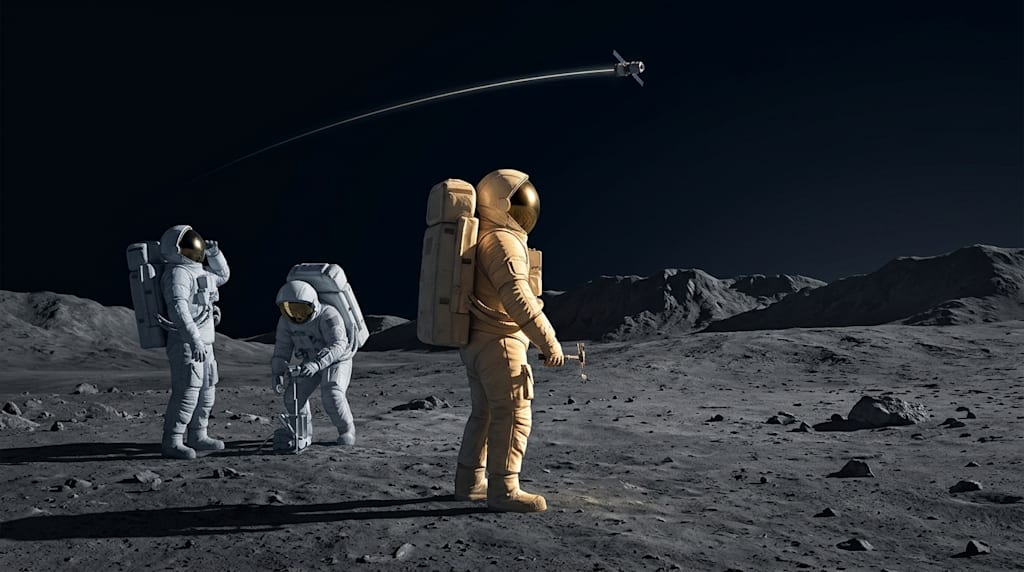
In March 2026, Yang Liwei said something that cut the discussion in half: "The astronauts who will land on the Moon in the future must first have flown a space station mission, must have executed that task." In May, Ji Qiming, spokesperson for China's manned space engineering program, confirmed the criterion. Without space station flight experience, you're not in the first lunar landing conversation.
The second threshold is timing. In September 2026, Yang Liwei announced that all 14 first-batch Chinese astronauts had been grounded and stopped training in October 2025. Deep-space training is harder than routine space station flights. Restoring a full training regimen for grounded personnel costs too much and carries too much risk. The program won't prioritize them.
Combined, the candidate pool narrows to the second and third batches. The fourth batch entered in August 2024. Its first member, Li Jiaying, completed her first flight on Shenzhou-23 only in May 2026. By 2030 she will still be accumulating flight experience. Some reporting suggests early crewed lunar missions will include only professional astronauts (pilots and spaceflight engineers), excluding payload specialists. Li Jiaying's payload specialist status is a second obstacle on top of being fourth-batch. The same applies to Gui Haichao and Wang Jie.
The names worth discussing are concentrated among sixteen people: Chen Dong, Zhang Lu, Ye Guangfu, Cai Xuzhe, Tang Hongbo, Wang Yaping, Liu Yang, Zhu Yangzhu, Tang Shengjie, Jiang Xinlin, Li Cong, Li Guangsu, Song Lingdong, Wang Haoze, Chen Zhongrui, and Zhang Zhiyuan.
The frontrunner
Chen Dong has the highest probability. As of 2026, he has spent about 418 days in orbit, the longest among Chinese astronauts. Two of his three flights were as commander. During the Shenzhou-20 mission in 2025, debris struck the return capsule's window, and he helped decide to switch vehicles for the return. Lunar missions differ from low-Earth-orbit missions in two ways: communication delay and the impossibility of a rapid return. Astronauts must rely on their own judgment to handle failures far from Earth. 418 days in orbit, two commander assignments, one high-level contingency: he has the long-duration stay, the command decision-making, and the emergency response. Chen Dong was born in 1978 and will be 52 in 2030. For a first lunar landing that prioritizes stability, age is not an obstacle.
The competition
Ye Guangfu has about 375 cumulative days in orbit, the first Chinese astronaut to spend more than a year in space. In early 2026, he was one of the commanders of China's first astronaut cave training. That training is for crewed lunar landing. It focuses on psychological adaptation and handling unknown scenarios in extreme environments: enclosed, dark, and dependent on limited information for decisions. The conditions mirror lunar surface operations. His role as commander shows he is central to lunar-specific training. Born in 1980, he will be 50 in 2030.
Zhang Lu has conducted seven EVAs, the most among Chinese astronauts. Lunar surface operations are essentially an ultra-long, high-risk EVA: descent in the lander, walking on the surface, sampling, deploying equipment, returning to the ascent vehicle. All of it depends on EVA operational capability. Seven EVAs is the strongest evidence for that capability. Born in 1976, he will be 54 in 2030. That is relatively old, but if the task division has someone focusing on extravehicular work, his experience is hard to replace.
Zhu Yangzhu's situation changed in 2026. His original label was the first spaceflight engineer from the third batch to fly, with about 271 cumulative days in orbit and training focused on systems operation, fault troubleshooting, and payload management. In May 2026, he commanded Shenzhou-23, becoming the first third-batch astronaut to serve as commander and the first spaceflight engineer to do so. Commander experience sends a stronger signal for lunar missions than a technical background. Organizational coordination, decision-making command, team management: the engineering side has recognized all three. Born in 1986, he will be 44 in 2030, the youngest of the three-man candidates.
The competition among the three is real. If the priority is the classic pairing of commander and lunar pilot, Chen Dong (commander/lunar landing) + Ye Guangfu (lunar landing/orbital stay) + Zhang Lu (orbital stay/lunar landing) is the combination with the most experience. If the priority is the spaceflight engineer's ability to handle technical failures on the lunar surface alone, Chen Dong (commander/lunar landing) + Zhu Yangzhu (lunar landing) + Ye Guangfu (orbital stay) is the alternative. Zhu Yangzhu's commander experience and his age of 44 keep him available for follow-on missions.
The case for a woman in orbit
Another combination: two men and one woman. Academician Long Lehao once named Liu Yang, Wang Yaping, and Wang Haoze as possible candidates for "the world's first female astronaut to land on the Moon."
Age is a practical variable. Liu Yang was born in 1978 and Wang Yaping in 1980; in 2030 they will be 52 and 50. Wang Haoze was born in 1990 and will be 40. Wang Haoze is a third-batch spaceflight engineer who flew Shenzhou-19. Her technical background matches the orbital stay duties: system monitoring, emergency operations, independent decision-making. Orbital stay is not "secondary" to lunar surface work. The astronaut remaining in orbit must independently monitor the spacecraft's status during the lander's descent and ascent. In an anomaly, that astronaut must judge whether to return emergently or wait for rescue. This requires systems thinking and fault-handling experience. Wang Haoze's spaceflight engineer background covers it.
Placing a woman in orbital stay rather than on the lunar surface makes engineering sense. The lander's descent and ascent phases and the lunar surface EVA are the highest-risk parts of the mission. If the first mission divides the work as "two men landing, one woman remaining in orbit," it controls risk and still puts a woman on the mission. Wang Haoze (orbital stay) + Chen Dong and Ye Guangfu (lunar landing) is a combination where the jobs don't overlap: Chen Dong's command decisions, Ye Guangfu's long-duration stay and cave training command experience, Wang Haoze's system monitoring and emergency operations.
Corrections
Fourth-batch astronauts (including Li Jiaying) are out of first lunar landing consideration. They entered recently, flew late, and have not completed lunar-specific training. Before 2030 they won't have the qualifications a lunar mission requires.
Payload specialists may be excluded from early lunar missions. If the "temporarily only professional astronauts" criterion holds, Gui Haichao, Wang Jie, and Li Jiaying are not first-crew candidates. Wang Haoze is a spaceflight engineer, so she is unaffected.
Zhu Yangzhu's 2026 commander appointment made him more competitive. He is not just a spaceflight engineer with a strong technical background. He is a core third-batch member tested in the commander role. In the three-man group, he is real competition for Zhang Lu or Ye Guangfu.
For the female orbital stay slot, Wang Haoze's age and job fit beat Liu Yang's and Wang Yaping's. That is not a knock on the latter two. It is the result of the mission timeline and the selection logic for long-duration deep-space missions.
Three combinations
Combination one: Chen Dong (commander/lunar landing) + Ye Guangfu (lunar landing/orbital stay) + Zhang Lu (orbital stay/lunar landing). All three have long-duration stay experience. Chen Dong and Ye Guangfu have command and emergency decision-making experience. Zhang Lu brings EVA operational capability.
Combination two: Chen Dong (commander/lunar landing) + Zhu Yangzhu (lunar landing) + Ye Guangfu (orbital stay). Chen Dong anchors. Zhu Yangzhu handles lunar surface technical failures with his spaceflight engineer background and commander experience. Ye Guangfu takes orbital stay and emergency support.
Combination three: Wang Haoze (orbital stay) + Chen Dong and Ye Guangfu (lunar landing). A woman joins the first lunar landing mission. Wang Haoze takes orbital stay with her spaceflight engineer background. Chen Dong and Ye Guangfu land.
Chen Dong appears in every combination. Ye Guangfu appears in two. Wang Haoze, Zhu Yangzhu, and Zhang Lu each appear in one. That roughly maps the odds under current public information: Chen Dong is the safest bet, Ye Guangfu second, the third slot is contested within the three-man group, and the two-men-one-woman group keeps a clear path open for Wang Haoze.
The final list depends on spacecraft matching training scores, psychological evaluations, physical condition, and task division. Astronaut selection is not ranked by seniority. Performance in training, team chemistry, and changes in medical indicators can all alter the outcome. The projection above shows how public information narrows the possibilities. It does not provide the answer.
About the Creator
Jin
Writer of reamstories
https://reamstories.com/jin
Enjoyed the story? Support the Creator.
Subscribe for free to receive all their stories in your feed. You could also become a paid subscriber, letting them know you appreciate their work.
Comments
There are no comments for this story
Be the first to respond and start the conversation.