
Atlantis: Tales from Beneath the Waves
A Voyage Across the Ocean to a Lost Empire.

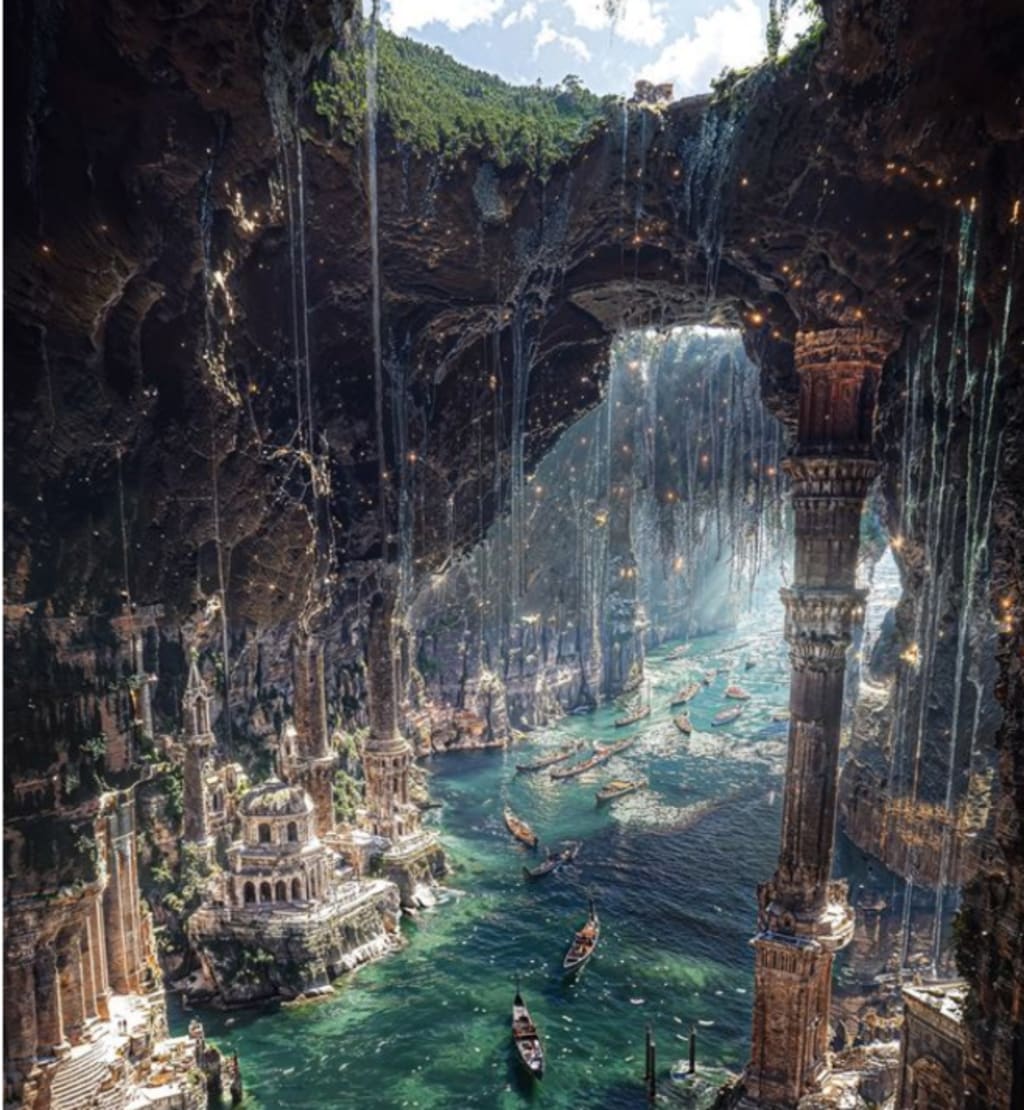
What if you were told that there was a land long lost and long buried forever beneath the calm depths of a serene, endless sea? Would you believe it? Picture a land so magnificent that even the ancient gods said to covet its splendor. A place of golden towers and crystalline domes. A city born of stars and seafoam.
This was Atlantis, an ancient civilization believed to be shrouded by the silent, towering waves of the ocean.
For centuries, the legend of Atlantis has murmured through time like a half-forgotten lullaby; too wondrous to be real, yet too vivid to be silenced. It beckons to dreamers, explorers, and to those who believe that not all tales are condemned to be mere stories.
Where Atlantis First Stirred
The earliest whispers of Atlantis came not from a sailor returning from some forbidden sea or tales murmured along distant shores, but from the pen of a philosopher. Around 360 BCE, Plato wrote two dialogues: Timaeus and Critias, in which he conjured life into this mesmerizing vision of a mighty island empire; “larger than Libya and Asia combined”, a realm of lush landscapes, advanced architecture, and a flourishing civilization.
He placed Atlantis at the far reaches of civilization, “There was an island situated in front of the straits which are by you called the Pillars of Hercules.” This intriguing imagery is widely believed to reference the modern-day Strait of Gibraltar, a portal between familiar lands and the enigmas beyond.
Whether intended as history, allegory, or philosophical lesson, Plato’s account has endured over two millennia, inspiring debate, daring expeditions, and countless retellings. Fact or fable, its story resonates, a voice from antiquity that refuses to fade.
The Island Awoke in Splendor, Only to Sleep Forever
Long ago, before the rise of modern empires, before mankind carved kingdoms from stone and steel, there was a place whispered of only in the echoes of time:
Atlantis.
It was no ordinary island. It was a paradise sculpted by gods themselves,a kingdom, said to have sprung from both mortal and divine blood. For within its oldest tale is the name of Cleito, a woman who would capture the heart of Poseidon, the god of the sea; whose descendants would rule the island and shape its destiny. From her line emerged kings who guided a people as gifted in wisdom as in artistry, as skilled in law as in craft.
A land of argent mountains, gilded temples, and forests untouched by decay, with gardens that shimmered like a reverie. Atlantis rose in beauty and strength.
At its heart stood a city unparalleled, built in perfect circles; rings of land and sea interwoven like ripples on still water, Atlantis was a masterpiece. Bridges arched across its canals, ivory towers pierced the sky, and fountains of fresh water danced through opulent courtyards. The inhabitants thrived in harmony with nature, their cities pulsing with life, knowledge, and art.
They were not just affluent in gold and jewels. No, they possessed something more potent: wisdom. They studied the stars, the tides, the human spirit. Their ships ventured farther than any had dared. They built machines and monuments whose secrets remain shrouded in mystery.
But time is a trickster.
As even paradise is fragile. Luxury bred excess, pride eclipsed wisdom, and ambition began to overshadow justice. The Atlanteans, once noble and wise, grew arrogant.
Their hearts, once open to wonder, hardened with greed.
Temples transmuted into palaces. Knowledge became weapons.
And the gods, watching from above, wept.
Then came the tempest.
Not merely of wind and rain, but of divine wrath.
The earth groaned. The ocean surged.
And, “In a single day and a single night of misfortune,”
Atlantis vanished.
Swallowed by the sea.
All that remained was legend; a whisper carried on by the tides, a memory of a world where human brilliance once brushed against divinity, and of a paradise lost to pride and the inexorable power of nature.
Because, at the end:
“Greed and arrogance may build palaces, but the tides wash them away.”
Hidden beneath waves or sands, a secret waits
If Atlantis truly existed, where does it lie, hidden beneath the fathomless tides? Since antiquity, the whereabouts of Atlantis have remained a tantalizing enigma. Could it lie beyond the Pillars of Hercules, in the Atlantic, guarding the threshold between the Mediterranean, as Plato described? Or might it rest within the Mediterranean itself, beneath Santorini, where a volcanic cataclysm destroyed a civilization—perhaps inspiring the legend?
Some envision the Caribbean, where shallow banks hint at lands swallowed by the waves. Others turn to the Sahara, pointing to the Eye of the Sahara in Mauritania, the Richat Structure, whose concentric rings echo Plato’s description, as though the desert conceals a once-fertile paradise.
Each theory is speculative, yet together they weave a tapestry of possibility. Atlantis persists, not in stone or soil, but in imagination, whispering of a civilization both tangible and mythic, a realm that may have touched reality yet drifts perpetually just beyond human grasp.
"We all want Atlantis to be somewhere. It makes the story more than a story," says historian James Romm. And perhaps that is the true enchantment of Atlantis: not where it lies, but that it continues to dwell in our minds, a legend suspended between history and dream.
Was It Ever More Than a Vision?
Was Atlantis real?
Or merely a tale draped in silk and stars?
For centuries, the question lingers. Some argue Plato dreamed it to teach. Others whisper he preserved an echo of catastrophe, etched in fire and ash, like Santorini’s shattered shores.
Plato’s words bear the gravity of history, yet unfold with the cadence of myth: a radiant empire blessed with wisdom, wealth, and divine favor, only to see its grandeur undone by pride. Temples became palaces, justice yielded to ambition, and paradise fell into ruin.
No traces remain, yet Atlantis endures; half legend, half dream. A vanished kingdom where perfection and folly once entwined, where rivers and palaces gleamed beneath a radiant sun, and where mankind, if only for a moment, brushed the edge of divinity. Suspended between myth and memory, history and imagination, it drifts like a song upon the tide—both cautionary and wondrous, forever summoning those who long for the unreachable.
Stories rise where maps fall silent
The enigma of the sunken realm continues to captivate artists, writers, and filmmakers alike. It has graced the pages of novels by Jules Verne and H.P. Lovecraft, and inspired films such as Disney’s Atlantis: The Lost Empire. The tale embodies the allure of lost knowledge, the perilous weight of hubris, and the tantalizing hope of rediscovering civilizations forgotten by time.
What Time Cannot Wash Away
This submerged empire endures as one of history’s most beguiling mysteries: part myth, part memory. Though no proof survives, Atlantis breathes; in whispers, in echoes, in the dream that refuses to fade. Was it real, or merely a vision? Perhaps both. Perhaps neither. Perhaps its legacy was never meant to be confined to maps or seas, but to dwell in the boundless human imagination, stirring the yearning for what lies eternally beyond reach.
And so it drifts through time like a phantom of light, a citadel both drowned and eternal. Its towers shimmer only in imagination, yet brighter than any marble could gleam. Its fate warns us, its beauty haunts us, its silence resonates louder than history itself.
Atlantis is not gone. It waits, half shadow, half flame; on the horizon of eternity, forever calling to those who dare to dream of paradise, and to mourn the cost of its fall.
Even as the waves close over its vanished spires, Atlantis remains, luminous, lost, and unforgettable. Forever a memory of a lost world for what might have been; a reminder that even the brightest kingdoms can sink when corruption reigns.
------------------------------------
This was just a piece i wrote sometime ago for a competition. Although i never got to win a place, i'd still like to share it with the internet. Thank you for reading!
About the Creator
SR
just giving writing another try!
Enjoyed the story? Support the Creator.
Subscribe for free to receive all their stories in your feed.
Comments
There are no comments for this story
Be the first to respond and start the conversation.