
Archaeologists Found a Mysterious Bone in a Cave
Bone in a Cave

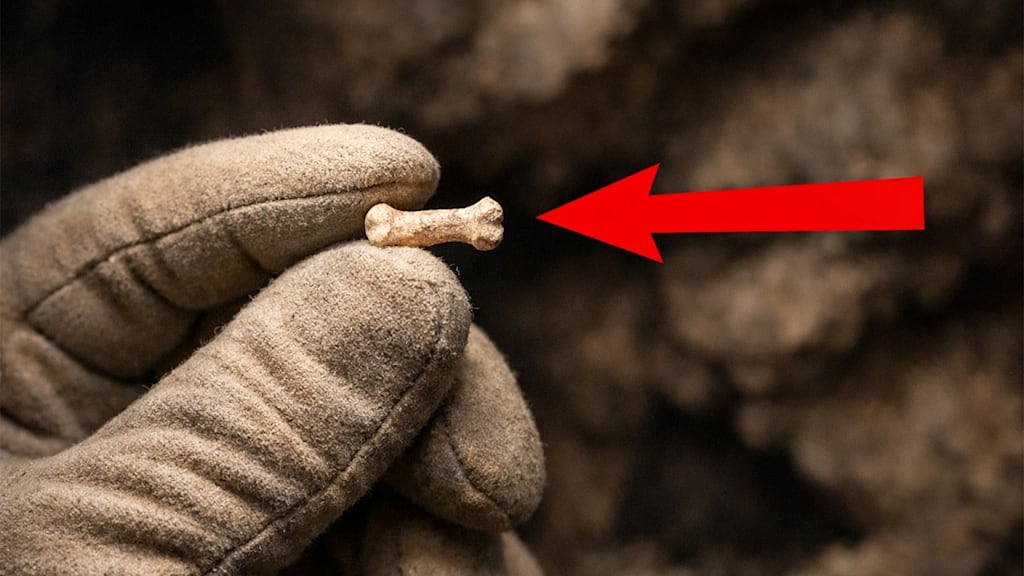
In 2008, in a remote region of Siberia, archaeologists were excavating inside a cave called Denisova. Suddenly, they found a small piece of bone buried in the soil. Upon closer examination, it turned out to be a tiny finger bone from a human hand.
When researchers began studying it, they initially thought it might belong to a Neanderthal who lived around 40,000 years ago. But when DNA and genetic tests were conducted, the results shocked everyone. The DNA did not match Neanderthals, nor did it match modern humans (Homo sapiens). It belonged to a completely unknown type of human—one never seen before.
This tiny bone belonged to a young girl who lived tens of thousands of years ago. Because it was discovered in Denisova Cave, this new group was named “Denisovans.”
When this discovery was announced, it shook the scientific world. Until then, the human evolutionary tree seemed simple: modern humans (Homo sapiens) and Neanderthals. But this finding proved that a third type of human once lived alongside us.
Even more surprising, Denisovans were not weak or primitive. They had abilities that even modern humans don’t fully possess. Yet, despite being so advanced, they are barely mentioned in history books.
The biggest twist is that although Denisovans are now extinct, their DNA still exists in many people today. Scientists compared the DNA from the bone with populations around the world and found that people in Tibet, Mongolia, Papua New Guinea, and Australia still carry up to 5% Denisovan DNA. This means that ancient humans and Denisovans interbred.
However, a major mystery remains: while many Neanderthal fossils have been found, Denisovan remains are extremely rare—just a finger bone, a few teeth, a jawbone from Tibet, and a skull from China.
Studies suggest Denisovans looked different from modern humans. Their skulls were larger, jaws thicker, and teeth unusually big. Their brain size may have been up to 20% larger than ours. While a bigger brain doesn’t always mean greater intelligence, their DNA suggests unique neural development that may have enhanced memory and pattern recognition.
One fascinating discovery is that some modern human abilities come from Denisovans. For example, Tibetans can live at high altitudes with low oxygen levels due to a gene (EPAS1) inherited from Denisovans.
They may also have had stronger immune systems and possibly aged more slowly than modern humans.
Archaeological findings suggest they were highly skilled. A green stone bracelet found in Denisova Cave, dated to 50,000–70,000 years ago, had a perfectly drilled hole—something that would require advanced tools. A bone needle with an eye for thread was also discovered, indicating they could sew fitted clothing.
These discoveries suggest Denisovans were intelligent, skilled, and possibly more advanced than previously thought.
There are also mysterious megalithic stone structures in regions associated with Denisovans, with massive precisely cut stones aligned with celestial events—similar to later civilizations like the pyramids or Stonehenge. Some speculate whether Denisovans influenced later human cultures.
But the biggest question remains: if they were so advanced, why did they disappear?
One theory is that modern humans, being more numerous and aggressive, outcompeted or eliminated them. Another suggests interbreeding gradually absorbed them into the human population.
A more mysterious theory claims they retreated into remote regions and were eventually wiped out by a catastrophic event around 12,800 years ago, known as the Younger Dryas—marked by sudden climate change, floods, and destruction.
Perhaps their entire civilization was lost beneath the earth, leaving behind only fragments like that tiny finger bone.
If an entire advanced human species could vanish from history, it raises a chilling question: how many other secrets are still buried beneath our feet, waiting to be discovered?
About the Creator
Imran Ali Shah
🌍 Vical Midea | Imran
🎥 Turning ideas into viral content
✨ Watch • Share • Enjoy
Enjoyed the story? Support the Creator.
Subscribe for free to receive all their stories in your feed.
Comments
There are no comments for this story
Be the first to respond and start the conversation.