
Ancient Cities Had No Factories and Still Couldn't Drink Their Own Water
Chang'an moved its capital over bitter wells. Beijing dug 27,000 sewage pits. London lost 10,000 people to one pump. Your kitchen tap is the ending they never got.
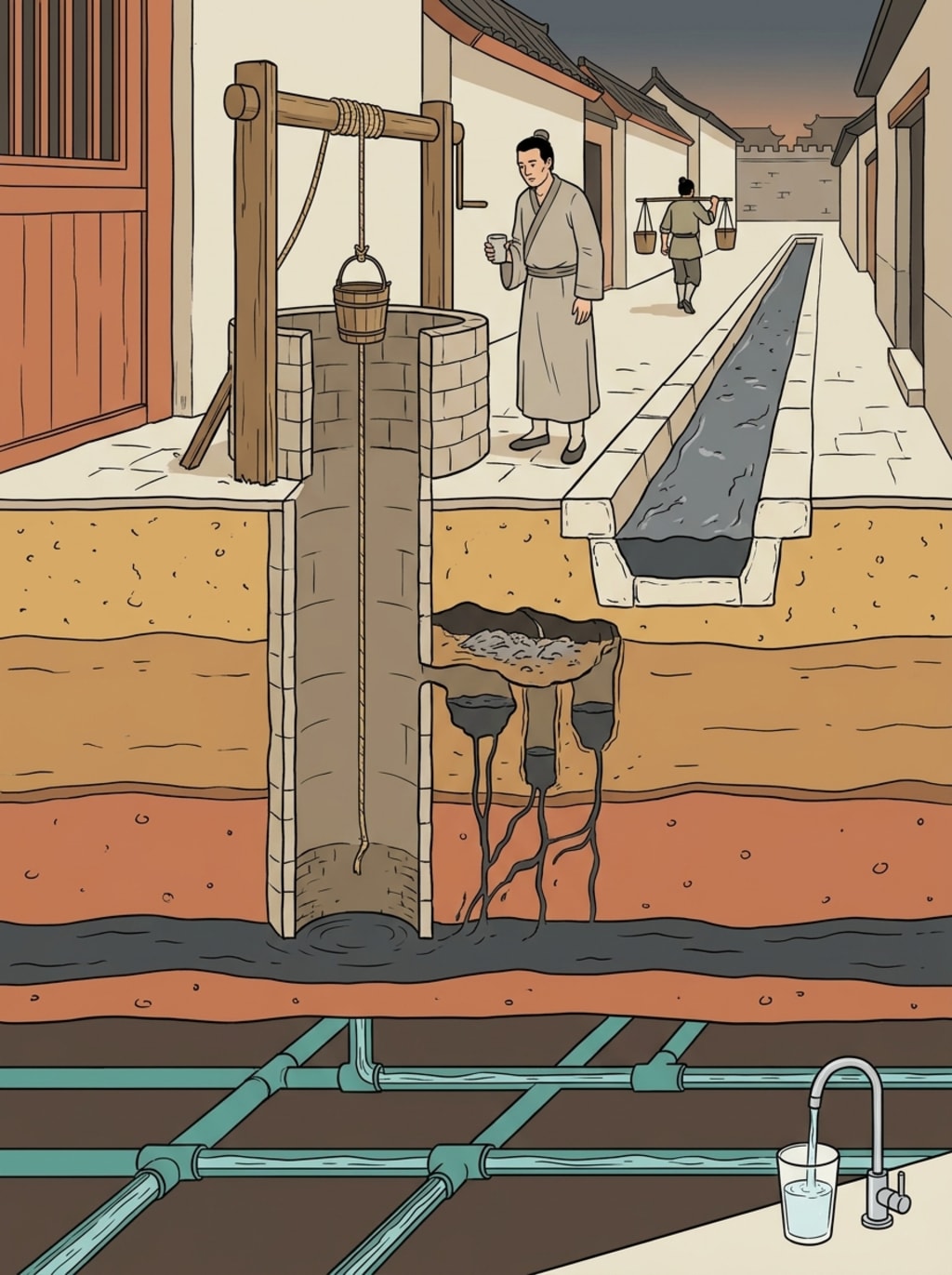
Friend, imagine you are standing in a lane beside the Eastern Market of Tang Chang'an. You are thirsty. You see a well. The rope is worn shiny. You lower the bucket and pull it up. The water looks all right. You lean in and sniff it. There is a smell you cannot name. You do not drink. An old man with a carrying pole glances at you and says, "Young man, this water is no good anymore. Go two streets west; that well is still passable." You walk west. On the way you step across an open drain. Gray-black water moves in the ditch. Under the summer sun, the smell hits your nose. You reach the "passable" well, draw water, and take a sip. Salty. Bitter. You cannot swallow it.
Nobody would blame you for refusing it. From the mid-Tang onward, bitter and salty well water was everywhere in Chang'an. A capital that received envoys from ten thousand states was having its water ruined underground.
1. What Water Did Ancient People Drink?
Ancient people mainly drank well water. The Hemudu site has a wooden well; a pottery well model came out of a Han tomb at Shaogou in Luoyang. Wells were basic infrastructure. People also drank river water, stream water, and lake water, and collected rain. Well water was the main source because it was stable and close by.
Clear-looking well water did not mean safe water. Ancient times had no industrial pollution, but they had human and animal excrement, household garbage, parasites, and microorganisms. Well water comes from shallow groundwater, and shallow groundwater takes whatever surface waste seeps down. Rivers and streams were worse: upstream people washed clothes, dumped waste, and watered livestock; downstream people drank. Rain was comparatively clean, but it went into open vats and pools where dust settled and mosquitoes bred. Today's closed tanks do not have that problem.
Once garbage or excrement got into a source, or when floods and waterlogging came, microorganisms and parasites rose, along with suspended matter. At best you got stomach trouble. At worst, cholera, dysentery, typhoid. Water pollution in ancient cities could get bad enough to force a dynasty to move its capital.
2. How Did Ancient Cities Deal with Sewage?
Ancient cities did have drainage. Pingliangtai in Huaiyang, Henan, more than 4,300 years old, has ceramic drainage pipes connected to open ditches. Linzi, capital of Qi during the Spring and Autumn and Warring States periods, had three drainage systems and four outlets: more than 5,000 meters of stone-built channel connected to ditches and the moat. The outlets had three tiers with five square openings each; stones were staggered inside so water ran out through the gaps and people could not get through. Qin Xianyang had straight ceramic pipes and elbow pipes. Water ran from a funnel, turned, and went on. Han Chang'an used the moat and open channels, with round ceramic pipes and brick culverts in some quarters.
Impressive. But the underground pipes were the backup. The main system was open ditches. Sewage sat exposed to the air and stank in summer. When rain flooded the streets, water poured into the ditches, pollution overflowed, and whatever seeped down went into the ground. Ancient ditches leaked. Sewage reaching the wells was routine.
Worse, people dug wells next to ash pits, seepage wells, and cesspits. In 2015, the site east of Tang Chang'an's Eastern Market turned up 4 water wells, 2 storage wells, 11 seepage wells, and 12 ash pits, all crowded together. A well next to a cesspit is a well with bad water.
3. Why Could People No Longer Bear to Live in Chang'an?
Han Chang'an stood for eight hundred years. Wars came and went; the infrastructure decayed. The open channels could not carry the sewage anymore. People dumped garbage at their doors, dug pits for trash, dug seepage wells for excrement. Waste sat underground and rotted, and the leachate went into the groundwater. The wells turned salty and bitter. The Book of Sui, in the biography of Yu Jicai, says it plainly: "The Han built this city; by now nearly eight hundred years have passed, and the water is all salty and bitter, not very suitable for people."
Emperor Wen of Sui, Yang Jian, lasted a little over a year in the old city. He ordered a new capital built southeast of it, Daxing City, which became the base of Tang Chang'an. An emperor moving his capital because the water tastes bad sounds like an exaggeration until you ask what the palace did and what everyone else did. The palace sent men to fetch water from far away. Everyone else drank from the wells.
Tang Chang'an grew. The sewage system did not change: open channels first, pipes as backup, pits for the waste. From the mid-Tang on, the wells got worse. More people, faster contamination. No number of new deep wells fixes that.
4. Beijing's Seepage Wells
Beijing ran the same course. A late Ming source says: "Most well water in the capital is salty and bitter and cannot be drunk." By the Qing, most of the city's well water was undrinkable. The palace drank spring water hauled in from Yuquan Mountain in the western hills. The wells inside the palace were backup. Ordinary residents used a handful of public wells and took what they got.
The mechanism was the seepage well. Before 1949, Beijing had 27,195 of them, each producing an average of more than a thousand tons of sewage a year. Sewage went down. The shallow groundwater took it. Seepage wells are one of the main reasons Beijing's groundwater was in bad shape.
The palace drank Yuquan. Everyone else drank from the public well. Good water existed. It could not be delivered to everyone. A few sent servants for spring water; most walked to the nearest well. When the well went bad, the risk arrived immediately.
5. London's Cesspits and the Broad Street Pump
London had the same problem. In the mid-nineteenth century it had no modern sewer. Waste went into cesspits and crude septic tanks, which are seepage wells by another name. In 1854 cholera broke out on Broad Street. John Snow mapped the cases and traced them to the public pump on Broad Street. One detail from the investigation: a mother poured the water she had washed her baby's diapers in into the cesspit in front of the house. The cesspit leaked into the pump well. More than ten thousand people died in that outbreak.
Cholera returned to London in 1831–32, 1848–49, 1853–54, and 1865–66. The four outbreaks killed more than forty thousand. Industrial pollution had barely arrived. The sewers could not keep up, and that was enough to wreck a city of that size.
6. Ancient Water-Treatment Wisdom: Why Was It Not Enough?
Ancient people did treat water. They boiled it, the oldest disinfection there is. They settled it with alum, which pulls down some of the suspended matter. They filtered it through sand. They chose well sites away from filth and sealed the mouths. The palace and the nobility had their own supply; the Qing court drank Yuquan spring water.
None of it scaled. Boiling takes fuel, and fuel was the hard constraint. Alum and sand filters need someone who knows how to use them and materials to keep them going. Protecting a well takes a neighborhood that agrees to protect it. A separate supply serves only the people on the list. A city could send carts to a mountain spring for the emperor. It could not lay pipe to every courtyard.
7. Modern Tap Water Is Not Perfect Either
Modern tap water runs through physical, chemical, and biological treatment and holds contamination indicators very low. China's Standards for Drinking Water Quality (GB 5749-2022) lists 97 indicators, 43 of them routine, covering microbiology, toxicology, and sensory quality. What the system delivers is safe household water at low cost, every day.
It is not perfect. Disinfection leaves by-products. Pipe networks add contamination after the plant. Conventional treatment does not fully remove some heavy metals, pharmaceutical metabolites, or fluoride. Water that passes at the plant does not automatically pass at your tap. Old pipes and the tank on the roof of your building can both undo the work. Boil water when you should. Clean the tank when it needs cleaning.
Set against an ancient city, the modern system carries far less health risk. It is not flawless, but it reaches everyone and it answers to a written standard. An ancient city might have had a clean spring. Most people never got to drink from it. A modern city has water problems and a tap in the kitchen.
8. Back to That Well
If you do go back, do not trust a sweet-looking well. Find moving water upstream. Stay away from wells near seepage pits, ash pits, and cesspits. Let the water settle, filter it, boil it. Keep it in something closed. Springs and rain if you can get them, with dust and insects kept out along the way. Fuel was scarce then too, which is the other reason the modern tap matters.
You wake up. You walk to the kitchen, turn on the tap, fill a glass. The water is cold. It has no taste. You drink it. You fill the glass again. Somewhere under the street, the pipes are still doing their job.
About the Creator
Jin
Writer of reamstories
https://reamstories.com/jin
Enjoyed the story? Support the Creator.
Subscribe for free to receive all their stories in your feed. You could also become a paid subscriber, letting them know you appreciate their work.
Comments
There are no comments for this story
Be the first to respond and start the conversation.