
An Object from Ancient Rome Without Instructions: What the Mysterious Dodecahedron May Be Hiding
Why one of the strangest small objects from the Roman world is still found across Europe without any clear explanation of what it was for.
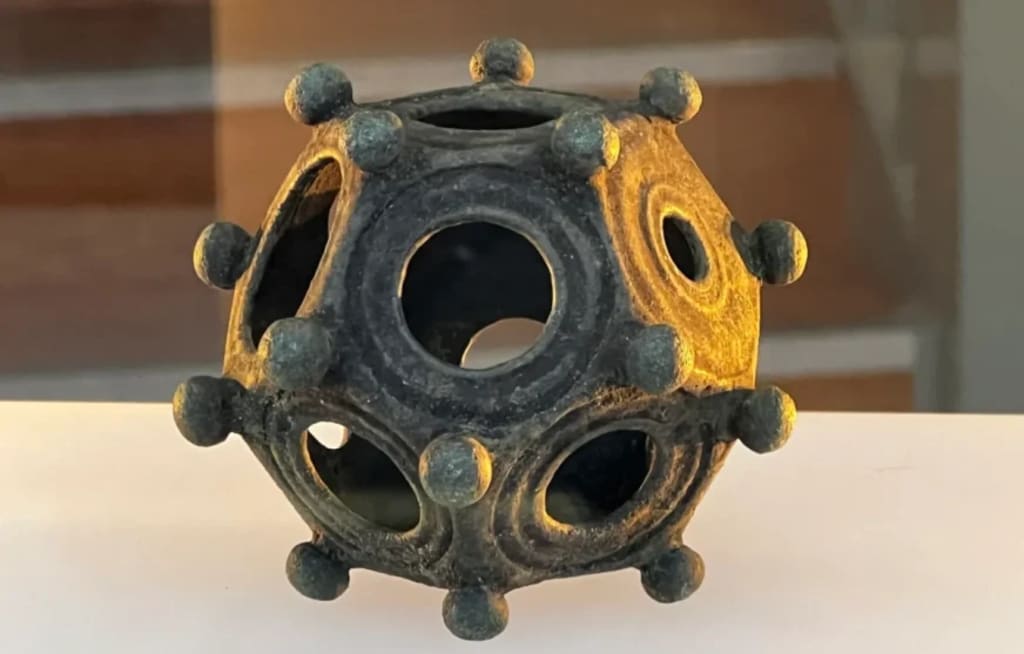
Archaeologists find these objects all across Western Europe. They are small, usually bronze, hollow inside, and made in the form of a regular polyhedron. Each one has 12 pentagonal faces. In every face there is a round hole. The holes are usually of different sizes. At the corners there are small knobs. No inscriptions, no numbers, no obvious traces of use. This object is called a Roman dodecahedron, or a Gallo-Roman dodecahedron. And the main problem is that no one knows for certain what it was for. Since the eighteenth century, about 130 such objects have been found. They have turned up in Britain, France, Germany, Belgium, the Netherlands, Switzerland, Austria, Hungary, and other countries. But in Italy, the center of the Roman Empire, such finds are almost unknown. That is why many researchers connect them not with Rome as a city, but with the northwestern provinces of the empire, above all with the Gallo-Roman world.
What kind of object it is
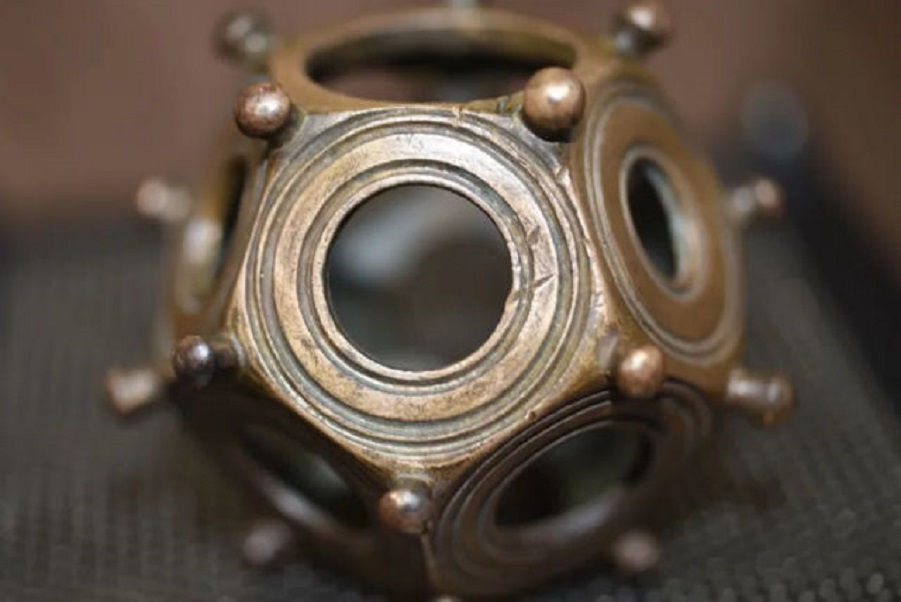
The Roman dodecahedron is a hollow object made of copper alloy, most often bronze. It is usually dated to the Roman period, roughly the second to fourth centuries CE, although some descriptions give a wider range. The sizes vary. Some examples are small, around 4 centimeters, while others reach 10 to 11 centimeters. The weight also differs, from a few dozen grams to several hundred. There is no single standard. A dodecahedron looks like this: 12 faces; a round hole in each face; holes of different diameters; a small knob at every corner; an empty space inside; and often circles, lines, or other simple decorations on the outside. The strangest thing is that there are no labels on them. If this were an ordinary instrument, measuring device, mechanical part, or gaming object, one might expect at least numbers, marks, or clear signs of heavy wear. But these are usually absent.
Why the find is so strange
The difficulty is not the shape. A dodecahedron is a clear geometric figure. The mystery lies elsewhere: many such objects have been found, they were carefully made, and yet Roman texts and images offer no clear explanation of what they are. The Romans wrote a great deal: about laws, wars, taxes, construction, daily life, and religion. But there is no known direct description of dodecahedrons. That makes the mystery especially difficult. If this were an ordinary household object, its purpose would most likely long ago have been understood from texts, images, or traces of use. But dodecahedrons seem to have fallen out of written history.
Where they are found
The find contexts vary. Dodecahedrons have been discovered near military sites, in burials, hoards, baths, theaters, settlements, and even in a river. That does not help produce one exact answer. If they all came only from workshops, one might think of a craft tool. If only from temples, then of a cult object. If only from graves, then of a funerary rite. But the finds are too varied. At the same time, there is one important detail: many dodecahedrons are found in the northwestern regions of the former Roman Empire. That is why they are often called specifically Gallo-Roman rather than simply Roman.
The Norton Disney find
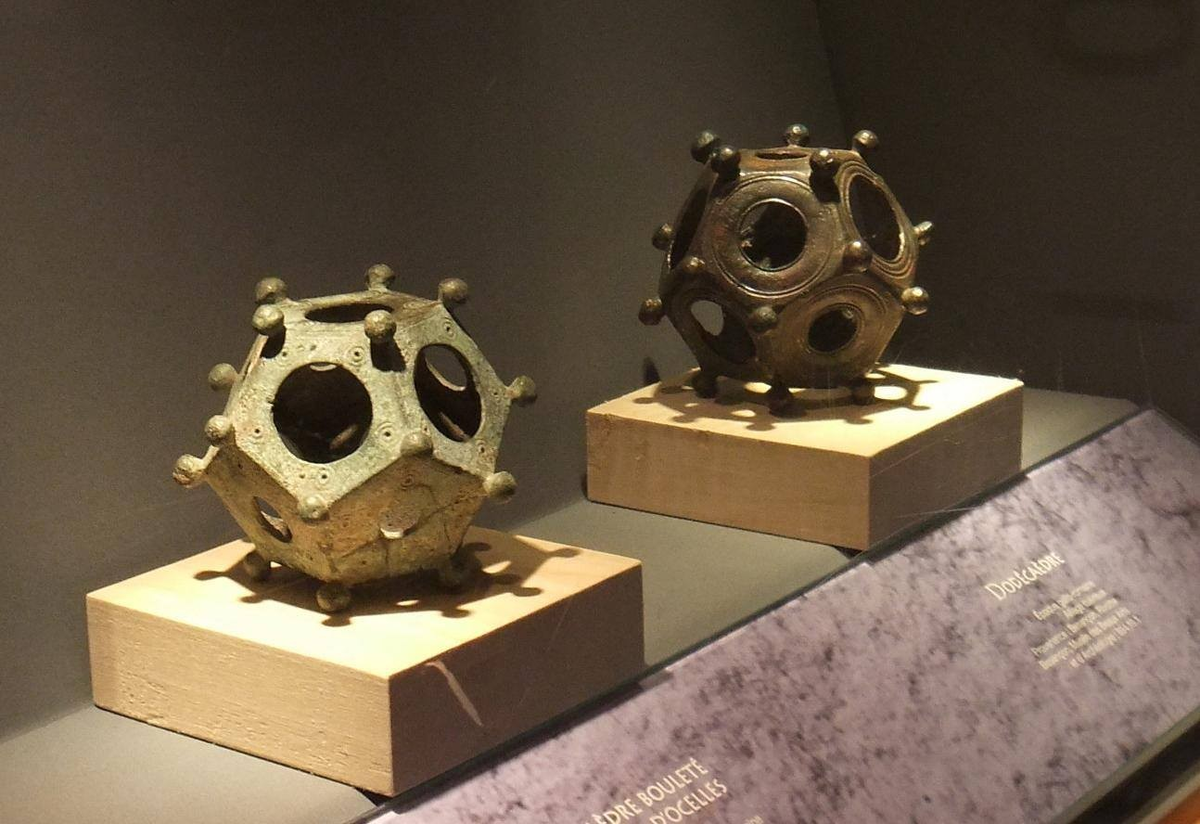
One of the most famous recent finds took place in June 2023 in the village of Norton Disney in Lincolnshire, England. The dodecahedron was discovered during excavations by a local archaeological group. It was well preserved, intact, and almost undamaged. It is the thirty-third known example from Britain and the first such object found in the Midlands. The find measures about 8 centimeters and weighs about 250 grams. Analysis showed a composition of roughly 75% copper, 7% tin, and 18% lead. The object was found in a pit or quarry together with Roman pottery. Researchers consider it important that it was not lying randomly on the surface, but in an archaeological context that is still being studied. This find did not solve the mystery, but made it even more intriguing. The object was clearly valuable, difficult to make, and well preserved. But why it was placed in the ground is still unknown.
What explanations have been proposed
Over three centuries, many explanations have appeared. The dodecahedron has been interpreted as a household object, a tool, a game piece, a ritual item, or a symbol.
A candlestick
This is a simple version: the object is stable, it can be placed on different faces, and the holes seem as if candles might be inserted into them. The problem is that the holes are different sizes, traces of soot are usually absent, and Romans more often used oil lamps. So the theory sounds understandable, but does not explain everything.
A die
The object has 12 faces, so it is sometimes compared to a gaming die. But the faces have no numbers, marks, or symbols. Besides, the knobs at the corners would interfere with a normal throw. So as an ordinary die, it does not look convincing.
A measuring instrument
There is a theory that the dodecahedron might have been a rangefinder or a device for estimating distance. One could look through holes of different diameters at an object and compare its size. But the main problem here is the lack of standardization. Dodecahedrons differ in size, in the holes, and in the quality of manufacture. That is strange for a precise measuring device. If one object gives one set of values and another gives different ones, it is hard to use them as a single measure.
A knitting tool
One popular modern theory claims that the dodecahedron was used for knitting gloves or cords. But this theory is weak as well. For such work, a bronze object of such a complex shape would be too expensive and inconvenient. There is also no reliable evidence that this is how it was used in the Roman period.
A ritual or symbolic object
Today, the ritual or symbolic theory seems one of the strongest. But it is not a final answer. Several things support it. Dodecahedrons are difficult to make. They require metal, molds, skill, and time. Many examples show no clear signs of heavy practical use. Some were found in burials or in places where the object may have been intentionally deposited. There is also the idea of a link to philosophical symbolism. In Platonic and Pythagorean tradition, regular polyhedra had special meaning, and the dodecahedron was associated with the structure of the cosmos. A new study by Michael Guggenberger and Steven Leach, published in 2025, examines the possible connection between Gallo-Roman dodecahedrons and such ideas. But here too there is a problem: there is no direct text saying, “this object was used for such-and-such a rite.” So the theory remains strong, but unproven.
What it comes down to
The Roman dodecahedron remains one of the most interesting archaeological mysteries in Europe. We know the approximate time: the Roman era, most often the second to fourth centuries. But we still do not know the main thing: what it was actually for.
About the Creator
Enjoyed the story? Support the Creator.
Subscribe for free to receive all their stories in your feed.
Comments
There are no comments for this story
Be the first to respond and start the conversation.