
A Mosaic Among the Ruins of Conflict and War
Syria's Remarkable Roman-Era Discovery Reveals Ancient Depictions of the Trojan War and the Amazons

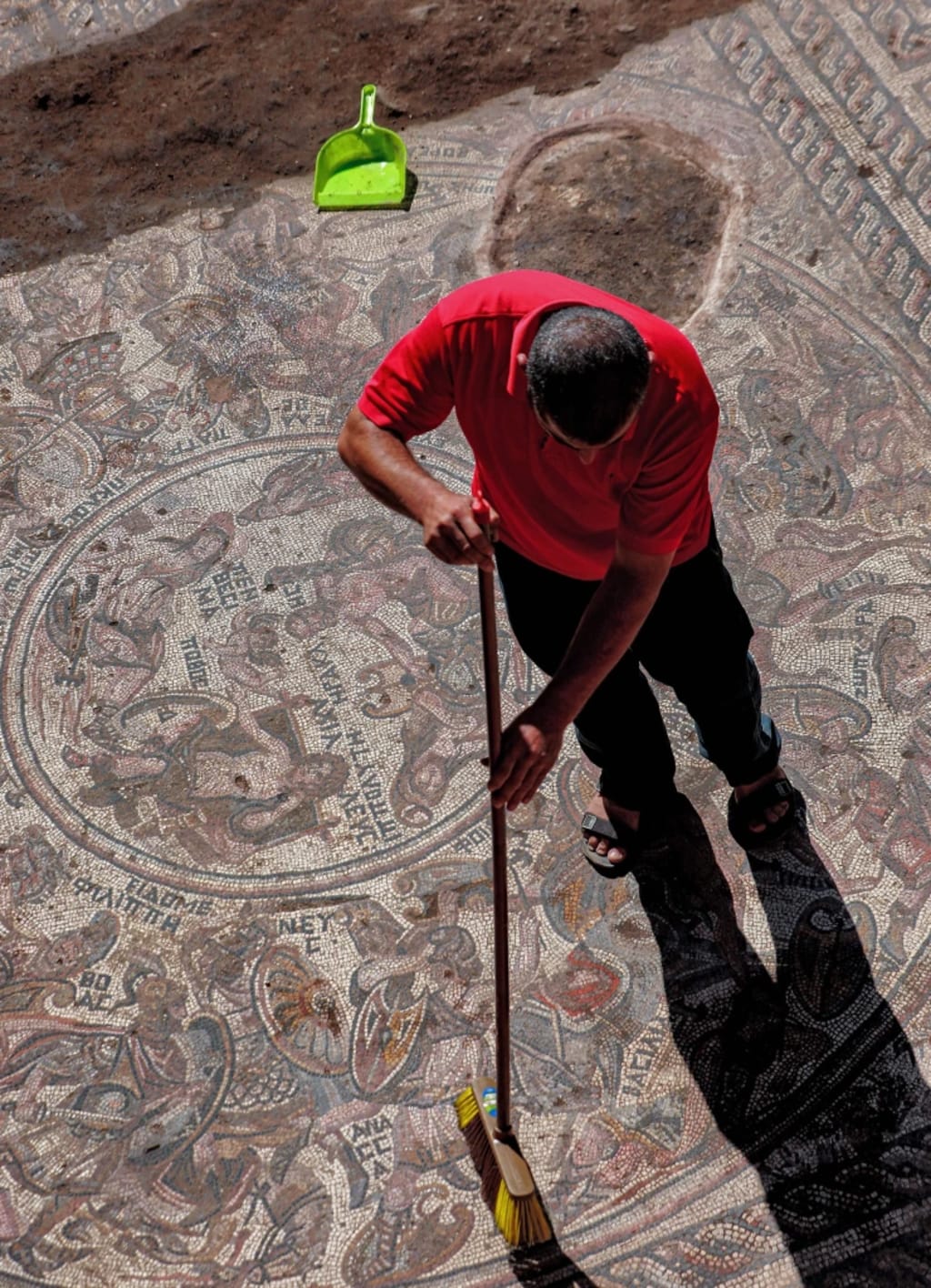
In October 2022, Syria unveiled a remarkable Roman-era mosaic measuring approximately 1,300 square feet (120 square metres), considered by Syrian archaeologists to be one of the country's most significant archaeological discoveries since the outbreak of civil war in 2011. Found in the town of Rastan, near Homs, the mosaic offers a rare glimpse into the region's extraordinary cultural heritage, much of which has suffered throughout the years of conflict.
Rastan itself was under rebel control until 2018 and experienced considerable destruction during the war. Across Syria, archaeological sites and historical monuments have been damaged, destroyed, or looted by various armed groups. One of the most notorious examples is Palmyra, where the Islamic State deliberately destroyed ancient temples and monuments in 2015. The illegal trafficking of antiquities also became an important concern, as archaeological objects were removed from their original locations and entered international markets. The survival of the Rastan mosaic is therefore particularly remarkable. Parts of it had reportedly been discovered several years before its public unveiling, and attempts had allegedly been made to sell sections of the artwork illegally. Nevertheless, the mosaic remained in place until archaeologists were able to uncover and examine it. Syrian archaeologist Dr Humam Saad, who was involved in the excavation, described its preservation and artistic detail as exceptional. The mosaic was discovered beneath a building dating to the Roman period, around the fourth century AD. However, when the discovery was announced, researchers had not yet established the original purpose of the building, including whether it might have served as a private residence, a public bathhouse, or something else.


What immediately attracted attention was not only its size and remarkable preservation, but the complexity of its mythological imagery. The artwork depicts warriors, horses, shields, weapons, and figures whose names are recorded in Greek inscriptions. Among the represented stories are episodes involving the Amazons, legendary female warriors who occupy an important place in ancient Greek mythology. However, some of the initial international coverage deserves closer examination. Reports by the Associated Press and several other news organisations described the mosaic as depicting the Roman god Neptune alongside forty of his mistresses, as well as Hercules killing Hippolyta, queen of the Amazons.
Neptune is the Roman equivalent of Poseidon, the Greek god of the sea. A separate composition within the wider mosaic pavement has indeed been interpreted as depicting Neptune accompanied by the Nereids, the sea nymphs of Greek mythology. But describing these figures simply as his forty mistresses is misleading. The Nereids possess their own mythological identities, and ancient tradition commonly describes them as the fifty daughters of Nereus and Doris. More importantly, this description risks overlooking what I find to be the most fascinating aspect of the discovery: the representation of the Amazons and their encounters with some of the greatest heroes of Greek mythology.
Rather than concentrating further on the inaccuracies of the initial reporting, I would like to examine the artistic and mythological details of the mosaic itself. Its main Amazonian composition can be understood through two concentric circles: an inner circle containing two distinct mythological episodes and an outer circle depicting a wider battle involving Greek heroes and Amazon warriors.
The Inner Circle: Hercules, Achilles, and the Amazons
At the centre of the composition, we encounter two different stories. The first depicts Hercules, or Heracles in Greek, confronting Hippolyta, the queen of the Amazons. The scene is associated with the ninth of Hercules' twelve labours, during which he was ordered to obtain the queen's girdle, a symbolic possession traditionally associated with the god Ares. According to one version of the myth, Hippolyta initially agreed to surrender the girdle. However, Hera intervened, provoking a confrontation between Hercules and the Amazons. Believing that he had been betrayed, Hercules killed Hippolyta and seized the girdle. Other versions of the story differ, revealing how ancient mythology was continually reshaped through oral and literary traditions.
The second scene is perhaps even more interesting. Here, we encounter Achilles confronting Penthesilea, another Amazon queen. According to ancient traditions concerning the Trojan War, Penthesilea travelled to Troy with a group of Amazon warriors to defend the city against the Greeks. She eventually faced Achilles in battle and was killed.
But the story does not end with her death. In one of the most emotionally complicated episodes of the Trojan War's wider mythological tradition, Achilles discovers the beauty of Penthesilea after removing her helmet. Having already killed her, he becomes overwhelmed by admiration, longing, and grief. The story is described in the Posthomerica of Quintus of Smyrna, an epic poem that recounts events associated with the Trojan War beyond those narrated in Homer's Iliad.
What makes the Rastan mosaic particularly interesting is a small detail between Achilles and Penthesilea: a winged figure accompanied by the Greek inscription ΠΟΘΟΣ (Pothos). In ancient Greek, pothos expresses longing, yearning, or an intense desire for someone or something that may be absent or impossible to attain. The concept also appears in Greek philosophical and literary traditions, where desire can be understood as something more complicated than immediate physical attraction. The winged figure represents the personification of this longing, closely associated with Eros in Greek mythology. The mosaic also depicts the emotional contradiction of a warrior who experiences desire and sorrow for the very person he has just killed. The mosaic thus preserves not only a story of warfare, but also a remarkably unsettling representation of human emotion, where violence, longing, admiration, and regret coexist.
The Outer Circle: The Trojan War
Surrounding these central scenes, a wider circular composition depicts additional battles involving Greek heroes and Amazon warriors. The figures are particularly interesting because many are identified by inscriptions written in Greek. Among the names recognised in the mosaic are Menelaus, Agamemnon, Patroclus, Idomeneus, and Thoas, characters associated with the wider mythological tradition of the Trojan War.
Menelaus was the king of Sparta and husband of Helen, whose departure for Troy with the Trojan prince Paris became one of the legendary causes of the war. His brother Agamemnon led the Greek expedition against Troy, while Patroclus was the close companion of Achilles whose death became a decisive moment in Homer's Iliad. These inscriptions provide valuable information about how the stories were understood and represented during the Roman period, centuries after the earliest surviving Greek literary accounts.
It is important, however, to distinguish between the Trojan War as described in the Iliad and the broader mythological tradition surrounding it. Not every scene represented in the mosaic belongs directly to Homer's poem. The encounter between Achilles and Penthesilea, for example, belongs to later or otherwise separately preserved narratives of the Trojan War. The combination of different episodes within the same composition reveals something particularly interesting about ancient art. Mythological stories were not necessarily represented as isolated literary events. They could be brought together within a larger visual narrative, allowing different characters, conflicts, and meanings to coexist.

What Lies Ahead?
Despite the destruction suffered by Syria's cultural heritage during the civil war, the Rastan mosaic survived. Following its discovery, Syrian actress Sulaf Fawakherji, a member of the board of trustees of Lebanon's Nabu Museum, expressed interest in acquiring additional properties around the archaeological site, where further remains might still be hidden beneath modern buildings. The possibility of uncovering additional sections of the mosaic suggests that researchers may not yet have seen the full extent of the artwork.
Syria's archaeological importance extends far beyond this discovery. Throughout antiquity, the region was home to numerous civilisations and cultural traditions, including Canaanite, Greek, Roman, Byzantine, and later Islamic societies. Its geographical position contributed to centuries of commercial, cultural, and political interaction. Unfortunately, the conflict that began in 2011 inflicted tremendous damage on this historical inheritance. In Homs, religious and historical buildings such as the Khalid ibn al-Walid Mosque and the Umm al-Zinar Church suffered damage during the fighting. Elsewhere, archaeological sites became targets of deliberate destruction, looting, and neglect.
Against this background, the discovery at Rastan reminds us how much historical and cultural material may still remain beneath the surface, even in places that have experienced years of devastation. The mosaic itself is particularly significant because of the stories it preserves. A work created approximately sixteen centuries ago continues to communicate myths that were already ancient when its artists assembled the coloured stones. Perhaps future excavations will reveal further sections of the pavement and allow archaeologists to understand more about the building in which it was originally displayed. For now, the surviving mosaic offers something remarkable: a connection between the ancient world and the present, preserved through centuries of historical change and, more recently, the destruction of war.
Written and published by Sergios Saropoulos
Sources and Selected Bibliography
The Associated Press. “A Rare Roman-Era Mosaic Is Uncovered During the Excavation of an Old Building in Syria.” KPBS, 15 October 2022. Contemporary reporting on the excavation, archaeological interpretations, and statements by Dr. Humam Saad and Sulaf Fawakherji.
https://www.kpbs.org/news/news/international/2022/10/15/a-rare-roman-era-mosaic-is-uncovered-during-the-excavation-of-an-old-building-in-syriaAgence France-Presse. “Syria Unearths Stunning Roman-Era Mosaic.” Arab News, 12 October 2022. Contemporary reporting on the mosaic's dimensions, preservation, and Trojan War imagery.
https://www.arabnews.com/middle-east/syria-unearths-stunning-roman-era-mosaic-2180136Al-Zibawi, Mahmoud. “أمازونيات الرستن: ما الذي حرَمتنا منه السماء وأعطته للرجال؟” [The Amazons of Rastan]. Al-Modon, 18 October 2022. Detailed iconographic interpretation of the mosaic, including Hercules, Hippolyta, Achilles, Penthesilea, Pothos, and the Greek inscriptions.
https://www.almodon.com/culture/2022/10/18/أمازونيات-الرستن-ما-الذي-حرَمتنا-منه-السماء-وأعطته-للرجال؟Quintus of Smyrna. The Fall of Troy (Posthomerica), Book I, lines 494–765. English translation by A. S. Way, 1913. Ancient literary source for the death of Penthesilea and Achilles' subsequent reaction.
https://www.greekmythology.com/sources/quintus-smyrnaeus/fall-of-troy/book-1-654-765Apollodorus. The Library, Book II, 5.9. English translation by J. G. Frazer. Perseus Digital Library, Tufts University. Ancient account of Hercules' ninth labour and his confrontation with Hippolyta.
https://www.perseus.tufts.edu/hopper/text?doc=Perseus:text:1999.01.0022:text=Library:book=2:chapter=5:section=9Neira Jiménez, María Luz. “Written and Visual Culture About the Mosaic of Castulo: The Influence of Lucian's Works.” Journal of Mosaic Research, vol. 8, 2015, pp. 61–79. Scholarly discussion of Pothos as a personification of longing in Roman mosaic iconography.
https://dergipark.org.tr/tr/download/article-file/294118Deutsche Welle. “Roman-Era Mosaic Discovered in Syria.” 13 October 2022. Reporting on the discovery's historical context, the Nabu Museum's involvement, and the dangers faced by Syria's archaeological heritage.
https://amp.dw.com/en/scenes-from-troy-roman-era-mosaic-discovered-in-syria/a-63427092UNESCO. “Rapid Assessment Mission to Palmyra.” Documentation of the damage inflicted on the World Heritage site, including the destruction of major monuments during the Syrian conflict.
https://www.unesco.org/en/culture-emergencies/heritage-emergency-fund/rapid-assessment-mission-palmyra
About the Creator
Sergios Saropoulos
As a Philosopher, Writer, Journalist and Educator. I bring a unique perspective to my writing, exploring how philosophical ideas intersect with cultural and social narratives, deepening our understanding of today's world.
Enjoyed the story? Support the Creator.
Subscribe for free to receive all their stories in your feed.
Comments
There are no comments for this story
Be the first to respond and start the conversation.