
A hiker in Norway discovers a rare gold sword scabbard from the sixth century behind a tree.
A Gold Fitting of Superb Artistry

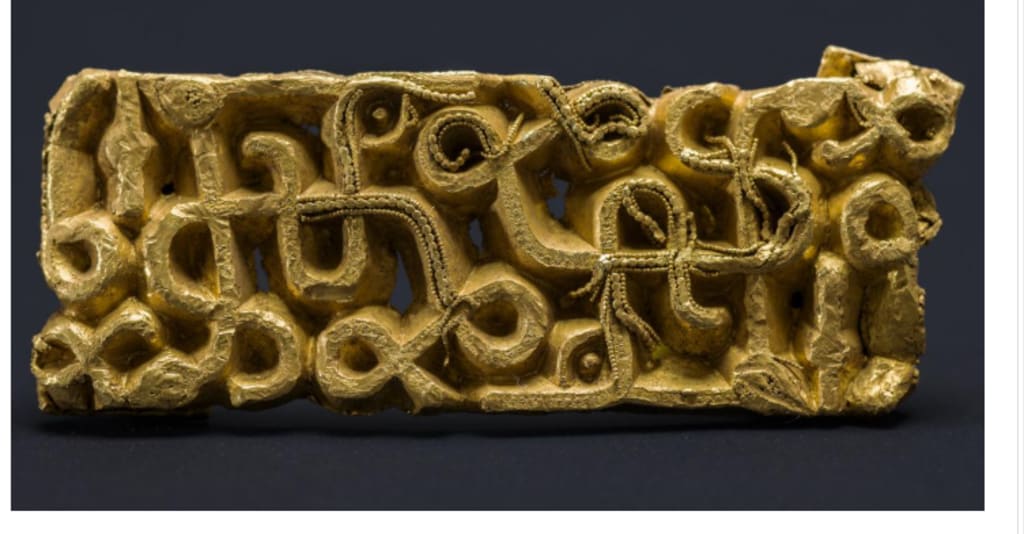
A local hiker saw something glinting under a fallen tree during a morning stroll through the well-known Dalsnuten hiking region near Sandnes in southwest Norway. This moment became historic. Using a stick to poke at a mound of dirt, he discovered an artefact that was perhaps 1,500 years old: a highly decorated gold fitting from a sword scabbard.
Since then, archaeologists at the University of Stavanger's Museum of Archaeology have verified that it is the first of its sort to be found in Rogaland and one of only 17 such items ever found in all of Northern Europe.
When discoveries like this are made, you are totally unprepared," stated Håkon Reiersen, an associate professor and archaeologist at the University of Stavanger's Museum of Archaeology. "The chances of finding something like this are minimal." The hiker put it like way:
A Gold Fitting of Superb Artistry
The fitting weighs only 33 grams and is around 6 centimetres wide by a few centimetres high, yet its creativity is far but modest. In his detailed description of the sculpture, retired professor Siv Kristoffersen of the Museum of Archaeology pointed out that remnants of filigree—a technique involving triple-stranded, beaded gold threads—remain evident layered over the ornamental lines.
In a statement released by the University of Stavanger, Kristoffersen said, "This places the object among the finest works from the period, created by highly skilled goldsmiths."
Two animal creatures in profile facing each other are hidden along the upper and lower margins of the complex pattern, which initially appears to be a tangle of curved lines. Kristoffersen said that "it is possible that this should be interpreted as a human head with an animal body — a hybrid motif frequently found in this type of ornamentation."
This type of animal ornamentation is typical of Norway in the first half of the sixth century and is part of a larger artistic tradition known as "Animal Style I," which expanded throughout much of northern and western Europe during this turbulent time.
The fitting's worn state is also noteworthy because, in contrast to the majority of gold scabbard ornaments from the era, which exhibit minimal wear, this one clearly shows signs of heavy wear, indicating that its owner carried it frequently and used it as a constant declaration of rank and authority.
A Center of Power and a Chieftain's Treasure
Numerous gold artefacts had already been found in the nearby site of Hove, a sizable farm complex in the Austætt area of Sandnes. According to Reiersen, the gold scabbard fitting was buried on purpose as a ceremonial offering, most likely at some point in the disastrous sixth century.
"Whoever wore the sword it was on was probably the leader in this area in the first half of the 6th century and had a warrior retinue of loyal men attached to him," he stated. "By sacrificing such magnificent objects to the gods, the leaders at Hove confirmed their status and power."
This is not the first noteworthy discovery from the hiking area's bogs beneath Riaren Hill. Gold-adorned silver neck rings were discovered during ploughing in the nineteenth century, and an exceptionally massive Roman bronze cauldron made around 300 AD along the Rhine was found in the same spot in 1907.
The new gold fitting, located northeast of Hove, contributes to what scholars are beginning to identify as a concentrated concentration of elite authority in Jaeren, the Rogaland coastal plain. As Reiersen has said before, "Jæren has the highest density of power centers in all of Norway."
The Gold Sacrifice and the Fimbulwinter
In the Northern Hemisphere, the sixth century was a time of severe distress. A devastating volcanic eruption in Central America in 536 AD released ash into the sky, causing years of extreme cooling that are described in several European sources.
This period is sometimes connected to the Norse idea of Fimbulwinter, the great winter that comes before the end of the world. Scandinavian populations may have drastically decreased, temperatures fell, and crops regularly failed. This was made worse during the same period when pandemics of the bubonic plague swept across Europe.
Archaeologists interpret the intentional interment of valuable gold artefacts against this tragic setting. The gold scabbard fitting is part of an uncommon and mysterious collection of items that can occasionally be found throughout Scandinavia, such as spiral rings, disc-shaped gold pendants.
These harmonica-shaped weapon decorations and disc-shaped gold pendants are thought by experts to have been purposefully placed as "sacrificial" or "killed" offerings to the gods in order to seek protection from natural disasters.
After scientists have finished studying the item, the new discovery will be on display at the University of Stavanger Archaeological Museum. According to Kristin Armstrong-Oma, director of the museum, the discovery "allows us to further research the find itself and the ornamentation and find new answers about the power elite that ruled here at this time."
About the Creator
Enjoyed the story? Support the Creator.
Subscribe for free to receive all their stories in your feed.
Comments
There are no comments for this story
Be the first to respond and start the conversation.