
8 Things You Did Not Know About New Orleans’ Roosevelt Hotel
Even if you’re a New Orleans native or a regular visitor of this iconic hostelry, some of these facts may still be news to you

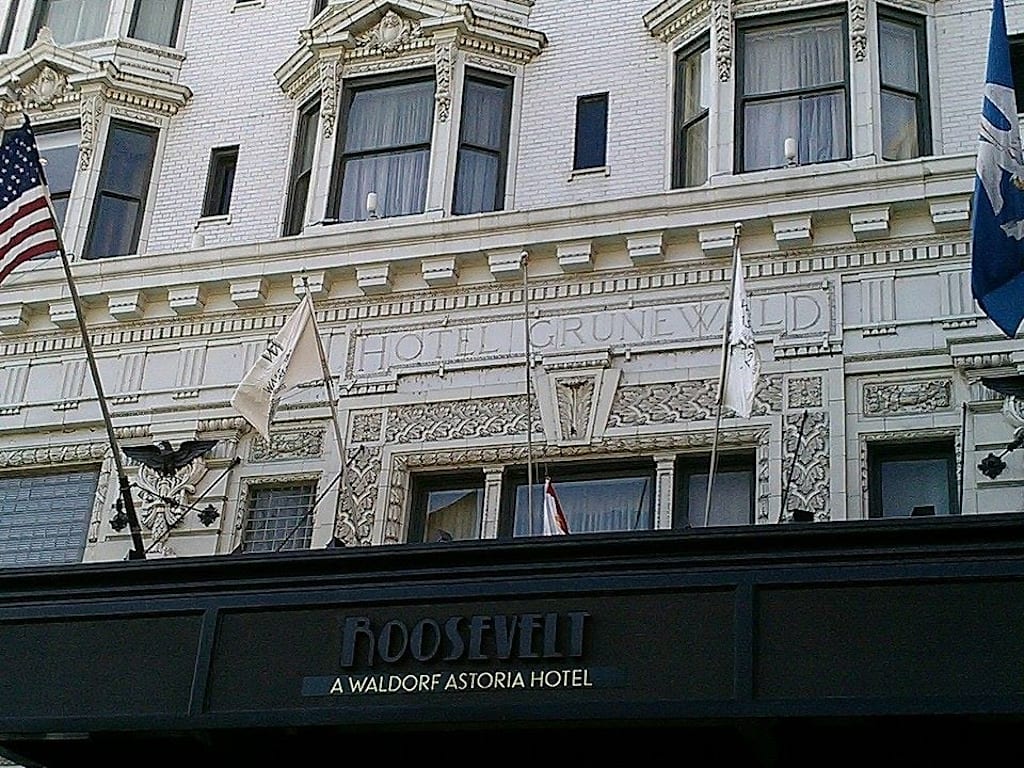
It has been the nonpareil of the New Orleans hotel industry for over a century. With its gilded lobby that spans an entire city block, its longstanding standard of luxury, and its connection to the world-famous Sazerac, the Roosevelt Waldorf-Astoria is a sought-after hostelry for visitors and a paradigm of New Orleans history.
This hotel has seen the birth of jazz, the creation of sno-balls to beat the summer heat, and over 125 years of floodwaters, as well as just as many years of carnivals of myth and fantasy.
As such a constant in the city scape, however, much of its history remains relatively unknown. I know this firsthand, as I have had present-day hotel employees contact me for inspiration regarding its yesteryears. And the reason they ask is because I am the 3rd great-granddaughter of Louis Grunewald who built and originally owned this hotel (I have written on this before — it is one of my better-known articles).
With that in mind, I present you with 8 lesser-known facts about the history of New Orleans’ Roosevelt Waldorf-Astoria hotel.
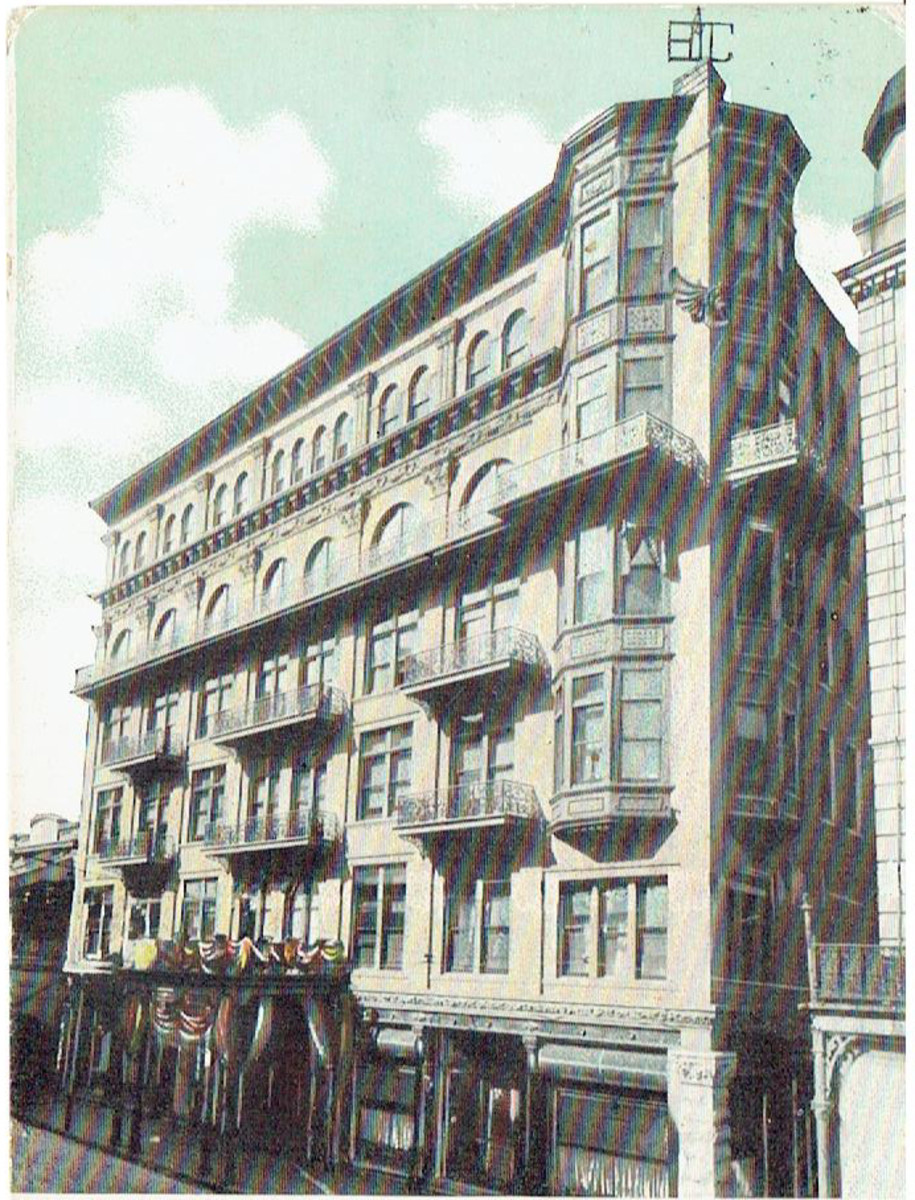
1. Its original name was NOT the Roosevelt, and the original owner was a music merchant
Even through the Fairmont years, many old timers nostalgically remembered the hotel’s days as the Roosevelt. Because of this, much was made about the hotel “returning to its original name” during the restoration period following Katrina, when it was announced that it would be called the “Roosevelt Waldorf-Astoria.”
Its original name, however, hearkens back to a period some have tried to erase from New Orleans’ history, particularly during the heat of both world wars.
For all the credit we give to the French and Spanish for the bulk of the city’s landscape, the Germans were actually the second largest and most industrious foreign population in New Orleans during the 19th century.
Among this enterprising class of immigrants was Louis Grunewald, a native of the village of Hanhofen in the Rhineland-Palatinate, just outside of Speyer.
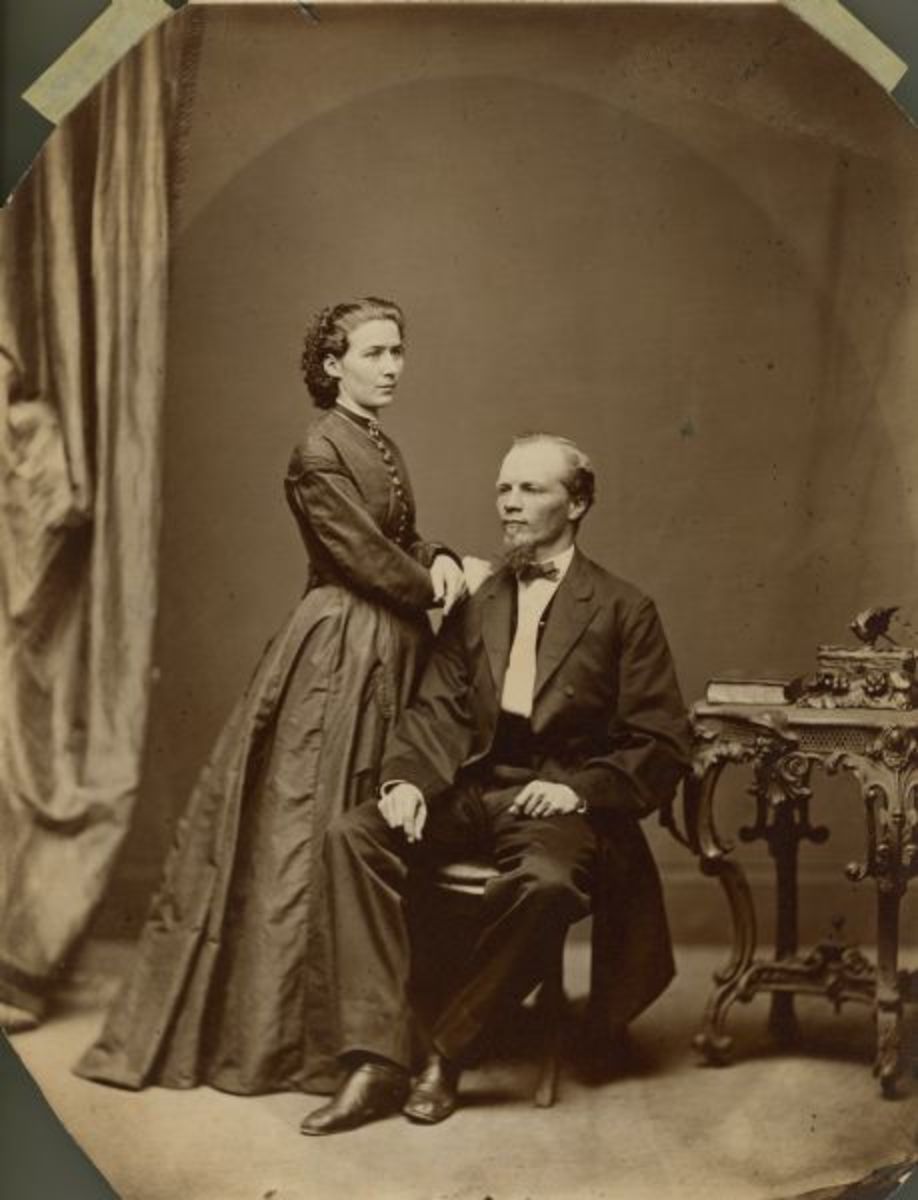
Often billed as an architect by today’s journalists and bloggers, Louis Grunewald was actually a music merchant. He received his early training as a pianist in his hometown before coming to the New World in 1852 to teach piano and play organ at the Catholic churches of the Lower Garden District.
With the commercial music industry in America just taking foot, Grunewald saw the increased need for musical instruments and opened a small store on Magazine Street in 1856.
Nearly two decades later, he opened Grunewald Hall, a large concert hall, on Baronne Street, which brings us to our next piece of history.
2. It was preceded in location by a concert hall (and prior, Charity Hospital)
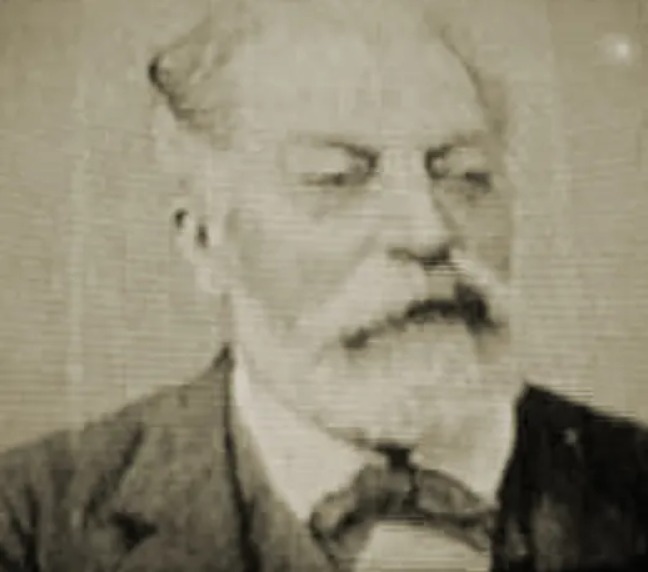
Grunewald Hall (also known as Grunewald Opera House) was erected in 1873. The Bavarian Baroque structure was multi-faceted and palatial. Among its features were Grunewald’s ever-growing music store and piano showroom, though its main attraction — of course — was the concert hall. It was designed by a German architect named Hilger and, upon its erection November 3rd of that year, was proclaimed by the Times Picayune to be a concert hall “equaled by few and surpassed by none in the city.”
You’ll have to use your imagination here. The walls were ornately frescoed and decorated with portraits of classical music’s great composers, complimented by niches all around displaying statues of Greek mythology’s nine muses. Circling them were bronze brackets of three or more burners, the lights of which blended with a huge starburst effect in the ceiling.
Grunewald Hall was destroyed by a fire in the wee hours of October 31, 1892. However, this was not before it served as both an icon in New Orleans concert life as well as popular gathering space for numerous organizations and benevolent societies.
Prior to Grunewald Hall, the area looked starkly different, and would have been unrecognizable to locals and tourists alike. Back in 1815, the land encapsulated a remote, swampy edge of town, close to a ship turn. This was when an early incarnation of Charity Hospital occupied the space until 1832.
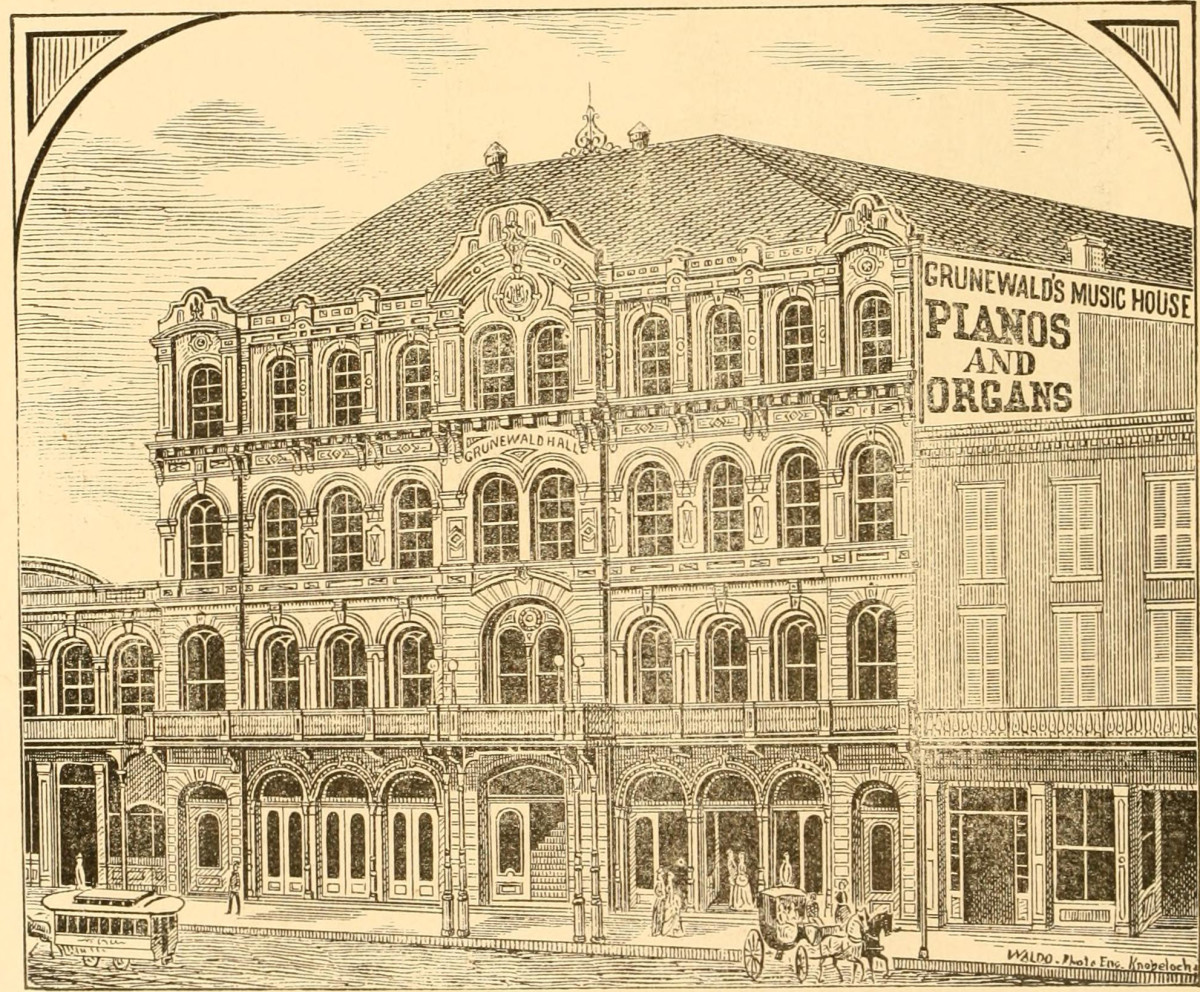
3. When the annex (now the main entrance) was added in 1907, it was the tallest building in Louisiana
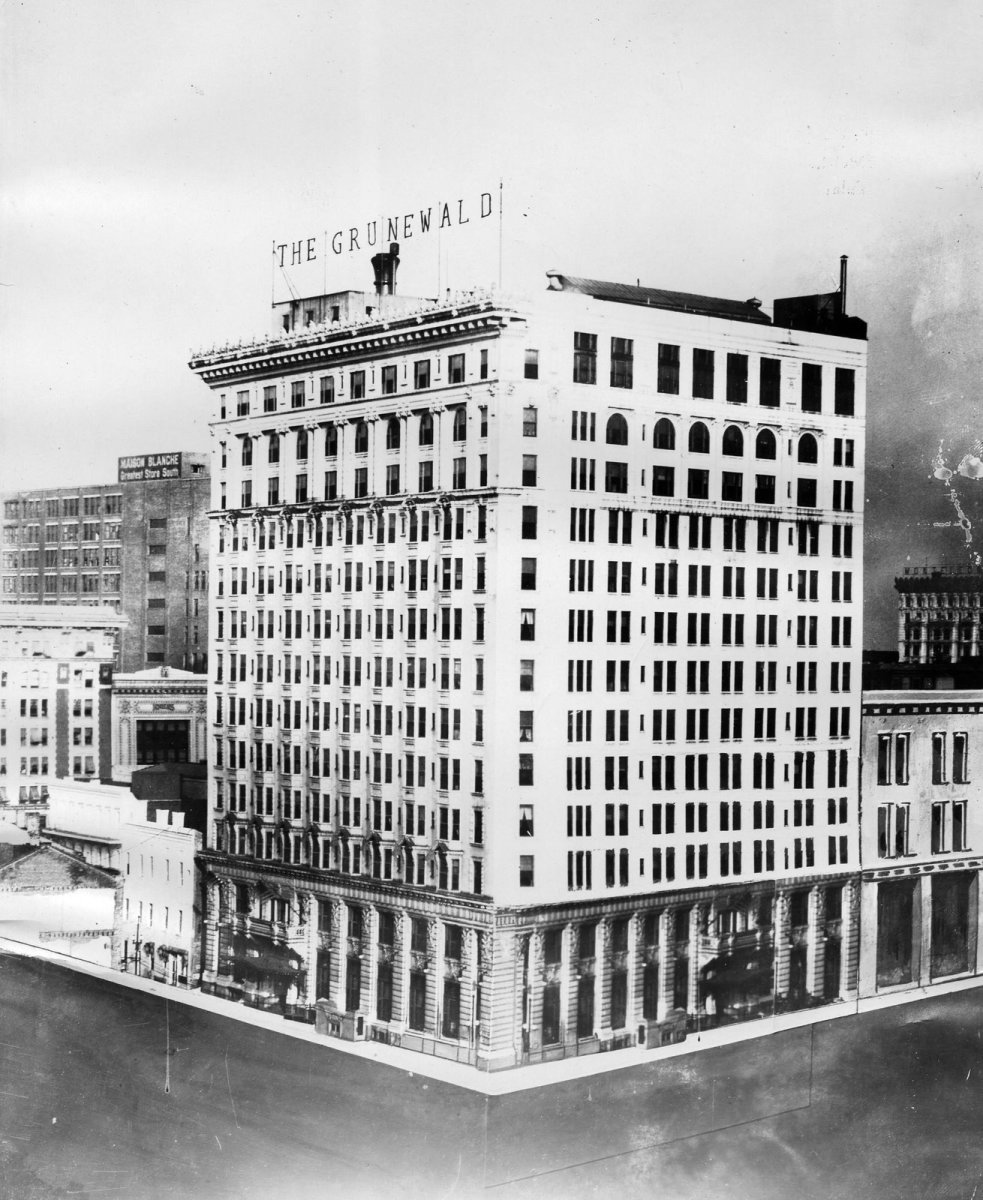
The monstrous edifice was unveiled at the flash of midnight on New Year’s Day, 1908. At the time, it was proclaimed the tallest building in Louisiana, at 14 stories.
In this modern age, with the landscapes of most of our cities dominated by skyscrapers, this seems hard to fathom. But this was a record the Grunewald Hotel held until 1920.
Had health problems not forced Theodore Grunewald, son of Louis Grunewald, to sell the property in 1923, the building might still rank among the top 40 tallest in the state. Prior to being forced to sell his business assets, Theodore was planning to build a 23-story addition.
4. It was designed by the same architect who designed the Pfister Hotel in Milwaukee, WI
The 14-story expansion was, in origin, almost as German-Louisianian as its owner Louis Grunewald. It was designed by German-born architect Henry C. Koch, whose firm operated primarily out of Milwaukee.
Koch was born in Hanover, Germany, before immigrating to the United States with his family as a toddler. He started his own architectural firm, HC Koch and Sons, after the Civil War, and specialized in a distinct building style called Richardson Romanesque.
Richardson Romanesque, ironically, was popularized by — and subsequently named for — a Louisiana native, Henry Hobson Richardson, who was a popular architect during the late 19th century. Richardson’s revival style incorporated elements of 11th and 12th century French, Spanish, and Italian Romanesque architecture. Its common qualities included semi-circular arches, symmetry, copious use of stone, and generally simple facades.
The Hotel Grunewald was one of the few works (if not the only) of Henry Koch and his firm to be completed outside of the Midwest. Most buildings of his undertaking are located in Wisconsin or Iowa.
Koch’s most recognized landmark designs include Milwaukee’s magnificent Pfister Hotel, and City Hall. The latter’s design was heavily inspired by Koch’s fatherland; Hamburg City Hall’s neo-renaissance visage served as the model.
The Grunewald’s Milwaukee connection was in part through their friends, the Flanner’s, several of whom married into the family. The eponymous music store they started is now a well-known home entertainment store in Milwaukee and West Allis.
5. It was home to America’s first night club
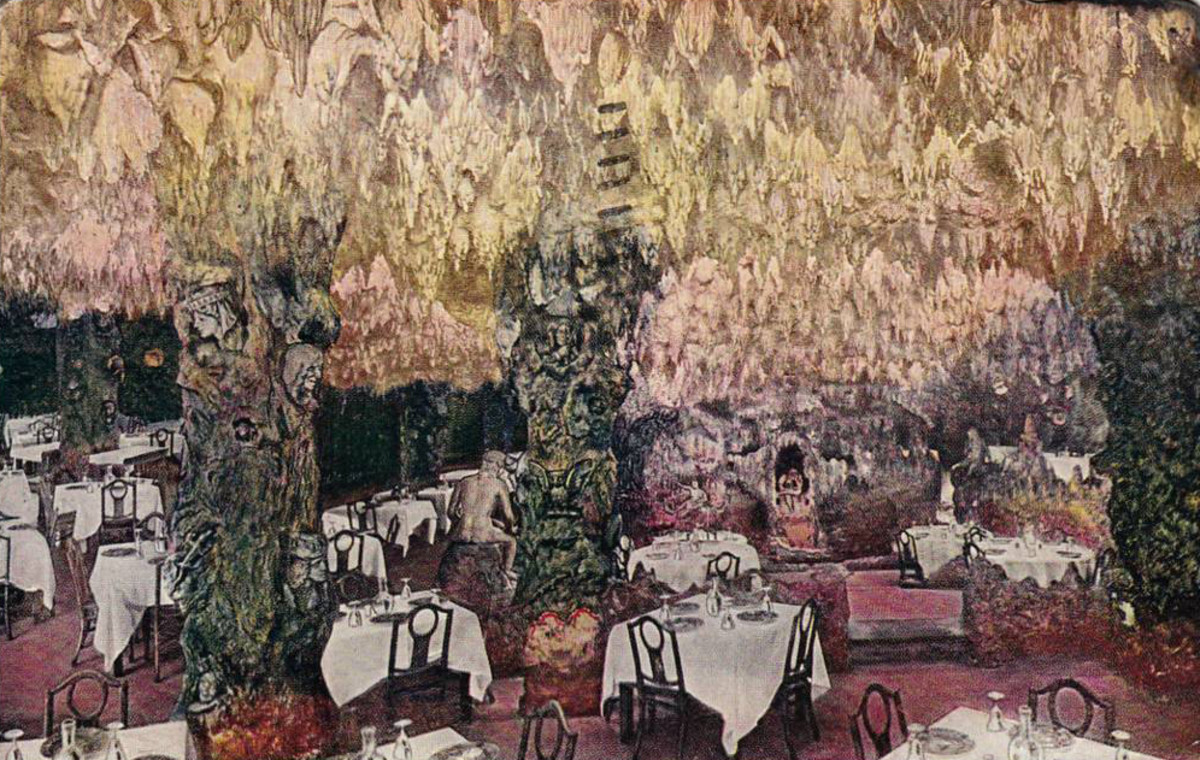
Situated in the hotel’s basement, The Cave was an idea Theodore Grunewald had conceived when the hotel first opened in 1893 and he was serving as manager. It wasn’t until Thanksgiving night of 1910, however, that the venue was completed and fully operational.
Why it took so long to finally come to life is somewhat understandable.
Upon its opening, Theodore proclaimed The Cave “unlike anything in the cafe line anywhere in the world.” Had he been referring to the mere fact that it featured some of the most expensive vaudeville shows ever seen in a hotel or cabaret, his claim would have been widely validated. He was referring more, however, to The Cave’s most fascinating feature — its interior — which literally resembled a real life cave.
The ceilings and walls were covered in meticulously-place stalagmites, stalactites, and pseudo-limestoned crystals, concocted of cement and plaster of Paris. They were colored to resemble Kentucky’s Mammoth Caves and expertly lit with incandescent lights concealed in the stalactite formations as well as in the sides of the room.
Completing the fantasy underground supper club were a waterfall and a collection of stucco nymphs, all placed throughout the space.
The Cave is reputed by historians to have been America’s first night club. It remained one of the hotel’s main attractions until 1930.
6. The tradition of “outdoor wonderlands” long pre-dated the X-Mas festivities
Today’s Roosevelt Hotel, much like the Fairmont before it, is known for its lavish holiday decorations adorning the entire length of its block-long lobby over the Christmas season. As showcased by The Cave (see item #5), however, it is evident that natural wonders provided inspiration for the hotel’s distinct interior as early as its days as the Grunewald.
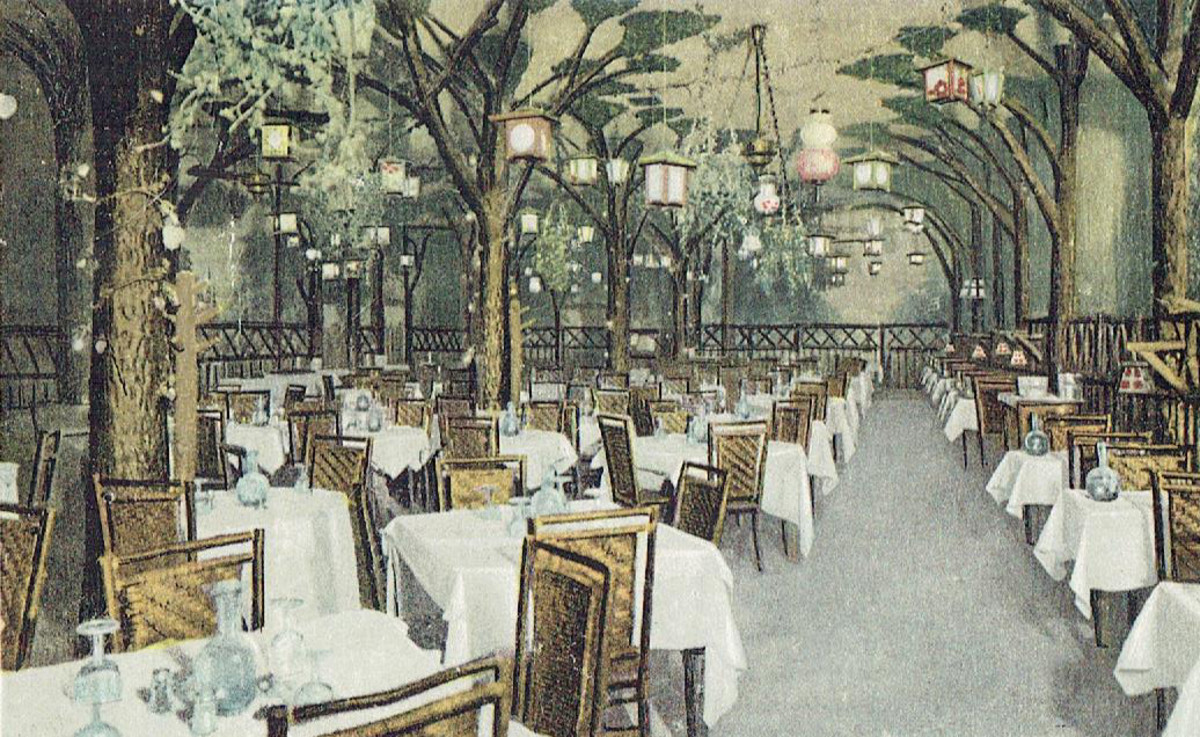
The hotel, beginning in 1913, boasted a second landscape-inspired establishment called the Forest Grill — perhaps a nod to the family name, which means “green forest” in German.
Like the Cave, the Forest Grill provided live music and fantasy-like enchantment to all who entered.
Its entrance extended back from the Baronne Street end 100 feet. It was here where guests pass through a gate before crossing a miniature bridge to the tables, which were all “set in secluded nooks of a wonderland beyond, according to a 1913 feature in the Times Democrat. This miniature woodland was finished with hickory and sassafras, and the Grunewald symphony entertained every afternoon and evening.
The aforementioned Times Democrat had proclaimed this new venue “one of the most beautiful lunch and dining rooms in the South.”
7. It once had a “sister” hotel
When Theodore Grunewald took over the family hotel business following his father’s death in 1915, one of his visions was expanding the enterprise. As mentioned in item #3 (see above), he had planned a 23-story addition to the Hotel Grunewald before health problems forced him to sell his business assets, in 1923.
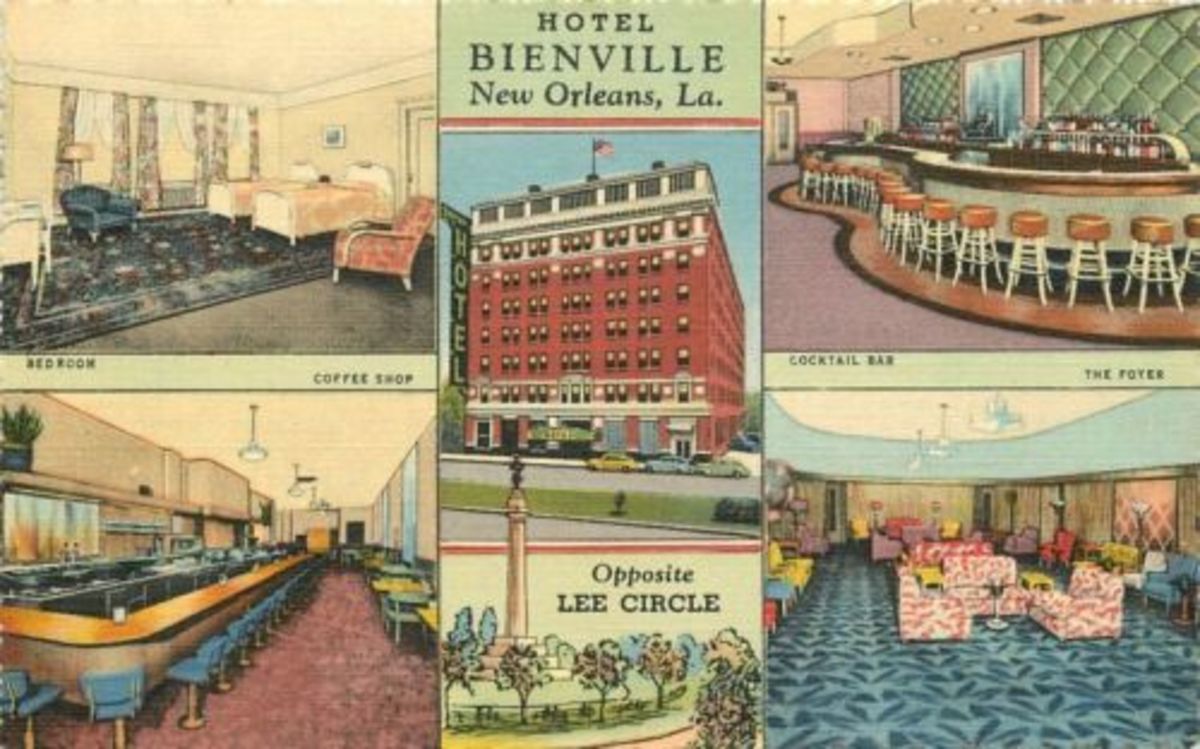
Though the Grunewald addition never materialized, Theodore did build an apartment hotel on St. Charles Avenue just off of Lee Circle, in 1920. It was named the Hotel Bienville, after Louisiana’s first governor, and consisted of 225 rooms. According to Hotel World Magazine from the time, the new building was expected to serve guests of the original Grunewald while the unrealized 23-story wing was erected.
When Theodore Grunewald sold the Bienville along with the Grunewald Hotel, the new owners added a roof garden, in 1928. The roof garden was a popular attraction for smart set socialites and tourists alike.
The Bienville building now operates as Tivoli Place Apartments, an affordable housing complex for senior citizens.
8. Its name was changed during the anti-German movement during WWII
“Cancel culture” is something that has dominated the news in recent years. It is by no means a new thing, however. As alluded to in item #1, it was something essentially forced upon the German-American population during both world wars. In the event of the first, many German immigrants were accused of being too loyal to the German empire.
In response, various laws were passed that prohibited the teaching of German in schools, forbade the display of the German flag, and suppressed German culture in general. Various streets were re-named and many German-American organizations also disbanded at this time. A number of German entrepreneurs even felt compelled to change their business names.
Though the Hotel Grunewald was no longer under its original German ownership by the time the first world war ended, the aftermath still lingered enough for the new owners to feel justified in changing its name. They chose the name of “Roosevelt” in honor of President Theodore Roosevelt, whose efforts in building the Panama Canal had been tremendous for New Orleans’ economy.
About the Creator
Liesl Grunewald
6G NOLA Native . Dancer, Diver, & Martial Artist for life . Aspiring athletics & movement polymath . Creative techie . Slightly reformed neurotic.
Enjoyed the story? Support the Creator.
Subscribe for free to receive all their stories in your feed. You could also become a paid subscriber, letting them know you appreciate their work.
Comments
There are no comments for this story
Be the first to respond and start the conversation.