
This Halloween, Indigenous Cultures Are Not Costumes: Why It’s Time to Leave Pocahontas Alone
We can enjoy fictional characters while still recognizing that Indigenous peoples, cultures, traditions, and histories are not props for Halloween.

Content Warning: This article contains potentially triggering material. The text discusses colonialism, cultural appropriation, harmful stereotypes, the history of indigenous subjugation, massacres of Indigenous people, sexual exploitation, and violence against indigenous women. Matoaka/Pocahontas is presented as a mythological figure in popular culture. The reader is warned that the article may contain upsetting information.
Every year, as Halloween approaches, the same old arguments about cultural appropriation erupt: whether something is done in bad faith or simply in a way that might be considered disrespectful. What it means for everyone to cosplay their favorite characters is debated.
These disputes are especially contentious when it comes to depictions of indigenous peoples and accessories that might be considered part of their culture.
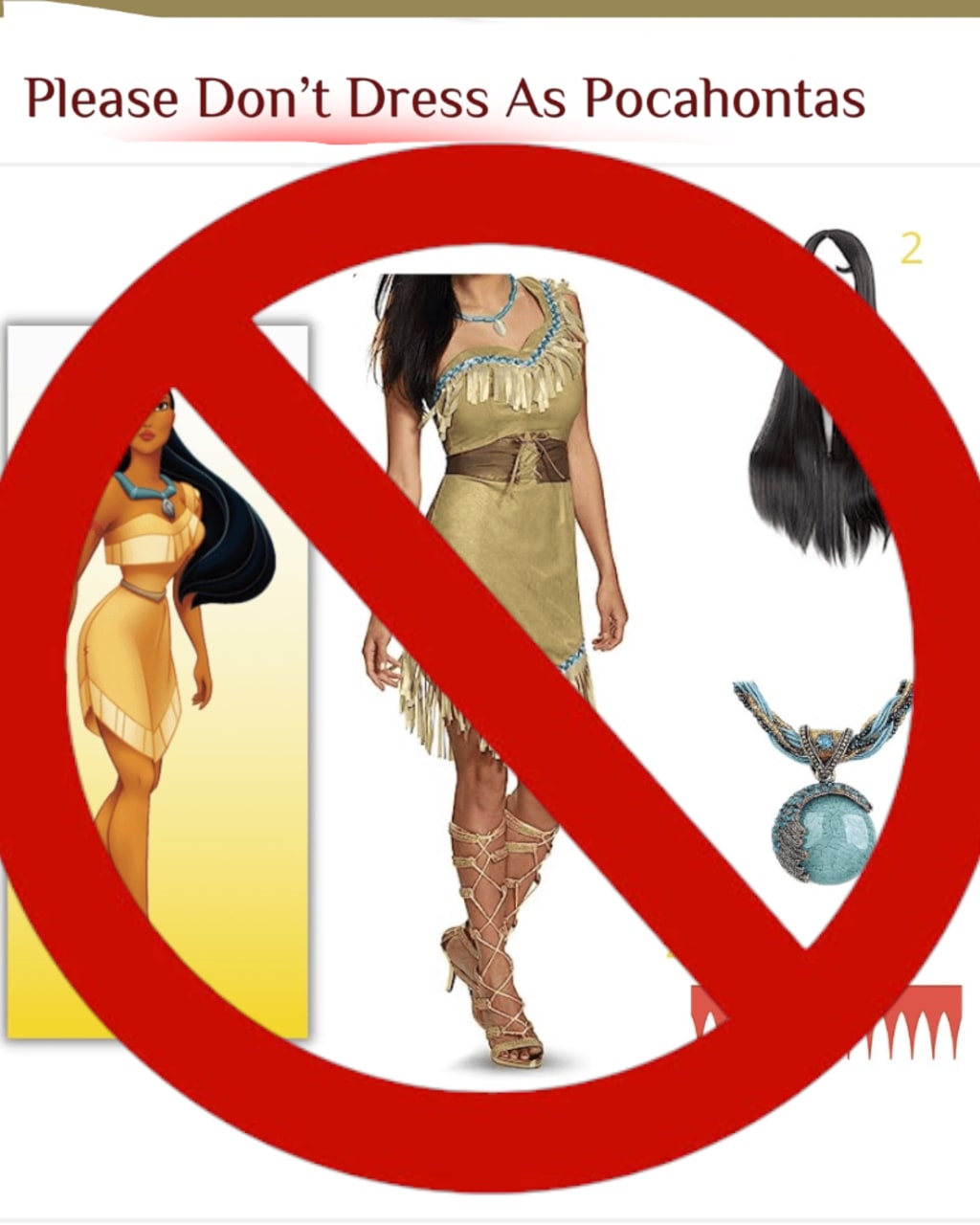
Instead of focusing on how much it might upset non-indigenous people, it is time to focus on the viewpoint that many indigenous peoples have been trying to make for years: that their cultures are not costumes. So let's put that thought out there for everyone to see. This year, you should not be dressing up as Pocahontas for Halloween.
That is, unless you think no one should be able to enjoy Disney, or think that all indigenous peoples believe the same thing about cosplay, or think that nobody who wears a Pocahontas costume is doing so in bad faith.
Pocahontas Was A Real Person, Not A Disney Princess
To begin with, what may be the most important: Disney’s Pocahontas does not depict a fictional Indigenous character. She is based on a real-life Native American woman named Matoaka, a Powhatan Indian also known as Pocahontas. Although the film portrays her in a very different light, the real-life Pocahontas has a very real and notable history.
Disney’s version of events has her as an adult when she falls in love with John Smith. Then attempts to save her people by bringing together the English colonists and the Powhatan tribe through love and music. The actual events are significantly less romantic.
When John Smith first encountered the Powhatan, Matoaka was merely a child, and there is no evidence to suggest that any romantic relationship ever occurred. In fact, she was eventually captured and held as a slave before being forced to marry John Rolfe, and later brought to England as an exhibit. This, unfortunately, appears to be the real story.
It is a shame that the legacy of this Powhatan girl is being used to further commercialize Disney’s princess brand. By depicting a real Indigenous person in such a romanticized and fictionalized setting, they created an entire fictional history around a real person, which continues to contribute to cultural appropriation around Indigenous peoples to this day.
Disney’s Pocahontas Isn’t a History Lesson
While Pocahontas was intended as a Disney animated fantasy rather than a biographical documentary, the fictionalized account of a real historical figure risks overshadowing the perception of the actual person.
Considering the fact that the film presents a romanticized view of the period associated with colonization, conquest, and genocide. Cultural appropriation may be a disservice to the viewers. Moreover, the film portrays the Powhatan tribe’s culture unrealistically, essentially dressing it in Disney makeup.
The children who watch the film may not be able to distinguish between what is real and what is a product of Disney’s imagination, thereby leading them to accept the company’s agenda. On the other hand, Disney does not help the situation by marketing Matoaka as if she were real.
Disney Is Still Selling Pocahontas Costumes
This aspect of the issue is particularly difficult to ignore.
Disney continues to profit from merchandise that celebrates its animated Pocahontas character, the Pocahontas Costume for Kids being the Disney Store's latest offering, including a leaf pattern, braided belt, fringe, and faux-suede.
Regardless of the availability of this costume, there arises a question of why to turn a character of Disney's very own invention into a Halloween trick-or-treat costume.
Asking a child to wear the costume does not provide them with an opportunity to learn about the real-life Powhatan Native American culture or Matoaka. On the contrary, it allows them to become a character in the commercial fantasy of Disney, which is entirely different from reality.
Indigenous Cultures Are Living Cultures
A particularly insidious aspect of the costume is that it presents living indigenous traditions as something that belongs to the past.
Generic "Native American" costumes combine different elements (feathers, fringe, fake buckskin, braids, turquoise, face paint) and present them as a single, unique culture.
In the real world, there is no such culture.
Each indigenous nation has its own unique set of languages, histories, governments, rituals, clothing, and artistic heritages.
These nations continue to survive and thrive to this day: there are Powhatan-descended communities, the Choctaw nation, the Mohawk people, and countless other groups.
Although Hollywood and the media would like you to think of them as ancient tribes of the past, these cultures still survive and have vibrant modern traditions.
That is why reducing their cultural heritage to Halloween costumes is so offensive—it decontextualizes and detaches living traditions from the groups that created them, presenting them as something outdated and only suitable for novelty props.
This Isn’t Just About Pocahontas
The problem of Indigenous peoples' costumes is not limited to what Disney has to offer.
The company was selling such outfits as 'Pocahottie' or 'Native American Seductress.'
A petition seeking the removal of dozens of such items from the site has attracted more than 23 thousand signatures. Activists pointed out that such costumes are blatantly racist and sexist and present Indigenous women in a sexualized manner.
The activists included Zoe Dejecacion and Amanda Blackhorse, who took it upon themselves to deliver their message directly to the company's headquarters.
It was not just a general statement about how they did not like such costumes.
This was much broader and more involved.
Objectification
Reducing Indigenous women and their valuable heritage to nothing more than fantasies, and dressing them up in sexualized costumes, turns a lively and diverse group of real people into a harmful Halloween stereotype.
Stereotyping
Indigenous heritage does not represent a single, uniform identity but rather includes a great number of different traditions and cultures. Yet commercial products often combine separate cultural elements, thus reducing these rich and diverse practices down to a homogenized "Native American" stereotype.
Disrespect for Sacred Traditions
Traditional Indigenous garments, regalia, feathers, jewellery, and ceremonial objects have great spiritual, cultural, family, and community significance and should not be regarded as interchangeable elements of a uniform 'Native' style since they are nothing more than disposable Halloween decorations or fashionable accessories.
Historical Trauma
Indigenous peoples have been subjected to centuries of violence in the forms of invasion, colonization, uprooting, silencing, and assimilation.
Hence, when a person wearing such an outfit is seen in a social setting, it does not matter what they think or what exactly they intend by doing so – it is still a disrespectful act laden with a dark history.
The Sexualization of Indigenous Women
Native rights advocates point out that objectifying Indigenous women reinforces harmful biases related to the ongoing crisis of missing and murdered Indigenous people.
While saying that the costume itself does not directly contribute to the violence, these stereotypes are deeply ingrained in the culture.
Instead of dismissing the concerns as oversensitivity, it is better to take them seriously and respect the feelings of Indigenous people.
“But I Didn’t Mean Any Harm”
While many people who opt for culturally appropriative costumes do not necessarily have bad intentions, good intentions do not excuse the repercussions of the offense. It is a mistake to think that intent determines everything, and it is possible to have bad intentions and act inappropriately without meaning to.
Saying "I didn't mean to be offensive" could be an attempt to explain one's actions. In the end, it doesn't change the fact that the offense was committed. To achieve true understanding, we must first listen to the affected groups rather than attempting to defend ourselves.
Listen to Indigenous Voices
Organizations such as Native Partnerships have already addressed the issue from the perspective of Native Americans, stating that their culture is not a costume.
Therefore, indigenous peoples expect that, in the future, instead of asking yourself the question “How would it feel to me if…”, you will ask yourself the question “What are indigenous peoples saying to me about it?” And act accordingly.
The voices of indigenous peoples are not one, but many. Some of them may be against the depiction of certain elements of their culture in a form of cosplay, fashion, or art, while some may be okay with it; you can’t listen to everybody and do as one says, for there will always be those who seek to oppose your actions.
Listening to them does not mean seeking approval from any particular group of Native Americans to invalidate the claims of the rest; it means recognizing the fact that the Native Americans themselves have the ultimate say in the matter.
What About Marvel’s Echo and Kahhori?
For Marvel fans and cosplayers, these examples may be used as a comparison.
First, take Maya Lopez (Echo), a Choctaw superheroine, whose roots play a significant role in the series — and the fact that Marvel Studios has turned to the Choctaw Nation for assistance in costume-making and linguistic authenticity. Iconography is important. This way, the company strives to improve the representation of indigenous peoples, which could set an example for the industry.
Another example includes Kahhori in What If…?, whose creation also involved the Mohawk community in the adaptation of her appearance and the environment. A specific language, which again speaks of positive intentions in avoiding previous Hollywood stereotypes. However, despite the careful attitude toward the culture bearers, it does not mean that all the depicted elements are acceptable for use in daily life.
Why Some Cosplayers Choose Not to Cosplay Echo or Kahhori
In my experience, people often skip dressing as Maya Lopez because they are not Indigenous and do not want to upset any potential customers by appearing in public as an Indigenous person.
But this also extends to cases where no darkening of the skin takes place, as it demonstrates a level of awareness.
There is a big difference between “you are not allowed to cosplay this character” and “I personally do not feel comfortable cosplaying this character because I am not Indigenous and I respect their culture enough to not appropriate it”.
This kind of awareness is especially important if the clothing you are wearing has any traditional or ceremonial aspects.
As Kahhori’s clothing and accessories are inspired by the Mohawk tribe, it is possible that a similar approach will have to be taken if one wishes to depict her in public.
Representation Isn’t Ownership
Crucially, we must distinguish between these scenarios, as they are not the same.
It is self-representation when indigenous artists, actors, and creators share their own culture. This includes designers and cosplayers who express their own backgrounds.
On the other hand, cultural consultation and collaboration occur when a film’s production directly works with the indigenous nation.
Meanwhile, when a non-indigenous person wears some traditional indigenous dress as a Halloween costume, it is a completely different situation.
The goal is not to erase indigenous representatives from mainstream cinema. On the contrary, the point is to promote indigenous heroes in popular culture. We need more native authors, directors, actors, artists, and superheroes. Most importantly, there is a need for indigenous narratives to shape the stories being told, rather than simply being a part of them.
And That’s Why Pocahontas Is Different
The main problem is that there is a paradox in making a beloved princess out of a historical character while erasing the real person from public memory.
Although many people know about Disney’s Pocahontas, not many can tell you about the real Matoaka and the indigenous peoples and nations that survived until the present day and have their own cultures that have nothing to do with the story told in the Disney film. Thus, Disney turns a respected historical figure into a children’s cartoon character and removes real cultural heritage from the region.
Moreover, the company continues to appropriate indigenous culture by turning it into a children’s cartoon character and continuing to sell toys and costumes so that people can dress as Pocahontas.
You Don’t Have to Hate Disney to Say No
It is entirely possible for anyone to have cherished memories about Disney's Pocahontas, to remember and be able to hum "Colors of the Wind", or to value the media figure in their childhood and still not want to wear the persona as a Halloween mask.
We must remember to respect other cultures and listen to natives. Do not disregard any of their voices just because a media conglomerate decided to make a profit out of it. Instead, we can critique and deconstruct the problematic media piece and educate ourselves on the subject it was based on.
So, when you see the Disney Princess on the T-shirt, you can remember that it is not an accurate portrayal of an indigenous woman. You should familiarize yourself with the real Matoaka.
You can critique the medium (Disney) for capitalizing on indigenous cultures instead of portraying them in an accurate light.
This Halloween, Choose Something Else
With thousands of purely fictional characters to choose from for Halloween and cosplay enthusiasts, there is nothing to stop anyone from creating an outstanding outfit or a spectacular cosplay. However, it does not involve dressing in sacred regalia or enjoying the holiday as if it were another group’s living culture, not a mere aesthetic.
As the holiday draws near, non-Indigenous peoples in particular are urged to put Pocahontas off the list of costume ideas, for good.
It is not to shame or limit the creativity of non-Indigenous peoples or to villainize the beloved Disney princess, however; it is to remind that Indigenous peoples are real people. Their culture, regalia, and history are not a prop to be used as a part of seasonal festivities or discarded with the end of October. Indigenous peoples are living and vibrant, with their own stories to tell on a daily basis.
The best way to honor and respect them this Halloween season is to research and educate oneself on their rich cultures and choose not to partake in cultural appropriation as a form of holiday celebration.
About the Creator
Jenna Deedy
Just a New England Mando passionate about wildlife, nerd stuff & cosplay! 🐾✨🎭 Get 20% off @davidsonsteas (https://www.davidsonstea.com/) with code JENNA20-Based in Nashua, NH.
Instagram: @jennacostadeedy
Enjoyed the story? Support the Creator.
Subscribe for free to receive all their stories in your feed. You could also become a paid subscriber, letting them know you appreciate their work.
Comments
There are no comments for this story
Be the first to respond and start the conversation.