
The Red and the Black by Stendhal
Why It's a Masterpiece (Week 125)

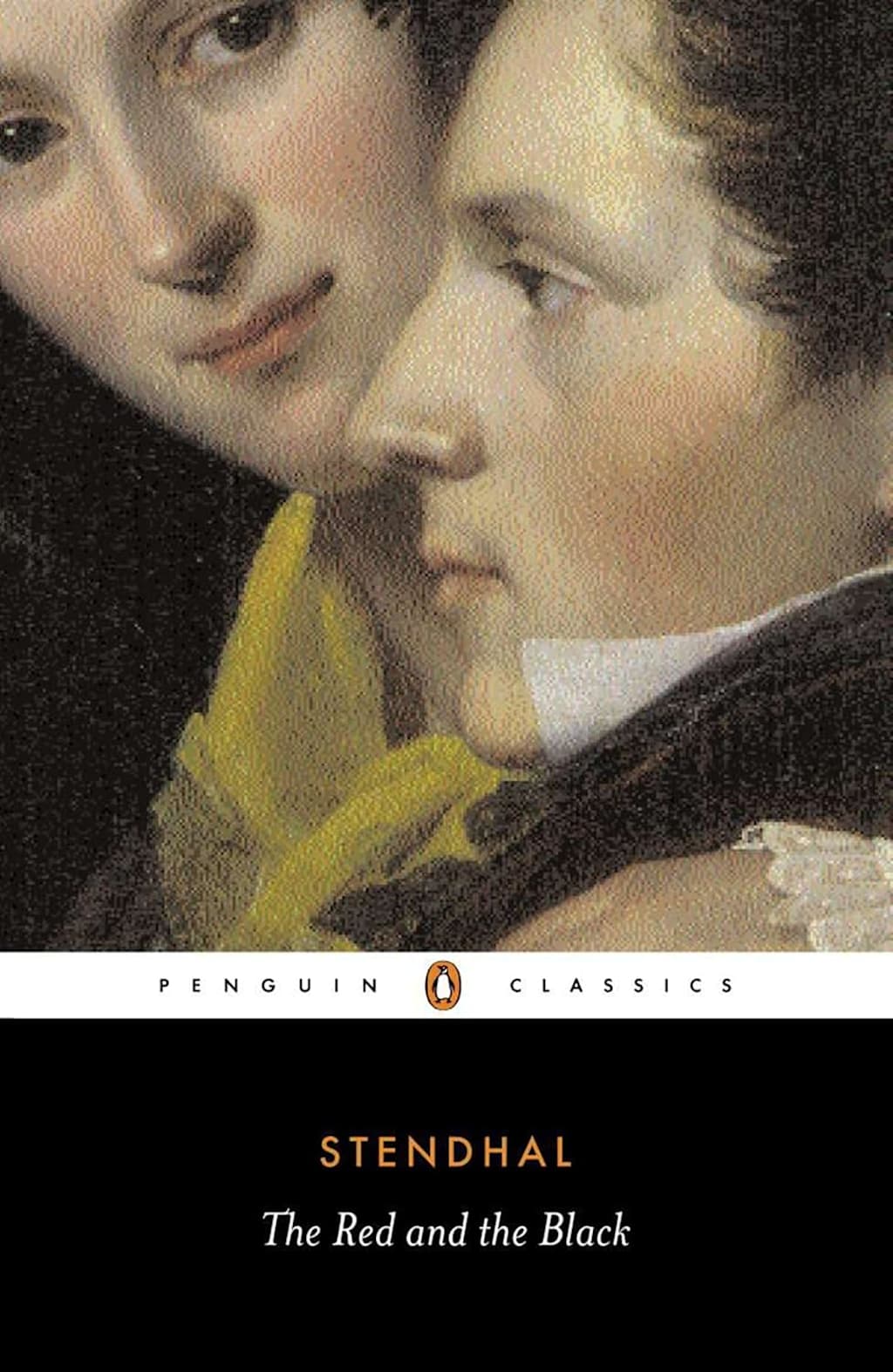
Stendhal is probably best known for lending his name to the famed 'Stendhal Syndrome' but, he was also a fantastic writer. Publishing the novel The Red and the Black in Paris during 1830, the original subtitle: Chronique du XIXe siècle, suggests the novel's aim to reflect the sociopolitical climate of Restoration France after the fall of Napoleon. Stendhal based the novel loosely on the 1827 trial of Antoine Berthet, a young seminarian who shot a woman he had an affair with after she dismissed him; this case fascinated the public and highlighted class tensions.
The title refers to the contrasting forces in French society: “red” symbolising the military (or revolutionary fervor) and “black” representing the clergy; both are career paths for ambitious men of humble origins like Julien Sorel, the protagonist. You reader would probably be more familiar with the song from Les Miserables (based on the book by Victor Hugo) which refers to 'The Red and the Black' - two colours important to the revolution during this period however divisively represented.
The Red and the Black remains Stendhal's most well-known novel, constantly resonating with the reader who has suffered or observed injustice. It is a fantastic example of French Revolutionary literature which focuses on informing the reader about the massive class divides across the country at the time. Ambition means different things to different people.
Plot

Deeply influenced by the ideals of Napoleon and harbouring a contempt for his father's crude materialism, Julien aspires to rise in society through intelligence and cunning. Though his low birth restricts his opportunities, he excels in Latin and theology, eventually securing a position as a tutor for the children of Monsieur de Rênal, the town’s mayor. Julien quickly becomes entangled in a secret love affair with Madame de Rênal, his employer’s devout and emotionally conflicted wife.
Their relationship is both passionate and fraught with danger, as Madame de Rênal is torn between her religious conscience and her feelings for the young tutor. Julien’s pride and ambition blind him to the risks involved, and their liaison inevitably draws suspicion, setting into motion the first major upheaval in his quest for upward mobility.
Madame de Rênal’s anonymous letter of confession, written under the coercion of her confessor, leads to Julien’s disgrace in the town. While devastated by the betrayal, Julien suppresses his emotions and pivots strategically. He decides that a clerical path will now best serve his ambitions. In the seminary, however, Julien is disillusioned by the hypocrisy, mediocrity, and power games of the institution.
His intelligence sets him apart, but it also incites jealousy among his peers and resentment from the director, Abbé Castanède. Fortunately, Julien catches the attention of the influential Abbé Pirard, who recognises his potential and arranges for him to leave the seminary. Julien is soon recommended to the Marquis de la Mole in Paris as a secretary - a critical turning point, positioning him within the upper echelons of aristocratic society and offering him a new battlefield in his relentless climb up the social ladder.
Now moving in elite circles, Julien is exposed to the intricacies of courtly manners, patronage, and the artificial codes of high society. Though he is initially out of his depth, he learns quickly and uses his keen observation and adaptive nature to win the favour of the Marquis. Despite his disdain for aristocratic frivolity, Julien is captivated by their power and prestige. He begins to see himself as a worthy participant in the societal game he once scorned.
During this period, he also becomes increasingly conscious of his own duplicity, as he suppresses his true feelings and origins in order to project an image of cultured sophistication. The complexities of navigating both ambition and integrity come to the fore, and Julien, though calculating, struggles internally with the self-loathing that his imposture generates. Still, the role offers a fresh opportunity: he soon becomes entangled in a romantic intrigue with Mathilde, the Marquis’s proud daughter.
Mathilde, spirited and rebellious, is intrigued by Julien’s cool intellect and enigmatic presence. Her attraction to him deepens precisely because he seems immune to her aristocratic charms, challenging her expectations. Julien, meanwhile, sees her both as a romantic conquest and a means to ascend further. Their relationship is marked by alternating power plays, passionate outbursts, and emotional volatility. Mathilde moves between idolising Julien as a romantic hero and scorning him for his low birth.
Julien, ever strategic, writes love letters modelled on Napoleon’s language, fanning the flames of her fascination. Eventually, their affair becomes serious, and Mathilde informs her father she is pregnant. The scandal threatens to ruin her reputation and social standing, but the Marquis, though initially outraged, relents and arranges for Julien’s ennoblement and a military commission to legitimise the union. Julien appears to have finally achieved the social status he has long craved, but his past soon resurfaces.
Having genuinely repented for their past affair and still caring deeply for Julien, Madame de Rênal writes to the Marquis de la Mole after hearing about his daughter’s engagement. In her letter, she portrays Julien as an opportunist who manipulates women for his personal gain, believing she is acting in moral and spiritual good faith. When the Marquis receives the letter, he is deeply disturbed and immediately calls off the engagement between Julien and Mathilde.
Julien, devastated and furious, sees the letter as a betrayal beyond forgiveness. In a moment of passionate vengeance and despair, he travels to Verrières, enters the church where Madame de Rênal is attending Mass, and shoots her at close range. The act shocks the community. Though she survives the shooting, Julien is swiftly arrested and imprisoned. This violent rupture marks the collapse of his ambitions and the beginning of a reflective, tragic final chapter in his life.
Removed from the schemes and pretences of society, Julien begins to reflect deeply on his life, his identity, and the consequences of his relentless ambition. He no longer clings to social advancement or glory but embraces a kind of spiritual clarity in the face of death. He sees the futility in chasing status and is struck by the emptiness of his achievements.
Madame de Rênal visits him regularly in prison, having fully forgiven him and still loving him deeply. Their renewed bond is tender and sincere, contrasting starkly with the manipulative and performative relationships that characterised much of Julien’s earlier life. In these final days, he experiences authentic emotion and moral awakening, shedding the armour of ambition.
During the proceedings, Julien surprises many by delivering a defiant and eloquent speech. He openly acknowledges his crime but insists that his actions were driven by pride, wounded honour, and the unjust structures of a society that punishes men for their origins rather than their merits. He refuses to portray himself as a mere victim of passion or to beg for leniency. His dignity in court impresses some but does little to sway the outcome. The judges, reflecting the conservative and class-conscious values of Restoration France, sentence him to death. Julien’s final stance is not one of desperation but of almost heroic resignation.
Mathilde’s pride and impulsiveness give way to desperation as she petitions tirelessly on Julien’s behalf, trying to have the sentence overturned. She uses her social status and influence to appeal to powerful figures, but her efforts are futile. Her love for Julien deepens as she sees him as a tragic, noble figure, more romantic and heroic in death than in life. She dreams of rescuing him or fleeing with him, but Julien, having accepted his destiny, rejects such fantasies. He remains steadfast in his decision to face execution with composure.
On the day of his execution, Julien walks calmly to the guillotine, unflinching and resolute. He has achieved, in death, a kind of purity that eluded him in life. The ambitions, vanities, and fears that once consumed him have fallen away. For Julien, death becomes the final act of rebellion against a society that constrained him, misunderstood him, and denied him equality. His courage in facing his end grants him a moral victory, one that contrasts sharply with the shallowness of the world he strove to conquer.
Madame de Rênal, heartbroken and physically weakened by the ordeal, dies just three days after Julien’s execution. Her death is serene, almost saintly, a final expression of the deep, unwavering love she held for him, despite all that had occurred. Mathilde, meanwhile, immerses herself in mourning with operatic intensity. She claims Julien’s body and has it buried in a secluded location, where she constructs a private mausoleum. There, she visits and even lies beside his tomb, imitating the romantic gestures of legendary heroines of history.
Into the Book

Ambition, Social Climbing and Acceptance
Julien Sorel’s overwhelming desire to rise above his humble origins defines the novel’s central conflict. In a rigidly hierarchical Restoration France, Julien views personal merit and ambition as his only tools for social mobility. Throughout the novel, Julien moulds himself into what each context demands: a pious seminarian, a submissive secretary, a bold lover.
Each role assumed not from authenticity but strategy. His ambition, however, is always haunted by insecurity and self-loathing. Despite his intelligence and charisma, he remains painfully aware that his background renders him an outsider. The futility of his efforts becomes most evident in his downfall: no amount of imitation or manipulation can overcome the entrenched class prejudice that ultimately rejects him. Julien’s fatalism by the end reflects not just personal failure, but a broader indictment of a society hostile to meritocracy.
"A poor peasant like me, the son of a carpenter, to be loved by a woman of noble birth! It is a miracle! And they want to take it away from me!"
- The Red and the Black by Stendhal
Religious and Societal Hypocrisies
Stendhal presents religion as deeply hypocritical and politically corrupted. Julien’s time in the seminary reveals a clerical world that values conformity, sycophancy, and social control over spiritual virtue. The clergy are shown not as moral guides but as instruments of power, often more concerned with self-preservation and patronage than with piety. This mirrors the hypocrisy found in broader society, where appearances often matter more than truth.
Characters like Madame de Rênal struggle sincerely with moral questions, but the institutions around them push them towards duplicity and repression. Julien himself embodies this duplicity, using religious devotion as a mask for ambition. Stendhal critiques how social and religious orders claim to uphold virtue while rewarding manipulation and falsehood. This thematic undercurrent exposes the disjunction between professed ideals and lived realities, especially in a world where advancement depends not on goodness but on strategic pretence.
"What a fine career a priest’s is! That is the only road open to talent and ambition without any money."
- The Red and the Black by Stendhal
Love as Conflict and Revelation
Love in The Red and the Black is not a simple redemptive force; it is a source of inner conflict, revelation, and at times, destruction. Julien’s relationships with Madame de Rênal and Mathilde de la Mole are shaped as much by power, pride, and identity as by affection. With Madame de Rênal, love begins as seduction and evolves into genuine tenderness, revealing Julien’s capacity for vulnerability.
With Mathilde, love is a battleground of wills, often theatrical and volatile, but also tied to Julien’s pursuit of status. In both cases, love is not purely emotional, it’s entangled with the characters’ social positions, self-conceptions, and desires for transcendence. These relationships strip away Julien’s calculated façades and expose his deeper fears and longings. Yet, love also becomes the context in which Julien’s tragic destiny is sealed. It brings moments of truth, but never liberation; it elevates, complicates, and ultimately undoes him.
"She loved him for the dangers he had passed, and he loved her that she did pity them."
- The Red and the Black by Stendhal
Why It's a Masterpiece

The Red and the Black is considered a masterpiece for its pioneering psychological depth and bold social critique. Stendhal masterfully explores the inner life of Julien Sorel, blending Romantic passion with realist detail in a way that anticipates the psychological novel of the 20th century. It is a thriller wrapped in a romance, touched with constant hints of the morality which is explored during the latter part of the 19th century.
Julien’s conflicted psyche, torn between ambition, pride, love, and self-doubt offers a complex portrait of human motivation rarely seen in fiction of the time. The novel also delivers a scathing critique of post-Napoleonic French society, exposing the hypocrisy of the Church, the rigidity of class, and the emptiness of aristocratic life. Stylistically, Stendhal’s ironic tone, fast-paced narrative, and sharp character insight feel almost modern. His use of free indirect discourse and attention to emotional depth influenced later writers like Flaubert, Tolstoy, and Proust.
Conclusion

Here's what I wrote on The Red and the Black five years' ago now - take what you may from it:
I believe Julien represents the very essence of the changing France. It is constantly changing position and piece and yet, it struggles to keep up with itself. It becomes almost pitiful and whines over its sorrows until one day, through the time wasted through contemplation - it is destroyed by an act of absolute foolery. Yet, around them, nobody really believes that what they did merited the punishment. It is a sad story when you look at it, but it is told with great satire, great humour and it starts off with one of the greatest opening chapters I’ve ever read.
[Me]
I hope you seek out this wonderful, deep and intense novel.
Next Week: Morte D’Urban by JF Powers
About the Creator
Annie Kapur
"Et in Arcadia Ego"
***
I am:
🙋🏽♀️ Annie
📚 Avid Reader
📝 Reviewer and Commentator
🎓 Post-Grad Millennial (M.A)
***
I have:
📖 300K+ reads on Vocal
🦋/X @AnnieWithBooks
📸 ThePrancingPonyBakery
🔗 PrancingPonyBakery.com
***
🏡 UK
Enjoyed the story? Support the Creator.
Subscribe for free to receive all their stories in your feed. You could also become a paid subscriber, letting them know you appreciate their work.
Comments
There are no comments for this story
Be the first to respond and start the conversation.