
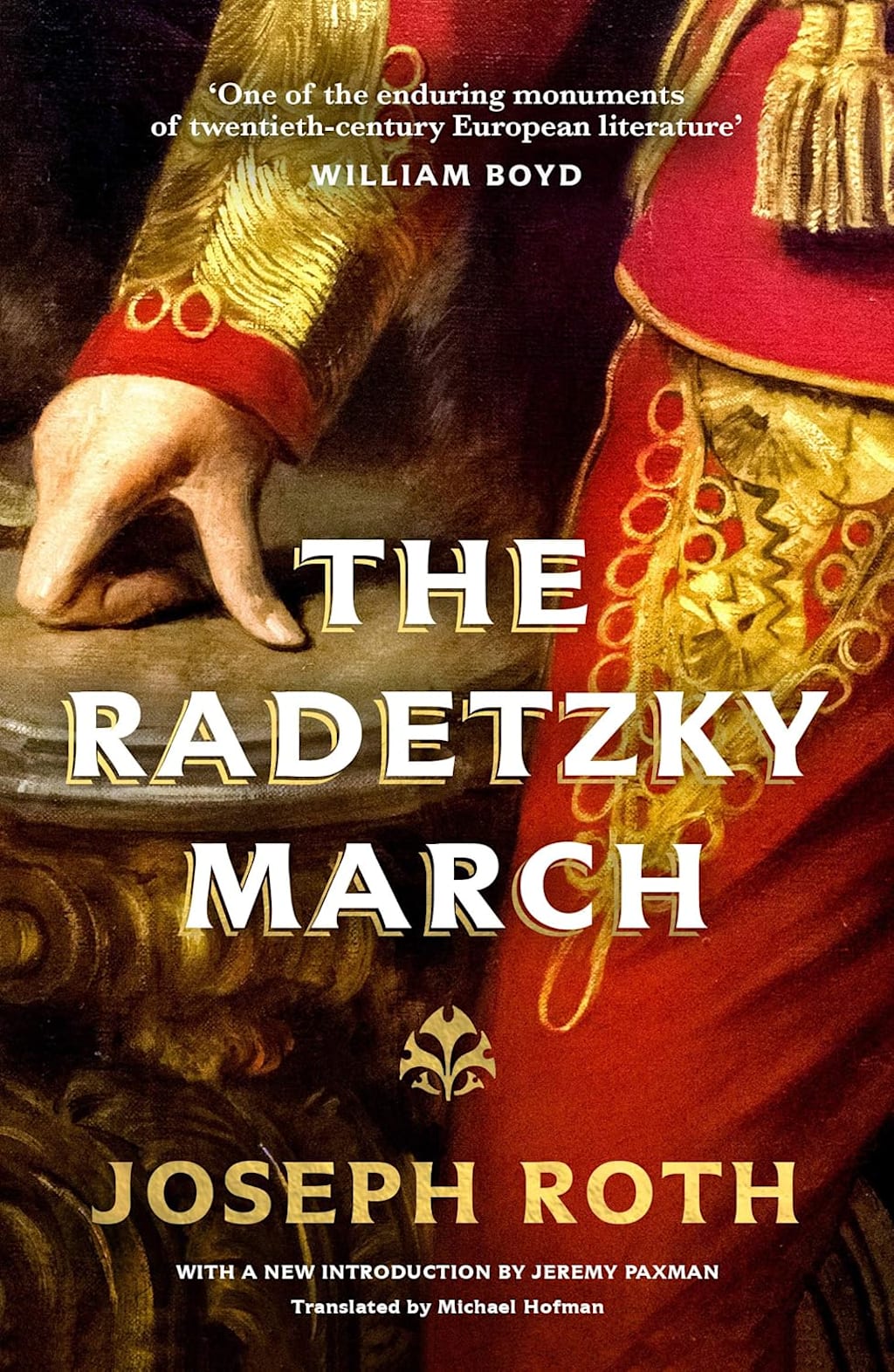
The Radetzky March by Joseph Roth
Why It's a Masterpiece (Week 114)

Background and Context:
I haven't read this book for a long time but only included it because I recently saw it on social media. I once loved reading Joseph Roth's wriitng and yet, this one flew completely under my radar until a few years' back. Even though I probably enjoyed 'Weights and Measures' more. I still had to write about 'The Radetzky March'.
The Radetzky March by Joseph Roth
'The Radetzky March’ was published in 1932 by Austrian-Jewish author Joseph Roth. Written during a time of deep personal and political turmoil, the novel reflects Roth’s nostalgia for the Austro-Hungarian Empire and his despair at the rise of nationalism and fascism in Europe. Roth, a journalist and novelist, had been a passionate monarchist and viewed the fall of the Habsburg Empire in 1918 not just as a political collapse but as a spiritual and moral one. This novel captures that sense of decay with haunting precision.
The title refers to Johann Strauss Sr.’s 1848 military march, often played during parades in honour of Field Marshal Radetzky and, later, the empire itself. It serves as both a literal and symbolic motif throughout the novel, echoing the rhythms of empire, discipline, and decline. The march bookends the novel, tying personal fates to the larger march of history.
The book was first published in German by Gustav Kiepenheuer Verlag. Though Roth had already achieved success with earlier works, The Radetzky March is widely considered his magnum opus. The novel’s reception was mixed upon release. Some contemporaries admired its lyricism and political melancholy, while others found its imperial sentimentality out of step with the modern, turbulent interwar period.
Plot

‘The Radetzky March’ chronicles the decline of the Austro-Hungarian Empire through the story of the Trotta family, spanning three generations. It begins in 1859 with a pivotal moment during the Battle of Solferino, where a young Slovenian lieutenant, Joseph Trotta, saves Emperor Franz Joseph’s life. As a result, Trotta is ennobled and becomes Baron Trotta of Sipolje. However, this sudden elevation leaves him uncomfortable; he withdraws from military service, troubled by the empire's mythologising of his actions.
His son, the district commissioner, lives a life of strict duty, deeply loyal to the emperor and imperial order. He raises his own son, Carl Joseph, with the same stern values, sending him to a military academy. Carl Joseph becomes a cavalry officer and is the central figure of the novel, embodying both the empire’s decaying ideals and its fading grandeur.
Carl Joseph, sensitive and melancholic, fails to live up to the heroic image his family name suggests. He drinks excessively, engages in hollow affairs, and is weighed down by the burden of his heritage. As the empire begins to show cracks: ethnic tensions, political unrest, and the inefficacy of its bureaucracy, so too does Carl Joseph’s spirit decline.
His life is punctuated by personal tragedies: the death of a close friend in a senseless duel, a failed love affair, and the slow erosion of his ideals. His father, the district commissioner, meanwhile, continues to revere the emperor with near-religious devotion, unable or unwilling to see the decay surrounding him.
Eventually, Carl Joseph is stationed at the empire’s eastern edges, in a border town populated by Slavs, Jews, and other ethnic minorities. Here, he confronts the empire’s contradictions—its fragility and its injustice. A final blow comes with the death of his father and the realisation that the empire is sliding towards war and collapse.
The novel ends with Carl Joseph dying anonymously during a meaningless border skirmish just before the outbreak of the First World War. The emperor himself dies shortly after, symbolising the death of an entire way of life. The Trotta family line, like the empire, quietly ends.
Into the Book

The Decline of the Empire:
Perhaps the most pervasive theme in The Radetzky March; is the inevitable decline of the Austro-Hungarian Empire, presented not just as a political event but as a spiritual collapse. Roth uses the Trotta family as a microcosm for the empire’s disintegration, beginning with a moment of heroic intervention and ending in futile, anonymous death.
The novel is filled with the rituals, ceremonies, and rigid hierarchies of imperial life, all slowly unravelling. Roth writes subtly demonstrating how the people living within it continue to perform the motions of loyalty even as the empire crumbles beneath their feet.
The Emperor, Franz Joseph, is portrayed as a symbol of this outdated order: weary, dutiful, and blind to the realities of the modern age. The characters cling to the empire with a mixture of nostalgia and inertia, even as the world changes around them. The futility of their loyalty deepens the novel’s tragic tone.
“The monarchy... was no longer an idea, it was an illusion,”
The Radetzky March by Joseph Roth
Duty and Honour:
Another prominent theme is the crushing weight of duty and inherited honour. Joseph Trotta’s rescue of the emperor leads not to freedom or joy, but to a legacy that his descendants cannot escape. The commissioner raises his son, Carl Joseph, to uphold this name, but without giving him the tools to navigate the complex world he inhabits.
Carl Joseph becomes a tragic figure who is honourable, well-meaning, but unsuited to the rigid, performative military life expected of him. His downward spiral is marked by self-doubt and a sense of inadequacy.
This motif of inherited identity becomes increasingly oppressive. The past, idealised and mythologised, dictates the present, leaving no room for individuality or personal morality. Roth is unsparing in showing how blind allegiance to duty destroys rather than elevates. Carl Joseph dies not as a hero, but as a pawn with his honour intact and yet meaningless.
“He was a Trotta and a soldier. Yet all he could do was obey, drink, and forget.”
The Radetzky March by Joseph Roth
Politics:
Roth’s Austro-Hungarian Empire is a mixture of ethnicities, languages, and religions, united more by imperial fantasy than political cohesion. Characters move through a world of fractured identities: Germans, Jews, Slavs who all outwardly conforming to imperial roles while inwardly struggling with alienation.
This tension is especially acute on the empire’s borders, where Carl Joseph is stationed among diverse, marginalised populations. Here, the supposed unity of the empire is exposed as fragile. It is a world of mimicry, where outward displays of loyalty mask deep divisions.
The novel reflects Roth’s own complex identity as an assimilated Jew, nostalgic monarchist, and sceptical observer of nationalism. The characters often feel like strangers in their own land, performing roles in a dying theatre. Even Carl Joseph's closest companions seem more like actors than friends, speaking in formalities, repressing inner truths.
“The Empire was held together by ceremonies, not love.”
The Radetzky March by Joseph Roth
Why It’s a Masterpiece

The prose is one thing, but there are few novels that match this one in historical insight. The vanishing old world is a present moment, the melancholy is palpable and the weaving together of prose and story through a crumbling empire is something to be admired - a quiet and yet, tragic despair.
Carl Joseph is one of the Thomas-Sutpen-like figures of literature - a tragic antihero of almost Shakespearean proportions. His inherited ideals will not hold up in this changing world, the question is, when will he realise they won't and will it be too late? When will everyone stop with the empty rituals and pretentious crap so that they may take a moment to see the reality of what lies ahead for their country?
Conclusion

It really is no wonder as to why Stefan Zweig loved this book and praised it so much. It is so powerful in its portrayal of how one family is at the centre of it all: they inherit money and power, the world changes around them and no longer cares for their titles or status. It is a Brideshead Revisited kind of novel, mixed with a bit of Faulknerian philosophy.
Next Week: Through the Looking Glass by Lewis Carroll
About the Creator
Annie Kapur
"Et in Arcadia Ego"
***
I am:
🙋🏽♀️ Annie
📚 Avid Reader
📝 Reviewer and Commentator
🎓 Post-Grad Millennial (M.A)
***
I have:
📖 300K+ reads on Vocal
🦋/X @AnnieWithBooks
📸 ThePrancingPonyBakery
🔗 PrancingPonyBakery.com
***
🏡 UK
Enjoyed the story? Support the Creator.
Subscribe for free to receive all their stories in your feed. You could also become a paid subscriber, letting them know you appreciate their work.
Comments
There are no comments for this story
Be the first to respond and start the conversation.